
Swiss financial reporting standards: A guide for global entrepreneurs
- Mar 29
- 7 min read

Swiss financial reporting is not a formality you can figure out later. Many international entrepreneurs assume that because Switzerland has a business-friendly reputation, its accounting rules are flexible or similar to what they know at home. That assumption creates real legal exposure. Switzerland operates under a distinct statutory framework that applies to every incorporated company, regardless of ownership or origin. Getting it wrong means penalties, audit failures, and damaged credibility with Swiss banks and partners. This guide breaks down exactly what governs Swiss reporting, how the key standards compare, and what you need to do to stay compliant from day one.
Table of Contents
Key Takeaways
Point | Details |
Swiss reporting legal basis | The Swiss Code of Obligations (OR) governs all companies’ financial statement requirements. |
OR vs. FER explained | OR focuses on creditor protection; FER is for investor transparency and group reporting. |
Strict compliance deadlines | Annual statements must be prepared and ready within six months after year-end. |
Common pitfalls for foreigners | International firms often miss local requirements, deadlines, and documentation details. |
Expert help available | Professional support can mitigate reporting risks and ensure regulatory compliance in Switzerland. |
What governs Swiss financial reporting standards?
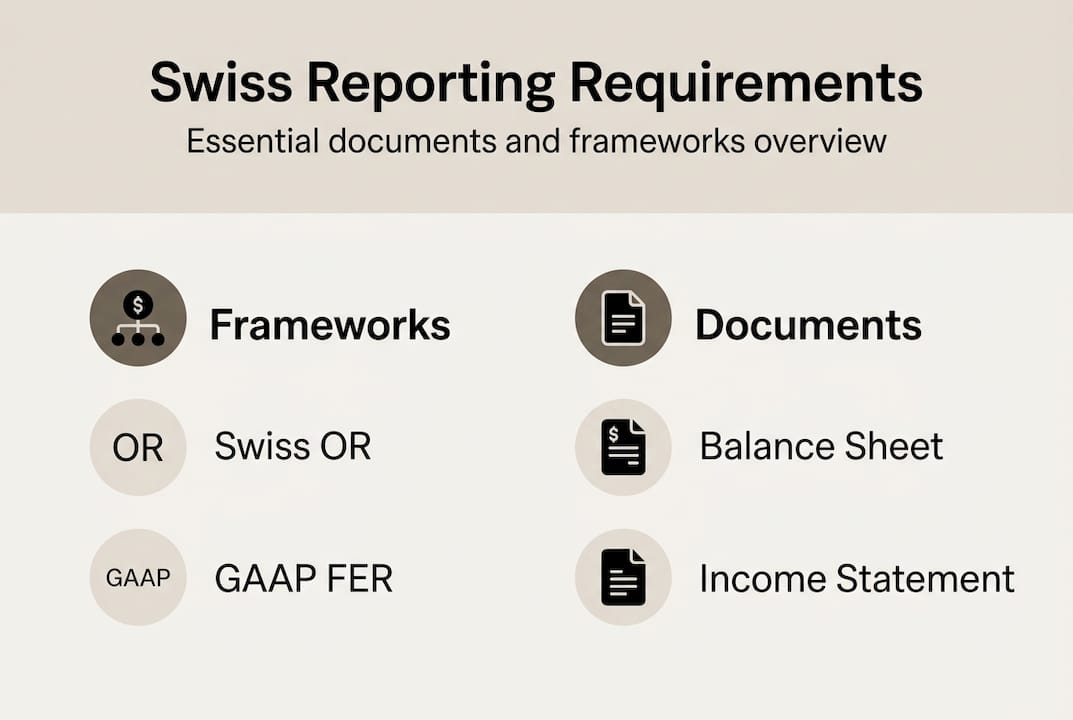
Switzerland does not follow IFRS or US GAAP as its baseline. The legal foundation is the Swiss Code of Obligations (OR), a federal statute that sets the floor for every company registered in Switzerland. Whether you run a GmbH or an AG, the OR applies to you.
The minimum statutory requirements under OR include three core documents:
Balance sheet: A snapshot of assets, liabilities, and equity at year-end
Income statement: A record of revenues and expenses over the financial year
Notes to the financial statements: Disclosures that explain accounting policies and material items
All three must be prepared within 6 months of the financial year-end. That is a firm deadline, not a guideline. Missing it puts your company in breach of Swiss law.
“Swiss financial reporting is governed by the Swiss Code of Obligations, which sets minimum statutory requirements for all companies, including balance sheet, income statement, and notes, prepared within 6 months of year-end.”
The OR applies to sole proprietorships, partnerships, and corporations alike, though the depth of reporting scales with company size. Understanding the full scope of Swiss accounting requirements before you incorporate saves you from retrofitting your processes later. Foreign-owned entities are not exempt. If your company is registered in Switzerland, Swiss law governs your books, regardless of where your parent company files. Reviewing accounting standards for foreign companies early in your setup process is a practical first step.
Swiss Code of Obligations (OR) vs. Swiss GAAP FER: Key differences
Once you understand the OR baseline, you will encounter a second framework: Swiss GAAP FER (Fachempfehlungen zur Rechnungslegung). These are voluntary accounting recommendations developed for Swiss entities that want more transparent, investor-oriented reporting.
Here is how the two compare:
Feature | OR | Swiss GAAP FER |
Legal status | Mandatory for all Swiss companies | Voluntary, but required for some listed entities |
Primary focus | Creditor protection | Investor transparency |
Valuation approach | Conservative (prudence principle) | Fair presentation |
Complexity | Lower | Higher |
Tax relevance | Basis for tax calculation | No direct tax impact |
Best suited for | SMEs, startups, private companies | Groups, listed companies, nonprofits |
The OR is creditor-focused and conservative, while FER is investor-focused and transparent. Switching to FER does not change your tax bill because Swiss tax authorities always use the statutory OR numbers as the basis for calculation.
Pro Tip: If you are raising capital from institutional investors or planning a group structure, adopting FER signals financial maturity and makes due diligence smoother. It is not required, but it can open doors.
Your choice between OR and FER depends on your business type, size, and who your key stakeholders are. Reviewing Swiss financial reporting compliance options early helps you pick the right framework before your first year-end. Understanding the accounting standards benefits of each approach also helps you align your reporting with your long-term business goals.
Typical reporting requirements for Swiss companies
Knowing the framework is one thing. Knowing exactly what you must produce, and when, is another. Here is a practical breakdown of annual reporting obligations by company type.
Company type | Balance sheet | Income statement | Notes | Audit required |
Sole proprietorship (small) | Simplified | Simplified | Limited | No |
GmbH / AG (small) | Full | Full | Full | Optional |
GmbH / AG (large or listed) | Full | Full | Full | Mandatory |
Group / consolidated | Full | Full | Full | Mandatory |
For most international entrepreneurs forming a GmbH or AG, the full set of documents is required. Here is the standard annual reporting sequence:
Close your books at financial year-end
Prepare the balance sheet, income statement, and notes
Submit to the board of directors for approval within 6 months
Hold the annual general meeting (AGM) to formally approve the statements
Retain records for at least 10 years
The OR Article 958 makes these steps legally binding. Non-compliance can trigger fines, forced dissolution, or loss of good standing with Swiss authorities. The IMF’s financial stability assessment of Switzerland notes strong overall reporting quality, but also flags gaps in supervisory data for certain entity types, a reminder that regulators are watching.
For a step-by-step walkthrough, the Swiss annual reporting steps guide covers each phase in detail. If you want a broader view of ongoing obligations, the company administration guide is a useful companion resource.
Swiss reporting in practice: Common pitfalls and compliance tips
Even well-run companies make avoidable mistakes when they first encounter Swiss reporting. Foreign entrepreneurs are especially vulnerable because they often apply home-country logic to a Swiss context.
The most frequent errors include:
Late preparation: Assuming the 6-month deadline is flexible. It is not.
Incomplete notes: Skipping disclosures because they seem optional. Swiss auditors check these carefully.
Wrong language: Financial statements must be in an official Swiss language (German, French, or Italian) or English if accepted by the canton. Verify this before filing.
Ignoring audit thresholds: Companies that exceed two of three thresholds (CHF 20 million in revenue, CHF 10 million in assets, or 50 full-time employees) must have an ordinary audit. Many foreign-owned subsidiaries hit these thresholds faster than expected.
Mixing parent-company standards: Applying IFRS or US GAAP logic to Swiss statutory books creates errors that are hard to unwind.
The IMF assessment confirms that while Switzerland’s reporting environment is strong, gaps in supervision data exist, particularly for SMEs and certain group structures. That means you cannot assume your size protects you from scrutiny.
Pro Tip: Appoint a local Swiss accountant or fiduciary from the start. They know the cantonal nuances, the language requirements, and the audit thresholds. The cost is far lower than fixing a compliance failure after the fact.
For a deeper look at what to watch for, the accounting best practices resource covers 2026-specific guidance. You can also review common compliance risks that foreign-owned entities face in Switzerland.
Applying Swiss standards: What international businesses must know
Compliance does not start at year-end. It starts the day you incorporate. Here is how to build Swiss reporting into your operations from the beginning.
Choose your accounting framework at formation: Decide between OR-only and Swiss GAAP FER before your first transaction. Changing frameworks mid-stream is possible but disruptive.
Set up a Swiss-compliant chart of accounts: Your bookkeeping structure must align with OR requirements. Generic international templates often miss Swiss-specific categories.
Appoint a company secretary or local fiduciary: The company secretary’s role in Switzerland includes ensuring that board resolutions, AGM minutes, and financial approvals are properly documented and timed.
Understand your banking obligations: Swiss banks require clean, compliant financial statements before opening accounts or extending credit. The banking requirements for Swiss companies are directly tied to your reporting quality.
Plan for real estate or investment reporting: If your company holds Swiss real estate or investment assets, additional disclosure rules apply. The OR Article 958 framework, combined with sector-specific rules, governs how these assets are valued and reported. For investment-heavy structures, real estate reporting guidance adds another layer of compliance to plan for.
The key insight here is that Swiss reporting is not a back-office task. It is a strategic function that affects your banking relationships, your investor credibility, and your legal standing. Building it correctly from day one is far easier than correcting it under pressure.
Take the next step: Swiss reporting support for your business
Navigating Swiss financial reporting as a foreign entrepreneur is manageable when you have the right structure and the right partners in place. The framework is clear, the deadlines are firm, and the standards are well-defined. What makes the difference is execution.

At RPCS, we work with international entrepreneurs and investors to set up Swiss companies that are compliant from the first day of operations. From company formation services that include proper accounting framework selection, to ongoing Swiss accounting solutions that keep your books clean and your filings on time, we handle the complexity so you can focus on your business. If you are ready to enter the Swiss market with confidence, our team is here to make it straightforward.
Frequently asked questions
Which companies are obligated to follow Swiss financial reporting standards?
All Swiss-incorporated companies must comply with OR reporting standards. Additional standards like Swiss GAAP FER may apply to listed, large, or group entities depending on size and structure.
Is Swiss GAAP FER mandatory for foreign-owned subsidiaries?
FER is not mandatory. Foreign-owned subsidiaries must comply at minimum with OR, but may opt for FER voluntarily for greater investor transparency or group reporting purposes.
What is the deadline for filing annual financial statements in Switzerland?
Financial statements must be prepared within 6 months after the end of the financial year. This deadline is set by the Swiss Code of Obligations and is legally binding.
Does switching to Swiss GAAP FER affect my tax calculations?
No. Swiss tax authorities always use the statutory OR numbers as the basis for tax calculation, regardless of whether your company also prepares FER statements.
What are the most frequent mistakes in Swiss financial reporting?
The most common errors are incomplete notes, missed deadlines, and applying foreign accounting logic to Swiss statutory books. The IMF’s assessment also highlights supervisory data gaps that can catch unprepared companies off guard.
Recommended