
Swiss company formation for foreign investors explained
- Mar 26
- 9 min read

Many foreign investors assume forming a Swiss company requires local ownership or navigating impenetrable bureaucracy. The reality is far simpler. Swiss law permits 100% foreign ownership, but specific legal requirements exist, particularly around director appointments and documentation. This guide breaks down the essential steps clearly, helping you establish your Swiss company efficiently while avoiding common pitfalls that delay or complicate the process.
Table of Contents
Understanding Swiss company ownership and director requirements
Choosing the right canton: How location impacts taxes and business operations
Step-by-step company formation process and essential documentation
Maintaining Swiss company compliance and annual administrative duties
How RPCS solutions helps you form your Swiss company seamlessly
Key Takeaways
Point | Details |
Full foreign ownership | Foreigners can form Swiss companies with 100 percent ownership, but must appoint at least one Swiss resident director. |
Swiss resident director | The director must be a Swiss resident who can act, is not disqualified by criminal or bankruptcy restrictions, and actively participates in governance. |
Cantonal profiles | Zug offers the lowest effective tax rate, Zurich suits banking and fintech, Geneva serves trading and global operations, and Basel supports pharma and life sciences. |
Cantonal tax impact | Choosing the right canton can substantially affect corporate tax rates and operating costs. |
Compliance essentials | Proper documentation and ongoing compliance reduce delays and errors in registration and banking. |
Understanding Swiss company ownership and director requirements
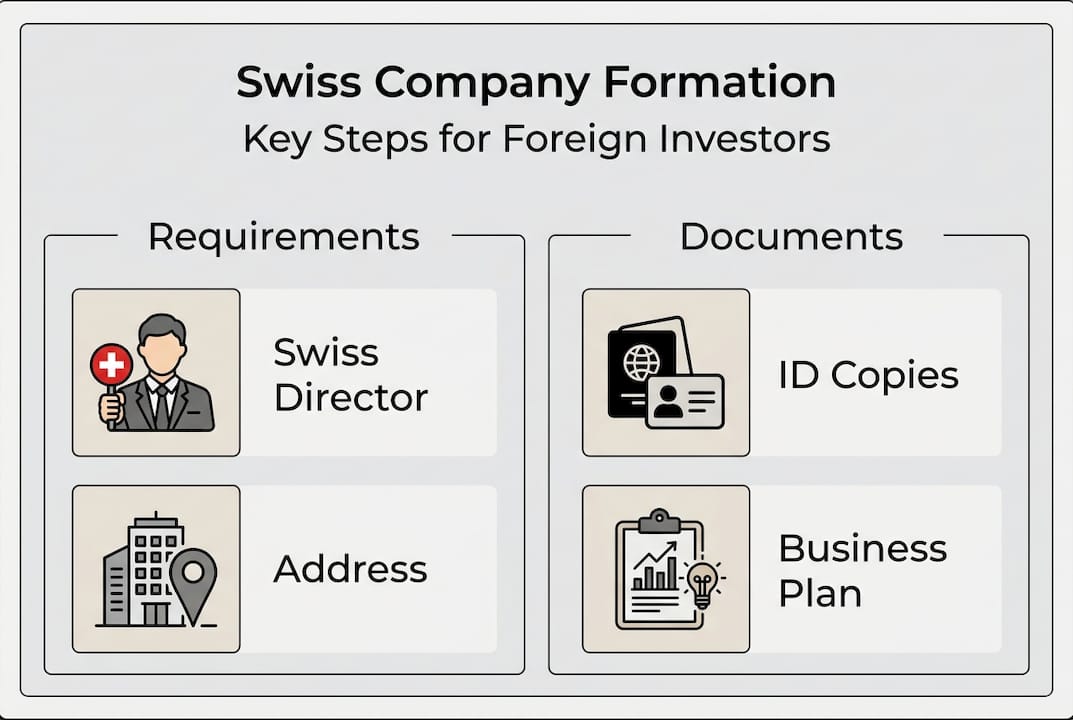
Swiss corporate law offers exceptional flexibility for international entrepreneurs. Foreigners can form Swiss companies with 100% ownership, no nationality requirement, but must appoint at least one Swiss-resident director. This structure allows you to maintain full control while meeting legal compliance standards.
The director residency requirement serves as the primary legal hurdle for foreign investors. Your Swiss-resident director must have legal capacity to act and cannot be subject to certain criminal or bankruptcy restrictions. This individual holds fiduciary responsibility for corporate governance, ensuring compliance with Swiss commercial law and representing the company in official matters.
Many foreign investors mistakenly believe they can circumvent this requirement through nominee arrangements or minimal involvement. Swiss authorities scrutinize director appointments carefully. Your director must genuinely participate in company decisions and maintain accessible contact information. Appointing an unqualified or disengaged director creates compliance risks and potential liability.
Finding a qualified Swiss-resident director requires careful consideration. Options include:
Professional director services specializing in corporate governance
Trusted business partners or advisors with Swiss residency
Family members residing in Switzerland with relevant expertise
Corporate service providers offering director appointment packages
Pro Tip: When appointing a Swiss director, prioritize individuals with industry knowledge relevant to your business. Their expertise adds strategic value beyond mere compliance, helping you navigate local market conditions and regulatory requirements effectively.
Director responsibilities extend beyond symbolic representation. They sign official documents, attend required meetings, and ensure financial statements meet Swiss accounting standards. Compensation arrangements should reflect these duties appropriately, whether through fixed fees, equity participation, or hybrid structures. Clear documentation of director roles, obligations, and remuneration prevents future disputes and demonstrates proper corporate governance to banking partners and regulatory authorities.
Choosing the right canton: How location impacts taxes and business operations
Switzerland’s federal structure creates significant variation in business conditions across its 26 cantons. Corporate tax rates range from approximately 11.9% to 21%, making canton selection a critical strategic decision that affects your bottom line substantially.

Certain cantons have developed specializations that attract specific industries. Zug offers the lowest effective tax rates and has become the global hub for cryptocurrency and blockchain companies. Zurich provides sophisticated financial infrastructure, making it ideal for banking, insurance, and fintech ventures. Geneva’s international character suits trading companies and organizations with global operations. Basel attracts pharmaceutical and life sciences businesses due to its research ecosystem.
Canton | Effective Tax Rate | Industry Specialization | Key Advantage |
Zug | ~11.9% | Crypto, commodities | Lowest tax burden |
Zurich | ~14.6% | Finance, technology | Infrastructure depth |
Geneva | ~14.0% | Trading, international | Global connectivity |
Basel | ~13.2% | Pharma, chemicals | Research ecosystem |
Schwyz | ~12.2% | General business | Low cost base |
Tax rates represent only one consideration when choosing a Swiss canton. Evaluate these additional factors:
Regulatory environment and administrative efficiency
Quality of business infrastructure and transportation links
Availability of skilled workforce in your industry
Proximity to international airports and markets
Local business incentives and support programs
Cost of commercial real estate and operating expenses
Pro Tip: Match your canton choice to your operational reality. If your business requires frequent international travel, proximity to Zurich or Geneva airports justifies slightly higher tax rates. If you operate primarily online with minimal physical presence, prioritize pure tax optimization in cantons like Zug or Schwyz.
Some cantons offer specific incentives for new businesses or targeted industries. These may include reduced tax rates during initial years, grants for research and development, or simplified administrative procedures. Contact cantonal economic development offices directly to explore available programs. Their staff typically speak English and welcome foreign investment inquiries.
Remember that changing your company’s registered canton later involves significant administrative complexity and potential tax implications. Invest time in thorough canton analysis before registration. This upfront research prevents costly relocations and ensures your Swiss company operates in the jurisdiction best aligned with your strategic objectives.
Step-by-step company formation process and essential documentation
Forming a Swiss company follows a structured legal process requiring specific documentation and procedural steps. Understanding this sequence helps you prepare efficiently and avoid delays that extend your timeline unnecessarily.
The formation process typically follows these stages:
Select your company structure (GmbH or AG) based on capital requirements and governance preferences
Choose your company name and verify availability through the commercial registry
Draft Articles of Association specifying company purpose, share capital, and governance structure
Deposit minimum share capital in a blocked Swiss bank account (CHF 20,000 for GmbH, CHF 100,000 for AG)
Execute notarized incorporation documents with all founding shareholders present or represented
Register the company with the cantonal commercial registry
Obtain business licenses and permits specific to your industry and location
Register for VAT if projected annual revenue exceeds CHF 100,000
Enroll in mandatory social insurance programs for employees
Open operational business bank accounts for daily transactions
Proper documentation and compliance are essential for smooth company registration. The commercial registry scrutinizes submissions carefully, rejecting incomplete or improperly formatted filings.
Document Type | Purpose | Key Requirements |
Articles of Association | Define company structure and rules | Must specify purpose, capital, shares, governance |
Incorporation Deed | Legal formation document | Requires notarization and all founder signatures |
Director Declarations | Confirm acceptance of duties | Must include Swiss residency proof |
Capital Confirmation | Verify minimum capital deposit | Bank statement from blocked account |
Shareholder Registry | Record ownership structure | Updated with each ownership change |
Common errors that delay registration include incomplete shareholder identification, unclear company purpose descriptions, and improperly formatted Articles of Association. Swiss commercial registries require precise legal language following established templates. Working with experienced legal counsel familiar with cantonal requirements significantly reduces rejection risk.
The Switzerland company formation checklist varies slightly by canton and company type. Some cantons process registrations within days, while others require several weeks. Budget adequate time for each stage, particularly notarization and commercial registry review. Rush processing options exist in certain cantons for additional fees.
Foreign investors must provide additional documentation beyond Swiss residents. Expect to submit passport copies, proof of address in your home country, and potentially apostilled documents depending on your nationality. Some cantons require certified translations of foreign documents into German, French, or Italian.
Review key company registration documents thoroughly before submission. Errors discovered after registration require formal amendments through additional notarization and registry filings, adding unnecessary costs and delays to your formation timeline.
Maintaining Swiss company compliance and annual administrative duties
Successful company formation represents just the beginning of your Swiss business journey. Ongoing compliance obligations ensure your company maintains good standing and avoids penalties that could jeopardize operations.
Swiss companies must submit annual financial statements to the commercial registry within six months of fiscal year end. These statements require preparation according to Swiss accounting standards, with larger companies subject to mandatory audits. Even small companies benefit from professional accounting support to ensure accuracy and compliance.
Corporate governance requirements include:
Holding annual general meetings of shareholders
Maintaining minutes of all shareholder and board decisions
Updating the commercial registry within defined timeframes for changes in directors, shareholders, or company structure
Preserving corporate books and records for the legally mandated retention period
Filing beneficial ownership declarations with cantonal authorities
Tax obligations extend beyond corporate income tax. Your company must file annual tax returns with federal, cantonal, and municipal authorities. VAT-registered businesses submit quarterly or annual VAT returns depending on revenue levels. Withholding tax applies to dividend distributions and certain payments to foreign entities. Missing deadlines triggers interest charges and potential penalties.
Compliance with Swiss annual administration is essential to maintain good standing and avoid sanctions. Swiss authorities take corporate compliance seriously, with penalties ranging from financial fines to director liability for serious violations.
Pro Tip: Establish a compliance calendar immediately after company formation. Mark all filing deadlines, meeting requirements, and renewal dates. Digital tools and professional service providers can automate reminders, ensuring you never miss critical obligations that could compromise your company’s status.
Regulatory requirements evolve as Swiss law adapts to international standards and domestic policy changes. Stay informed about updates affecting your industry and company structure. Professional advisors monitoring regulatory developments provide valuable early warning of changes requiring action.
The Swiss company compliance guide offers detailed information about specific obligations and best practices. Investing in proper compliance infrastructure from the start prevents costly corrections later and builds credibility with banking partners, investors, and business counterparts.
Maintaining compliance becomes significantly easier with proper systems and professional support. Many foreign investors underestimate the administrative burden of Swiss company operations, leading to rushed filings and preventable errors. Allocate adequate resources to administration or engage qualified service providers who manage these responsibilities efficiently.
How RPCS solutions helps you form your Swiss company seamlessly
Navigating Swiss company formation as a foreign investor involves complex legal requirements, documentation standards, and administrative procedures. RPCS specializes in guiding international entrepreneurs through every stage of establishing a Swiss business presence.

Our Swiss company formation services handle the entire process from initial planning through final registration. We prepare all required documentation, coordinate notarization appointments, and manage commercial registry submissions. Our team includes legal experts familiar with cantonal requirements across Switzerland, ensuring your formation proceeds smoothly regardless of your chosen location.
Beyond company formation, we facilitate opening a Swiss bank account for your new entity. Banking relationships often challenge foreign investors unfamiliar with Swiss compliance standards. Our established partnerships with Swiss financial institutions streamline account opening, helping you access the banking services essential for business operations.
Explore our comprehensive service offerings at RPCS to discover how we simplify Swiss company establishment for international entrepreneurs. Our experience with foreign investor needs ensures efficient, compliant formation that positions your business for success in the Swiss market.
Frequently asked questions
What documents are needed to form a Swiss company?
Forming a Swiss company requires Articles of Association defining your company structure, notarized incorporation documents signed by all founders, proof of minimum capital deposit, and director declarations accepting their roles. You must also provide identification documents for all shareholders and directors, including passports and proof of address. Foreign documents often require apostille certification or official translation. The commercial registry may request additional documentation depending on your company type and canton. Review key documents for company registration for comprehensive preparation guidance.
Can foreigners be the sole owners of a Swiss company?
Yes, foreigners can own 100% of Swiss companies, but must appoint one Swiss-resident director. No nationality restrictions limit ownership, making Switzerland exceptionally accessible for international investors. The director residency requirement ensures local legal representation and compliance oversight. You maintain full ownership control while meeting this mandatory governance standard. Many foreign investors successfully operate Swiss companies through this structure, combining international ownership with local director expertise.
How does the canton choice affect my company?
Corporate tax rates vary significantly by canton, from about 11.9% to 21%, directly impacting your company’s tax burden. Different cantons offer varying regulatory environments, business incentives, and industry specializations. Zug attracts crypto companies with low taxes, while Zurich provides financial infrastructure for banking ventures. Your canton choice affects operational costs, workforce availability, and administrative efficiency. Selecting the right canton aligns with your business needs and tax planning objectives. Explore choosing a Swiss canton for detailed comparison and selection guidance.
How long does Swiss company formation take?
Typical Swiss company formation takes two to four weeks from initial documentation to commercial registry approval. Timeline variations depend on canton processing speeds, notarization scheduling, and documentation completeness. Some cantons offer expedited processing for additional fees, reducing timelines to one week. Delays commonly occur from incomplete documentation, unclear company purpose descriptions, or missing shareholder information. Proper preparation and professional guidance significantly accelerate the process. Budget adequate time for capital deposit, notarization, and registry review stages to ensure realistic timeline expectations.
What ongoing costs should I expect after company formation?
Swiss companies incur annual costs including accounting and audit fees, commercial registry renewal charges, and professional service fees for compliance management. Tax preparation and filing require professional support, with costs varying by company complexity. Director fees compensate your Swiss-resident director for governance duties. Social insurance contributions cover mandatory employee programs. Budget approximately CHF 3,000 to CHF 8,000 annually for basic compliance and administration, with larger companies facing higher costs due to audit requirements and expanded reporting obligations. Proper cost planning ensures adequate resources for ongoing operations.
Recommended
Comments