
Swiss company exit strategies: Legal and financial guide
- May 8
- 10 min read

TL;DR:
Most Swiss SMEs lack formal succession plans, risking undervaluation, regulatory delays, or failed deals. Choosing the right exit structure involves understanding legal, tax, and strategic factors tailored to industry and ownership profiles. Early comprehensive preparation and professional guidance are critical for successful, compliant Swiss company exits.
Over 80% of Swiss SMEs lack a formal succession plan, which means most owners face their exit with no roadmap, no valuation baseline, and no clear legal structure in mind. That is not a minor oversight. It is the kind of gap that costs millions in lost deal value, triggers regulatory delays, and sometimes collapses transactions entirely. Whether you are a foreign investor looking to divest a Swiss holding, a founder preparing for acquisition, or a shareholder evaluating your options, understanding the legal and financial mechanics of Swiss company exits is not optional. This guide gives you the framework you need to get it right.
Table of Contents
Key Takeaways
Point | Details |
Multiple Swiss exit routes | Trade sales, mergers, IPOs, MBOs, and liquidations offer tailored options for Swiss company exits. |
Legal and tax complexities matter | Exit structures greatly impact liabilities, tax, and asset protection—expert planning is essential. |
Valuation and timing are critical | Understanding industry multiples and preparing years in advance maximize value and smooth exits. |
Regulatory compliance prevents delays | Merger thresholds and notifications can trigger regulatory scrutiny—planning ahead avoids setbacks. |
Human factors make or break exits | Beyond checklists, culture and succession planning are often the real keys to a successful Swiss company transition. |
Core Swiss company exit strategies
Not every Swiss company exit looks the same. The structure you choose shapes everything: tax exposure, buyer risk, timeline, and total proceeds. Getting this right starts with knowing what your actual options are.
Main exit strategies for Swiss companies include trade sales structured as either share deals or asset deals, mergers under the Swiss Merger Act, initial public offerings (IPOs), management buy-outs (MBOs), and voluntary liquidation for solvent companies. Each route has a different risk profile and serves different strategic goals.
Here is a quick comparison of the five main exit types:
Exit method | Best for | Key advantage | Main risk |
Trade sale (share deal) | Most M&A exits | Tax-efficient for sellers | Buyer inherits all liabilities |
Trade sale (asset deal) | Partial exits, risk-sensitive buyers | Selective liability transfer | Higher complexity, possible tax cost |
Merger | Strategic consolidation | Streamlined legal process | Integration risk |
IPO | High-growth tech or large firms | Liquidity and valuation upside | Regulatory burden, market timing |
MBO | Ownership continuity | Smooth transition | Financing challenges |
Liquidation | Wind-down scenarios | Clean closure | Lower value recovery |
When it comes to valuation, industry sector matters enormously. Swiss SME multiples vary widely: manufacturing companies typically trade at 4 to 7 times EBITDA (earnings before interest, taxes, depreciation, and amortization), tech companies command 6 to 12 times, and service businesses land between 3 and 6 times. M&A accounts for over 90% of startup exits, with an average time from founding to exit of around 10 years.
Key factors that determine which strategy fits your situation:
Ownership structure: GmbH (Gesellschaft mit beschränkter Haftung, or limited liability company) vs. AG (Aktiengesellschaft, or corporation) affects transfer mechanics
Tax residency: Seller’s jurisdiction determines capital gains exposure
Buyer profile: Strategic acquirer vs. financial buyer vs. internal management
Timeline: Are you exiting over 12 months or 5 years?
Debt load: Existing liabilities shape deal structure preferences
If voluntary closure is on the table, the Swiss company liquidation process has specific legal steps, creditor notification requirements, and timelines that owners must follow to stay compliant.
Pro Tip: Never let valuation multiples be the only driver of your exit choice. The after-tax proceeds often differ radically between a share deal and an asset deal, even at the same headline price.
Share deals, asset deals, and mergers: Comparing structures and implications
Now that the main exit types are clear, let’s compare the legal and financial impact of the most commonly used structures. This is where most international owners make costly mistakes by choosing the wrong structure based on headline price alone.
In a share deal, the buyer acquires the company’s shares directly. Ownership transfers in full, which means the buyer steps into every existing contract, liability, and legal obligation. For sellers, this is typically the preferred route because capital gains are often exempt for private Swiss shareholders under the participation exemption. However, the buyer inherits everything, including undisclosed risks, which is why buyers often push for warranties and indemnities that can reduce your net proceeds.
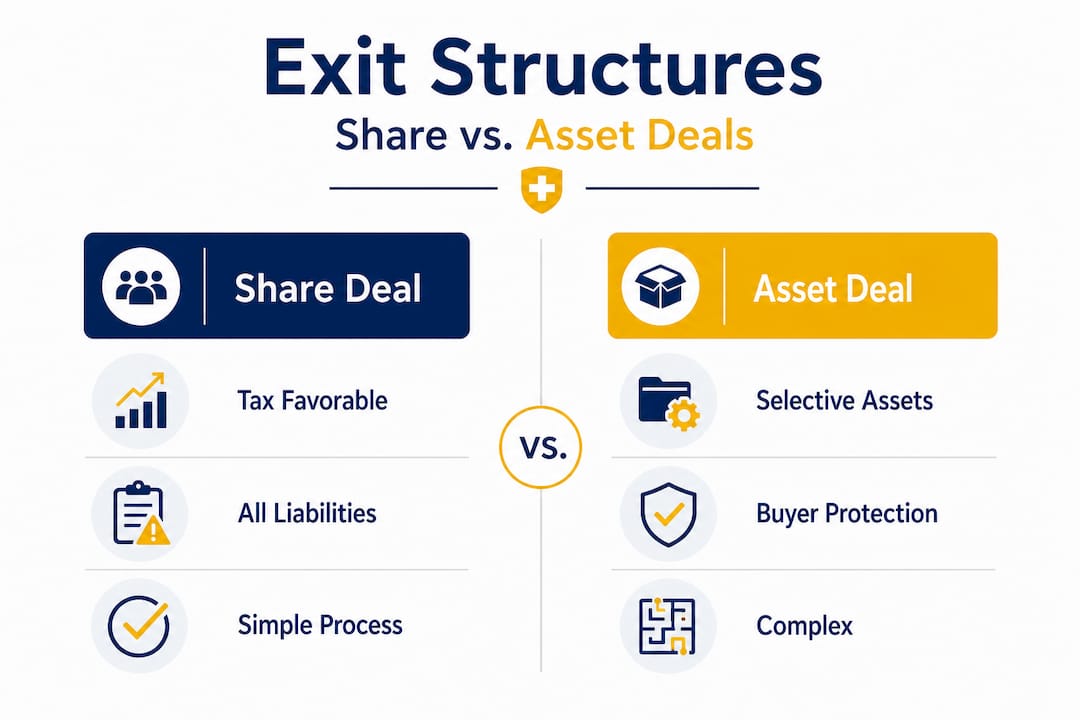
In an asset deal, the buyer selects specific assets and liabilities to acquire. This protects the buyer from hidden risks and allows both parties to be precise about what changes hands. However, sellers typically face higher tax friction, and the transaction requires more detailed legal documentation. Asset deals are common when a buyer wants only one division of a business, or when the company carries legacy liabilities the buyer will not absorb.
Mergers under the Swiss Merger Act offer a third path. They allow universal transfers of assets and liabilities between legal entities, with built-in creditor protection mechanisms. Creditors can demand security for their claims within three months of the merger being published. This makes mergers attractive for corporate restructurings and cross-border consolidations.
Structure | Tax treatment for seller | Buyer’s liability exposure | Complexity |
Share deal | Often tax-exempt (private shareholders) | Full inheritance of all liabilities | Moderate |
Asset deal | Taxable gains on assets | Selective, controlled exposure | High |
Merger | Depends on structure | Governed by Swiss Merger Act | High |
Before finalizing any structure, it pays to understand the Swiss business tax advantages your current setup already enjoys, since restructuring could inadvertently forfeit participation exemptions or trigger cantonal tax recaptures. Similarly, business confidentiality in Switzerland can be a selling point in negotiations, and retaining it during due diligence requires careful information management.
A practical checklist for choosing your exit structure:
Confirm the seller’s tax residency and capital gains treatment
Map all existing contracts, licenses, and permits (are they transferable?)
Identify contingent liabilities, including pending litigation and tax audits
Assess buyer preference and financing structure (debt-financed buyers often prefer asset deals)
Consult a Swiss tax advisor before setting deal terms
Pro Tip: In Switzerland, private shareholders selling shares in a qualifying company can often benefit from full capital gains tax exemption at the federal level. Get a tax ruling before you sign any letter of intent.
Valuations, timelines, and preparing for exit
With the legal mechanics understood, owners need practical strategies on value and timing for an effective exit.
Swiss startup exits average around 10 years from founding, but that number is misleading if you use it as a benchmark without context. A tech company with recurring revenue and strong IP can exit in 5 to 6 years with the right investor. A family-owned manufacturing business might take 15 years to transition properly. Industry, buyer market conditions, and readiness all shift the timeline.
Here are the standard Swiss SME valuation ranges by sector:
Sector | Typical EBITDA multiple | Notes |
Manufacturing | 4 to 7x | Asset-heavy; machinery and IP matter |
Technology | 6 to 12x | SaaS models push toward higher end |
Professional services | 3 to 6x | Client concentration risk discounts value |
Retail/distribution | 2 to 5x | Inventory and lease terms affect multiple |
Despite these benchmarks, 80% of Swiss KMU (small and medium enterprises) begin exit preparation too late, without a current valuation, without analyzing internal strengths and weaknesses, and without identifying successor profiles. The result is rushed deals, undervaluation, and damaged relationships.
“Starting your exit planning 5 to 10 years early is not excessive. It is the minimum required to protect the value you have built.”
A step-by-step preparation plan for your Swiss company exit:
Commission an independent valuation at least 3 years before your target exit date, so you have a baseline and time to improve it
Conduct a strengths and weaknesses analysis covering financials, key person dependencies, client concentration, and IP ownership
Clean up your books: ensure accounts are audited, tax filings are current, and related-party transactions are documented
Resolve legal exposures: settle pending disputes, renew key contracts, and confirm IP ownership is properly registered
Identify potential buyers or successors and build relationships before a formal process begins
Optimize your corporate structure with advice from a Swiss advisor on incorporating in Switzerland best practices
Consider entrepreneur relocation requirements if the exit involves ownership change or restructuring of management residency
Build a data room containing all contracts, IP filings, employment agreements, and financial statements
Engage an M&A advisor or notary with Swiss deal experience for transaction management
Plan the post-exit structure, including royalties arrangements if applicable, since royalties planning for startups can generate ongoing income after the primary sale
Pro Tip: If your company has owner-dependent revenue (clients who do business because of personal relationships with the founder), document a clear transition plan to preserve those relationships post-sale. Buyers discount heavily for key person risk.
Regulatory oversight: Competition, notifications, and risk management
Securing your value is only part of the challenge. The final hurdle is regulatory compliance and managing exit risks throughout the transaction process.

Switzerland’s Competition Commission (WEKO, known internationally as ComCo) oversees merger control. Merger control notification is mandatory when the combined Swiss turnover of the merging parties exceeds CHF 500 million, and at least two of the parties each generate more than CHF 100 million in Swiss turnover. If your transaction triggers these thresholds, you must file before closing. Failure to do so can result in fines and forced unwind of the transaction.
For most Swiss SME exits, these thresholds will not apply. However, international buyers with significant Swiss market presence may inadvertently trigger the requirement, especially in consolidating sectors like pharma, logistics, or financial services.
Practical compliance priorities for Swiss company exits:
Verify ComCo thresholds early: run a quick calculation before signing any binding agreement
Check for sector-specific rules: banking, insurance, and telecoms have additional regulatory layers
Assess cross-border implications: EU merger regulation may apply independently if the combined EU turnover meets European thresholds
Run a pre-exit liability audit: check for undisclosed pension obligations, environmental liabilities, and underpaid taxes
Protect confidential information during due diligence: use a clean team process and non-disclosure agreements with bite
Notify employment authorities if required: large-scale workforce changes may require prior consultation with employee representatives
Risk management during a Swiss exit also means having a clear plan for company dissolution risks, particularly if negotiations fail and you need to execute an alternative closure scenario.
Pro Tip: Even if ComCo thresholds are not met, voluntary pre-notification discussions with ComCo can be useful for complex transactions in concentrated markets. They help you identify issues before they become blockers.
Why most Swiss company exits fail: What the checklists miss
After working through valuations, due diligence, and legal structures with dozens of international clients, one pattern stands out. Most failed or underperforming Swiss company exits do not collapse because of legal technicalities. They fail because of people and money.
Management buy-outs are a perfect example. MBOs are often championed as ideal for continuity because the management team knows the business and can preserve culture and client relationships. However, MBO financing hurdles are brutal in practice. Banks rarely finance 100% of an MBO. The result is vendor loans (where the seller effectively finances part of the purchase) or significant discounts compared to external management buy-in (MBI) offers. Sellers who favor MBOs for emotional reasons often leave real money on the table.
Succession is even more persistently undervalued. Most owners treat it as a future problem. The math says otherwise. If 80% of Swiss SMEs lack formal succession plans, and most exits take 5 to 10 years to execute properly, that means the majority of owners reading this article right now are already behind. The solution is not more checklists. It is cultural. You have to build the company as if someone else is going to run it, from day one.
The human elements that kill deals are also the least discussed. Seller attachment to legacy pricing (anchoring to a number that made sense 5 years ago, not today’s market), disagreement between co-founders about exit terms, key employees resigning during due diligence when they sense a change, and buyer fatigue from prolonged negotiations all derail transactions that were legally sound.
Our practical guidance on Swiss company management consistently points to one underrated fact: the most valuable thing a founder can do for exit readiness is to make themselves strategically replaceable. Document your processes, distribute your client relationships, and build a leadership layer that operates without constant founder input. Buyers pay premium multiples for companies that work without the founder. They discount heavily for those that do not.
The checklist culture in M&A creates a false sense of security. Ticking off legal boxes is necessary but never sufficient. The deals that succeed are the ones where the seller has done the unglamorous internal work, years before any letter of intent is signed.
Expert support for your Swiss company exit
Planning a Swiss company exit involves legal structure decisions, tax optimization, regulatory compliance, and financial preparation that most international owners cannot navigate alone.
At RPCS Solutions, we provide personalized guidance for every stage of the exit process, from initial structuring advice to compliance support during due diligence. Whether you are considering a trade sale, an MBO, or a corporate liquidation, our team combines deep knowledge of Swiss corporate law with practical experience serving international investors. We support Swiss company formation from the start and offer ongoing Swiss company accounting services to ensure your books are exit-ready when the time comes. If you are planning an exit in the next 3 to 10 years, start the conversation now. The earlier you engage, the more options you have.
Frequently asked questions
What is the difference between a share deal and an asset deal in Switzerland?
A share deal transfers ownership of the company (with all liabilities), which is usually tax-favorable for sellers, while an asset deal transfers specific assets and allows the buyer to control which liabilities they absorb with creditor protection mechanisms available under Swiss law.
How long does it typically take to exit a Swiss company?
The average exit timeline runs about 10 years from company founding, but the active transaction process can take 12 to 24 months depending on deal complexity, buyer type, and preparation level.
When is Swiss merger control notification required?
Notification to ComCo is required when the combined Swiss turnover exceeds CHF 500 million and at least two parties each exceed CHF 100 million in Swiss turnover; failing to notify before closing can lead to significant fines.
Why is Swiss company succession planning so important?
Because over 80% of Swiss KMU lack succession plans, most owners face rushed, undervalued exits; starting 5 to 10 years ahead with a proper valuation and successor strategy protects deal value and prevents legal complications.
What is the key regulatory risk when exiting a Swiss company?
The primary risk is failing to comply with Swiss merger notification rules where ComCo thresholds are triggered, but cross-border deals also need to be assessed against EU competition law independently from Swiss requirements.
Recommended
Comments