
Understanding the Role of a Legal Representative in Switzerland
- May 6
- 9 min read

TL;DR:
Foreign entrepreneurs often underestimate the importance of appointing a qualified Swiss resident legal representative for their company to ensure legal compliance. This role involves maintaining regulatory filings, representing the company in legal matters, and managing ongoing statutory obligations to prevent penalties or dissolution. Choosing a professional, experienced representative facilitates smoother operations, enhances credibility, and is essential for long-term success in Switzerland.
Many foreign entrepreneurs assume that registering a Swiss company is primarily a paperwork exercise. They pick a legal structure, open a bank account, and expect to operate freely from abroad. What catches them off guard is a non-negotiable statutory requirement buried in Swiss corporate law: every company must have a qualified legal representative physically based in Switzerland. Miss this requirement and your registration stalls before it begins. Get it wrong after formation and you face penalties, forced dissolution, or personal liability. This guide breaks down exactly what this role involves, who qualifies, and how to handle it correctly.
Table of Contents
Core duties and legal obligations of a Swiss legal representative
Legal representative vs. director vs. company secretary: Key differences
Best practices for appointing and collaborating with a Swiss legal representative
Why the right legal representation is a game-changer for foreign-owned Swiss companies
How RPCS simplifies legal representation and Swiss company setup
Key Takeaways
Point | Details |
Statutory requirement | Every Swiss company must have a legal representative for compliance and official communication. |
Distinct legal roles | Legal representative, director, and company secretary each carry unique Swiss statutory duties. |
Residency criteria | The legal representative must be a Swiss resident with the authority to represent the company. |
Ongoing compliance | Legal representatives handle essential filings, reports, and risk mitigation year-round. |
Professional support | Engaging expert representation smooths company formation and operational success in Switzerland. |
What is a legal representative in Switzerland?
Understanding the role starts with basic definitions, so let’s unpack what a legal representative actually is and why this role carries so much weight under Swiss law.
A legal representative is a person authorized to act on behalf of a company in all formal, legal, and administrative matters within Switzerland. This is not simply a figurehead position. Swiss authorities need a domestic point of contact they can reach, serve legal notices on, and hold accountable. As a result, Swiss company roles are carefully defined in Swiss law, with the legal representative serving as the company’s face before official bodies.
It is important to separate this role from others you will encounter during company formation:
Owner or shareholder: Holds equity in the company but may not be involved in daily operations at all.
Director (Geschäftsführer for GmbH or Verwaltungsrat for AG): Responsible for strategic decisions and overall management.
Legal representative: Specifically designated to fulfill statutory obligations and interface with Swiss authorities.
One person can technically hold more than one of these roles, but only if they meet each role’s individual requirements. For foreign owners who are not Swiss residents, the legal representative position cannot be held by them directly, which creates an immediate practical challenge.
A legal representative is required for Swiss companies to ensure legal compliance and serve as the domestic point of contact for authorities.
Swiss law is explicit about this. A company registered in Switzerland must have at least one individual with Swiss domicile who can represent it in legal matters. This person’s name appears in the Commercial Register, making their role publicly visible and legally binding. For foreign entrepreneurs, this typically means engaging a professional service or trusted local contact who can take on this formal responsibility.
Core duties and legal obligations of a Swiss legal representative
Now that the foundational role is clear, it’s time to examine exactly what legal representatives must do to keep your business running legally in Switzerland.
The responsibilities are substantial and span both day-to-day operations and annual statutory requirements. Understanding these duties upfront prevents costly surprises later. Here is a structured breakdown of the core obligations:
Maintaining regulatory compliance: The representative monitors ongoing requirements from the Commercial Register, cantonal tax authorities, and federal agencies. They ensure the company remains in good standing at all times.
Submitting statutory filings: This includes annual financial reports, tax declarations, and any mandatory updates to the Commercial Register such as changes in directors, share capital, or company address.
Representing the company in legal matters: If the company receives a summons, audit request, or regulatory inquiry, the legal representative is the first point of official contact. They receive notices and coordinate responses.
Managing correspondence with authorities: Swiss authorities communicate in German, French, or Italian depending on the canton. The representative bridges this language and procedural gap for foreign owners.
Signing statutory documents: Many filings require an authorized signature from a Swiss-domiciled representative. Without this, documents are legally invalid.
Legal representatives are responsible for ensuring statutory filings and ongoing compliance. Missing even a single annual filing can trigger fines, and repeated failures can lead to compulsory liquidation of the company by cantonal authorities.

This is where annual administration becomes critical. Many foreign owners underestimate how rigorous the annual cycle is in Switzerland. Financial accounts must be properly structured, approved by the board, and filed on time. Value-added tax (VAT) registration, quarterly VAT filings, and social insurance contributions add further complexity.
Pro Tip: Build a compliance calendar in your first month of operation. Work with your legal representative to map every statutory deadline across the full calendar year, including tax filing windows, social security payments, and register update deadlines. This single step can prevent the majority of compliance failures that plague foreign-owned Swiss companies.
Penalties for non-compliance range from administrative fines to personal liability for the representative and directors. In serious cases, the Commercial Register can strike a company from the register entirely. For foreign investors who have spent significant capital on Swiss company formation, this outcome is devastating and entirely avoidable.
Legal representative vs. director vs. company secretary: Key differences
Because Swiss companies often assign multiple statutory roles, let’s unpack exactly how legal representatives differ from and complement directors and company secretaries.
Foreign entrepreneurs sometimes assume these roles are interchangeable or that one senior hire can cover all three. Swiss law does not work that way. Each role carries distinct legal responsibilities, and combining them without understanding the implications creates serious gaps in governance. Swiss law distinguishes between legal representatives, directors, and company secretaries, each with specific statutory responsibilities.
Here is a side-by-side comparison of the three roles:
Role | Primary function | Residency required? | Appears in Commercial Register? | Personal liability? |
Legal representative | Statutory compliance and authority liaison | Yes, Swiss domicile required | Yes | Yes, for compliance failures |
Director (Geschäftsführer/Verwaltungsrat) | Strategic management and decision-making | At least one must have Swiss domicile | Yes | Yes, for management decisions |
Company secretary | Administrative coordination and record-keeping | No | No | Limited, mostly administrative |
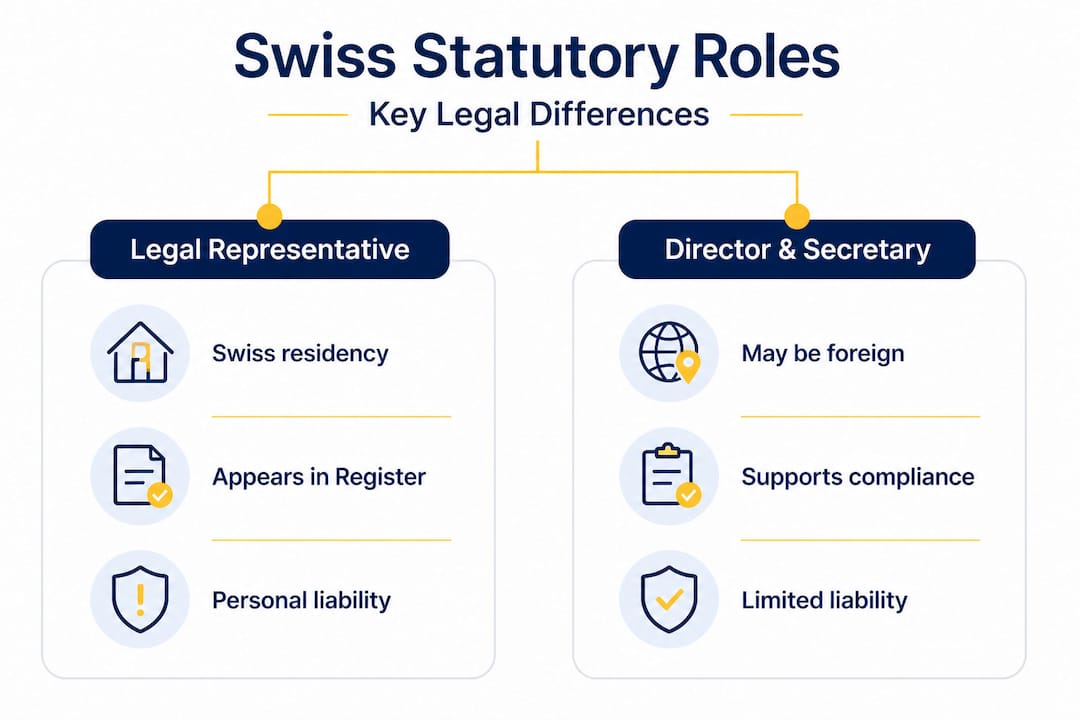
The company secretary role is often overlooked, but it plays a supporting function in organizing board meetings, maintaining minutes, and managing documentation. It does not carry the statutory weight of the legal representative or director.
A critical point for foreign entrepreneurs: you cannot simply appoint a nominee director abroad and call it done. Swiss corporate governance requires that the person occupying the legal representative and director role with signing authority actually holds Swiss residency. Authorities will verify this. If your structure does not reflect this reality, registration will be refused or existing registrations can be challenged.
Where these roles overlap, coordination is essential. For example, both the director and the legal representative may need to co-sign certain documents. If they are different people, miscommunication between them can delay filings or create contradictory official positions. Establishing clear internal protocols from day one prevents these operational breakdowns.
Best practices for appointing and collaborating with a Swiss legal representative
Once you know what to look for, the next step is to appoint and work with a legal representative the right way. Here is how to avoid the costly mistakes many newcomers make.
Criteria for choosing the right representative:
Swiss domicile: This is a legal baseline, not a preference. Appointing a Swiss-resident representative is often legally required and supports smoother compliance.
Professional credentials: Look for attorneys, fiduciaries, or regulated corporate service providers rather than informal contacts. Professionals carry liability insurance and understand their obligations.
Industry familiarity: A representative with experience in your sector will understand specific regulatory requirements that apply to your business type.
Clear contractual terms: Define scope, fees, response times, and termination conditions in a formal engagement agreement before any appointments are filed.
References and track record: Ask for verifiable references from other foreign-owned companies they have served.
Pro Tip: Avoid appointing a single individual who is already the sole director, sole legal representative, and sole signatory for dozens of other companies simultaneously. This common structure in budget formations creates a bottleneck where your company gets minimal attention. Look for service providers with clear staffing ratios and response time guarantees.
Building an effective working relationship:
Once appointed, the legal representative needs access to key company documents, banking credentials for compliance purposes, and regular communication with the foreign owner or management team. Schedule quarterly check-ins to review compliance status, discuss upcoming deadlines, and address any regulatory changes that affect your business.
Here is a practical overview of typical appointment logistics:
Step | Action required | Timeline |
Selection | Due diligence, references, engagement letter | 1 to 2 weeks |
Notarization | Formal appointment via notary deed | 1 to 3 days |
Commercial Register filing | Update official records | 5 to 10 business days |
Onboarding | Document handover, process setup | 1 week |
Common pitfalls to avoid:
A major mistake is treating the legal representative appointment as a one-time checkbox. The role requires ongoing collaboration. Failing to inform your representative of material changes in the business, such as new shareholders, revenue milestones that trigger VAT registration, or new business lines subject to licensing, creates compliance gaps that will surface during audits.
Another pitfall is how to appoint a Swiss director without understanding who is actually empowered to sign. Many entrepreneurs discover after the fact that their chosen representative has limited signing power, meaning third parties such as banks or contract partners will not accept their signatures on key documents. Always clarify signatory authority scope before finalizing appointments.
Conflicts of interest represent a third risk area. If your representative also serves clients who compete in your market, sensitive business information could be inadvertently exposed. Require a confidentiality clause in your engagement contract as a minimum safeguard.
Why the right legal representation is a game-changer for foreign-owned Swiss companies
Here is an honest perspective on why this role goes far beyond a compliance checkbox for foreign entrepreneurs.
Most articles describe legal representatives in terms of duties and filing deadlines. What they understate is the compounding effect that a skilled, engaged representative has on the actual trajectory of a foreign-owned company in Switzerland. We have seen the difference up close.
When a qualified representative actively monitors regulatory shifts, such as changes in cantonal tax rules or updates to the Commercial Register ordinance, they can flag implications before they become problems. An uninformed representative simply processes paperwork reactively. That distinction can mean the difference between a smooth operating company and one that receives an unexpected tax assessment covering three years of back payments.
There is also a trust dynamic that is easy to underestimate. Swiss banks, cantonal offices, and major corporate partners pay attention to who represents a foreign company locally. A credible, well-regarded representative signals legitimacy. It tells counterparties that the company is serious and that someone reputable has put their name to it. This informal credibility can accelerate banking approvals, regulatory responses, and even commercial negotiations in ways that are hard to quantify but very real.
Foreign owners who attempt to minimize this role to save fees often pay a higher price later. Regulatory gaps accumulate quietly. When compliance risks in Switzerland surface through an audit or legal dispute, the cost of remediation far exceeds what was saved on professional fees. We firmly believe that the legal representative position deserves as much careful selection effort as the choice of company structure or banking partner.
The right representative is not just a local contact. They are a partner in building a sustainable Swiss business operation.
How RPCS simplifies legal representation and Swiss company setup
If you’re ready to act or want guaranteed peace of mind, here’s how RPCS can help bring your Swiss business vision to life.
RPCS exists specifically to remove the guesswork from building a Swiss company as a foreign entrepreneur. From the very first step of Swiss company formation to placing a qualified legal representative, handling notarization, and managing ongoing compliance, RPCS provides end-to-end support that keeps your company in good standing from day one.

Our team handles legal representative appointments, Commercial Register filings, and annual statutory obligations so you can focus on running your business rather than decoding Swiss administrative procedures. We also guide you through the often complex process to open a Swiss bank account, connecting you with the right banking partners for your business profile. Whether you are forming a GmbH or AG, or looking to restructure an existing entity, RPCS offers the expertise and local presence that foreign entrepreneurs need to succeed in Switzerland.
Frequently asked questions
Does a Swiss company need a legal representative if all owners are foreign?
Yes, Swiss law requires at least one legal representative residing in Switzerland, regardless of the owners’ nationality or country of residence.
What qualifications must a legal representative in Switzerland have?
A legal representative must be an individual with Swiss residency and the legal capacity to act on the company’s behalf in all statutory matters.
Can the owner of a company also serve as the legal representative?
Yes, if the owner has Swiss residency and meets the legal requirements, they can be appointed as the legal representative, since Swiss law distinguishes these roles by function rather than by person.
What are the key annual obligations of a legal representative?
Key obligations include submitting annual reports, filing taxes, and ensuring ongoing statutory compliance with Swiss cantonal and federal authorities throughout the year.
Recommended
Comments