
Swiss Business Licenses Explained: Legal Pathways and Pitfalls
- Jan 9
- 7 min read
Updated: Jan 12

More than half of foreign entrepreneurs struggle to secure the right Swiss business license on their first attempt. For European and Asian tech founders, the stakes are high as legal compliance and credibility drive every decision. Whether you are competing with large American companies or launching a new crypto venture, understanding what a Swiss business license really means could determine your company’s long-term stability and reputation in Switzerland’s trusted financial system.
Table of Contents
Key Takeaways
Point | Details |
Swiss Business License Importance | A Swiss business license is essential for operating legally, ensuring compliance with national and cantonal regulations. |
Types of Licenses | Various licenses exist, including trade licenses and sector-specific authorizations, each with unique requirements. |
Regulatory Bodies | Multiple federal and cantonal bodies oversee the licensing process, requiring localized knowledge for successful compliance. |
Compliance Risks | Common compliance errors can lead to significant penalties; proactive management of documentation and regulations is crucial. |
What a Swiss Business License Really Means
A Swiss business license represents far more than a simple bureaucratic document. It is the legal gateway that transforms an entrepreneurial concept into a legitimate commercial enterprise within Switzerland’s sophisticated regulatory landscape. This authorization signifies legal recognition by Swiss authorities, confirming that a business meets comprehensive national and cantonal commercial standards.
At its core, a Swiss business license validates an organization’s right to operate commercially, encompassing critical aspects such as tax compliance, operational legitimacy, and legal accountability. Unlike casual business registrations in other jurisdictions, Swiss licenses involve rigorous scrutiny of a company’s structure, financial capabilities, and adherence to stringent regulatory frameworks. The process demands meticulous documentation, demonstrating the applicant’s professional capacity and commitment to Swiss economic principles.
The license itself serves multiple strategic functions for international entrepreneurs. It provides legal permission to conduct transactions, hire employees, open bank accounts, and establish formal commercial relationships within Switzerland. More importantly, it signals credibility to potential investors, partners, and financial institutions. Foreign founders must recognize that obtaining this license is not merely an administrative task but a comprehensive evaluation of their business model’s viability and alignment with Swiss economic standards.
Pro Tip: Before applying for a Swiss business license, thoroughly research the specific requirements for your business sector and consult with a local legal expert who understands the nuanced regulatory landscape.
Types of Swiss Licenses and Permits
Switzerland maintains an intricate system of business licenses and permits that reflect the country’s sophisticated regulatory environment. Multiple regulatory frameworks govern different business sectors, creating a complex landscape for entrepreneurs seeking to establish commercial operations. These licenses are not uniform but vary significantly across cantons, industries, and specific business activities.
The primary categories of Swiss business licenses include trade licenses, professional permits, sector-specific authorizations, and regional certifications. For instance, businesses in highly regulated industries such as banking, healthcare, finance, and technology require specialized permits that demonstrate advanced compliance standards. Construction, hospitality, import/export, and manufacturing sectors each have unique licensing requirements that mandate detailed documentation, proving the business’s operational competence and commitment to Swiss economic standards.

Foreign entrepreneurs must navigate a multilayered permitting process that extends beyond simple registration. Each license represents a comprehensive evaluation of the business’s structural integrity, financial stability, and alignment with Swiss commercial regulations. The process typically involves submission of detailed business plans, financial statements, professional qualifications, and sometimes mandatory local partnerships or resident director requirements. This rigorous approach ensures that only well-prepared and credible businesses can establish legal commercial presence in Switzerland.
Pro Tip: Engage a local Swiss business consultant who specializes in regulatory compliance to help you accurately identify and secure the precise licenses required for your specific business sector and canton.
Here is a concise comparison of major Swiss business license types and their typical requirements:
License Type | Key Regulatory Focus | Example Sectors | Typical Requirements |
Trade License | Commercial transactions | Retail, services | Basic business registration, local permit |
Professional Permit | Specific qualifications | Law, medicine, accounting | Accredited degrees, sector association |
Sector-Specific Authorization | Specialized compliance | Finance, healthcare, IT | Advanced documentation, sector oversight |
Regional Certification | Cantonal/local policies | Construction, hospitality | Local approvals, municipal checks |
Who Regulates Licensing in Switzerland
Switzerland’s business licensing ecosystem is characterized by a complex network of federal and cantonal regulatory bodies, each playing a crucial role in overseeing commercial operations. Economic policy coordination) is primarily managed by the State Secretariat for Economic Affairs (SECO), which serves as the central governmental agency responsible for implementing national business regulations and supporting entrepreneurial activities across different sectors.
Within specific industries, specialized regulatory bodies provide targeted oversight. The Swiss Financial Market Supervisory Authority (FINMA) represents a prime example, exclusively managing licensing for financial institutions, banks, insurance companies, and securities dealers. This specialized approach ensures that each sector receives detailed, expert-level regulatory scrutiny, maintaining Switzerland’s reputation for rigorous and transparent business standards. Other critical regulatory entities include cantonal commercial registries, professional associations, and industry-specific supervisory commissions that collectively create a comprehensive licensing framework.
The multilayered regulatory system reflects Switzerland’s commitment to maintaining high-quality business standards while providing clear pathways for entrepreneurs. Foreign business owners must engage with multiple regulatory bodies, understanding that licensing is not a uniform process but a nuanced journey requiring precise documentation, local expertise, and compliance with both national and regional requirements. Each canton may have additional specific regulations, making local knowledge and professional guidance essential for successful business establishment.
Pro Tip: Consult with a Swiss business registration expert who understands the intricate interactions between federal and cantonal regulatory bodies to navigate the complex licensing landscape effectively.
Step-by-Step Licensing Process Explained
The Swiss business licensing process demands meticulous attention to detail and a comprehensive understanding of regulatory requirements. Business registration steps involve a structured approach that begins with fundamental strategic decisions about business structure and operational scope. Entrepreneurs must carefully select their company type, whether a limited liability company (GmbH), stock corporation (AG), or partnership, each carrying distinct legal and financial implications.
The licensing journey typically unfolds through several critical phases. Initial requirements include selecting a unique company name, preparing notarized articles of association, and registering with the appropriate cantonal commercial registry. Foreign entrepreneurs must provide extensive documentation, including proof of identity, detailed business plans, professional qualifications, and evidence of sufficient capital. Specialized sectors like finance, technology, and healthcare demand additional sector-specific permits and demonstrable expertise, making the process more intricate for international founders.
Each canton maintains distinct regulatory nuances, necessitating localized knowledge and potentially multiple permit applications. Businesses must navigate tax registrations, acquire municipal permissions, and comply with industry-specific licensing requirements. This multilayered approach ensures that only well-prepared, financially stable, and professionally competent enterprises can establish legal commercial presence. Entrepreneurs should anticipate comprehensive background checks, financial scrutiny, and potential requirements for local representation or resident directors.
Pro Tip: Engage a Swiss legal consultant specializing in business registration to help you systematically navigate the complex cantonal and federal licensing requirements and avoid potential regulatory pitfalls.
Risks, Costs, and Common Compliance Errors
Navigating the Swiss business licensing landscape involves understanding complex financial and legal risks that can significantly impact entrepreneurial success. Regulatory compliance costs represent a critical consideration for international founders, encompassing not just monetary expenses but potential operational disruptions and legal complications. These expenses extend beyond initial application fees, including ongoing maintenance of comprehensive compliance systems, periodic reporting, and potential mandatory inspections.
Foreign entrepreneurs frequently encounter specific compliance challenges that can derail their business objectives. Common errors include failing to update licenses when business activities evolve, submitting incomplete documentation, and overlooking cantonal-specific regulatory nuances. Each mistake carries substantial consequences, ranging from financial penalties and potential license revocation to reputational damage that can undermine future business opportunities. Specialized sectors like finance, technology, and healthcare face even more stringent scrutiny, with compliance requirements that demand sophisticated understanding of Swiss regulatory frameworks.
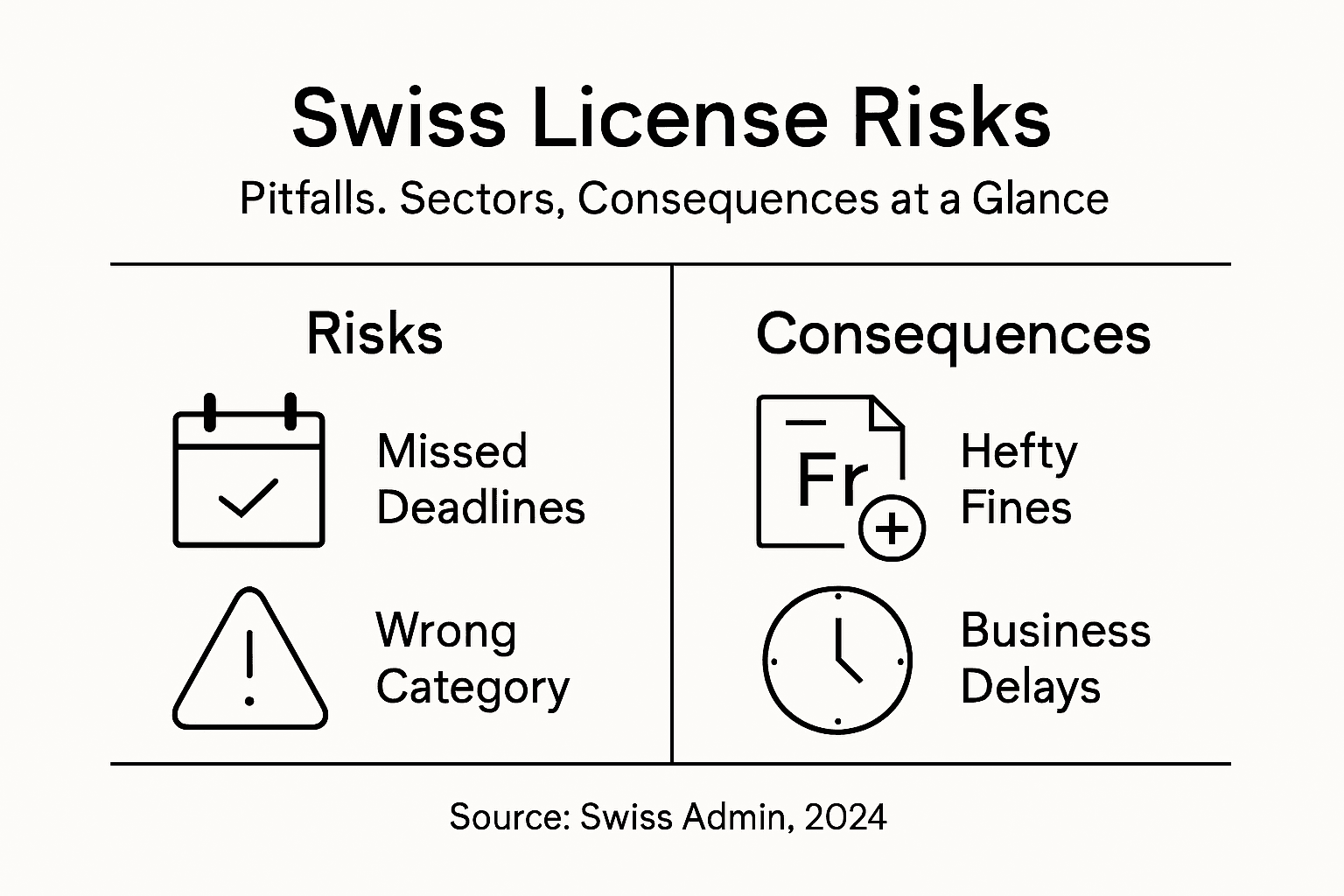
The financial implications of non-compliance can be devastating. Businesses may face unexpected costs for corrective measures, potential operational suspensions, and legal remediation. Proactive risk management involves maintaining meticulous documentation, staying informed about regulatory changes, and potentially engaging local compliance experts who understand the intricate Swiss legal landscape. International entrepreneurs must recognize that compliance is not a one-time achievement but an ongoing commitment requiring continuous adaptation and vigilance.
This summary table highlights common compliance risks and the potential consequences for Swiss business owners:
Compliance Risk | Most Affected Sectors | Typical Consequence |
Incomplete documentation | All sectors | License delays, rejection |
Overlooking local requirements | Hospitality, retail | Fines, operational suspension |
Not updating licenses | Finance, healthcare | Penalties, license revocation |
Pro Tip: Allocate a dedicated budget for ongoing compliance management and consider retaining a Swiss legal consultant who specializes in your specific industry to provide real-time regulatory guidance.
Secure Your Swiss Business License With Expert Guidance
Understanding the complex legal pathways and common pitfalls of obtaining a Swiss business license can be overwhelming, especially for international entrepreneurs facing strict documentation, cantonal regulations, and sector-specific compliance. If you are concerned about navigating the multilayered licensing process or avoiding costly compliance errors mentioned in the article, you are not alone. Critical challenges include proving financial stability, meeting local permit requirements, and ensuring continuous regulatory adherence in sectors like finance, healthcare, or technology.
At RPCS, we specialize in streamlining Swiss company formation by handling every step from legal documentation, notarization, to registration with precise attention to these licensing nuances. Our comprehensive services include ongoing administrative, accounting, and legal support designed to protect your business from common licensing and compliance risks. Our confidential and rapid setup process is tailored to secure your commercial credibility and operational legality in Switzerland.
Take control of your Swiss business journey now and avoid delays or penalties caused by incomplete or incorrect licensing submissions.

Ready to transform your entrepreneurial vision into a fully licensed Swiss company without guesswork? Visit RPCS today for expert assistance that ensures compliance and speeds up your business licensing. Start your hassle-free Swiss incorporation and simplify ongoing compliance by connecting with our dedicated specialists now.
Frequently Asked Questions
What is a Swiss business license and why is it important?
A Swiss business license is a legal authorization that allows an enterprise to operate commercially in Switzerland. It signifies compliance with national and cantonal regulations, ensuring credibility, tax compliance, and operational legitimacy for business activities.
What types of Swiss business licenses are there?
Swiss business licenses include trade licenses, professional permits, sector-specific authorizations, and regional certifications. Each type has distinct requirements based on industry regulations and local policies.
What is the general process for obtaining a Swiss business license?
The process involves selecting a business structure, preparing required documentation (such as articles of association and business plans), and registering with the cantonal commercial registry. Additional permits may be necessary based on the industry.
What are the common pitfalls when applying for a Swiss business license?
Common pitfalls include submitting incomplete documentation, failing to update licenses when business activities change, and overlooking specific cantonal requirements. Such errors can lead to delays, fines, or even revocation of the license.
Recommended
Comments