
What is a Swiss foundation? Key benefits for entrepreneurs 2026
- Mar 10
- 10 min read

Most entrepreneurs believe Swiss foundations serve only charity. That’s wrong. Under Swiss law, foundations are flexible business tools offering unmatched confidentiality, legitimacy, and tax advantages. International investors use them to protect assets, enhance credibility, and optimize structures. This guide reveals how Swiss foundations work, their legal framework, tax benefits, privacy features, and practical setup steps to help you decide if a foundation fits your business strategy.
Table of Contents
Key takeaways
| Point | Details | |-------|---------|| | Swiss foundations are legal entities without shareholders, purpose-driven and governed by trustees under strict Swiss law. | | They offer strong confidentiality and privacy, with beneficiary identities not publicly disclosed unlike companies. | | Tax treatment varies: non-commercial foundations often enjoy exemptions, while commercial uses face standard taxation. | | Minimum capital of CHF 50,000, notarization, and trustee appointment are required for establishment. | | Foundations differ from AG/GmbH companies in ownership, governance, and commercial activity scope. |
Introduction to Swiss foundations
A Swiss foundation is a legal entity created to serve a specific purpose, typically holding and managing assets without shareholders. Unlike companies that distribute profits, foundations exist to fulfill their stated mission, whether protecting family wealth, supporting business interests, or achieving long-term goals. Swiss law recognizes foundations as independent entities with legal personality, meaning they can own property, enter contracts, and operate separately from their founders.
Swiss foundations differ fundamentally from companies and trusts. Companies have shareholders and profit motives. Trusts, while similar in asset protection, lack legal entity status in many jurisdictions. Foundations blend these concepts: they hold assets like trusts but operate as recognized legal entities like companies. This unique position grants foundations flexibility and international acceptance.
Historically, Swiss foundations emerged from civil law traditions emphasizing purpose over ownership. Swiss law refined foundation structures to balance flexibility with accountability, making them attractive for international business. Today, entrepreneurs use foundations for:
Asset protection and succession planning
Holding intellectual property or real estate
Enhancing business legitimacy and credibility
Facilitating long-term governance without shareholder disputes
Achieving confidentiality in complex ownership structures
Foundations are not mysterious offshore vehicles. They are transparent legal entities subject to Swiss oversight, offering strategic advantages when properly structured and managed.
Legal framework and governance of Swiss foundations
Swiss law requires foundations to operate under a board of trustees responsible for fiduciary duties and compliance. The Swiss foundation board must comply with fiduciary duties and regulatory requirements, adding governance layers that mitigate misuse risks. Trustees oversee foundation activities, ensure adherence to statutes, and manage assets in line with the foundation’s purpose.
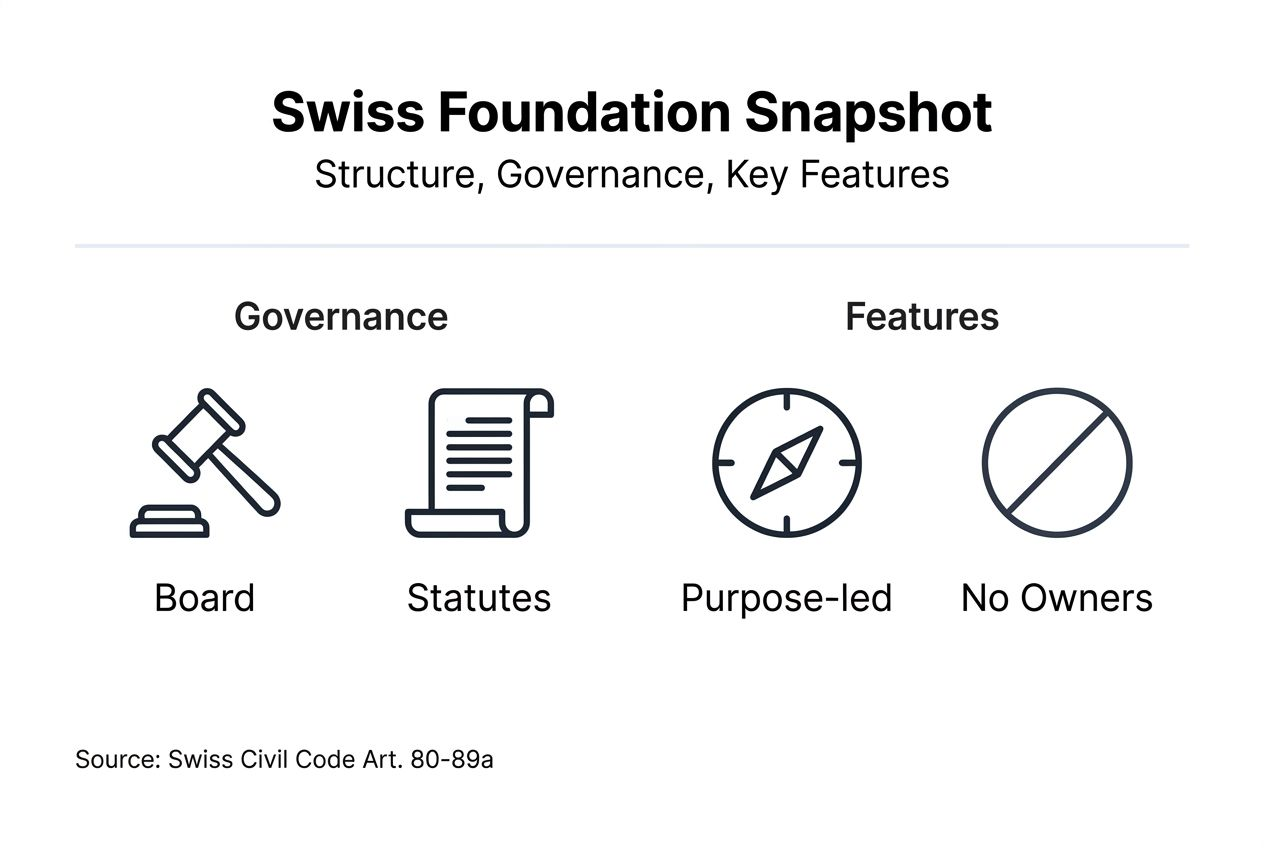
To establish a foundation, you must deposit minimum capital of CHF 50,000 and notarize foundation statutes. These statutes define the foundation’s purpose, governance structure, and operational rules. Notarization ensures legal validity, while registration with cantonal authorities creates a public record, though details about beneficiaries remain confidential.
Trustee qualification matters significantly. Swiss law mandates trustees act in good faith, avoid conflicts of interest, and prioritize the foundation’s purpose above personal gain. Recent compliance reforms tightened anti-money laundering rules, requiring foundations to document beneficial ownership and report suspicious activities. This regulatory evolution enhances credibility but demands careful adherence.
Key governance requirements include:
Annual financial reporting and audits for larger foundations
Transparent documentation of trustee decisions
Compliance with cantonal and federal regulations
Regular review of foundation purpose and activities
Proper record-keeping for beneficiary distributions and asset changes
Pro Tip: Choose trustees with relevant expertise in finance, law, or your industry. Qualified trustees not only ensure compliance but also add strategic value to foundation management.
Tax implications and benefits
Swiss tax treatment of foundations depends on their purpose and activities. Non-commercial foundations pursuing charitable, educational, or public interest goals often qualify for tax exemptions at federal and cantonal levels. This exemption eliminates income and capital taxes, making foundations highly efficient for wealth preservation and philanthropy.

Commercial foundations operating businesses or generating investment income face standard corporate taxation. Federal tax rates are low compared to global standards, and cantonal variations allow strategic location choices. Some cantons offer preferential rates for holding companies or foundations with limited commercial activity, creating optimization opportunities.
International tax considerations enhance foundation appeal. Switzerland’s extensive tax treaty network reduces withholding taxes on cross-border income, while foundations themselves avoid double taxation in many scenarios. For international entrepreneurs, structuring investments through Swiss foundations can lower overall tax burdens, especially when combined with proper planning.
Important tax planning considerations include:
Define foundation purpose clearly to establish tax status
Separate commercial activities into subsidiary companies if needed
Leverage cantonal differences for optimal tax positioning
Document all transactions meticulously for audit readiness
Consult Switzerland tax benefits for entrepreneurs to maximize advantages
Foundations also benefit from Switzerland’s political stability and respect for legal structures, reducing risks of retroactive tax changes. This predictability supports long-term planning. For deeper strategies, explore the Swiss business tax optimization guide 2026.
Tax efficiency alone should not drive foundation formation. Align tax benefits with legitimate business purposes to ensure compliance and avoid scrutiny. Properly structured, Swiss foundations deliver sustainable tax advantages alongside operational benefits. Entrepreneurs seeking comprehensive protection might also consider international expat health insurance as part of their Swiss planning.
Confidentiality and privacy features
Swiss foundations offer exceptional confidentiality compared to companies. Beneficiary and founder identities are not publicly disclosed, unlike AG or GmbH shareholders listed in commercial registers. This privacy attracts international investors seeking discretion in wealth management, succession planning, or business structuring.
Swiss law balances confidentiality with transparency. Foundations must register with authorities and comply with anti-money laundering regulations, but this information remains within regulatory circles. The public cannot access beneficiary details or internal governance documents. For comparison, company shareholders appear in public registers, exposing ownership structures to competitors and unwanted attention.
Trusts, while offering privacy in some jurisdictions, lack legal recognition in many countries, limiting their international utility. Swiss foundations combine strong privacy with global legal acceptance, creating a robust confidentiality framework. This dual advantage explains why 85% of international investors using Swiss structures prioritize confidentiality features.
Privacy Insight: 85% of international investors choose Swiss structures primarily for confidentiality benefits, valuing non-disclosure of beneficiary identities and internal governance details.
Legal limits protect against abuse. Swiss authorities require foundations to maintain accurate records of beneficiaries and report suspicious transactions. Recent reforms mandate transparency with regulators while preserving public confidentiality. This framework ensures foundations serve legitimate purposes without enabling illicit activities.
Foundations safeguard investor identities through:
Non-public beneficiary registers
Confidential trustee communications
Legal protections against disclosure except under court order
Regulatory oversight without public exposure
For more on Swiss privacy standards, review this Swiss confidentiality policy example.
Comparison with other Swiss legal entities
Swiss foundations differ fundamentally from companies like AG (corporation) and GmbH (limited liability company) in ownership and governance. Companies have shareholders who own equity and control decisions through voting rights. Foundations have no owners; trustees manage assets according to statutes, serving the foundation’s purpose rather than shareholder interests.
Feature | Swiss Foundation | AG/GmbH Company | Trust |
Ownership | No shareholders, purpose-driven | Shareholders own equity | Beneficiaries, no legal entity |
Governance | Board of trustees | Board of directors, shareholders | Trustee discretion |
Commercial Activity | Limited to purpose | Full commercial freedom | Depends on jurisdiction |
Legal Recognition | Full legal entity status | Full legal entity status | Varies by country |
Privacy | High (beneficiaries confidential) | Low (shareholders public) | High but limited acceptance |
Governance structures reflect these differences. Company directors answer to shareholders and prioritize profits. Foundation trustees answer to the foundation’s purpose, balancing stakeholder interests within statutory limits. This distinction makes foundations ideal for long-term goals where shareholder disputes or profit pressures could derail strategy.
Swiss law limits foundation commercial activity to protecting claimed purposes, unlike commercial company models. A foundation can invest assets or operate businesses aligned with its purpose, but launching unrelated commercial ventures violates its statutes. For active trading or profit-driven enterprises, AG or GmbH structures offer greater flexibility.
International acceptance varies. Companies are universally recognized and easily understood by banks, regulators, and business partners. Foundations, while respected, sometimes require additional explanation. Trusts face legal uncertainty in civil law countries, limiting their global utility.
Advantages of foundations:
Strong asset protection through separate legal personality
Confidentiality in beneficiary and ownership details
Alignment with long-term, purpose-driven goals
Tax benefits for non-commercial uses
Stable governance without shareholder conflicts
Disadvantages include limited commercial scope, higher setup complexity, and regulatory oversight. Choosing between foundations and companies depends on your goals: asset protection and privacy favor foundations, while active business favors companies. For detailed comparisons, see limitations of Swiss foundations.
Common misconceptions about Swiss foundations
Many believe Swiss foundations exist only for charity. This myth limits understanding. Foundations serve diverse purposes, from holding family wealth to supporting business strategies, provided activities align with statutes. Swiss law allows commercial foundations, though their scope remains narrower than companies.
Another misconception: foundations can replace companies for all business activities. Misconception: Swiss foundations can replace companies for all business activities. Correction: Foundations have limited commercial activity scope compared to AG or GmbH entities, impacting their business operational use. Active trading, frequent transactions, or profit distribution require company structures. Foundations excel at holding assets, managing investments, or supporting specific purposes, not running day-to-day businesses.
Privacy misunderstandings also persist. Some think Swiss foundations offer complete anonymity, hiding all activities from authorities. This is false. Foundations must comply with regulations, report to supervisory bodies, and maintain accurate records. Privacy protects against public disclosure, not regulatory oversight.
Common myths include:
Foundations are tax havens with no oversight (False: they face strict compliance)
Any business can operate through a foundation (False: commercial scope is limited)
Founders retain full control like company owners (False: trustees govern independently)
Setting up a foundation is quick and simple (False: it requires careful planning and legal expertise)
Understanding these limits helps entrepreneurs use foundations appropriately. They are powerful tools within their proper scope, not universal solutions. Misusing foundations by exceeding commercial limits or ignoring compliance can trigger legal issues and reputational damage.
Pro Tip: Consult legal experts before forming a foundation to ensure your intended activities align with Swiss law. Proper structuring avoids costly mistakes and maximizes benefits. For more clarity, explore Swiss foundation misconceptions.
Practical steps to establish a Swiss foundation
Forming a Swiss foundation requires careful planning and precise execution. Follow these steps to ensure compliance and success:
Define your foundation’s purpose clearly in draft statutes. Specify whether it will hold assets, support business interests, or pursue other goals. Purpose drives all subsequent decisions, including governance and tax status.
Deposit minimum capital of CHF 50,000 into a designated bank account. This capital requirement demonstrates financial commitment and ensures the foundation can fulfill its purpose. Choose a reputable Swiss bank familiar with foundation accounts.
Draft and notarize foundation statutes with a Swiss notary. Statutes outline purpose, governance structure, trustee powers, and operational rules. Notarization ensures legal validity and prepares documents for registration.
Appoint a qualified board of trustees with relevant expertise. Trustees assume fiduciary duties and legal responsibility, so choose individuals or entities with strong reputations, financial acumen, and understanding of Swiss law.
Register the foundation with cantonal authorities in your chosen location. Registration creates a public record, granting the foundation legal personality and enabling it to operate, own assets, and enter contracts.
Ensure ongoing compliance with fiduciary duties, reporting requirements, and regulatory changes. Annual audits, financial statements, and proper documentation keep the foundation in good standing and protect against legal risks.
Additional considerations include selecting the right canton for tax optimization and regulatory environment, establishing banking relationships early to facilitate capital deposit and operations, and planning for succession by defining trustee appointment and replacement procedures.
For comprehensive guidance on documentation and procedural requirements, consult the company formation checklist Switzerland. Detailed preparation of statutes and legal documents is critical; learn best practices from prepare Swiss company documents.
Proper foundation setup takes time. Rushing through steps or cutting corners creates compliance risks and operational challenges. Engage experienced advisors to navigate Swiss legal requirements efficiently.
Conclusion and strategic applications
Swiss foundations offer a unique blend of legitimacy, confidentiality, and tax efficiency for international entrepreneurs. They excel at asset protection, long-term governance, and privacy, serving purposes beyond traditional charity. Understanding their legal framework, tax treatment, and operational limits ensures you leverage foundations strategically.
Key strategic insights:
Foundations balance purpose-driven governance with flexible asset management
They provide exceptional privacy compared to companies while maintaining legal recognition
Tax benefits vary by purpose, with non-commercial foundations enjoying exemptions
Commercial activity limits require careful structuring, often combined with subsidiary companies
Proper trustee selection and compliance are essential for long-term success
Entrepreneurs must recognize foundations are not universal solutions. They fit specific scenarios: holding intellectual property, managing family wealth, supporting business ecosystems, or achieving succession goals without shareholder conflicts. For active trading or profit-driven ventures, companies remain superior.
Engaging legal and tax experts optimizes foundation benefits and ensures compliance. Swiss regulations evolve, and professional guidance keeps structures aligned with current requirements. Use foundations as part of broader strategies, combining them with companies, trusts, or other tools to achieve comprehensive goals.
Explore Swiss company formation services with RPCS
Navigating Swiss foundation and company formation requires local expertise and regulatory knowledge. RPCS specializes in helping international entrepreneurs establish and manage Swiss entities, from foundations to AG and GmbH companies. Whether you need guidance on statutes, trustee appointments, or ongoing compliance, RPCS provides comprehensive support tailored to your goals.

RPCS offers end-to-end Swiss company formation services, handling legal documentation, notarization, and registration efficiently. Beyond formation, RPCS provides accounting services to maintain compliance and optimize financial structures. Establishing banking relationships is seamless with RPCS assistance to open a Swiss bank account, ensuring smooth capital deposits and operational transactions. Let RPCS streamline your Swiss foundation or company setup, maximizing benefits while minimizing complexity.
FAQ
What is a Swiss foundation used for in business?
Swiss foundations serve as legal structures to hold assets, enhance credibility, and protect business interests. They facilitate succession planning and long-term stewardship without shareholder ownership, offering stability and confidentiality for entrepreneurs managing complex international structures.
Can a Swiss foundation conduct commercial business?
Foundations have limited commercial scope, mostly tied to achieving their stated purposes. Active trading or profit-driven operations are better suited to AG or GmbH companies, which offer full commercial freedom without statutory restrictions.
How private is a Swiss foundation?
Swiss foundations offer strong confidentiality compared to companies, with beneficiary identities generally not publicly disclosed. However, they must comply with regulatory requirements, maintaining transparency with authorities while protecting privacy from public exposure.
What are the key steps to form a Swiss foundation?
Define your foundation’s purpose, notarize statutes, deposit minimum capital of CHF 50,000, appoint qualified trustees, and register with cantonal authorities. Ensure ongoing compliance with fiduciary duties and reporting requirements. For detailed procedural guidance, review the Swiss company formation checklist.
Recommended
Comments