
Swiss Business Environment: Key Insights for Foreign Investors
- Apr 14
- 8 min read

TL;DR:
Switzerland maintains a highly investor-friendly environment with political stability, low taxes, and no broad FDI screening until 2027.
Foreign owners can fully establish Swiss companies with the requirement of appointing at least one Swiss-resident director.
Location choice among cantons significantly impacts tax rates and incentives, making strategic planning vital.
Switzerland stands apart from most of Europe in one striking way: while other nations have spent years tightening foreign investment rules, Switzerland has remained highly investor-friendly with political stability, a competitive tax system, and no general FDI screening regime until very recently. That openness surprises many international entrepreneurs who expect European-style bureaucracy and restrictions. What they find instead is a well-structured, federalist system that rewards careful planning. This article walks you through the Swiss business environment from the ground up: legal structures, tax strategy, regulatory changes in 2026, and the practical steps to enter the market with confidence.
Table of Contents
Key Takeaways
Point | Details |
Open to investment | Switzerland maintains high accessibility for foreign entrepreneurs in most sectors. |
Choose the right structure | You can fully own GmbH and AG companies, but must appoint a Swiss-resident director. |
Optimize through canton selection | Selecting a low-tax canton like Zug or Lucerne can significantly improve fiscal outcomes. |
Regulations tightening | New rules in 2026 and 2027 require targeted compliance for investment and sustainability. |
Expert support recommended | Professional guidance helps navigate complex formation, regulatory, and tax issues. |
Understanding Switzerland’s investor-friendly business environment
Switzerland’s reputation as a business hub is not marketing. It is built on decades of political neutrality, a strong rule of law, and a tax regime that actively competes for international capital. The investor-friendly environment is characterized by political stability, a competitive tax system, and, until very recently, no general FDI screening mechanism at all. That combination is rare in Europe.
For foreign entrepreneurs, this means you can establish a Swiss company without facing the national security reviews or sector-specific restrictions common in Germany, France, or the United Kingdom. The Swiss system trusts market mechanisms and relies on targeted regulation rather than blanket oversight. This philosophy shapes everything from company registration to banking access.
Here is what makes Switzerland structurally attractive for international investors:
Political and legal stability: Switzerland has not experienced a government collapse or major legal overhaul in decades. Contracts are enforced reliably, and the judicial system is independent.
Competitive corporate tax rates: The effective combined federal, cantonal, and municipal tax rate typically ranges between 11% and 22%, depending on location.
No general FDI screening: Private investors from any country can acquire Swiss companies or establish new ones without triggering a national review process.
Strong infrastructure and talent pool: Switzerland ranks consistently among the top nations for innovation, education, and quality of life, which matters when recruiting internationally.
Currency stability: The Swiss franc (CHF) is one of the world’s most stable currencies, which protects the real value of your investment.
That said, the landscape is shifting. In December 2025, Switzerland adopted a new targeted FDI Act, expected to come into force in 2027. This law applies only to state-controlled foreign investors acquiring stakes in sensitive sectors such as critical infrastructure, energy, and defense. Private investors are not affected. You can read more about the Swiss business benefits that still make Switzerland one of the most accessible markets in the world.
Now that you see Switzerland’s broad accessibility, let’s clarify what that means in practice for new entrants.
Legal structures: Company types and ownership rules
With the foundation of openness and stability established, let’s dive into the types of Swiss companies you can set up and the core rules you must follow.
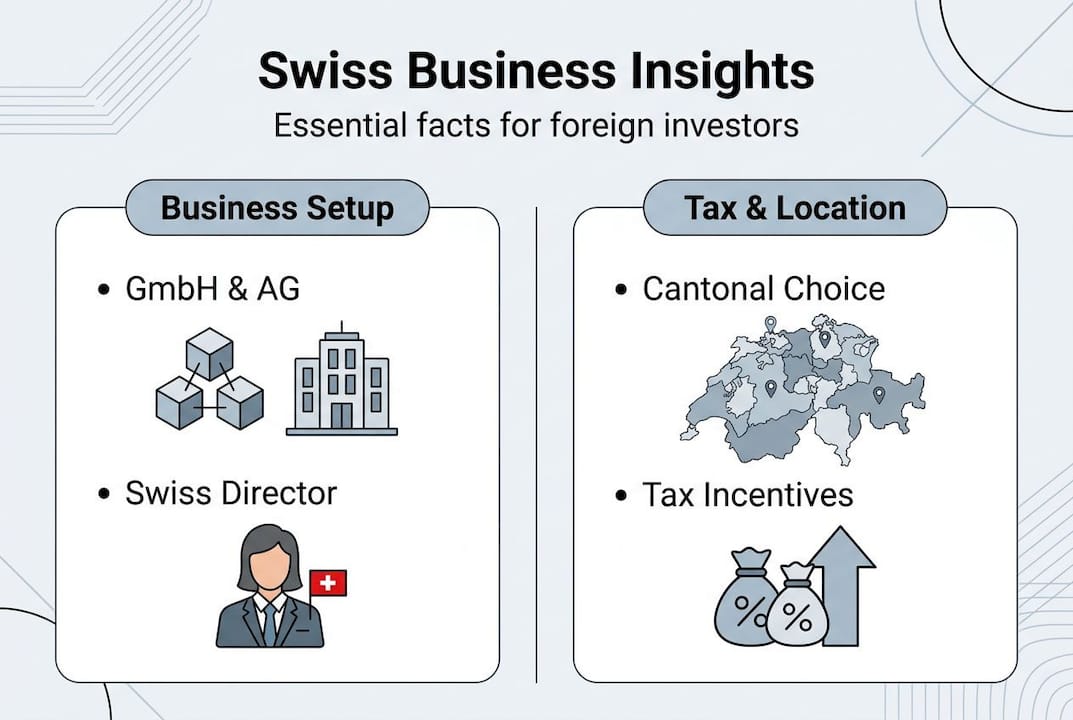
The two dominant business structures for foreign investors are the GmbH (Gesellschaft mit beschränkter Haftung, or limited liability company) and the AG (Aktiengesellschaft, or stock corporation). Both allow full foreign ownership, but they differ in capital requirements, governance flexibility, and public disclosure obligations.

Feature | GmbH | AG |
Minimum capital | CHF 20,000 | CHF 100,000 |
Paid-up minimum | Full amount | CHF 50,000 |
Share transferability | Restricted | Freely transferable |
Public shareholder list | Yes | No (bearer shares abolished) |
Best suited for | SMEs, startups | Holdings, larger ventures |
Foreign entrepreneurs can fully own Swiss companies of either type without residency requirements on shareholders. However, there is one critical rule: at least one director with signing authority must be a Swiss resident. This is not a formality. The resident director must be able to legally represent the company in Switzerland.
Here is how the residency requirement plays out in practice:
EU/EFTA nationals living in Switzerland can obtain a work permit relatively easily and qualify as resident directors.
Non-EU/EFTA nationals face stricter permit quotas and must demonstrate a genuine business case to Swiss cantonal authorities.
Foreign-based owners who cannot relocate typically appoint a professional nominee director, a licensed local representative who fulfills the legal requirement.
Nominee arrangements must be structured carefully to maintain actual management control with the foreign owner while satisfying Swiss legal requirements.
Pro Tip: Never treat the resident director requirement as a checkbox. A poorly structured nominee arrangement can create real legal exposure. Work with a specialist in Swiss director residency rules before you finalize your governance documents.
For a detailed walkthrough of the full Swiss company formation process, including notarization and commercial register filing, review the formation process overview tailored for foreign investors.
Cantonal competition: Tax, incentives, and location strategy
After choosing your business structure, location selection sharpens your tax and incentive profile. Here is how to approach cantonal strategy.
Switzerland’s federalist system creates cantonal competition on taxes and incentives, and the differences are significant enough to change your bottom line. Choosing the wrong canton can cost a holding company hundreds of thousands of CHF in unnecessary tax over a decade.
Canton | Effective corporate tax rate (approx.) | Known for |
Zug | ~11.9% | Tech, crypto, holdings |
Lucerne | ~12.3% | SMEs, regional headquarters |
Nidwalden | ~11.9% | Family offices, asset management |
Zurich | ~19.7% | Financial services, large enterprises |
Geneva | ~13.99% | International organizations, finance |
Zug and Lucerne are consistently favored for technology companies and holding structures because of their low rates and efficient cantonal administrations. Zurich, despite higher rates, attracts large financial institutions because of its talent pool, infrastructure, and international connectivity.
Here is what drives smart cantonal selection:
Holding company regimes: Several cantons offer participation exemptions that effectively eliminate tax on dividend income and capital gains from qualifying subsidiaries.
Patent box regimes: Income from intellectual property can be taxed at reduced rates in cantons that have implemented the OECD-aligned patent box.
Cantonal incentive grants: Some cantons offer temporary tax holidays or reduced rates for companies creating local jobs or investing in specific sectors.
Proximity to talent: For operational companies, being near universities or tech clusters in Zurich or Basel can outweigh a modest tax disadvantage.
You can explore the full Swiss tax structure advantages and review Swiss tax strategies to model which canton fits your specific business model. For a curated list of Swiss tax benefits by structure type, that resource breaks it down clearly.
Note that the new Investment Screening Act does not affect cantonal tax competition or incentive programs. Those remain fully available to all private investors.
Regulatory and compliance trends: New developments in 2026
With your tax and location choices defined, staying ahead of regulatory changes is essential. Here is what to expect in 2026.
Switzerland’s openness persists, but compliance expectations are tightening in specific areas. Understanding what is changing, and what is not, protects your investment and avoids costly surprises.
The most significant development is the new FDI Act, adopted in December 2025. Key points:
Scope is narrow: Only acquisitions by state-controlled foreign entities in critical sectors trigger review. Private investors are not affected.
Entry into force: The Act is expected to come into force in 2027, giving businesses time to prepare.
Notification thresholds: Deals above certain size thresholds in sensitive sectors will require pre-closing notification to Swiss authorities.
No retroactive effect: Existing investments and structures are not subject to review under the new law.
“No private FDI screening preserves openness; regulatory trends tightening (FDI Act, sustainability diligence via NAP) affect only specific investor categories and sectors.”
Beyond the FDI Act, Switzerland’s National Action Plan (NAP) on business and human rights is pushing companies toward more formal sustainability and supply chain diligence. This is not yet a hard legal obligation for most SMEs, but larger companies and those with international supply chains should begin documenting compliance practices now.
Pro Tip: Even if your company falls outside the FDI Act’s scope, building a clean compliance paper trail from day one strengthens your position with Swiss banks. Knowing your Swiss banking requirements before you apply for a corporate account saves weeks of back-and-forth. A solid tax optimization guide for 2026 can also help you align your structure with the latest regulatory expectations.
A fresh take: What most guides miss about Swiss business setup
Most articles about Switzerland focus on the headline numbers: low taxes, stable politics, strong franc. Those facts are real. But they create a misleading picture of frictionless entry.
The truth is that cantonal selection matters far more than most entrepreneurs realize at the start. Choosing a canton based on a single tax rate comparison, without factoring in cantonal administration responsiveness, local banking relationships, and permit processing times, is a mistake we see repeatedly. Zug is fast and efficient. Other cantons with similar rates can add months to your timeline.
Regulatory openness also creates a hidden friction: because Switzerland does not have a single federal business registration portal, the process is distributed across cantonal commercial registers, notaries, and tax offices. Each has its own pace. Foreign investors who expect a centralized, digital process are often caught off guard.
Local talent acquisition is another underestimated challenge. Switzerland has strict immigration quotas for non-EU/EFTA nationals, and even with a registered company, hiring from outside the EU requires demonstrating that no suitable local or EU candidate was available. This affects your staffing timeline significantly.
Our experience working with international clients through the foreign investor guide consistently shows that the entrepreneurs who succeed fastest are those who engage local specialists early, not after problems arise.
Next steps for your Swiss venture: Professional support
Having explored the Swiss business environment, here is how expert support makes your entry easier and safer.
Setting up a Swiss company involves more moving parts than most foreign investors expect: notarized documents, commercial register filings, bank account opening, tax registration, and ongoing accounting obligations. Getting one step wrong delays everything else.
RPCS offers end-to-end company formation services designed specifically for international entrepreneurs who need a reliable local partner. From GmbH and AG incorporation to Swiss bank account setup and fully managed accounting solutions, the platform covers every stage of your Swiss business journey. You bring the vision. We handle the Swiss paperwork, compliance, and administrative complexity so you can focus on building your business.
Frequently asked questions
Can a foreigner fully own a Swiss company?
Yes, foreign entrepreneurs can fully own Swiss companies, but they must appoint at least one Swiss-resident director with signing authority to satisfy local legal requirements.
What is the minimum capital required to start a Swiss company?
A GmbH requires CHF 20,000 in minimum capital, while an AG requires CHF 100,000, with at least CHF 50,000 paid up at the time of registration.
Do Swiss cantons have different business taxes?
Yes, each canton sets its own tax rates and incentives. Cantonal competition means location choice is one of the most powerful tools for optimizing your effective tax rate.
Is there a foreign investment screening regime in Switzerland?
No general regime exists for private investors. A new targeted FDI Act, adopted in December 2025, applies only to state-controlled foreign entities in sensitive sectors and is expected to come into force in 2027.
What new compliance requirements will impact Swiss businesses in 2026?
The key changes include targeted investment screening for state-controlled acquirers and new sustainability diligence expectations under Switzerland’s National Action Plan, which are beginning to affect larger companies and those with complex supply chains.
Recommended
Comments