
How to Hire Employees in Switzerland: 2026 Guide
- Jun 4
- 9 min read

TL;DR:
Hiring in Switzerland requires choosing between establishing a local entity or engaging an Employer of Record to ensure compliance with employment laws and permit regulations. The process involves precise contract drafting, timely registration with cantonal authorities, and securing work permits, especially for non-EU nationals, to avoid delays and legal liabilities. Utilizing EOR services offers rapid market entry for small teams or pilots, but long-term employment is more cost-effective with a registered Swiss company, emphasizing the importance of early planning and thorough documentation.
Hiring employees in Switzerland requires choosing between two legal models: establishing a Swiss entity or engaging a Switzerland-based Employer of Record (EOR). Either path demands compliance with Swiss employment contracts, social security registration, payroll obligations, and work permit rules. Get the model wrong and you face criminal liability, delayed payroll, or invalid employment relationships. This guide gives you the exact process, in the right order, so you can build a compliant Swiss workforce without costly detours.
How to hire employees in Switzerland: entity setup vs. Employer of Record
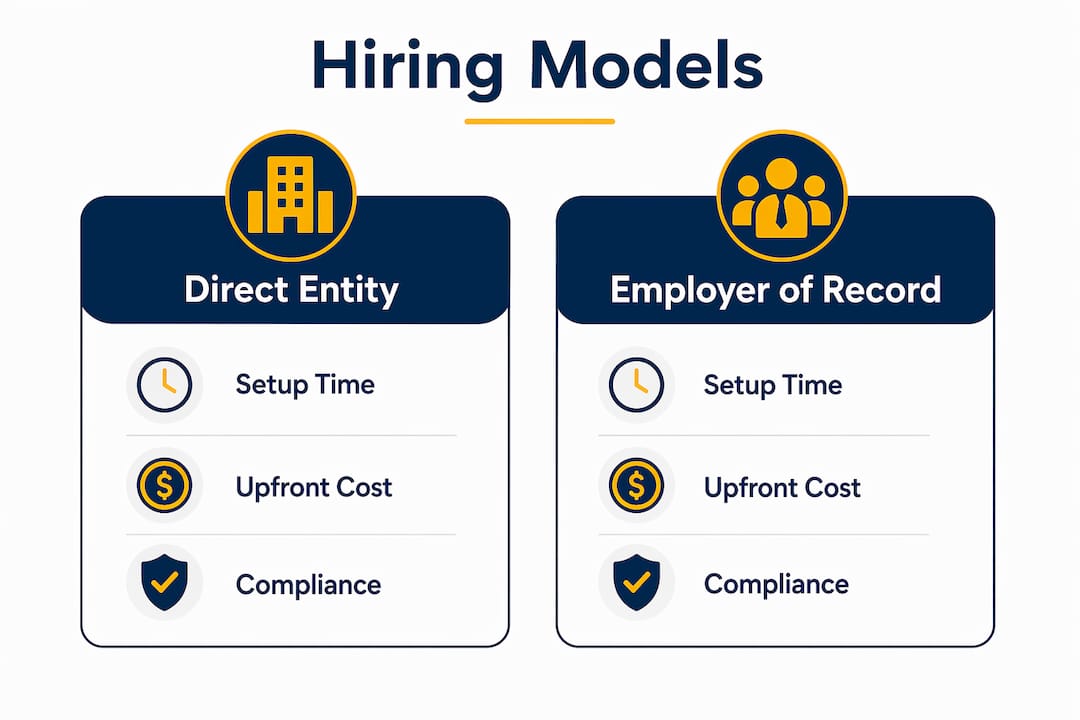
The two main hiring models are direct entity employment and EOR. Each carries distinct compliance obligations, cost structures, and timelines that directly affect when your first employee can legally start work.
Direct entity employment means registering a Swiss GmbH or AG, appointing a Swiss resident director, depositing share capital, and taking on full employer responsibility for payroll, taxes, and social security. Swiss company formation typically takes four to eight weeks, and ongoing compliance includes annual filings, audits above certain thresholds, and cantonal registrations. This model suits teams of five or more, long-term market commitments, or businesses that need a registered address in Switzerland for credibility and banking purposes.
EOR employment means a licensed Swiss EOR becomes the legal employer on paper while your employee works under your direction. The EOR handles contracts, payroll, AHV/AVS contributions, accident insurance, and withholding tax. You can place an employee in Switzerland within two to four weeks without any entity. EOR services represent an effective solution for companies testing the Swiss market with a small pilot team or a single hire.
Factor | Direct entity | EOR |
Setup time | 4 to 8 weeks | 1 to 2 weeks |
Upfront cost | High (capital, notary, registration) | Low (monthly fee per employee) |
Best for | Teams of 5 or more, long-term presence | 1 to 4 employees, market pilots |
Compliance burden | Employer carries all obligations | EOR manages payroll and filings |
Swiss resident director | Required | Not required |
Pro Tip: Due diligence on EOR provider licensing and cantonal labor leasing permissions is non-negotiable. Unauthorized staffing activities can trigger criminal liability for both the EOR and the client company.
How to conduct the recruitment process in Switzerland
About 34.3% of Swiss companies report difficulties recruiting qualified workers as of early 2026. This means your sourcing strategy and candidate evaluation process must be sharper than average to attract and retain the right people.
Follow this structured recruitment workflow to stay compliant and competitive:
Write a compliant job advertisement. Swiss anti-discrimination law prohibits criteria unrelated to job performance. Tailor language to the canton’s dominant language: German in Zurich, French in Geneva, Italian in Ticino. Post on Swiss-specific platforms like jobs.ch and LinkedIn Switzerland.
Screen applications with AI awareness. 86% of Swiss candidates use AI to tailor their applications, but only 39% of employers are more likely to hire AI-optimized candidates. Design your screening to test actual skills, not polished CVs. Use work samples, case studies, or structured competency tests.
Conduct structured interviews. Define evaluation criteria before the first interview. Ask every candidate the same core questions. This protects you legally and produces comparable data for hiring decisions.
Document everything. Employers must retain interview and recruitment records for at least five years to demonstrate compliance with anti-discrimination laws. Store notes, scoring sheets, and rejection rationale in a secure HR system.
Deliver a compliant job offer. State the role, salary, start date, and probation period in writing before the contract is signed. Verbal offers create ambiguity and potential legal exposure.
Pro Tip: Swiss candidates expect prompt, professional communication throughout the hiring process. A delayed response between interview and offer is one of the most common reasons strong candidates accept competing offers.
What are the key Swiss employment contract elements?
Written employment contracts are strongly recommended in Switzerland, even though oral agreements are technically valid. Ambiguity in an oral contract becomes your liability the moment a dispute arises.
Every Swiss employment contract must address these core elements:
Job title and duties: Describe the role specifically. Vague descriptions create scope disputes.
Salary: State the gross monthly amount and confirm whether a 13th salary applies. The 13th month payment is customary across most sectors but is not a statutory requirement.
Working hours: Standard is 40 to 42 hours per week depending on the sector and any applicable collective bargaining agreement (CBA).
Probation period: Typically one to three months. During probation, either party may terminate with just seven days’ notice.
Notice periods: After probation, notice increases with tenure: one month in year one, two months in years two through nine, and three months from year ten onward, unless the contract specifies otherwise.
CBA references: Many Swiss sectors, including construction, hospitality, and retail, operate under collective bargaining agreements that set minimum wages, hours, and benefits. Check whether your sector has a binding CBA before drafting the contract.
Social benefits: Contracts must reflect mandatory contributions to AHV/IV/EO (old age, disability, and income replacement insurance), accident insurance under SUVA or a private insurer, and the BVG occupational pension fund.
Termination rules: Swiss law restricts termination during illness, pregnancy, and military service. Document delivery of termination notices in a proven, traceable manner to avoid wrongful dismissal claims.
For a deeper look at HR compliance obligations under Swiss labor law, including contract templates and CBA mapping, Rpcs provides structured guidance for foreign employers.
How to navigate Swiss payroll, social security, and tax obligations
Payroll setup for a first Swiss hire typically takes four to eight weeks due to cantonal Ausgleichskasse registration, pension fund enrollment, and accident insurance setup. The pension fund selection causes most delays. Start this process the day you sign the employment contract.

Here is what the registration sequence looks like in practice:
Step 1: Register with the cantonal compensation office (Ausgleichskasse). Employers must register each employee within 30 days of their start date. This office administers AHV, IV, and EO contributions. Contribution rates are split between employer and employee.
Step 2: Enroll in a BVG pension fund. Every employer must affiliate with a recognized pension fund. You can join an industry fund, a collective foundation, or establish your own. Cheap plans reduce employer cost but can harm employee satisfaction and retention. Select a fund that matches your sector and employee profile.
Step 3: Set up accident insurance. Occupational accident insurance is mandatory from day one. Non-occupational accident insurance applies to employees working more than eight hours per week. SUVA covers most industrial sectors; other sectors use licensed private insurers.
Step 4: Register for withholding tax (Quellensteuer). Foreign employees without a Swiss permanent residence permit (C permit) are subject to withholding tax. Each employee maps to their specific canton for correct Quellensteuer calculation and compensation office registration. Rates vary significantly between cantons like Zug and Geneva.
Step 5: Run monthly payroll with detailed payslips. Swiss payslips must itemize gross salary, all deductions (AHV, IV, EO, accident insurance, pension), and net pay. Errors in deduction calculations trigger retroactive correction demands from cantonal offices.
Pro Tip: Selecting your pension fund early in the payroll setup process is the single most effective way to avoid delaying your first salary payment. Most employers underestimate the fund enrollment lead time.
For a full breakdown of employer responsibilities, the Rpcs guide to Swiss payroll compliance covers cantonal registration steps, pension fund selection criteria, and accident insurance requirements.
What work authorization applies when hiring non-Swiss nationals?
Switzerland distinguishes sharply between EU/EFTA nationals and non-EU/EFTA nationals when it comes to work authorization. Getting this wrong delays start dates and, in some cases, voids the employment relationship entirely.
EU/EFTA nationals benefit from the Agreement on the Free Movement of Persons. For assignments under 90 days, employers must submit an eight-day advance notification online. For longer stays, the employee registers with the cantonal migration office and receives a B permit (long-term) or L permit (short-term) within a few weeks.
Non-EU/EFTA nationals face federal and cantonal quota limits. Required documents include a valid passport, signed employment contract, proof of qualifications, and a medical certificate. Processing times range from six to twelve weeks depending on the canton and permit type.
Permit types to know: The B permit covers long-term residence and employment. The L permit covers short-term contracts under one year. The G permit applies to cross-border commuters living in neighboring countries.
Quota constraints: Non-EU/EFTA hires consume annual federal quotas. Cantons with high demand, such as Zurich and Geneva, exhaust quotas faster. Plan non-EU hiring at least three months before the intended start date.
Documentation readiness matters. Non-EU hires require comprehensive documentation ready immediately after offer acceptance. Gaps in paperwork restart processing timelines at the cantonal level.
Local legal counsel or an EOR with established cantonal relationships reduces permit processing time and prevents documentation errors that cause rejections.
Key takeaways
Hiring employees in Switzerland requires selecting the right legal model, building a compliant contract, registering with cantonal authorities, and securing work permits before the first day of work.
Point | Details |
Choose your hiring model first | Entity formation suits large teams; EOR suits pilot hires and avoids upfront capital requirements. |
Start payroll setup immediately | Pension fund enrollment and cantonal registration take four to eight weeks; delays push back first salary. |
Write every contract | Include salary, duties, probation, notice periods, and CBA references to prevent costly disputes. |
Plan non-EU permits early | Non-EU/EFTA nationals require quota-limited cantonal permits; allow at least three months lead time. |
Document your recruitment process | Retain interview records for five years to demonstrate anti-discrimination compliance. |
What I’ve learned about hiring in Switzerland as an international entrepreneur
The most expensive mistake I see international entrepreneurs make is treating Switzerland like a single, uniform jurisdiction. It is not. Zurich, Geneva, and Basel each have distinct cantonal compensation offices, different Quellensteuer rates, and varying permit processing speeds. A payroll setup that works cleanly in Zug can hit unexpected delays in Vaud simply because the cantonal office has a different enrollment form and a longer review queue.
My second observation: EOR services are underused by early-stage companies and overused by companies that should have formed an entity two years ago. An EOR is a bridge for market validation, not a permanent operating model. Once you have three or more employees in Switzerland, the monthly EOR fees typically exceed the cost of maintaining a GmbH with proper accounting support. Run the numbers at the 12-month mark.
The contract detail that catches most foreign employers off guard is the termination notice delivery requirement. Swiss courts have ruled against employers who sent termination letters by regular mail because the employee denied receipt. Registered mail with a return receipt, or personal delivery with a witness, is the only defensible approach. I have seen a single missed procedural step turn a clean termination into a six-month legal dispute.
Finally, do not underestimate the 13th salary expectation. It is not in the Swiss Code of Obligations as a statutory requirement, but in practice, omitting it from a contract in sectors where it is standard will cost you candidates and create resentment among existing staff. Include it, budget for it, and treat it as a fixed cost of Swiss employment.
— Rolands
How Rpcs helps you hire in Switzerland with confidence
Setting up a compliant Swiss employment operation from abroad is manageable when you have the right structure in place from day one.
Rpcs provides Swiss company formation for GmbH and AG structures, including legal documentation, notarization, cantonal registration, and Swiss resident director services. Once your entity is active, Rpcs supports payroll setup, accounting compliance, and business address registration so your hiring operations meet every Swiss legal requirement. Whether you are forming a new entity or need ongoing administrative support, Rpcs gives international entrepreneurs a single point of contact for the entire Swiss employment setup process. Contact Rpcs to start your Swiss company formation today.
FAQ
What is the fastest way to hire an employee in Switzerland?
Using a Switzerland-based Employer of Record is the fastest legal hiring method, typically enabling employment within one to two weeks without requiring entity formation or cantonal registration by the client company.
How long does Swiss payroll setup take?
Payroll setup for a first Swiss hire takes four to eight weeks due to cantonal Ausgleichskasse registration, pension fund enrollment, and accident insurance setup. Starting this process immediately after signing the employment contract prevents delays to the first salary payment.
Do Swiss employment contracts need to be in writing?
Written contracts are not legally required in Switzerland, but they are strongly recommended. Oral contracts are valid but create ambiguity over salary, notice periods, and duties that becomes the employer’s liability in any dispute.
What permits do non-EU employees need to work in Switzerland?
Non-EU/EFTA nationals require a cantonal work permit, typically a B permit for long-term employment, subject to federal quotas. Required documents include a passport, employment contract, proof of qualifications, and a medical certificate, with processing times of six to twelve weeks.
What social security contributions must Swiss employers pay?
Swiss employers must contribute to AHV/IV/EO (old age, disability, and income replacement insurance), mandatory BVG occupational pension, and accident insurance. Employees must be registered with the cantonal compensation office within 30 days of their start date.
Recommended