
Swiss business benefits: 11.9% tax, stability, global reach
- Mar 28
- 8 min read

Switzerland’s effective corporate tax rates start at just 11.9% in Zug, a figure that surprises most international entrepreneurs who assume European business hubs are uniformly expensive. But the real story goes deeper than a single headline number. Switzerland combines legal stability, a AAA-rated economy, and a non-EU position that gives companies central European access without the regulatory weight of Brussels. This guide breaks down the actual numbers, the setup mechanics, the sector-specific incentives, and how recent global tax reforms have reshaped but not eliminated Switzerland’s edge for international investors and entrepreneurs.
Table of Contents
Key Takeaways
Point | Details |
Swiss tax rates are highly competitive | Cantonal tax rates as low as 11.9% ensure Switzerland stays attractive for global businesses. |
Stability and innovation matter | Legal certainty, digital infrastructure, and a strong talent pool give Swiss companies long-term advantages beyond just low tax. |
Reforms sustain not erase benefits | Even after OECD-aligned reforms, Switzerland’s strategic flexibility and special regimes maintain its business appeal. |
Sector-specific incentives amplify value | Startups, tech, biotech, and holding companies can access industry-focused incentives and simplified tax regimes. |
Proper setup is key for success | Remote-friendly company formation, VAT compliance, and optimal canton choice are critical for unlocking Swiss business benefits. |
What makes Switzerland uniquely attractive for businesses?
Most entrepreneurs hear “Switzerland” and think watches, banks, and expensive coffee. The business reality is far more strategic. Switzerland consistently ranks top 3 globally in competitiveness according to the IMD World Competitiveness Center, with a GDP per capita of roughly $86,000 and a stable AAA-rated economy that has weathered global financial shocks better than most.
What sets Switzerland apart from a pure tax haven is the substance behind the structure. You get a highly educated, multilingual workforce, world-class digital infrastructure, and a financial sector that operates with genuine depth and credibility. These are not cosmetic advantages.
Here is what the Swiss business environment actually delivers:
Central European access without EU membership obligations or compliance burdens
Political and monetary stability with a strong franc and independent central bank
High innovation output with leading R&D investment across pharma, fintech, and engineering
Transparent legal system with strong contract enforcement and property rights
Low bureaucracy relative to most EU jurisdictions for company formation and ongoing compliance
“Switzerland’s appeal is not just about tax rates. It is about building a business in a jurisdiction where the rules are clear, the institutions are reliable, and the infrastructure actually works.”
For international investors, this combination means Swiss companies attract investors precisely because Swiss incorporation signals credibility, not just tax efficiency. And for holding structures specifically, Swiss holding companies offer a layered set of tax benefits that go well beyond the headline rate.
Swiss corporate tax rates: How do they compare?
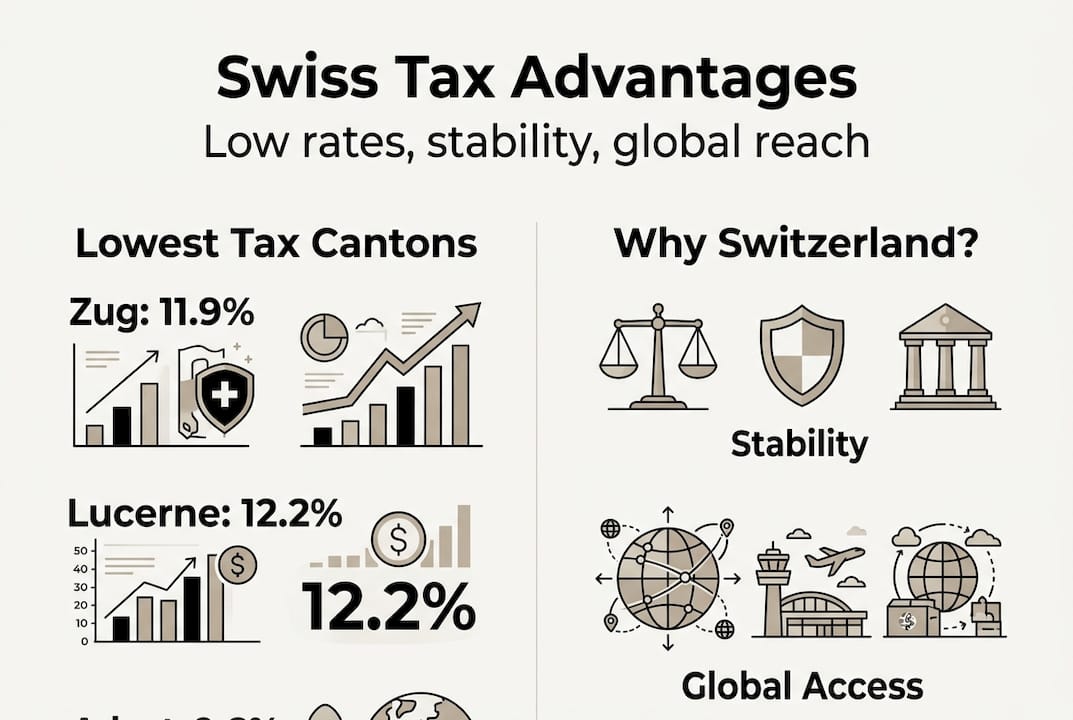
The numbers are where Switzerland’s case becomes undeniable. Effective corporate tax rates vary by canton, and the spread is significant. Here is how the leading cantons compare:
Canton | Effective corporate tax rate |
Zug | 11.9% |
Lucerne | 12.2% to 12.3% |
Nidwalden | 12.7% |
Obwalden | 12.8% |
Appenzell Innerrhoden | 13.0% |
Source: businessabc.net
Now compare those figures to major EU economies. Ireland, often cited as Europe’s low-tax champion, sits at 12.5%. Germany exceeds 30% when you factor in trade tax. The OECD average for statutory corporate tax rates runs between 21% and 23%, but Swiss effective rates land well below that range due to generous deductions and cantonal flexibility.
The critical distinction: headline vs. effective rates. Many countries advertise a statutory rate but layer on surcharges, trade taxes, and limited deductions that push the real burden much higher. Switzerland’s effective rates are already net of most deductions, making the comparison genuinely favorable.
Canton selection is also a strategic decision, not just a tax one. Zug is the natural home for fintech and crypto companies. Nidwalden suits manufacturing and industrial operations. Lucerne offers a balanced environment for SMEs that want urban infrastructure without Zurich-level costs. Understanding your sector before choosing a canton is essential, and resources like the Swiss company tax structure guide and the Swiss business tax optimization framework can help you map the right fit.

For a broader view of what Switzerland offers entrepreneurs specifically, the Swiss tax benefits list is worth reviewing before you commit to a canton.
How global reforms are reshaping (not erasing) Swiss advantages
The OECD’s Pillar 2 initiative and Switzerland’s own STAF reforms have generated real concern among international investors. The fear is straightforward: if global minimum tax rules push Swiss rates toward 15%, does the Swiss advantage disappear?
The answer is nuanced. Reforms under STAF and Pillar 2 do align Switzerland more closely with OECD standards, and some cantons like Basel and Geneva have seen rate adjustments that reduce their previous edge. That is real. But it misses the larger picture.
Here is what the reforms do not change:
Legal and institutional stability that most emerging markets cannot replicate
Non-EU status that gives Swiss companies flexibility in structuring international operations
Skilled workforce with deep expertise in finance, life sciences, and technology
Double taxation treaties with over 100 countries, reducing withholding tax friction
Crypto and fintech regulation that is clear, forward-looking, and business-friendly
“Switzerland’s competitive edge was never purely about the lowest possible rate. It was always about the combination of rate, stability, and substance.”
For startups and SMEs, simplified tax regimes still apply below certain revenue thresholds. Tech companies in Zug’s Crypto Valley continue to benefit from a regulatory environment that treats digital assets as legitimate business infrastructure. Biotech firms access R&D deductions that meaningfully reduce their effective burden. The tax optimization strategies available in 2026 are more sophisticated than ever, and the Swiss tax structure remains one of the most flexible in the world.
Pro Tip: If your company qualifies as a large multinational under Pillar 2 rules (revenue above EUR 750 million), work with a Swiss tax advisor before incorporation to model your effective rate under the new top-up tax rules. Most SMEs and mid-market companies are unaffected.
Essential steps to establish a Swiss company
Knowing the advantages is one thing. Getting your company legally registered and operational is another. Here is the practical sequence for international entrepreneurs:
Choose your structure. A GmbH (Gesellschaft mit beschränkter Haftung) requires a minimum capital of CHF 20,000. An AG (Aktiengesellschaft) requires CHF 100,000. The AG is better suited for companies planning to raise external investment or list shares.
Select your canton. This decision affects your effective tax rate, your regulatory environment, and your proximity to sector-specific ecosystems. Do not default to Zurich without comparing alternatives.
Appoint a Swiss director or local representative. Swiss law requires at least one director with Swiss residency. Appointing a Swiss director through a professional service is a common and fully legal solution for foreign founders.
Secure a Swiss business address. This is a legal requirement, not optional. A registered address is needed before you can complete cantonal registration.
Open a Swiss bank account. Capital must be deposited before the company is formally registered. This step often takes longer than founders expect, so start early.
Register with cantonal authorities. Submit your articles of association, notarized documents, and proof of capital deposit to the commercial register.
Handle tax and VAT registration. Foreign entities generating over CHF 100,000 in Swiss turnover must register for VAT. Review Swiss VAT compliance requirements early to avoid penalties. The corporate tax registration process runs in parallel and should not be delayed.
One frequently overlooked requirement is the Swiss business Impressum, a legal disclosure page required on Swiss business websites. Missing it can create compliance issues even before your first transaction.
Pro Tip: Choose your canton before you open your bank account. Some banks have preferences or faster processing for companies registered in specific cantons, and switching later is costly.
Special Swiss business regimes and incentives
Beyond the standard corporate tax framework, Switzerland offers targeted incentives that give specific sectors a meaningful additional edge. These are not obscure loopholes. They are structured, legal regimes designed to attract high-value business activity.
Here is where the extra advantages concentrate:
Crypto Valley (Zug): Fintech and blockchain companies benefit from low-tax fintech hub status, clear crypto regulation, and a dense ecosystem of investors, developers, and legal specialists.
Biotech and pharma R&D: Switzerland offers significant R&D deductions that reduce taxable income for companies investing in research. Basel and Zurich are global centers for life sciences, and the deduction regime makes Swiss incorporation genuinely cost-effective for R&D-heavy businesses.
Startups and SMEs: Simplified tax regimes apply below certain revenue thresholds, and there is no trade tax equivalent to Germany’s Gewerbesteuer, which meaningfully lowers the effective burden for early-stage companies.
Holding structures: Companies using Switzerland as a holding jurisdiction benefit from participation exemptions on dividends and capital gains from qualifying subsidiaries. The Swiss IP holding benefits and Swiss holding tax benefits are particularly attractive for groups with international IP or investment portfolios.
Double taxation treaties: Switzerland’s network of over 100 tax treaties reduces withholding taxes on dividends, interest, and royalties, making cross-border cash flows significantly more efficient.
The combination of these incentives means that the effective tax burden for a well-structured Swiss company can be substantially lower than even the already-competitive cantonal headline rates suggest.
Tap into Swiss business benefits with expert support
Switzerland’s advantages are real, but capturing them fully requires more than reading a guide. The canton selection, legal structure, director appointment, banking setup, and tax registration all interact in ways that can either maximize your benefit or create costly compliance gaps.
At rpcs.ch, we specialize in helping international entrepreneurs and investors navigate exactly this process. Our Swiss company formation services cover everything from structure selection and notarization to commercial register filing and banking coordination. Once your company is operational, our Swiss business accounting help ensures your ongoing compliance, VAT filings, and financial reporting meet Swiss standards without requiring you to build an in-house team. If you are ready to move from research to registration, we are ready to make it straightforward.
Frequently asked questions
Which Swiss canton has the lowest corporate tax rates?
Zug offers the lowest effective corporate tax rate at around 11.9%, closely followed by Lucerne at 12.2% to 12.3% and Nidwalden at 12.7%.
Can foreign entrepreneurs open a Swiss company remotely?
Yes. Foreign founders can establish a Swiss GmbH or AG remotely, provided they appoint a locally resident Swiss director and secure a registered Swiss business address.
How does Switzerland compare to the EU on corporate tax for investors?
Switzerland’s effective rates are lower than most EU countries, including Ireland at 12.5% and Germany at over 30%, largely because Swiss deductions and cantonal flexibility reduce the real tax burden well below statutory levels.
What sectors benefit most from Swiss business incentives?
Fintech, biotech, pharma, trading companies, and international holding structures benefit most. Crypto Valley in Zug and Switzerland’s R&D deduction regime are particularly powerful for technology and life sciences businesses.
Do recent global tax reforms reduce Switzerland’s advantages?
Not significantly for most businesses. Reforms under Pillar 2 affect large multinationals most, while Switzerland’s stability, treaty network, and skilled workforce continue to make it a top choice for international entrepreneurs and mid-market investors.
Recommended
Comments