
Swiss banking confidentiality: Legal insights for global entrepreneurs
- Apr 9
- 8 min read

TL;DR:
Swiss banking confidentiality is a legal obligation with specific exceptions such as AML suspicions and court orders.
International frameworks like CRS and FATCA have expanded disclosure obligations, impacting privacy for non-resident clients.
Effective privacy today relies on compliance, transparency, and proper structuring rather than secrecy alone.
Switzerland’s reputation for banking secrecy is one of the most misunderstood concepts in international finance. Many entrepreneurs arrive expecting an impenetrable wall of privacy, only to discover that the rules have shifted dramatically over the past decade. Global compliance frameworks, automatic data exchange agreements, and anti-money laundering obligations have reshaped what Swiss banking confidentiality actually delivers in 2026. This article cuts through the myth and gives you a clear picture of the legal foundations, the real exceptions, and the practical implications for your Swiss company or investment structure.
Table of Contents
How Swiss banking confidentiality works: Law and fundamentals
Major exceptions: When Swiss banks must disclose client information
International data exchange: CRS, FATCA, and global transparency
What confidentiality means for your Swiss company: Practical implications
The uncomfortable truth about Swiss banking confidentiality today
Key Takeaways
Point | Details |
Legal protection limits | Swiss bank confidentiality remains strong but is tightly regulated with defined exceptions for legal compliance. |
Disclosure triggers | Client data may be disclosed during court-ordered investigations, anti-money laundering checks, or under global tax treaties. |
Global data sharing | International standards like CRS and FATCA enable automatic sharing of account information with over 120 jurisdictions. |
Effective privacy tips | Corporate clients should maintain transparent records and proactive compliance to maximize privacy protections. |
How Swiss banking confidentiality works: Law and fundamentals
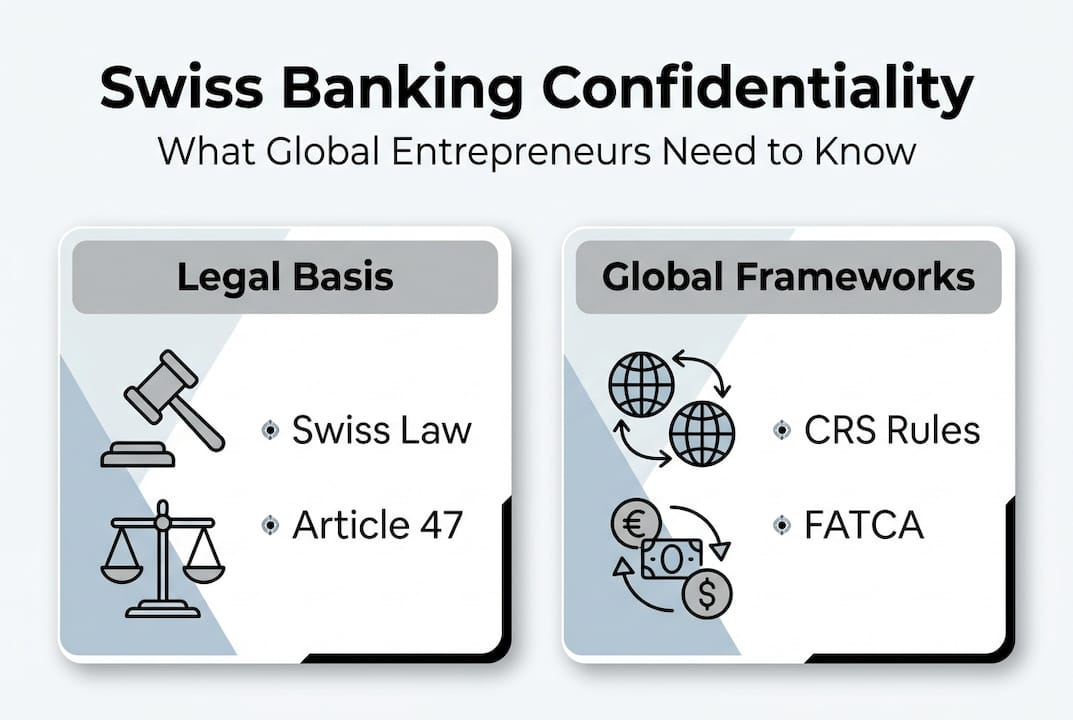
Swiss banking confidentiality, often called “bank client secrecy,” is not a tradition or a gentleman’s agreement. It is a legal obligation enforced by statute. Swiss banking confidentiality is governed by Article 47 of the Banking Act of 1934, which imposes strict penalties on any bank employee or officer who discloses client information without legal authorization. Violations can result in criminal prosecution, fines of up to CHF 250,000, and imprisonment of up to three years.
This protection covers a broad range of parties. Swiss residents, non-residents, corporations, holding companies, and individual investors all benefit from the same baseline legal shield. The law applies to banks, their employees, auditors, and any third party who obtains client data through their role. That is a meaningful protection, but it is not unlimited.
Protection element | Details |
Legal basis | Article 47, Swiss Banking Act (1934) |
Penalty for breach | Up to CHF 250,000 fine and/or 3 years imprisonment |
Who is covered | Individuals, corporations, Swiss and non-Swiss residents |
Who is bound | Bank staff, auditors, external advisors |
Key exceptions | Court orders, AML suspicions, criminal proceedings, CRS/FATCA |
For international entrepreneurs, the practical value is clear. Your financial data, account balances, transaction history, and business relationships are not accessible to competitors, foreign governments acting outside legal channels, or unauthorized third parties. Swiss banks are also prohibited from confirming or denying whether a specific person or company even holds an account.
Key use cases for corporate clients include:
Protecting sensitive M&A transaction details from premature disclosure
Shielding investor identity in early-stage funding rounds
Maintaining operational privacy for holding structures across multiple jurisdictions
Preventing unauthorized access to cash flow and treasury data
Pro Tip: Confidentiality is not blanket secrecy. Knowing exactly where the legal boundaries sit will protect you far better than assuming everything is hidden. Review the Swiss banking history to understand how the framework has evolved and what it was originally designed to protect.
Major exceptions: When Swiss banks must disclose client information
Understanding what’s protected is only half the story. It’s crucial to know exactly when and how those protections might be suspended.
Swiss banking secrecy has never been absolute, and the exceptions have grown more defined and more frequently triggered over time. Disclosure is mandatory for money laundering suspicions reported to MROS (the Money Reporting Office Switzerland), court orders, debt enforcement proceedings, and active criminal investigations. Strict KYC and AML due diligence applies to all corporate and international clients.
“Disclosure is not triggered by suspicion alone, but by legal mandate.” The scope of allowed breaches is narrow, but the triggers are well-defined and increasingly standardized across Swiss regulatory bodies.
Here are the top legal exceptions that can override bank client secrecy:
AML suspicion reports to MROS: If a bank suspects money laundering or terrorist financing, it is legally required to file a suspicious activity report. The client is not notified.
Court orders in criminal proceedings: Swiss courts can compel disclosure when a formal criminal investigation is underway.
Debt enforcement and bankruptcy: Creditors and insolvency administrators can access relevant account data through official legal channels.
Tax fraud (not mere evasion): Swiss law distinguishes between tax evasion (historically not a criminal offense) and tax fraud (a criminal offense). Fraud triggers disclosure; evasion historically did not, though this distinction has narrowed under international pressure.
Regulatory investigations by FINMA: Switzerland’s financial regulator can access client data during supervisory reviews of bank conduct.
For companies and investors, the most relevant trigger is KYC and beneficial ownership verification. Swiss banks require detailed documentation on bank KYC processes before opening any corporate account. This includes identifying ultimate beneficial owners (UBOs), confirming the source of funds, and verifying the legitimacy of the business purpose. Meeting Swiss bank account requirements upfront is the most effective way to avoid friction later.
Pro Tip: Be proactive. Prepare a clear, documented narrative of your company’s business model, revenue sources, and ownership structure before approaching any Swiss bank. Banks are more likely to maintain confidentiality for clients who demonstrate transparency from day one.
International data exchange: CRS, FATCA, and global transparency
Beyond Swiss borders, international rules add new layers. Here’s what global entrepreneurs must consider.
The two frameworks that have most fundamentally changed Swiss banking confidentiality are the Common Reporting Standard (CRS) and the Foreign Account Tax Compliance Act (FATCA). CRS applies to non-Swiss tax residents, with automatic information exchange starting in 2017 and now covering over 120 jurisdictions by 2026. FATCA brings additional requirements specifically for US persons.
Feature | CRS | FATCA |
Origin | OECD multilateral standard | US federal law |
Scope | 120+ countries | US persons and entities globally |
Trigger | Tax residency outside Switzerland | US citizenship or green card status |
Data shared | Account balances, income, asset values | Same, plus US-sourced payments |
Enforcement | Reciprocal government agreements | US Treasury penalties on non-compliant banks |
Under CRS, Swiss banks automatically report financial account data to the tax authority of the account holder’s country of residence. This is not a request-based process. It happens annually, without the account holder’s knowledge or consent. For CRS and Swiss business privacy, the key question is whether your company’s controlling persons are tax residents in a participating jurisdiction.
For multinational holding companies, the picture is more complex. If your holding structure spans multiple jurisdictions, each layer of ownership may trigger separate reporting obligations. Non-resident business owners need to understand that the effect of CRS/FATCA on their Swiss accounts depends heavily on where they are personally tax-resident, not just where the company is registered.
Steps to stay compliant without unnecessary exposure:
Confirm your tax residency status before opening a Swiss corporate account
Identify all UBOs and their respective tax residencies
Ensure your company’s legal structure does not inadvertently create US nexus
Work with advisors who understand both Swiss law and your home jurisdiction’s rules
Review CRS and bank secrecy obligations annually as the framework continues to expand
What confidentiality means for your Swiss company: Practical implications
Knowing the international rules, it’s time to see how confidentiality truly plays out for entrepreneurs and corporate decision-makers.
Swiss banking confidentiality still offers real, enforceable protection for legitimate business activity. But its practical value today is more nuanced than the legend suggests. Switzerland remains the world’s largest offshore financial center, with Swiss banks holding approximately US$6.5 trillion in cross-border assets as of 2018, a figure that reflects enduring global trust in the system.

Statistic to know: CRS now covers exchanges with 120+ countries, and expanded requirements for crypto assets take effect by 2026. If your company holds digital assets in a Swiss account, those are no longer outside the reporting perimeter.
For entrepreneurs looking to open a business bank account in Switzerland, the onboarding process is more rigorous than it was a decade ago. Banks conduct enhanced due diligence on corporate clients, especially those with complex ownership structures or cross-border operations. Expect requests for business plans, audited financials, proof of business activity, and detailed UBO declarations.
Common pitfalls that undermine corporate privacy:
Using shell structures without genuine business substance: Swiss banks and regulators look for real economic activity. Empty holding companies raise flags.
Incomplete or inconsistent documentation: Discrepancies between company documents and bank applications trigger additional scrutiny.
Misunderstanding reporting duties: Assuming that because your company is Swiss-registered, its accounts are invisible to foreign tax authorities is a costly mistake.
Ignoring crypto reporting rules: Digital asset holdings in Swiss accounts are increasingly subject to the same disclosure standards as traditional assets.
Understanding the full range of Swiss bank account benefits means accepting both the protections and the obligations that come with them. The entrepreneurs who benefit most are those who treat compliance as a feature, not a burden.
The uncomfortable truth about Swiss banking confidentiality today
Most articles on this topic stop at the legal framework. Here is what they rarely say plainly: the era of banking secrecy as a tool for opacity is over. What remains is something more valuable for legitimate businesses, a robust legal framework that protects genuine commercial privacy while meeting international standards.
The entrepreneurs who still chase secrecy for its own sake are operating with a 1990s mindset. Today, what actually protects your business is not a law that hides your data, but a system that handles your data with integrity. Technical controls, rigorous internal compliance, and clear beneficial ownership documentation matter far more than any statutory provision.
We have seen clients arrive expecting a black box and leave with something better: a credible, defensible privacy structure that holds up under scrutiny. That is a far stronger position than secrecy that collapses the moment a regulator asks a question. Build your privacy deliberately, not defensively. Anticipate international scrutiny and design your structure to withstand it. Review your Swiss firm banking options with that lens, and you will find Switzerland still offers a genuinely competitive advantage.
Next steps: Set up your Swiss company with trusted guidance
If you’re ready to apply these principles, here’s how to get started with reliable experts.
Navigating Swiss banking confidentiality rules, CRS obligations, and KYC requirements is not something you want to figure out alone, especially when your company’s financial privacy and regulatory standing are at stake.

At RPCS Solutions, we work with international entrepreneurs and investors every day to structure Swiss companies correctly from the start. From GmbH and AG formation to opening a Swiss bank account and managing ongoing compliance, our team handles the details so you can focus on your business. Reach out to our advisors and get clarity on your specific situation before you commit to any structure.
Frequently asked questions
Does Swiss banking secrecy still exist for corporate accounts in 2026?
Yes, banking secrecy remains legally protected, but it is subject to CRS, FATCA, and KYC/AML rules for business accounts. Corporate clients should expect rigorous due diligence rather than automatic privacy.
Who can access Swiss bank account information?
Access is restricted but may be granted to Swiss authorities, foreign tax officials under CRS or FATCA, or law enforcement agencies acting under a valid court order. Unauthorized access remains a criminal offense.
How do Swiss banks check business owners and UBOs?
Swiss banks require strict KYC and beneficial ownership due diligence for all corporate account openings, including background checks, source of funds verification, and confirmation of the company’s actual business activity.
Are there any differences for US-owned companies?
US-owned companies face additional FATCA scrutiny beyond standard CRS obligations, and some Swiss banks actively decline US-related business due to the compliance costs and liability exposure involved.
Recommended