
Role of Founders in Swiss AG: Legal Impact
- Jan 3
- 7 min read
Updated: Jan 8

More than CHF 100,000 in share capital is required to launch a Swiss AG, creating a benchmark that attracts both American and European investors looking for credibility and protection. For foreign founders, understanding the difference between initial legal obligations and ongoing director responsibilities can prevent costly missteps. This guide offers direct insights into the Swiss AG structure, unveiling practical details about compliance, liability, and the roles that safeguard your investment.
Table of Contents
Key Takeaways
Point | Details |
Swiss AG Structure | A Swiss AG provides a strong legal framework, ensuring limited liability and requiring a minimum share capital of CHF 100,000, enhancing financial credibility. |
Founders vs. Shareholders | Founders handle corporate establishment while shareholders focus on investment and governance; understanding this distinction is crucial for smooth operations. |
Incorporation Process | The incorporation of a Swiss AG requires precise adherence to legal mandates, including appointing a Swiss resident director for regulatory compliance. |
Director Responsibilities | Directors hold personal liability for breaches while ensuring compliance with Swiss regulations; documentation and diligence are essential to protect their interests. |
Swiss AG: Definition and Key Concepts
A Swiss AG (Aktiengesellschaft) represents a sophisticated corporate structure designed specifically for medium to large businesses and international investors seeking strategic opportunities in Switzerland. This stock corporation format provides entrepreneurs with a robust legal framework that balances operational flexibility with strong investor protections.
The Swiss AG structure offers several distinctive characteristics that make it attractive for corporate entities. Shareholders enjoy limited liability, meaning their financial risk is constrained to their capital contribution. The company requires a minimum share capital of CHF 100,000, with at least CHF 50,000 mandatorily paid in upon incorporation. This capitalization requirement ensures a baseline of financial stability and credibility for potential investors and business partners.
Governance in a Swiss AG is typically managed through a board of directors, with a critical requirement of having at least one Swiss resident serving in a management capacity. This regulatory mandate ensures local representation and compliance with Swiss corporate regulations. Share transfers are notably flexible, allowing shareholders significant autonomy in managing their investment. The structure also provides a unique blend of anonymity and transparency, making it an appealing option for international investors seeking a stable and predictable business environment.
Pro tip: When establishing a Swiss AG, carefully select your Swiss resident director, as their role is crucial for maintaining regulatory compliance and smooth operational management.
Founder Versus Shareholder: Critical Differences
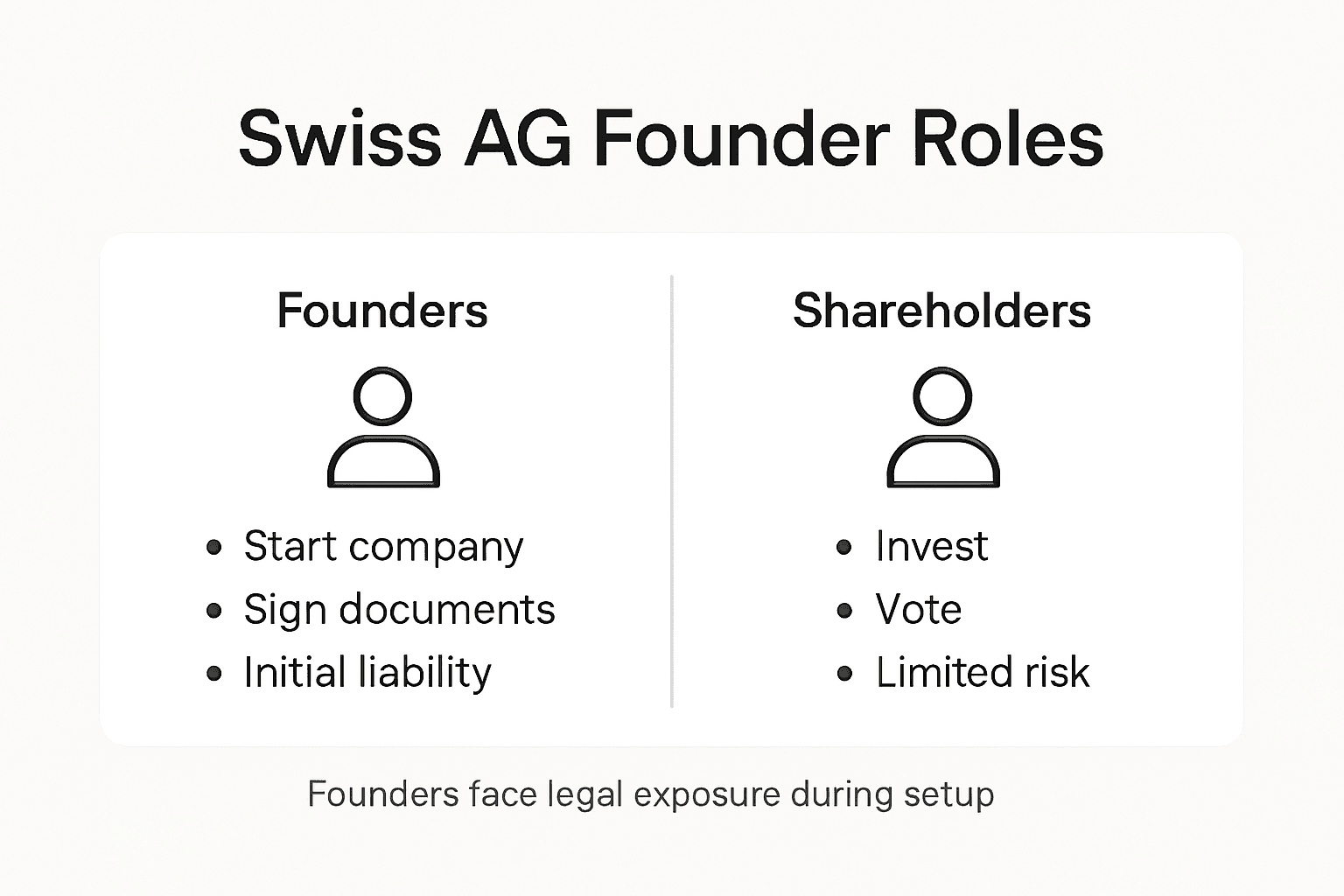
Founders and shareholders play distinctly different roles in the Swiss AG corporate structure, each contributing uniquely to the company’s lifecycle and governance. The legal distinction between these roles is critical for understanding corporate formation in Switzerland, with founders taking an active role during the initial establishment and shareholders maintaining an investment and governance perspective.
Founders are the primary architects of the Swiss AG, responsible for the critical initial steps of corporate creation. Their responsibilities include drafting the articles of incorporation, subscribing to initial shares, and executing official registration processes. Founders can be either individual persons or legal entities, and they bear significant legal responsibilities during the company’s formation phase. Their involvement is most intense during the startup period, where they transform a business concept into a legally recognized corporate entity.

In contrast, shareholders enter the picture after the company’s initial formation, primarily focusing on financial investment and governance participation. While founders complete the technical and legal groundwork, shareholders contribute capital and gain voting rights proportional to their share ownership. They participate in key decision-making processes through general meetings, elect board members, and have a financial stake in the company’s performance. However, their involvement is generally more passive compared to the founders’ hands-on role during the establishment period.
Here’s a summary of key differences between founders and shareholders in a Swiss AG:
Role | Main Responsibilities | Timing of Involvement | Legal Exposure |
Founders | Draft formation documents, register AG | Early formation phase | Possible liability during setup |
Shareholders | Provide capital, vote in meetings | After establishment | Liability limited to investment |
Pro tip: Carefully document the transition of responsibilities from founders to shareholders during the Swiss AG formation process to ensure clear legal and financial boundaries.
AG Incorporation Steps and Legal Requirements
Incorporating a Swiss AG involves a precise and structured process that requires careful attention to legal and financial requirements. The incorporation journey begins with fulfilling specific legal mandates that ensure the company’s legitimate establishment and operational compliance in Switzerland.
The foundational step involves gathering at least one founder who will sign the company’s articles of incorporation. The financial threshold is significant, requiring a minimum share capital of CHF 100,000, with at least CHF 50,000 mandatorily paid in during the initial formation. This substantial capital requirement demonstrates the Swiss regulatory system’s commitment to ensuring financial stability and credibility for new corporate entities.
After the initial financial and documentation requirements, the next critical phase involves formal registration processes. The founders must notarize the company formation documents and subsequently register the AG in the commercial register, which officially grants the company its legal existence. An essential requirement is appointing a board of directors that includes at least one Swiss resident director, ensuring local representation and compliance with Swiss corporate governance standards. Following the primary registration, additional regulatory steps become necessary, including VAT registration and social insurance registrations to fully comply with Swiss business regulations.
Pro tip: Engage a local Swiss legal expert during the AG incorporation process to navigate complex regulatory requirements and ensure seamless company registration.
Director Residency, Liability, and Representation
Director residency represents a critical compliance requirement for Swiss AG companies, with unique legal implications that foreign investors must carefully understand. The Swiss corporate governance framework mandates specific rules regarding director representation and domicile to ensure local accountability and regulatory adherence.
The primary requirement stipulates that at least one board member must be legally domiciled within Switzerland, serving as a crucial mechanism for maintaining direct regulatory oversight. This resident director acts as a legal anchor, ensuring the company’s operations align with Swiss corporate regulations. Directors collectively bear responsibility for management decisions, with the ability to delegate specific representation powers while maintaining overall accountability. The legal structure allows for strategic flexibility, enabling companies to distribute management responsibilities while preserving a centralized point of legal representation.
Liability considerations form another critical dimension of Swiss AG directorship. While shareholders enjoy limited liability restricted to their capital contributions, directors face potential personal liability for breaching fiduciary duties or violating statutory obligations. This nuanced approach balances investor protection with professional accountability. Directors must exercise diligence, maintain transparent financial practices, and adhere strictly to Swiss corporate governance standards. The personal liability provision serves as a powerful incentive for directors to act in the company’s best interests, promoting responsible and ethical corporate management.
Here is an overview of Swiss AG director requirements and risks:
Requirement | Description | Business Impact |
Swiss Resident Director | At least one director must reside in CH | Ensures local compliance |
Delegation of Authority | Board can delegate tasks, not liability | Flexible management, accountability remains |
Director Liability | Liable for breaches or misconduct | Strong incentive for diligence |
Pro tip: Carefully document all board decisions and maintain meticulous records to protect directors from potential personal liability claims in Swiss corporate governance.
Compliance Duties and Common Founder Risks
Navigating the complex landscape of Swiss AG formation requires founders to understand their critical compliance obligations and potential legal vulnerabilities. Swiss corporate regulations impose stringent requirements for founders during the company incorporation process, with significant consequences for overlooking mandatory procedural and financial standards.
Founders must meticulously manage several key compliance domains, starting with financial capitalization. This includes ensuring the minimum share capital of CHF 100,000 is properly subscribed and at least CHF 50,000 is paid in during initial formation. Beyond financial requirements, founders bear responsibility for executing articles of incorporation with absolute precision, ensuring all regulatory filings are completed accurately and transparently. Potential risks include personal liability for incorrect or fraudulent material statements during the incorporation process, which could expose founders to legal and financial penalties.
The ongoing compliance landscape extends well beyond initial formation, encompassing continuous obligations in corporate governance. Founders must establish robust systems for periodic reporting, maintain comprehensive bookkeeping records, and prepare for mandatory financial audits. Failure to meet these requirements can result in severe consequences, including potential legal sanctions, financial penalties, and damage to the company’s reputation. The Swiss regulatory environment demands a proactive approach, with founders expected to demonstrate diligence, transparency, and a commitment to maintaining the highest standards of corporate accountability.
Pro tip: Engage a Swiss legal professional specializing in corporate formation to conduct a comprehensive compliance review before and during your AG incorporation process.
Secure Your Swiss AG Foundation with Expert Support
The role of founders in establishing a Swiss AG carries significant legal impact and responsibility. Ensuring full compliance with strict regulatory requirements such as capital subscription, articles of incorporation, and correct registration can be overwhelming especially for international entrepreneurs new to Swiss corporate law. With founder liability and complex governance rules at stake, getting it right from the start is crucial to protect your investment and avoid costly legal risks.

Take control of your Swiss AG formation with trusted professionals who specialize in navigating these challenges. At RPCS, we provide comprehensive guidance through every incorporation step including drafting mandatory documentation, appointing Swiss resident directors, notarization, and registration. Our tailored services bring clarity and peace of mind to founders by ensuring full legal compliance and minimizing risk. Don’t leave your company’s future to chance. Visit RPCS now to streamline your Swiss AG setup and confidently build your business on a solid legal foundation.
Frequently Asked Questions
What responsibilities do founders have in a Swiss AG?
Founders are responsible for drafting the articles of incorporation, subscribing to initial shares, and executing the official registration process of the Swiss AG.
How does the role of founders differ from that of shareholders in a Swiss AG?
Founders are involved primarily during the initial formation phase, whereas shareholders generally focus on capital investment and governance after the company has been established.
What are the legal implications for founders during the incorporation process of a Swiss AG?
Founders face potential personal liability for incorrect or fraudulent statements during the incorporation process, making meticulous compliance with legal requirements essential.
Why is it important for founders to engage a local Swiss legal expert during the incorporation process?
Engaging a local legal expert helps navigate complex regulatory requirements, ensures compliance, and facilitates a smoother company registration process.
Recommended