
2025 Swiss Company Law: 3 Critical Changes for 87% Investors
- Feb 28
- 10 min read

Many foreign investors mistakenly believe all Swiss shell companies are illegal, yet the 2025 reforms distinguish clearly between prohibited over-indebted shells and legitimate shelf entities. Understanding these changes is critical for international entrepreneurs planning Swiss company formation this year. The new legislation fundamentally reshapes compliance requirements, governance options, and capital management strategies for AG and GmbH structures.
Table of Contents
Key Takeaways
Point | Details |
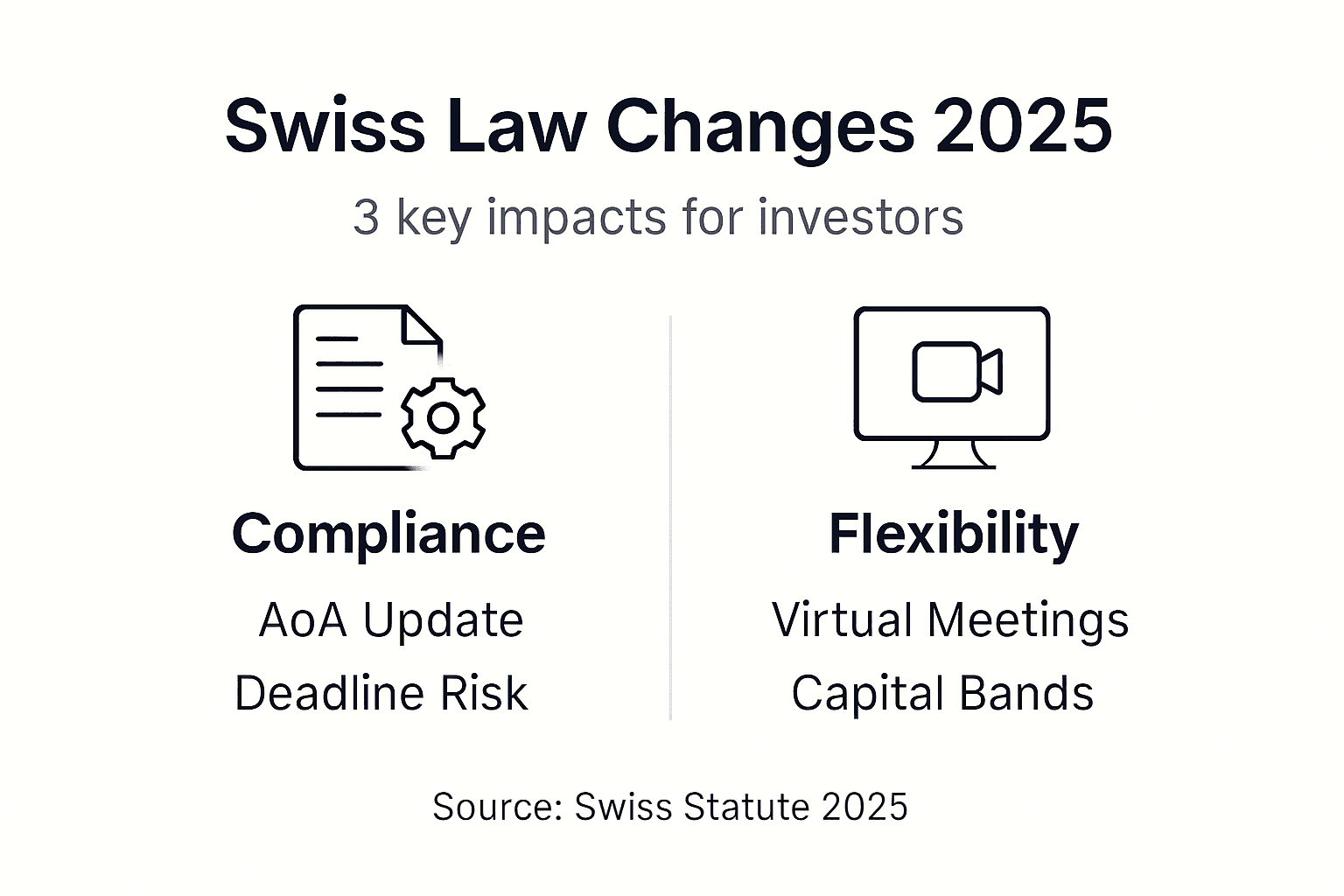
Compliance Deadline | Articles of association must reflect 2025 reforms by January 1st or conflicting clauses become invalid automatically. |
Shell Company Ban | Trading over-indebted shell companies is now prohibited to prevent bankruptcy abuse and enhance creditor protection. |
Governance Flexibility | Virtual, hybrid, and written meetings are legally permitted if articles of association explicitly authorize these formats. |
Capital Management | Capital band mechanism allows share capital adjustments within predefined limits over five years without repeated shareholder votes. |
Foreign Currency Option | Share capital can now be denominated in foreign currencies, simplifying structures for international investors. |
Introduction to 2025 Swiss Company Law Changes
Effective January 1, 2025, Switzerland implemented comprehensive company law reforms targeting AG (public limited) and GmbH (private limited) structures. These changes replace decades-old regulations that no longer matched modern business realities. The legislative goals center on three pillars: enhanced transparency, stronger creditor protections, and greater operational flexibility for business owners.
According to the Role of Swiss Corporate Law, the 2025 legislation enhances transparency, flexibility, and creditor protection for AG and GmbH company forms. Both structures benefit from modernized governance provisions that accommodate digital operations and international management teams. The reforms specifically address:
Modern corporate governance aligned with digital business practices
Flexible capital management tools reducing administrative burden
Enhanced shareholder rights including virtual participation options
Stricter regulations preventing financial abuse through shell company trading
Updated audit and dividend distribution rules supporting interim financial decisions
The benefits of GmbH structure and AG company structure essentials remain attractive for foreign entrepreneurs, with these reforms adding practical advantages for remote management. Switzerland’s corporate governance framework now ranks among Europe’s most progressive while maintaining the stability and credibility that attract international capital.
These updates directly impact formation strategy, ongoing compliance costs, and governance flexibility for foreign investors establishing Swiss entities.
Compliance Deadlines and Articles of Association Updates
Swiss companies faced a two-year transition period ending January 1, 2025 to update their articles of association (AoA). According to Mercator, companies must update their articles of association by January 1, 2025; conflicting provisions automatically become invalid. This deadline applies universally to all AG and GmbH entities, regardless of formation date or size.
Mandatory AoA updates must reflect several new legal features:
Virtual Meeting Provisions: Explicit authorization for virtual, hybrid, or written general meetings if the company intends to use these formats.
Capital Band Clauses: Optional but recommended provisions enabling flexible share capital adjustments within board-defined ranges.
Electronic Resolution Procedures: Clarification of board decision processes including electronic voting and casting vote rights.
Dividend Distribution Rules: Updated language reflecting new interim dividend possibilities based on audited interim financials.
Governance Role Definitions: Alignment with modified director and shareholder rights under the 2025 framework.
Companies that miss this deadline face immediate operational risks. Any AoA provision conflicting with 2025 legal standards becomes void automatically, creating potential governance gaps. For example, an outdated clause prohibiting virtual meetings cannot override the new statutory right if shareholders vote to adopt such formats.
The Swiss company statute requirements outline essential documentation standards that now incorporate these 2025 updates. Review the full 2025 company law compliance deadlines to ensure your entity meets all documentation standards.
Pro Tip: Schedule an AoA review with legal counsel even if your company formed recently. Standard formation templates from 2023 or earlier likely lack 2025-compliant language for virtual governance and capital flexibility provisions.
Rules Against Shell Companies and Creditor Protection
The 2025 reforms introduce precise legal definitions distinguishing legitimate shelf companies from prohibited shell companies. According to Lexology, since January 1, 2025, Swiss company law prohibits trading in over-indebted shell companies to prevent bankruptcy abuses. This addresses a specific loophole where insolvent entities were sold to unsuspecting buyers who inherited hidden liabilities.
Shell companies under the new law are defined as inactive entities with no meaningful assets, maintained solely for potential resale or reuse. The critical distinction:
Shell Companies (Now Restricted): Over-indebted entities with liabilities exceeding assets, traded to transfer bankruptcy risk to new owners.
Shelf Companies (Still Legal): Pre-formed, dormant entities with clean balance sheets, available for legitimate quick-start business needs.
The prohibition specifically targets trading shell companies in an over-indebted state. Selling or acquiring such entities now triggers legal liability for both parties involved in the transaction. Enhanced creditor monitoring provisions require:
Mandatory disclosure of company financial status during ownership transfers
Director liability for knowingly participating in shell company trades
Creditor rights to challenge suspicious ownership transfers within specific timeframes
Stricter due diligence requirements for company acquisitions
“The shell company ban protects creditors from deliberate bankruptcy shifting tactics, ensuring legitimate business debt cannot be strategically transferred to avoid payment obligations.” – Swiss Federal Council Legal Commentary
For international entrepreneurs, this means rigorous due diligence when acquiring existing Swiss entities. The Swiss holding company formation steps emphasize clean formations over acquisitions precisely because of these enhanced liability risks. Review detailed anti-shell company provisions before considering any existing entity acquisition.

Governance Flexibility: Virtual Meetings and Electronic Resolutions
The 2025 reforms dramatically expand governance options for Swiss companies, particularly benefiting international entrepreneurs managing entities remotely. According to Mercator, Swiss company law permits fully virtual, hybrid, and written general meetings if articles of association allow, effective by January 1, 2025.
Three distinct meeting formats are now legally recognized:
Fully Virtual Meetings: All participants join electronically without any physical gathering location.
Hybrid Meetings: Physical venue available with simultaneous electronic participation options for remote attendees.
Written Resolutions: Decisions circulated and approved via written correspondence without convening any meeting.
Each format requires explicit authorization in the articles of association. Companies cannot default to virtual formats without proper AoA language, even if all shareholders agree informally. The statutory requirements ensure:
Equal participation rights for all shareholders regardless of attendance method
Secure identification and authentication of electronic participants
Real-time communication enabling debate and voting during virtual sessions
Documentation standards proving valid resolution passage
Electronic board resolutions receive similar legal recognition. Directors can now vote on board matters electronically, including casting vote exercises by chairpersons in tied decisions. This eliminates previous legal ambiguity around email votes or video conference decisions.
For businesses following Swiss business governance trends 2025, these provisions enable cost-effective management across time zones. Foreign investors no longer face mandatory Switzerland travel for routine governance matters. Detailed virtual meeting legislation covers technical requirements and best practices.
Pro Tip: Include virtual meeting authorization in your AoA from formation, even if you initially plan physical meetings. Adding these provisions later requires a formal AoA amendment with notarization and registry filing costs.
Capital Management Innovations: Capital Bands and Foreign Currency
The 2025 reforms introduce two significant capital management tools that enhance financial flexibility while reducing administrative costs. The capital band mechanism allows boards of directors to increase or decrease share capital within predefined limits over a maximum five-year period. This eliminates repeated shareholder meetings and expensive notarization processes for routine capital adjustments.
Under the capital band framework, shareholders establish upper and lower share capital boundaries through an AoA provision. The board then exercises discretion to adjust capital within this range based on business needs, such as:
Raising additional equity from existing shareholders without formal capital increase procedures
Reducing capital to reflect operational downsizing or distribute excess reserves
Adjusting capital structure to optimize tax positions or meet regulatory requirements
Issuing new shares to incoming investors within the authorized band limits
Feature | Traditional Capital Change | Capital Band Mechanism |
Shareholder Vote | Required for each change | One-time authorization for five years |
Notarization Cost | Per transaction (CHF 1,000+) | Single initial setup cost |
Registry Filing | Each adjustment filed separately | Periodic updates only |
Processing Time | 4-8 weeks per change | Board resolution suffices (days) |
Flexibility | Limited, slow response to opportunities | High, rapid capital adjustment |
Foreign currency denomination represents the second major innovation. Swiss companies can now denominate share capital in currencies beyond Swiss francs, including EUR, USD, GBP, or other major currencies. This simplifies structures for international investors by:
Eliminating currency conversion requirements for cross-border investments
Reducing foreign exchange risk for shareholders investing in non-CHF currencies
Aligning financial reporting with investor base currency preferences
Simplifying dividend calculations and distributions for foreign shareholders
The reforms also update dividend and audit regulations. Interim dividends can now be distributed based on audited interim financial statements, provided the company meets solvency tests. Alternatively, all shareholders can unanimously opt out of the interim audit requirement, enabling faster dividend distributions for closely held entities.
These company management tips emphasize capital band adoption for growth-stage businesses expecting multiple financing rounds or operational scaling.
Practical Implications for International Entrepreneurs and Investors
The 2025 reforms create specific opportunities and obligations for foreign entrepreneurs establishing or managing Swiss companies. Translating legal changes into actionable strategies requires understanding how each provision impacts formation decisions, ongoing governance, and risk management.
Critical action steps for international investors include:
Immediate AoA Updates: Review and amend articles of association to incorporate virtual meeting provisions, capital band authorizations, and electronic resolution procedures before engaging in any governance activities under the new rules.
Capital Band Adoption for Growth Companies: Businesses planning multiple financing rounds or anticipating capital restructuring should authorize capital bands during formation or via AoA amendment to avoid repeated notarization costs.
Virtual Governance Implementation: Foreign entrepreneurs managing Swiss entities remotely must ensure AoA language permits virtual participation, then establish technical infrastructure (secure video platforms, electronic voting systems) meeting Swiss legal standards.
Enhanced Due Diligence Protocols: Any acquisition of existing Swiss companies requires rigorous financial analysis to avoid prohibited shell company risks, including independent audit of balance sheets and liability verification.
Foreign Currency Election: International investors should evaluate whether share capital denomination in their home currency reduces administrative complexity and currency risk compared to traditional CHF denomination.
The reforms particularly benefit entrepreneurs following strategies for opening Swiss holding companies or choosing Switzerland as a business location. Virtual governance eliminates geographic barriers to Swiss entity management, while capital flexibility supports dynamic international business models.
Technology infrastructure deserves special attention. Virtual meeting compliance requires platforms ensuring secure participant authentication, real-time communication, and proper documentation. Switzerland’s advanced digital infrastructure, covered in virtual hosting basics, supports reliable implementation of these governance tools.
Pro Tip: Combine virtual governance provisions with capital band authorization in your initial AoA. This one-time setup investment (typically CHF 500 to 1,000 in additional legal fees) provides maximum operational flexibility throughout your company’s lifecycle.
Common Misconceptions and Final Recommendations
Several misunderstandings about the 2025 reforms create unnecessary confusion or compliance risks for international entrepreneurs. Clarifying these points ensures accurate planning and execution.
Key misconceptions to avoid:
Shelf vs Shell Confusion: Shelf companies remain legal and useful for quick business launches. The prohibition targets only over-indebted shell companies being traded to shift bankruptcy risk. Legitimate shelf companies with clean financials pose no legal issues.
Interim Dividend Restrictions: Companies can distribute interim dividends based on audited interim financials, or all shareholders can unanimously waive the audit requirement entirely. The reforms actually expand dividend flexibility compared to previous annual-only distribution rules.
Virtual Meeting Automation: Virtual and hybrid meetings are fully legal but not automatic. Explicit AoA authorization remains mandatory. Simply holding a virtual meeting without proper AoA provisions creates invalid resolutions.
Capital Band Universality: While capital bands offer significant advantages, they require specific AoA provisions and shareholder authorization. They do not apply by default to all companies formed after January 2025.
Retroactive Compliance: The January 1, 2025 deadline applies to all existing companies. New companies formed after this date must incorporate 2025-compliant provisions from inception, but this does not exempt them from explicit authorization requirements for optional features.
Final compliance recommendations for international entrepreneurs:
Schedule professional legal review of all company documents, even for recently formed entities, to ensure 2025 compliance across articles of association, shareholder agreements, and board procedures.
Implement robust due diligence processes for any Swiss company acquisition, including independent financial audits and legal verification of company status to avoid shell company prohibition violations.
Proactively authorize virtual governance and capital management tools in your AoA, even if not immediately needed, as these provisions add minimal cost during formation but require expensive amendments if added later.
Maintain ongoing compliance monitoring through annual legal reviews, particularly regarding shell company risk factors if your business model involves holding multiple entities or complex group structures.
Document all board and shareholder decisions according to 2025 standards, including proper authentication for electronic resolutions and meeting minutes reflecting new statutory requirements.
Explore Expert Swiss Company Formation Services
Navigating 2025 Swiss company law reforms requires specialized expertise, particularly for international entrepreneurs unfamiliar with Swiss legal systems. RPCS Solutions provides comprehensive support throughout the formation and compliance process, ensuring your Swiss entity meets all current regulatory standards from day one.
Our Swiss company formation services cover complete setup including AoA drafting with 2025-compliant provisions, notarization coordination, commercial registry filing, and initial governance implementation. We help you leverage new capital flexibility and virtual governance options strategically based on your specific business model.

The company formation checklist Switzerland walks through every compliance requirement, while our specialized setup a GmbH in Switzerland guide addresses structure-specific considerations. Professional guidance ensures you capture the full benefits of 2025 reforms while avoiding costly compliance gaps.
Frequently Asked Questions About 2025 Swiss Company Law Changes
What is the difference between shelf companies and shell companies under 2025 Swiss law?
Shelf companies are pre-formed dormant entities with clean balance sheets, maintained for legitimate quick-start business purposes and remain fully legal. Shell companies are over-indebted entities with liabilities exceeding assets, traded to transfer bankruptcy risk, which the 2025 reforms now prohibit.
When must existing Swiss companies update their articles of association for 2025 compliance?
The mandatory deadline was January 1, 2025. Any AoA provisions conflicting with 2025 legal standards automatically became invalid on that date. Companies should update documents immediately to avoid governance gaps and operational uncertainty.
Are virtual shareholder meetings legally valid for Swiss AG and GmbH companies?
Virtual meetings are fully legal if the articles of association explicitly authorize this format. Without proper AoA provisions, companies cannot legally hold virtual meetings even with unanimous shareholder consent. Hybrid and written resolution formats have the same AoA requirement.
Can Swiss companies distribute interim dividends without a full annual audit?
Yes, through two mechanisms. Companies can distribute interim dividends based on audited interim financial statements, or all shareholders can unanimously waive the interim audit requirement entirely. Both approaches require proper documentation and solvency testing.
What risks do shell company prohibitions create for investors acquiring Swiss entities?
Investors acquiring over-indebted shell companies face direct legal liability under 2025 rules. Enhanced creditor protections allow challenges to suspicious ownership transfers. Rigorous due diligence including independent financial audits is essential before any existing company acquisition.
Recommended
Comments