Regulatory Environment in Switzerland: A Guide
Insights into the regulatory environment in Switzerland, and what investors and entrepreneurs need to understand before committing capital.

Switzerland's complex regulatory environment involves federal and cantonal laws, necessitating careful compliance planning. The EasyGov digital platform centralizes filings and will incorporate mandatory beneficial ownership reporting by October 2026. Sector-specific regulations, such as those from Swissmedic and FINMA, impose additional federal and cantonal compliance obligations for healthcare and financial industries.
Switzerland's regulatory environment is a multi-layered legal framework combining federal statutes and cantonal ordinances that govern every aspect of business formation, taxation, labor, and ongoing compliance. For international entrepreneurs, this structure creates both predictable federal standards and significant subnational variation that demands careful planning. The OECD identifies Switzerland as having relatively high startup costs and licensing hurdles compared to most member countries. Digital tools like EasyGov and reforms like the Corporate Relief Act of 2023 are actively reshaping how businesses interact with Swiss authorities, making 2026 a pivotal year to understand the full compliance picture.
What are the main federal and cantonal regulatory frameworks for businesses in Switzerland?#
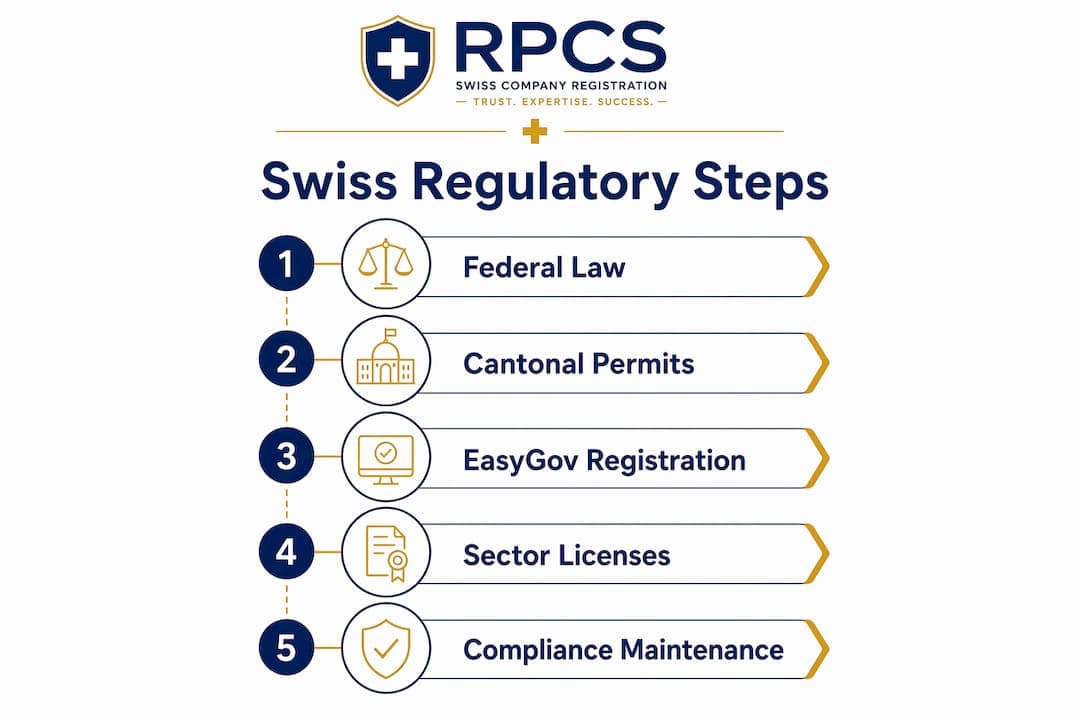
Switzerland's legal framework for businesses operates on two distinct levels: federal law sets the baseline, and cantonal law fills in the operational details. The Swiss Code of Obligations governs company formation, contract law, and corporate governance at the federal level. The Federal Tax Administration oversees corporate income tax at the federal tier, while cantonal tax authorities apply their own rates on top. This dual structure means a GmbH registered in Zug faces different permit requirements and cantonal tax rates than the same entity registered in Geneva or Zurich.
Federal laws cover the core pillars of business operations:
- Company formation: The Swiss Code of Obligations mandates minimum share capital of CHF 20,000 for a GmbH and CHF 100,000 for an AG, with specific notarization and commercial register requirements.
- Labor law: The Code of Obligations and the Swiss Labor Act set employment contract standards, working hours, and termination rules uniformly across all cantons.
- Taxation: The Federal Tax Administration collects federal corporate income tax at a flat rate of 8.5% on profit, while cantonal and municipal taxes vary significantly by location.
- Anti-money laundering (AML): The Federal Act on Combating Money Laundering and Terrorist Financing applies to financial intermediaries and, increasingly, to corporate structures through the new transparency register.
Cantonal authorities control business licensing, zoning permits, and sector-specific operating authorizations. A restaurant in Basel needs a cantonal food safety license. A financial advisor in Zurich must register with the cantonal supervisory body before the Financial Market Supervisory Authority (FINMA) federal layer even applies. This subnational inconsistency is the single biggest source of unpredictability for companies operating across multiple cantons. The OECD notes that cantonal regulatory inconsistencies directly reduce planning predictability for businesses.
Before selecting your canton of incorporation, map out the specific cantonal permits your business model requires. Zug and Nidwalden offer lean regulatory environments for holding structures, while Zurich and Geneva carry heavier cantonal licensing layers for client-facing operations.
Understanding the federal and cantonal licensing split early in your planning process prevents costly surprises after incorporation.
How does the EasyGov platform enhance business regulatory compliance in Switzerland?#
EasyGov.swiss is Switzerland's official digital gateway for corporate regulatory interactions, and it has become the central tool for Swiss regulatory oversight since its launch in 2017. The platform currently serves over 160,000 companies and handles tasks ranging from commercial register filings to social security registrations. That adoption figure reflects genuine utility: EasyGov consolidates processes that previously required separate visits to multiple federal and cantonal offices.
The modernization roadmap, branded EasyGov 2.0, is the most significant upgrade to Swiss digital compliance infrastructure in a decade. The key milestones include:
-
Procurement completion: Three service lots covering platform architecture, data integration, and user experience have been awarded to technology partners.
-
Implementation phases: Development and testing are running through 2026 and early 2027, with federal and cantonal authority integrations added progressively.
-
Planned go-live: Autumn 2027 launch is the target, at which point EasyGov 2.0 will serve as a unified hub for federal, cantonal, and partner authority services.
-
Corporate Relief Act integration: The platform will operationalize the Unternehmungsentlastungsgesetz (Corporate Relief Act) by embedding one-stop digital services that reduce duplicate filings across authorities.
The transparency register is the most urgent EasyGov feature for 2026 compliance. Switzerland's Transparency of Legal Entities Act (TLEA) and the amended AML Act require over 500,000 companies to report beneficial ownership data through EasyGov by autumn 2026. This is not optional reporting. Companies that fail to register beneficial owners face legal exposure under both the TLEA and the AML framework.
Register your company on EasyGov now and begin mapping beneficial ownership data into the registry fields before the October 2026 mandatory rollout. Early pre-registration on EasyGov prevents last-minute data gaps that can delay compliance filings.

What are sector-specific regulatory considerations for businesses operating in Switzerland?#
Switzerland's regulatory oversight varies sharply by sector, and two industries illustrate the full complexity: healthcare and financial services. Both sectors carry federal authorization requirements layered on top of cantonal enforcement, creating compliance obligations that general business regulations do not capture.
| Sector | Federal Authority | Key Obligation | Cantonal Role |
|---|---|---|---|
| Healthcare / Life Sciences | Swissmedic | Market authorization for therapeutic products, clinical trial approval, labeling compliance | Cantonal health departments conduct inspections and enforce local operating permits |
| Financial Services | FINMA | Licensing for banks, asset managers, insurance companies, and payment institutions | Cantonal supervisory bodies handle initial registration for certain advisor categories |
| Food and Beverage | Federal Food Safety and Veterinary Office (FSVO) | Product safety standards and import controls | Cantonal food inspectorates conduct on-site inspections and issue operating licenses |
| Real Estate | Federal Housing Office | Anti-money laundering compliance for transactions above thresholds | Cantonal land registries manage title transfers and zoning approvals |
Swissmedic's role in the healthcare sector deserves particular attention. The agency holds authorization and oversight responsibility for all therapeutic products sold in Switzerland, including pharmaceuticals, medical devices, and blood products. Enforcement powers include market inspections, product recalls, and compelled corrective actions. Cantonal health authorities execute those enforcement actions on the ground, meaning a company must maintain compliance relationships with both Swissmedic at the federal level and the relevant cantonal authority where it operates.
For financial services, FINMA's licensing requirements apply to any entity conducting banking, securities dealing, or collective investment scheme management. Anti-money laundering obligations under the AML Act require financial intermediaries to verify client identity, document beneficial ownership, and report suspicious transactions to the Money Laundering Reporting Office Switzerland (MROS). Operational compliance in regulated sectors demands separate management of authorization, labeling rules, and enforcement readiness by dedicated internal teams.
What compliance challenges and opportunities do international entrepreneurs face in Switzerland?#
Switzerland's business regulations carry a well-documented compliance burden, particularly for foreign entrepreneurs without local infrastructure. The OECD's 2026 competitiveness assessment confirms that Switzerland's startup costs and licensing hurdles rank among the highest in the OECD. That ranking reflects real friction: mandatory capital deposits, notarized founding documents, and multi-authority registrations add weeks to the formation timeline.
The specific challenges international entrepreneurs encounter most often include:
- Capital requirements: A GmbH requires CHF 20,000 in paid-up capital before registration. An AG requires CHF 100,000, with at least CHF 50,000 paid in at formation. These amounts must sit in a blocked bank account until the commercial register confirms incorporation.
- Cross-canton inconsistency: A company operating in three cantons may need three separate sets of cantonal permits, each with different renewal timelines and fee structures.
- Beneficial ownership reporting: The TLEA transparency register deadline of autumn 2026 requires companies to identify and verify ultimate beneficial owners, a process that can surface complex ownership chain questions for international holding structures.
- Language barriers: Commercial register filings, cantonal permit applications, and tax correspondence arrive in German, French, or Italian depending on the canton. Foreign entrepreneurs without local language support face real processing delays.
The reform trajectory is genuinely positive. The Corporate Relief Act of 2023 mandates cost-benefit analysis for all new federal regulations affecting businesses, and it requires authorities to expand one-stop digital services. EasyGov 2.0's 2027 launch will consolidate cantonal and federal filings into a single interface, reducing the current multi-portal friction. Entrepreneurs who build their compliance infrastructure around EasyGov now will be positioned to absorb those improvements without restructuring their processes.
How to prepare for and maintain compliance with Swiss regulatory requirements#
Compliance with Swiss regulatory requirements follows a defined sequence from incorporation through ongoing operations. Following this sequence prevents the most common delays and gaps that foreign entrepreneurs encounter.
-
Select your legal structure and canton. A GmbH suits most SMEs and startups. An AG suits companies planning external investment or stock issuance. Canton selection affects corporate tax rates, cantonal permit requirements, and proximity to sector-specific regulators.
-
Prepare founding documents. The articles of association, shareholder list, and board resolutions must be notarized by a Swiss notary. Foreign-language documents require certified translation before submission.
-
Open a capital deposit account. A Swiss bank must hold the minimum share capital in a blocked account before the commercial register accepts the incorporation filing. This step often takes two to four weeks for foreign applicants.
-
Register with the commercial register. The Handelsregisteramt in your chosen canton processes the incorporation. EasyGov handles the digital submission for most standard filings.
-
Register with tax and social security authorities. Federal and cantonal tax registrations, VAT registration if turnover exceeds CHF 100,000, and AHV/IV social insurance registration are all mandatory within defined timelines after incorporation.
-
File beneficial ownership data. Before October 2026, register on EasyGov and submit ultimate beneficial owner information under the TLEA. Consolidate ownership chain documentation before filing to avoid amendment requests.
The company formation checklist published by RPCS covers each of these steps with document-level detail. Ongoing compliance requires monitoring cantonal permit renewals, annual financial statement filings with the commercial register, and any sector-specific reporting obligations. Companies in regulated sectors should assign a named compliance officer to track Swissmedic or FINMA correspondence separately from general administrative tasks.
Key takeaways#
Switzerland's regulatory environment requires international entrepreneurs to manage federal and cantonal obligations simultaneously, use EasyGov for digital filings, and meet the October 2026 beneficial ownership deadline under the TLEA.
| Point | Details |
|---|---|
| Dual-level compliance | Every Swiss business must satisfy both federal law and canton-specific permits, licenses, and tax registrations. |
| EasyGov is the central tool | Over 160,000 companies use EasyGov for filings; EasyGov 2.0 launches in autumn 2027 with expanded cantonal integration. |
| Transparency register deadline | The TLEA requires over 500,000 companies to report beneficial owners via EasyGov by autumn 2026. |
| Sector-specific oversight | Healthcare companies answer to Swissmedic and cantonal health departments; financial firms answer to FINMA and cantonal supervisory bodies. |
| Reform momentum is real | The Corporate Relief Act of 2023 mandates cost-benefit analysis for new regulations and expands one-stop digital services. |
Why cantonal friction is the risk most foreign investors underestimate#
Most international clients I work with arrive focused on federal law. They research the Swiss Code of Obligations, understand the GmbH capital requirements, and feel prepared. Then they hit the cantonal layer and the timeline doubles.
The honest reality is that cantonal regulatory friction is not a minor administrative detail. It is the variable that most consistently separates a smooth Swiss market entry from a six-month delay. I have seen companies with perfectly prepared federal filings wait three months for a cantonal operating permit in a regulated sector, simply because they did not engage the cantonal authority early enough or did not have a local contact who understood the informal process norms.
The transparency register is the next version of this problem. The TLEA deadline is October 2026, and the companies that will struggle are those treating it as a one-time filing task rather than an organizational data governance exercise. Beneficial ownership structures for international holding companies are rarely clean. Mapping them accurately into EasyGov registry fields requires internal legal work that cannot be compressed into two weeks before a deadline.
My practical advice: treat Swiss compliance as a continuous program, not a formation checklist. Assign someone internally to own the cantonal relationship in each operating canton. Start your beneficial ownership mapping now, not in September 2026. And use the step-by-step compliance guide as a living reference, not a one-time read. The Swiss system rewards preparation and punishes improvisation.
Set up your Swiss company with full regulatory support from RPCS#
RPCS provides end-to-end Swiss company formation services for international entrepreneurs and investors, covering GmbH and AG incorporation, notarization, commercial register filing, and cantonal permit coordination. The platform also supports Swiss bank account opening and ongoing accounting services to keep your company compliant with federal and cantonal reporting requirements year-round. For foreign clients managing complex ownership structures, RPCS offers a resident director service and registered office solutions that satisfy Swiss residency requirements without requiring physical relocation. If you are preparing for the 2026 transparency register deadline or planning a new Swiss incorporation, RPCS delivers the local expertise and administrative infrastructure to get it done correctly the first time.
Frequently asked
01What is the regulatory environment in Switzerland for foreign businesses?
Switzerland's regulatory framework combines federal laws governing company formation, taxation, and AML compliance with cantonal rules covering permits, licenses, and local operating requirements. Foreign businesses must satisfy both levels simultaneously, with the cantonal layer varying significantly by location and sector.
02How does EasyGov support Swiss compliance requirements?
EasyGov.swiss is Switzerland's official digital platform for corporate filings, used by over 160,000 companies since 2017. It handles commercial register submissions, social security registrations, and from autumn 2026, mandatory beneficial ownership reporting under the Transparency of Legal Entities Act.
03What are the capital requirements for Swiss company formation?
A GmbH requires a minimum of CHF 20,000 in paid-up share capital, and an AG requires CHF 100,000, with at least CHF 50,000 paid in at formation. Both amounts must be held in a blocked bank account before the commercial register accepts the incorporation filing.
04What is the transparency register deadline for Swiss companies?
The Transparency of Legal Entities Act requires over 500,000 Swiss companies to register beneficial ownership information via EasyGov by autumn 2026. Companies should consolidate ultimate beneficial owner documentation and pre-register on EasyGov well before the October 2026 deadline.
05How does Swissmedic affect life sciences businesses in Switzerland?
Swissmedic authorizes and oversees all therapeutic products sold in Switzerland, including pharmaceuticals and medical devices. Cantonal health authorities conduct on-site inspections and can compel product recalls, so life sciences companies must maintain compliance programs at both the federal authorization level and the cantonal enforcement level.
Sources
Information verified as of 20 August 2026.
- Thresholds that trigger an ordinary audit
kmu.admin.ch, verified 20 August 2026
- Switzerland and the automatic exchange of information
sif.admin.ch, verified 20 August 2026
The content on this website is provided for general information purposes only and is general in nature. It does not constitute legal, tax or financial advice and is not a substitute for individual advice in a specific case. No warranty is given as to the accuracy, completeness or currency of the information, and any liability is excluded to the extent permitted by law. Use of this website or contacting us does not create any client, mandate or advisory relationship. For your specific situation we recommend obtaining individual advice from a qualified professional.
Related reading

Multilingual Support in Swiss Business: A Guide
Explore the role of multilingual support in Swiss business, and discover what it takes to reach customers across all four language regions.
Read article
Swiss Cross-Border Operations Explained
Understand Swiss cross-border operations. This guide explains the permits, payroll treatment and regulations that apply when staff cross a border.
Read article
Swiss Residency for Entrepreneurs: A Guide
Discover how to obtain Swiss residency as an entrepreneur. Learn the essential steps, the requirements, and what launching here involves.
Read article