
Step-by-Step Process for Swiss AG Incorporation
- Nov 21, 2025
- 8 min read
Updated: Dec 22, 2025

Starting a Swiss AG might seem complex, yet more american entrepreneurs are taking this step each year. Strict requirements and careful planning make the process challenging, but the rewards can be significant. Over 4,000 new companies are incorporated in Switzerland annually, drawing global investors with its stability and prestige. This guide outlines what every american business founder needs to know about each key stage in forming a Swiss AG, showing how to move from business plan to successful market entry.
Table of Contents
Quick Summary
Key Insight | Explanation |
1. Create a detailed business plan | Outline objectives, financials, market analysis, and strategies to ensure thorough compliance. |
2. Secure minimum share capital | Obtain at least CHF 100,000, with CHF 50,000 fully paid before registration. |
3. Prepare accurate legal documents | Draft essential documents like Articles of Association and appoint at least one Swiss resident director. |
4. Notarize and register documents | Submit notarized formation documents to the Swiss Commercial Register for legal recognition. |
5. Verify ongoing compliance | Ensure continuous adherence to regulations and secure necessary permits for business operations. |
Step 1: Define business plan and determine AG requirements
When establishing a Swiss AG (Aktiengesellschaft), crafting a comprehensive business plan is your strategic roadmap and foundational document. According to Nexova, this plan must outline your company’s core objectives, financial projections, market analysis, and operational strategies.
Your business plan should meticulously detail the specific requirements for Swiss AG incorporation. This includes determining your minimum share capital, which must be at least CHF 100,000, with a requirement that at least 20% (CHF 20,000) be fully paid in during company formation. You will need to clearly articulate your company’s purpose, identify potential shareholders, and develop a robust financial model that demonstrates the viability and growth potential of your business venture.
One critical warning when preparing your AG business plan: do not underestimate the importance of precision and thoroughness. Swiss regulatory authorities will scrutinize every detail, so ensure your documentation is comprehensive, accurate, and professionally presented. Incomplete or vague plans can significantly delay your incorporation process and potentially jeopardize your company’s approval.
With a solid business plan in hand, you are now prepared to move forward with the next crucial step in your Swiss AG formation journey.
Step 2: Secure minimum capital and select company name
In this critical stage of Swiss AG formation, you will establish the financial foundation and legal identity for your company. According to Nexova, the process involves meeting specific financial requirements and selecting a unique company name that complies with Swiss regulatory standards.
For the minimum capital requirement, you must secure CHF 100,000 as your total share capital. Importantly, at least 50% of this amount must be fully paid in during the company registration process. This means you will need to demonstrate that CHF 50,000 is immediately available and committed to the company. When selecting your company name, ensure it is distinctive and not already registered. The name must be in German, French, Italian, or English, and should clearly represent your business activity while avoiding any potential confusion with existing registered companies.
One critical tip when choosing your company name: conduct a thorough search in the Swiss commercial registry to verify name availability and uniqueness. Avoid generic or overly similar names that might lead to legal complications or rejection by regulatory authorities. A well-chosen name not only meets legal requirements but also serves as your first strategic branding decision.
With your minimum capital secured and company name selected, you are now ready to move forward with the next phase of your Swiss AG incorporation journey Steps to Open Swiss Holding Company: A 2025 Guide.
Step 3: Prepare legal documents and appoint directors
In this crucial phase of Swiss AG incorporation, you will draft the foundational legal documents and select the leadership team that will guide your company forward. According to Nexova, this stage requires meticulous preparation of key legal documents and ensuring at least one board member is a Swiss resident.
Your primary documentation will include the Articles of Association, which must comprehensively outline your company’s purpose, structure, and governance rules. This document needs to detail the rights and responsibilities of shareholders, board members, and management. When appointing directors, you must ensure at least one board member is a Swiss resident. This requirement helps establish local credibility and ensures compliance with Swiss corporate regulations. Consider selecting professionals with relevant industry experience and a strong understanding of Swiss business practices.
One critical tip when preparing your legal documents: work with a local legal expert who specializes in Swiss corporate law. They can help you navigate the nuanced requirements and avoid potential pitfalls that could delay your incorporation process. Precision and clarity in your documentation are key to a smooth approval process.

With your legal documents prepared and directors appointed, you are now ready to move forward and learn how to appoint a Swiss director for your company with confidence and expertise.
Step 4: Notarize formation documents and register with authorities
In this pivotal stage of Swiss AG incorporation, you will transform your company formation documents from drafts to legally recognized instruments through official notarization and registration. According to Nexova, this process involves carefully submitting notarized documents to the Swiss Commercial Register and completing the official registration timeline.
The notarization process requires presenting all your formation documents to a licensed Swiss notary who will verify their authenticity, accuracy, and legal compliance. This professional will carefully review your Articles of Association, shareholder agreements, and other critical incorporation documents. Once notarized, these documents must be submitted to the local commercial registry where they will undergo a comprehensive review. The registration process typically involves paying the required fees, providing certified copies of notarized documents, and demonstrating compliance with all Swiss corporate regulations.
One critical warning during this stage: timing and precision are paramount. Any discrepancies or incomplete documentation can significantly delay your registration process. Double check every detail before submission, and consider working with a professional who understands the nuanced requirements of Swiss corporate law.
Ensure all documents are translated into an official Swiss language if they were originally prepared in another language.
With your documents notarized and submitted to the authorities, you are now entering the final stages of bringing your Swiss AG to official legal existence.
Step 5: Open corporate Swiss bank account for shares deposit
In this critical stage of your Swiss AG incorporation, you will establish the financial foundation for your company by opening a dedicated corporate bank account to deposit your share capital. Understanding Swiss Business Bank Account Explained highlights the importance of selecting the right banking partner for your corporate structure.
To open a corporate bank account in Switzerland, you will need to gather several key documents including your company’s Articles of Association, proof of company registration, identification documents for all shareholders and directors, and a comprehensive business plan. Swiss banks maintain stringent due diligence requirements, so be prepared for an extensive verification process. You will typically need to schedule an in person meeting with a bank representative who will review your documentation and assess your company’s financial profile. Most Swiss banks require original notarized documents and may request additional information about your business activities, expected transaction volumes, and source of initial capital.
One critical tip when opening your corporate bank account: choose a bank that specializes in working with international businesses and understands the unique needs of newly incorporated companies. Some banks have more flexible requirements for startup entities, while others may have more complex onboarding processes. Consider working with a local banking consultant who can guide you through the nuanced requirements and help you select the most suitable financial institution for your specific business needs.
With your corporate bank account established and share capital deposited, you are now moving closer to fully operationalizing your Swiss AG and launching your business venture.
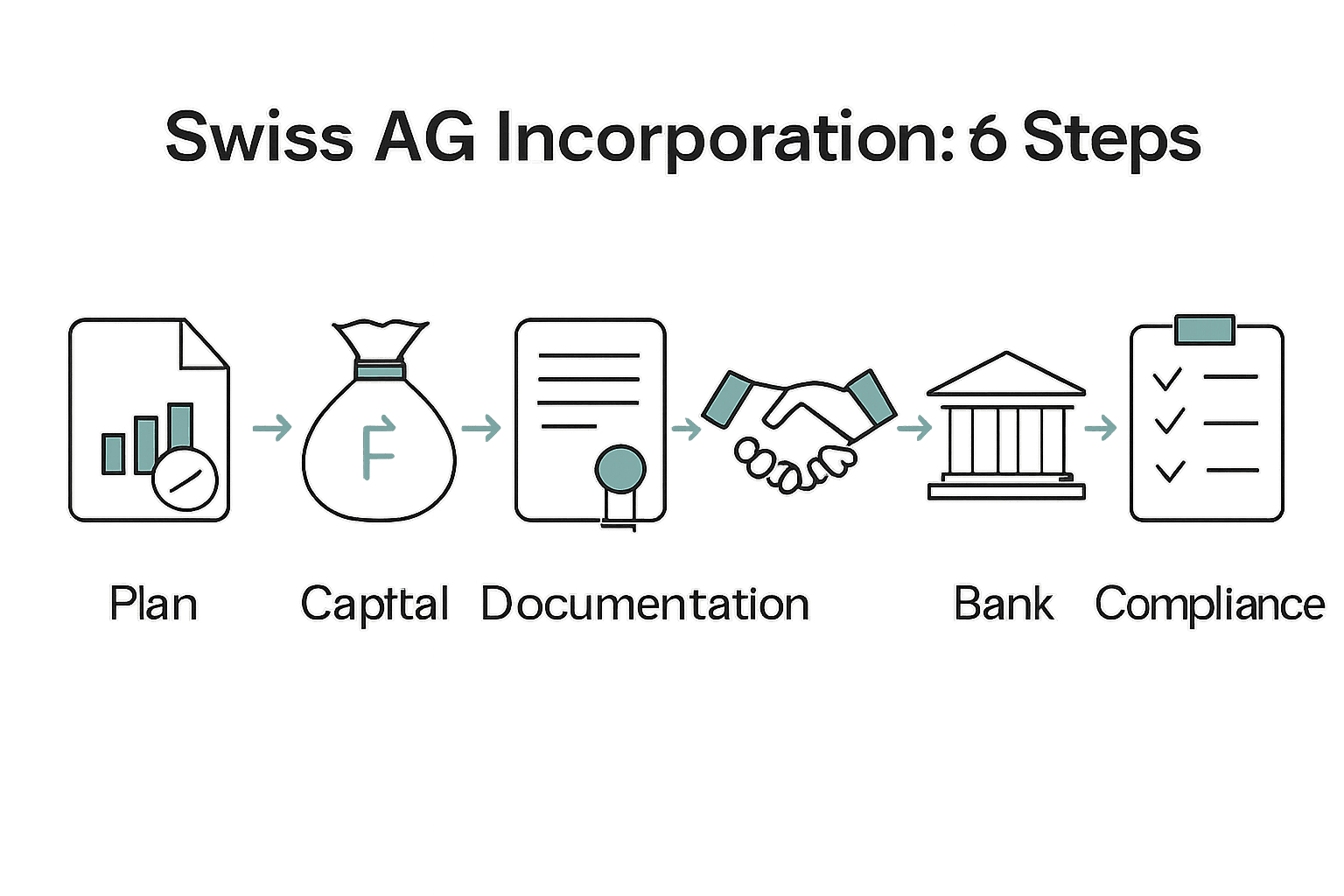
Step 6: Verify compliance and activate business operations
In the final stage of your Swiss AG incorporation, you will transition from legal formation to operational readiness by carefully verifying regulatory compliance and preparing to launch your business activities. According to Nexova, this critical phase involves comprehensive verification of legal requirements and obtaining necessary permits for full business activation.
The compliance verification process requires a systematic review of all regulatory obligations specific to your business sector. You will need to register for social security contributions, obtain relevant industry permits, register for VAT if your annual turnover exceeds CHF 100,000, and ensure all tax identification numbers are correctly assigned. This may involve coordinating with multiple government agencies including the cantonal commercial registry, tax authorities, and sector specific regulatory bodies. Each registration requires precise documentation demonstrating your company’s legal standing, financial stability, and operational intent.
One critical warning during this stage: compliance is not a one time event but an ongoing process. Swiss authorities maintain stringent monitoring of corporate entities, so developing a proactive approach to regulatory adherence is essential. Consider engaging a local legal or compliance consultant who can help you navigate the complex landscape of Swiss business regulations and ensure you remain fully compliant as your business evolves.
With your compliance verified and business operations activated, you have successfully completed the Swiss AG incorporation journey and are now positioned to pursue your entrepreneurial goals in one of the world’s most stable and respected business environments.
Simplify Your Swiss AG Incorporation Journey with Expert Support
Starting a Swiss AG involves complex challenges such as securing minimum capital, drafting precise legal documents, and navigating strict compliance requirements. If you feel overwhelmed by the process of notarization, registration, and banking setup, you are not alone. Many entrepreneurs struggle with meeting these meticulous demands while ensuring legal compliance and operational readiness.
At https://rpcs.ch, we understand these pain points and offer comprehensive solutions tailored for international clients. Our experienced team will help you craft detailed business plans, appoint qualified Swiss directors, handle notarization, and open corporate bank accounts swiftly. We guarantee confidentiality, legal precision, and rapid processing that cuts through bureaucratic delays.

Take control of your Swiss AG formation today. Visit Swiss Company Formation Services to get started and explore how our expert consulting and ongoing business support can transform your vision into a legally compliant, fully operational Swiss company. Do not let regulatory complexities hold you back from tapping into Switzerland’s stable and internationally respected business environment. Empower your business with trusted guidance now through https://rpcs.ch.
Frequently Asked Questions
What is the first step in the Swiss AG incorporation process?
To start the Swiss AG incorporation process, you need to define your business plan and determine the requirements for establishing an AG. Create a detailed plan that outlines your business objectives, financial forecasts, and operational strategies.
How much minimum share capital is required to form a Swiss AG?
The minimum share capital required for a Swiss AG is CHF 100,000, with at least CHF 20,000 needing to be fully paid at the time of incorporation. Ensure you secure these funds prior to the registration process to avoid delays.
What legal documents are necessary to incorporate a Swiss AG?
You will need to prepare several legal documents, including the Articles of Association, which outlines your company’s purpose and governance structure. Draft these documents carefully and ensure they comply with Swiss corporate regulations.
How can I ensure my company name is unique for the Swiss AG formation?
To ensure your company name is unique, conduct a thorough search in the Swiss commercial registry before finalizing your choice. Use distinctive names that reflect your business activities while avoiding similarities to existing registered companies.
What steps should I take after notarizing my formation documents?
After notarizing your formation documents, you should register your company with the Swiss Commercial Register. Submit all notarized documents, pay the necessary registration fees, and confirm compliance with Swiss regulations to officially establish your company.
How do I verify compliance before activating my business operations?
To verify compliance, conduct a thorough review of legal obligations specific to your industry and register for necessary permits, social security contributions, and tax identification numbers. Completing this process helps ensure you meet all regulatory requirements before launching your business.
Recommended
Comments