
HR Management Process in Switzerland: 2026 Guide
- May 31
- 9 min read

TL;DR:
Managing employment in Switzerland requires compliance with layered laws including the Labor Act, Code of Obligations, and sector-specific collective agreements, which must be integrated into HR policies. Employers must strictly adhere to working time limits, overtime compensation, protected periods, and proper termination procedures to prevent costly legal disputes. Effective HR management involves proactive system-based processes, continuous monitoring of compliance updates, and embedding legal requirements into everyday operational workflows.
Getting the HR management process in Switzerland right is not optional. Swiss labor law sits among the most detailed in Europe, with the Swiss Labor Act, the Code of Obligations, and a web of collective agreements creating obligations that catch even experienced HR managers off guard. This guide cuts through the complexity and gives you a practical framework for managing employment contracts, working hours, termination procedures, and HR policies in a way that keeps your company compliant and your people protected.
Key Takeaways
Point | Details |
Legal framework is layered | Swiss HR compliance requires aligning the Labor Act, Code of Obligations, and applicable collective agreements simultaneously. |
Working time limits are strict | Maximum weekly hours are 45 or 50 depending on the role, with overtime compensation legally mandated under CO Art. 321c. |
Contracts must be provided promptly | Written employment terms must be delivered within one month of start date if the employee requests them. |
Protected periods block termination | Notices issued during pregnancy, illness, or military service are legally null and void regardless of cause. |
Documentation prevents disputes | Thorough audit trails on service length, protected periods, and notice timing are your best defense against costly litigation. |
The HR management process in Switzerland: legal foundation
Before you write a single HR policy, you need to understand the three-layer legal structure that governs every employment relationship in Switzerland. Most HR professionals coming from outside Switzerland underestimate how precisely these layers interact, and that underestimation creates real risk.

The first layer is the Swiss Labor Act (ArG). It governs health and safety in the workplace, working hour limits, mandatory rest periods, and protections for vulnerable employee groups. Think of it as the floor. No employment relationship in Switzerland can fall below it.
The second layer is the Swiss Code of Obligations (CO). This is where your contracts live. The CO regulates how employment contracts are formed, what they must contain, how overtime is compensated, and how termination works. CO Art. 330b, for example, specifies exactly when written employment terms must be provided. CO Art. 321c sets the rules on overtime pay.
The third layer is often the most overlooked: Collective Labor Agreements, known in German as Gesamtarbeitsverträge (GAV). These sector-specific agreements set mandatory minimum standards for wages, working hours, holidays, and social protections. They do not supplement the law. They override or augment it, and they apply whether or not you have read them. Any human resources process in Switzerland that treats GAV as background reading rather than active configuration input is already behind.
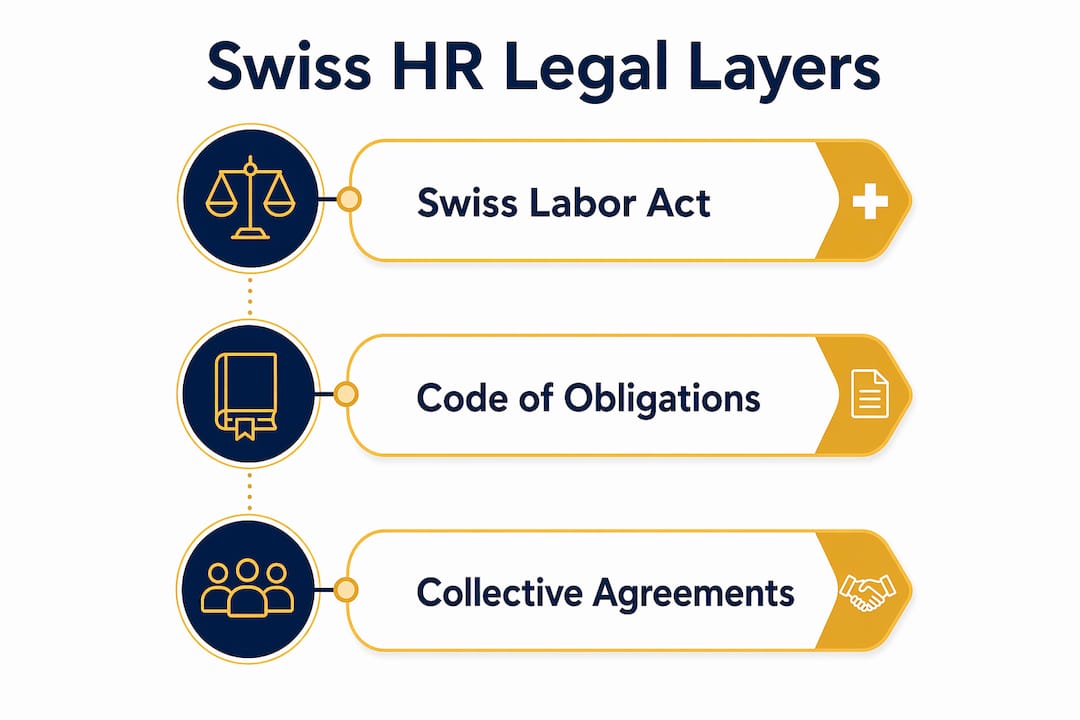
The practical implication is this: your HR policies cannot be generic. They must be calibrated against the specific GAV applicable to your sector, then layered onto the statutory minimums in the ArG and CO.
Pro Tip: Before you draft any employment policy or contract template, identify which collective agreement applies to your sector in Switzerland. This single step prevents the majority of compliance gaps that HR teams encounter during audits or disputes.
Working hours, overtime, and rest periods
Swiss working time law is specific and the penalties for getting it wrong are significant. Non-compliance fines can reach CHF 20,000, with potential criminal liability on top. That concentration of risk makes a structured approach to working time management non-negotiable.
The weekly maximums depend on the role. Industrial workers, office staff, and technical employees are subject to a 45-hour weekly limit. All other commercial employees face a 50-hour cap. Understanding which category your workforce falls into is the starting point.
Here is where Swiss law draws a distinction that surprises many HR managers: the difference between overtime and excess hours.
Category | Definition | Compensation rule |
Overtime | Hours above contract but within the legal maximum | Time off in lieu or 25% wage premium per CO Art. 321c |
Excess hours | Hours beyond the legal weekly maximum | Cannot be waived by contract; strict legal protections apply |
Normal hours | Hours within the contractual limit | Standard pay, no additional compensation required |
This distinction matters because overtime compensation rules under the CO are not optional. You cannot informally agree to flex time instead of paid overtime unless the employee explicitly consents and the arrangement is documented. The idea of a verbal understanding on extra hours creates exactly the kind of dispute that ends up in front of a labor tribunal.
Mandatory rest also carries teeth. Employees are entitled to 11 consecutive hours of rest per day and 35 consecutive hours per week. The health and economic protection rationale behind these rules is deliberate. Swiss law treats fatigue as both a safety and a compensation issue, which is why rest period violations expose employers to the same enforcement risk as overtime failures.
For practical tracking, refer to guidance on working-time limits and rest when building your monitoring workflows, especially if your teams work across time zones.
Pro Tip: Build a formal overtime approval process with written sign-off before hours are worked, not after. Retroactive approvals are difficult to defend and signal to auditors that your tracking is reactive rather than controlled.
Employment contracts and onboarding in Switzerland
Swiss employment contracts do not require a specific form to be valid. Verbal agreements are technically enforceable. That said, written terms must be provided within one month of the start date if the employee requests them, per CO Art. 330b. In practice, every Swiss employer should provide a written contract on day one. Waiting for a request is a compliance posture, not a best practice.
A compliant employment contract in Switzerland must include at minimum:
Full names and addresses of both parties
Employment start date
Role and function description
Agreed salary and payment schedule
Weekly working hours
Applicable notice period
That list is the legal floor. Your actual contracts should go further. Referencing the applicable GAV in the contract, specifying expense reimbursement policies, and addressing probation terms gives you a cleaner onboarding process and reduces ambiguity disputes later.
The most technically sound approach to contract management uses a layered template system. Your base contract template captures the statutory essentials. GAV-specific parameters, such as minimum wages for the sector, additional holiday entitlements, or sector-specific rest rules, are then applied as a second layer. Scalable HR models separate these two layers in HRIS systems precisely because a policy text update and an operational rules update are not the same thing. When a collective agreement is revised, the operational parameters need to change in the system, not just in a PDF sitting in a shared folder.
Onboarding workflows should align contract delivery with a documentation checklist. Before an employee’s first day, HR should confirm signed contract receipt, verify applicable work permits for non-EU nationals (refer to Swiss immigration requirements for specifics), and log the employment start date precisely. That start date controls your statutory notice periods and your protected period calculations.
Termination procedures and protected periods
Termination is where Swiss employee management strategies most frequently go wrong. The substantive grounds for dismissal may be solid, but procedural errors can convert a legitimate termination into a null and void one or trigger an expensive wrongful dismissal claim.
Follow this workflow for every termination:
Calculate continuous service length. Swiss statutory notice periods are tied to years of service: one month in the first year, two months in years two through nine, and three months from year ten onward. Your HRIS must track the precise start date, not an approximated one.
Screen for protected periods. Before issuing any notice, run a protected period check. Pregnancy, the 16-week post-birth period, illness or accident (with duration varying by service length), and active military service all block termination. Notices issued during protected periods are automatically null and void, regardless of what the underlying reason for dismissal was.
Issue written notice with correct timing. Notice must be given in writing. The effective date of the notice determines when the notice period begins, and that date must fall outside any protected period.
Build the documentation file. Log the date of notice issuance, the calculated notice expiry date, confirmation of no active protected period at the time of notice, and the employee’s acknowledgment of receipt. Documented audit trails covering service duration, protected periods, and notice effectiveness are not optional. Their absence shifts any dispute from a substantive question to a procedural one, and procedural challenges are almost always costlier.
Conduct an exit interview and complete offboarding documentation. Swiss law does not mandate exit interviews, but they create a record of the employee’s state of knowledge at departure, which matters if post-employment disputes arise.
Pro Tip: Run your protected period screening at least two weeks before you intend to issue notice. This gives you time to pause, reassess timing, and avoid the administrative chaos of a null termination.
Integrating HR policies into daily operations
Getting HR policies in Switzerland onto paper is the beginning, not the end. The gap between written policy and operational practice is where compliance breaks down.
Treat collective agreements as live configuration inputs, not reference documents. When a GAV is updated, that update needs to flow through to contract templates, HRIS parameters, payroll calculations, and manager briefing materials at the same time. Collective agreements represent a mandatory layer that requires proactive integration, and the companies that get this right assign explicit ownership for GAV monitoring to a named HR role.
Effective operational integration also requires:
Clear approval workflows for overtime requests, with written authorization before hours are incurred
Regular manager training on working time limits and rest period obligations, grounded in the health and economic protection rationale behind the rules
A formal complaint channel that employees can use to raise concerns about non-compliance. Employers who dismiss employees for good-faith complaints about health and safety violations face penalties of up to six months’ salary
Technology that records working time automatically wherever possible, reducing the reliance on employee self-reporting
Your Swiss corporate compliance framework should incorporate HR compliance checkpoints as a standing agenda item in quarterly reviews, not a one-time setup task. Swiss labor law evolves, and collective agreements are renegotiated on multi-year cycles. Passive compliance is not sustainable.
My take on where Swiss HR management actually breaks down
I’ve reviewed a lot of HR setups for companies operating in Switzerland, and the failure point is almost never ignorance of the law. Managers know the rules exist. The failure is treating compliance as a static document exercise rather than an operational discipline.
The most expensive mistakes I’ve seen involve protected periods. A manager decides to terminate someone, legal counsel confirms the grounds are sound, and nobody runs the protected period check because “we know the situation.” Two weeks later, the employee discloses a pregnancy that predates the notice. The termination is null. The company is back at square one, with legal costs and a damaged employment relationship.
The second pattern is informal overtime. Small teams in growth-phase companies accumulate significant undocumented overtime hours, assuming the culture of mutual flexibility covers it. It does not. When a key employee leaves unhappy, those undocumented hours become a liability that nobody budgeted for.
What actually works is treating the HR process like an engineering problem. Checklists, system parameters, and approval gates. Not because the people involved cannot be trusted, but because structured processes catch the exceptions that good intentions miss. The companies that do this well build their collective agreements directly into their HRIS as parameter overrides, run protected period checks as mandatory steps before any termination workflow can proceed, and train managers on the reasons behind the rules, not just the rules themselves. When managers understand that rest period requirements exist to protect employee health and prevent economic exploitation, they enforce them differently than when they see them as administrative boxes to tick.
— Rolands
How Rpcs supports compliant HR processes in Switzerland
Building a compliant HR function from the ground up in Switzerland requires getting the foundational structure right before you hire your first employee.

Rpcs provides Swiss company formation services that establish the legal and operational framework your HR processes need to sit on, from GmbH and AG structures through to registered address setup and banking. For ongoing HR compliance, Rpcs also supports Swiss accounting and payroll requirements, keeping your salary administration and statutory deductions aligned with Swiss labor regulations. Whether you are setting up new HR policies or managing a growing workforce, Rpcs brings the local expertise that prevents costly compliance gaps from forming in the first place.
FAQ
What are the maximum weekly working hours in Switzerland?
The legal maximum is 45 hours per week for industrial, office, and technical staff, and 50 hours for other commercial employees. Hours beyond these limits are subject to stricter compensation protections under Swiss law.
How must overtime be compensated under Swiss law?
Under CO Art. 321c, overtime must be compensated with equivalent paid time off or a 25% wage premium. Informal flex-time arrangements without written consent and documentation do not satisfy this obligation.
When can an employer not terminate an employee in Switzerland?
Termination notices issued during protected periods, including pregnancy, the 16 weeks post-birth, illness, accident, or active military service, are null and void. HR must screen for these periods before any notice is issued.
Are collective agreements mandatory in Switzerland?
Yes, where a collective agreement (GAV) applies to your sector, its minimum standards for wages, hours, and conditions are mandatory and override less favorable contractual terms. They must be actively integrated into your HR policies and systems.
What must a Swiss employment contract include?
At minimum, a compliant Swiss employment contract must state the names of both parties, the start date, the role, the agreed salary, the weekly working hours, and the applicable notice period. Written terms must be provided within one month of starting if the employee requests them.
Recommended
Comments