
How to Ensure Swiss Legal Compliance in 2026
- May 23
- 9 min read

TL;DR:
Setting up and operating a Swiss business offers credibility, stability, and global market access, but ensuring legal compliance can be challenging.
Key requirements include appointing a Swiss resident director, adhering to VAT thresholds, maintaining data protection protocols, and keeping detailed records for AML and tax authorities.
Setting up and running a business in Switzerland offers real advantages: credibility, stability, and access to global markets. But how to ensure Swiss legal compliance is the question that trips up even experienced international entrepreneurs. Miss a VAT deadline, skip a statutory director requirement, or mishandle a data breach notification, and you are looking at fines, forced restructuring, or worse. This guide walks you through the specific compliance areas that matter most: company formation, tax obligations, data protection, AML rules, and ongoing corporate record keeping. Every section is built for people running businesses across borders, not Swiss lawyers.
Table of Contents
Key takeaways
Point | Details |
Start with correct formation | Choosing the right entity type and appointing a Swiss resident director lays the compliance foundation. |
Know your VAT threshold | Companies exceeding CHF 100,000 in annual turnover must register for VAT and file returns electronically. |
Data fines target individuals | Swiss FADP fines up to CHF 250,000 can apply personally to responsible individuals, not just the company. |
AML records last 10 years | Transaction and due diligence records must be kept for a minimum of 10 years after a business relationship ends. |
Audit readiness is ongoing | Maintaining accurate minutes, statutory records, and accounting files prepares you for inspections before they happen. |
How to ensure Swiss legal compliance from day one
The foundation of a legally compliant Swiss business is built before you make your first sale. The legal structure you choose determines your compliance obligations, your liability exposure, and how much administrative overhead you will carry long term.
Choosing between GmbH and AG
A GmbH (Gesellschaft mit beschränkter Haftung) suits smaller operations and requires a minimum share capital of CHF 20,000. An AG (Aktiengesellschaft) demands CHF 100,000 and is the standard choice for companies seeking institutional credibility or planning to raise outside capital. Both structures carry formal compliance obligations, but the AG involves more rigorous governance requirements, including annual general meetings and statutory auditing beyond a certain size threshold.
The Swiss resident director requirement
This is where many foreign investors hit their first wall. Swiss companies must appoint a Swiss resident director and maintain a registered office address in Switzerland. You cannot substitute a foreign director or use a P.O. box. The resident director must be a genuine person domiciled in Switzerland with full signing authority.
Pro Tip: If you do not have a local contact with the right profile, a professional nominee director service gives you a compliant director without handing over operational control of the business.
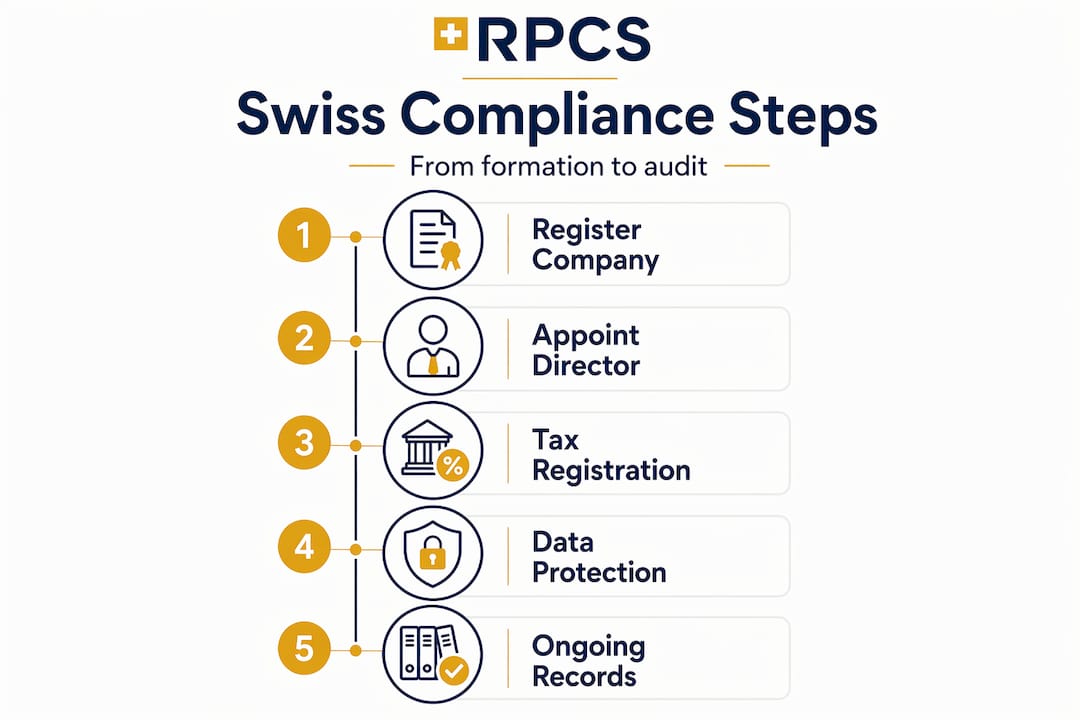
Here is what your corporate governance baseline must include from formation:
A duly appointed Swiss resident director on record with the commercial register
A registered address in Switzerland for all official correspondence
A signed shareholders’ agreement and articles of association filed with the Swiss commercial register
Resolutions recorded for every significant corporate decision
A statutory share register updated whenever ownership changes
Every one of these items is auditable. Gaps in any of them create compliance exposure from the moment you open your doors.
Swiss tax compliance: VAT, filings, and corporate tax
Tax compliance in Switzerland operates on clearly defined timelines, and the penalties for missing them are not symbolic.
VAT registration and filing deadlines
The CHF 100,000 annual turnover threshold for mandatory VAT registration applies to both resident and foreign companies operating in Switzerland. Once you cross that threshold, registration is not optional. You can also register voluntarily below the threshold, which makes sense if you have significant input VAT to recover.
VAT returns are filed quarterly or monthly via the Swiss Federal Tax Administration (FTA) portal, and submissions are due 60 days after the relevant period ends. Late payments attract 4% annual interest. There is no grace period that resets the clock.
Here is a practical compliance sequence for VAT:
Determine whether your projected or actual turnover exceeds CHF 100,000.
Register with the FTA before you reach the threshold, not after.
Set up your accounting software to tag transactions by VAT code from day one.
Choose your filing frequency (quarterly is standard; monthly suits high-volume businesses).
Submit returns electronically through the official FTA portal within 60 days of each period.
Pay any balance due at the same time as your filing to avoid interest charges.
Corporate tax rates and accounting obligations
Switzerland’s federal corporate tax rate is 8.5% on profit, but the effective combined rate (federal, cantonal, and municipal) typically ranges from 12% to 24% depending on the canton. Zug and Nidwalden consistently offer the lowest effective rates. Understanding your Swiss corporate tax rates before choosing a canton is genuinely worth the time.
Pro Tip: Cantons regularly update their tax rates. Lock in a cantonal tax analysis before incorporation, not after you have already signed a lease.
Swiss accounting must follow the Swiss Code of Obligations, which requires double-entry bookkeeping for companies above certain size thresholds and a formal annual financial statement. Small companies can use simplified accounting, but most foreign-owned businesses will exceed the thresholds quickly.
Data protection under the revised Swiss FADP
Switzerland’s revised Federal Act on Data Protection (FADP) came into force in September 2023. It is not a copy of GDPR, but it rhymes with it closely enough that you cannot ignore either one if you handle EU and Swiss customer data.
What the FADP actually demands
The compliance burden under FADP scales with the risk level of what you are doing with personal data. Routine processing (customer billing records, standard HR data) requires basic data inventories and a privacy policy. High-risk processing triggers additional obligations.
Controllers must perform a Data Protection Impact Assessment (DPIA) when processing is likely to result in high risk to individuals’ rights. If that assessment still shows unacceptable risk after mitigation measures, you must consult the Federal Data Protection and Information Commissioner (FDPIC) before proceeding. That is a hard stop, not a suggestion.
Breach notification works differently from GDPR’s 72-hour rule. Serious data breaches must be notified to the FDPIC “as quickly as possible,” with the assessment covering the sensitivity of the data, the circumstances of the breach, and the number of affected individuals. There is no fixed numeric deadline, which actually demands you have an internal response protocol ready before any breach happens.
Cross-border data transfers outside Switzerland require either an adequacy decision from the Federal Council or appropriate safeguards like standard contractual clauses. The EU is on Switzerland’s adequacy list, but this is reviewed periodically.
Maintain a data processing inventory regardless of company size
Appoint a data protection representative if you have no physical presence in Switzerland
Swiss FADP fines up to CHF 250,000 apply personally to individuals responsible for unlawful processing, not just the company as a whole
Implement technical and organizational measures proportionate to processing risk
Pro Tip: The personal liability model under FADP means a board member or data officer can be fined directly. Make sure your compliance program documents who owns each decision.
AML compliance and record keeping
Swiss anti-money laundering law applies broadly to financial intermediaries, but it also reaches many businesses handling significant transactions or acting as trustees or representatives for clients.

Core due diligence requirements
Your AML program must include documented customer due diligence (CDD) from the start of any business relationship. That means verifying the identity of the counterparty, identifying beneficial owners, and assessing the risk profile of the relationship. Ongoing monitoring is not a one-time exercise. If a client’s transaction patterns change materially, you review and update the file.
Collect and verify identity documents for every client before onboarding.
Identify and document all beneficial owners with 25% or more ownership or control.
Assess and record the risk level of each business relationship.
Monitor transactions for patterns inconsistent with the stated business purpose.
File a suspicious activity report (SAR) with the Money Laundering Reporting Office Switzerland (MROS) if suspicion arises.
AML documentation and transaction records must be retained for at least 10 years after the business relationship ends. That is a long time. It means your record storage system needs to be organized, access-controlled, and retrievable on demand.
Pro Tip: Do not treat AML as a one-time onboarding checklist. Effective AML programs include retention calendars, access controls, and documented links between KYC files and any suspicious activity decisions made over the life of the relationship.
Ongoing compliance: records, reporting, and audit readiness
Once your company is operating, the compliance work does not stop. It becomes cyclical. Swiss law requires that you maintain accurate corporate records continuously, not just at year-end.
What you must keep current
Maintaining accurate statutory records including minutes and statutory documentation is not just a best practice. It is a legal requirement under Swiss company law. Every board resolution, every change in directorship, and every shareholder vote needs to be documented and dated.
Here is what your ongoing compliance file should include at any given time:
Current and historical versions of articles of association
Minutes from every general meeting and board meeting
Up-to-date share register reflecting current ownership
Annual financial statements prepared according to Swiss GAAP or IFRS if applicable
VAT filing records for the past 10 years
AML and KYC documentation per client
Compliance area | Minimum retention period |
Accounting records | 10 years |
AML and KYC documentation | 10 years from end of relationship |
VAT filings and correspondence | 10 years |
Corporate minutes and resolutions | Duration of company plus 10 years |
Employment contracts and payroll | 5 years (varies by canton) |
Virtual office and banking compliance
A virtual office address in Switzerland satisfies the registered address requirement only if it is set up correctly with the commercial register. If it is simply a mail-forwarding service with no formal registration, it does not count. Similarly, your Swiss bank account must be opened and maintained with full KYC documentation on file with the bank. Banks in Switzerland run their own compliance checks, and an account opened without complete corporate documentation can be frozen or closed.
My take on Swiss compliance after years of advising foreign investors
Working with international entrepreneurs on Swiss legal compliance, I have noticed one pattern more than any other: people treat compliance as a final step rather than a founding decision. They incorporate the company, start operating, and then try to retrofit compliance around a structure that was never designed for it.
In my experience, the businesses that avoid costly penalties are the ones that appoint a qualified Swiss resident director before they start trading, not six months later. A competent director does not just satisfy a legal checkbox. They sign documents, attend to deadlines, and catch issues before they become enforcement actions.
I have also seen founders underestimate FADP. The personal fine model changes the psychology of compliance. When a board member can be fined CHF 250,000 individually, the conversation about data governance moves from the IT team to the boardroom fast.
The most underrated part of a solid Swiss compliance program is the accounting layer. When your accounting is accurate, current, and well-organized, every other compliance task becomes easier. Tax filings are faster. Audits are shorter. AML record reviews are clean. Treat your accounting as the spine of your compliance operation, not a back-office function.
— Rolands
How Rpcs can help you stay compliant
Setting up and maintaining a compliant Swiss company is genuinely complex when you are doing it without local infrastructure. Rpcs specializes in exactly this situation.

Through Swiss company formation services, Rpcs handles GmbH and AG incorporation from documentation through commercial register filing. The platform provides Swiss resident director and nominee director services for companies that need a compliant local presence without hiring a full-time employee. Accounting and tax compliance services keep your books audit-ready year-round. Rpcs also assists with opening a Swiss bank account, including the documentation preparation that Swiss banks require during onboarding. From registered address solutions to ongoing corporate administration, Rpcs gives international founders a single point of contact for the full compliance picture.
FAQ
What is the VAT registration threshold in Switzerland?
Companies with annual turnover exceeding CHF 100,000 must register for Swiss VAT. Voluntary registration is allowed below that threshold if input VAT recovery is beneficial.
Who can serve as a director of a Swiss company?
At least one director must be a Swiss resident with signing authority. Foreign directors are permitted alongside the resident director, but the local appointment is mandatory under Swiss law.
How quickly must data breaches be reported under FADP?
Serious breaches must be reported to the FDPIC as quickly as possible. Switzerland does not impose a specific 72-hour deadline, but delaying notification without cause increases regulatory risk.
How long must AML records be kept in Switzerland?
Transaction and due diligence records must be retained for at least 10 years after the business relationship ends. This applies to identity verification documents, beneficial ownership records, and transaction files.
What happens if my Swiss company misses a VAT deadline?
Late VAT payments in Switzerland accrue interest at 4% per annum from the due date. Repeated non-compliance can trigger audits and formal enforcement action from the Swiss Federal Tax Administration.
Recommended
Comments