
How to Appoint Swiss Director for Your Company Easily
- Nov 20, 2025
- 8 min read
Updated: Dec 29, 2025

Switzerland holds strong appeal for international companies, yet its business laws require careful navigation from the start. At least one Swiss-resident director with full signatory authority is a legal must for any company formed in Switzerland, making compliance more than just a formality. For founders, understanding each compliance step, legal obligation, and appointment procedure means fewer delays and a smoother path to successful company registration and ongoing operations.
Table of Contents
Quick Overview
Main Insight | Clear Explanation |
1. Understand local requirements | Swiss law mandates at least one local director for corporate compliance and representation. |
2. Select a qualified director | Choose a director with expertise in Swiss regulations, corporate governance, and local language fluency. |
3. Prepare necessary documentation | Legal documents for director appointment must be accurate, translated, and notarized according to Swiss standards. |
4. Complete notarization and registration | Submit all director appointment documents to the Swiss Commercial Register for official recognition. |
5. Maintain ongoing compliance | Regularly review and document your director’s performance and ensure adherence to Swiss corporate laws. |
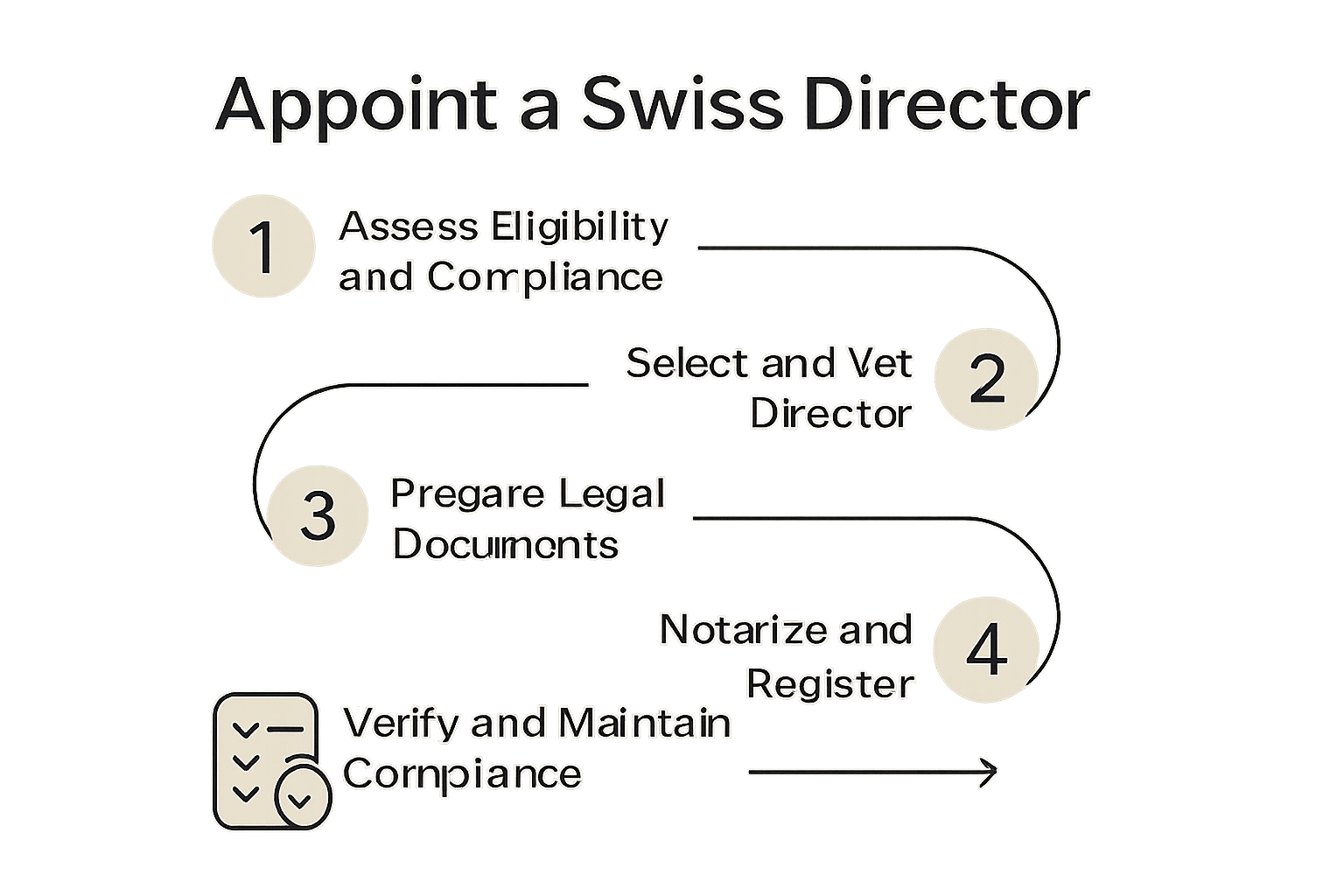
Step 1: Assess Eligibility and Compliance Needs
Before diving into Swiss company formation, you’ll need a clear understanding of the legal requirements and your specific compliance obligations. Understanding your company’s eligibility is the first critical step in successfully establishing your business in Switzerland.
According to CMS Law, Swiss law mandates that at least one person domiciled in Switzerland must have signatory authority to represent the company, ensuring local accountability and regulatory compliance. This requirement means you’ll need to secure a Swiss resident director who can legally represent your business and meet local governance standards.
When assessing your compliance needs, focus on several key areas. First, evaluate your business structure options - whether you’re planning a GmbH (limited liability company) or an AG (stock corporation). Each structure has unique requirements for director qualifications, minimum capital contributions, and registration procedures. Next, confirm that your proposed director meets Swiss residency requirements and has the necessary legal standing to serve in this role. You’ll want to verify their professional background, potential conflicts of interest, and ability to effectively manage local administrative responsibilities.
Quick pro tip: Work with a local Swiss corporate services provider who understands the nuanced legal landscape. They can help you navigate the complex compliance requirements and ensure smooth company formation.
The next step involves selecting and formally appointing your Swiss resident director who will serve as your legal representative and ensure ongoing regulatory compliance.
Step 2: Select and Vet Qualified Swiss Director
Selecting the right Swiss resident director is a critical step in establishing your company that demands careful consideration and strategic planning. Your goal is to find a qualified professional who can effectively represent your business and meet Swiss legal requirements.
The ideal Swiss director should possess a comprehensive profile that demonstrates professional credibility and local expertise. Look for candidates with strong backgrounds in corporate governance, financial management, and specific knowledge of Swiss business regulations. Key qualifications include a proven track record in business administration, legal understanding of Swiss corporate structures, fluency in local languages (German, French, or Italian), and a clean professional reputation. Verify their credentials through official channels, requesting detailed professional references, criminal background checks, and confirmation of their legal standing to serve as a corporate director in Switzerland.

During the vetting process, prioritize candidates who not only meet legal requirements but also align with your company’s strategic objectives. Consider their professional network, understanding of your industry, and ability to provide strategic insights into the Swiss business landscape. Conduct comprehensive interviews that assess their communication skills, professional judgment, and capacity to represent your company’s interests effectively.
Pro Tip: Consider working with a reputable Swiss corporate services firm that can help you identify and vet qualified director candidates who meet all regulatory requirements.
Once you have selected and thoroughly vetted your Swiss resident director, you’ll be ready to move forward with formal appointment procedures and company registration. Check out our Company Formation Checklist for Switzerland to understand the next steps in your incorporation journey.
Step 3: Prepare Legal Appointment Documentation
Now that you have identified your ideal Swiss resident director, the next critical step is preparing the comprehensive legal documentation required for their formal appointment. This process involves creating precise legal paperwork that meets Swiss corporate governance standards and ensures proper registration.
According to CMS Law, directors are generally appointed by resolution of the shareholders’ meeting, and the appointment must be documented and registered with the Swiss Commercial Register. This means you’ll need to draft a formal shareholders’ resolution that clearly outlines the director’s appointment, including their specific roles, responsibilities, and term of service. The documentation should include the director’s full legal name, professional credentials, residential address in Switzerland, and a detailed description of their authorized signatory powers.
Your appointment documentation package should typically include several key documents: a formal board resolution, the director’s signed acceptance of appointment, proof of their Swiss residency, professional qualifications certificates, and a comprehensive curriculum vitae. Ensure all documents are translated into an official Swiss language (German, French, or Italian) and notarized to meet legal authentication requirements. Pay special attention to precise language that defines the director’s scope of authority, including specific powers to represent the company, enter into contracts, and make strategic decisions.
Pro Tip: Work with a Swiss legal professional to review your documentation and ensure complete compliance with local corporate regulations.
Once your documentation is meticulously prepared and verified, you’ll be ready to submit the appointment records to the Swiss Commercial Register for official registration. Company Formation Checklist for Switzerland can provide additional guidance on navigating this critical administrative process.
Step 4: Complete Notarization and Registration Steps
Notarization and registration represent the final critical legal procedures that transform your director appointment from a private arrangement to an officially recognized corporate governance structure. This stage demands precision and careful attention to Swiss legal protocols to ensure your company gains full legal recognition.
The notarization process requires you to compile all previously prepared documents into a comprehensive registration package. This typically includes the original shareholders’ resolution, director appointment documents, signed acceptance letters, professional credentials, and proof of Swiss residency. Each document must be professionally translated into an official Swiss language and authenticated by a certified Swiss notary public who will verify the legitimacy of signatures and the accuracy of submitted information.
Your registration submission will be filed directly with the Swiss Commercial Register, a meticulous governmental body that rigorously reviews all corporate documentation. Prepare for potential requests for additional information or clarification. The registration process can take anywhere from two to six weeks, depending on the complexity of your submission and the current workload of local commercial registries. Ensure all documents are immaculately prepared to minimize potential delays or complications.
Pro Tip: Consider engaging a local Swiss corporate services expert who can navigate the registration process and anticipate potential administrative hurdles.
Once your registration is complete, you will receive an official confirmation from the Swiss Commercial Register, marking the formal recognition of your company’s leadership structure.
Explore our Swiss Incorporation Timeline Guide to understand the subsequent steps in establishing your Swiss business.
Step 5: Verify Appointment and Ensure Ongoing Compliance
After successfully appointing your Swiss resident director, your responsibility shifts to maintaining rigorous ongoing compliance and actively managing the director’s performance and legal obligations. This crucial phase ensures your company remains fully aligned with Swiss corporate governance standards and regulatory requirements.
Verification begins with a comprehensive review of your director’s initial documentation and continued professional standing. Schedule quarterly compliance reviews that examine the director’s executed responsibilities, financial reporting accuracy, and adherence to their defined scope of authority. This process should include detailed assessments of their decision making, financial management, legal representation, and strategic guidance. Create a structured performance evaluation framework that tracks key metrics such as regulatory compliance, strategic alignment with company objectives, and effective communication with shareholders.
Maintaining ongoing compliance requires proactive engagement and systematic documentation. Establish a robust reporting mechanism where your Swiss resident director provides regular updates on company activities, potential regulatory changes, and strategic recommendations. Implement secure digital documentation systems that allow for transparent tracking of all corporate communications, board resolutions, and significant business decisions. Ensure all documentation remains current and readily accessible for potential regulatory inspections or internal audits.
Pro Tip: Consider establishing an annual compliance audit to comprehensively review your director’s performance and your company’s adherence to Swiss corporate regulations.
As your company continues to evolve, stay informed about potential changes in Swiss corporate law that might impact your director’s responsibilities. Swiss Incorporation Timeline Guide can provide additional insights into maintaining long term compliance and corporate governance standards.
Simplify the Appointment of Your Swiss Director with Expert Support
Appointing a Swiss resident director is a crucial and complex step in forming your company in Switzerland. This process requires careful vetting, precise legal documentation, notarization, and timely registration to comply with local laws and ensure your business operates smoothly. Many international entrepreneurs face overwhelming challenges navigating residency requirements, shareholder resolutions, and ongoing compliance demands.
You do not have to manage this alone. At rpcs.ch, we specialize in guiding you through every step of Swiss company formation. From identifying qualified Swiss directors to preparing all the necessary legal documents and coordinating notarization tasks, our expert team takes care of the intricate details so you can focus on growing your business. Gain peace of mind knowing your company meets all Swiss corporate governance standards with minimal hassle.
Take the next step in securing your Swiss presence with confidence. Discover our tailored solutions on rpcs.ch and follow our Company Formation Checklist for Switzerland for a seamless incorporation journey.
Ready to appoint your Swiss director now and ensure full compliance?

Start today by visiting rpcs.ch and let us help you transform complex procedures into straightforward actions. Your Swiss business success begins with trusted guidance.
Frequently Asked Questions
What are the eligibility requirements for appointing a Swiss director?
To appoint a Swiss director, you must ensure that the individual is domiciled in Switzerland and possesses the necessary qualifications to fulfill the role. Begin by verifying their legal standing and professional background to ensure compliance with local regulations.
How can I find a qualified Swiss resident director for my company?
To find a qualified Swiss resident director, consider candidates with experience in corporate governance and financial management. Conduct thorough interviews and checks to assess their credentials and local knowledge, ensuring they align with your company’s strategic goals.
What legal documents are needed to appoint a Swiss director?
You will need a formal shareholders’ resolution, the director’s signed acceptance of appointment, proof of Swiss residency, and their professional qualifications. Compile all required documents and ensure they are properly translated and notarized to meet Swiss legal standards.
How long does the registration process for a new Swiss director take?
The registration process for a new Swiss director can take approximately two to six weeks, depending on the completeness of your submission and the workload of the commercial registry. Prepare all documentation meticulously to avoid delays and ensure a smooth registration.
How can I ensure ongoing compliance for my Swiss director?
To ensure ongoing compliance, conduct quarterly reviews of your director’s performance and adherence to their roles. Set up a reporting mechanism for regular updates on compliance and strategic decisions to maintain alignment with Swiss corporate regulations.
What actions should I take if my Swiss director’s performance declines?
If your Swiss director’s performance declines, initiate a structured performance evaluation to identify areas needing improvement. Engage in open discussions about their responsibilities and set clear expectations to foster better alignment with the company’s objectives.
Recommended
Comments