
AG vs GmbH in Switzerland: Key Differences Founders Need
- Apr 12
- 9 min read

TL;DR:
Choosing between AG and GmbH impacts capital, governance, privacy, and investor perception.
AG requires CHF 100,000 capital, offers greater transferability, and targets larger or public companies.
GmbH needs CHF 20,000, suits small businesses with simpler governance, and provides more control.
Choosing between an AG and a GmbH when setting up a Swiss company feels straightforward until you realize the decision touches everything from how much capital you must commit to whether investors will take you seriously. Many foreign founders pick a structure based on gut feeling or a quick Google search, only to discover months later that they’ve locked themselves into governance rules, residency obligations, or tax positions that don’t fit their actual business. Switzerland’s legal framework rewards founders who choose deliberately. This guide breaks down the real differences between AG and GmbH so you can make a confident, informed decision before you sign anything.
Table of Contents
Key Takeaways
Point | Details |
Capital requirements | AG requires CHF 100,000 share capital, GmbH only CHF 20,000. |
Privacy difference | AG shareholders remain private while GmbH owners are publicly listed. |
Structure selection | Choose based on company size, investor goals, and long-term plans, not just legal minimums. |
Residency rules | Both types require at least one Swiss-resident director or manager. |
Formation complexity | AGs have more complex governance, making GmbH simpler for most global founders. |
AG and GmbH: What they are and who they’re for
Both AG and GmbH are limited liability company structures under Swiss law, but they serve very different purposes and attract very different types of founders.
AG stands for Aktiengesellschaft, which translates roughly to “stock corporation” or “joint-stock company.” It’s the Swiss equivalent of a public limited company. Capital is divided into shares, and ownership can shift hands without the other shareholders needing to approve. Swiss company formation services confirm that an AG is commonly chosen for larger businesses aiming for public credibility and access to capital markets. Think of it as the structure that signals ambition and scale.
GmbH stands for Gesellschaft mit beschränkter Haftung, which means “company with limited liability.” It’s closer to a private limited company. Ownership is recorded in a public register, and share transfers require notarization and approval from other shareholders. A GmbH structure is often preferred for SMEs and privately owned ventures where founders want tighter control.
Here’s a quick breakdown of which structure fits which type of founder:
AG: Suited for startups seeking venture capital, companies planning eventual public listing, businesses where investor anonymity matters, and firms with multiple international shareholders
GmbH: Suited for family businesses, consulting firms, small to mid-size operations, and founders who want full control without complex governance
Both: Offer full limited liability, meaning personal assets are protected from business debts
Both: Are recognized as separate legal entities under Swiss law
The choice also shapes how outsiders perceive your business. Banks, partners, and institutional investors often view an AG as more credible for high-value transactions. A GmbH, by contrast, signals a tightly held, owner-managed operation, which is perfectly appropriate for most international SMEs.
Pro Tip: Foreign founders often overlook the residency requirement for directors. At least one board member or managing officer must be a Swiss resident, regardless of whether you choose AG or GmbH. Ignoring this early creates expensive delays later.
Key legal and financial differences: AG vs GmbH
Once you understand what each structure is, the real work begins: comparing the specifics that will affect your day-to-day operations and long-term strategy.
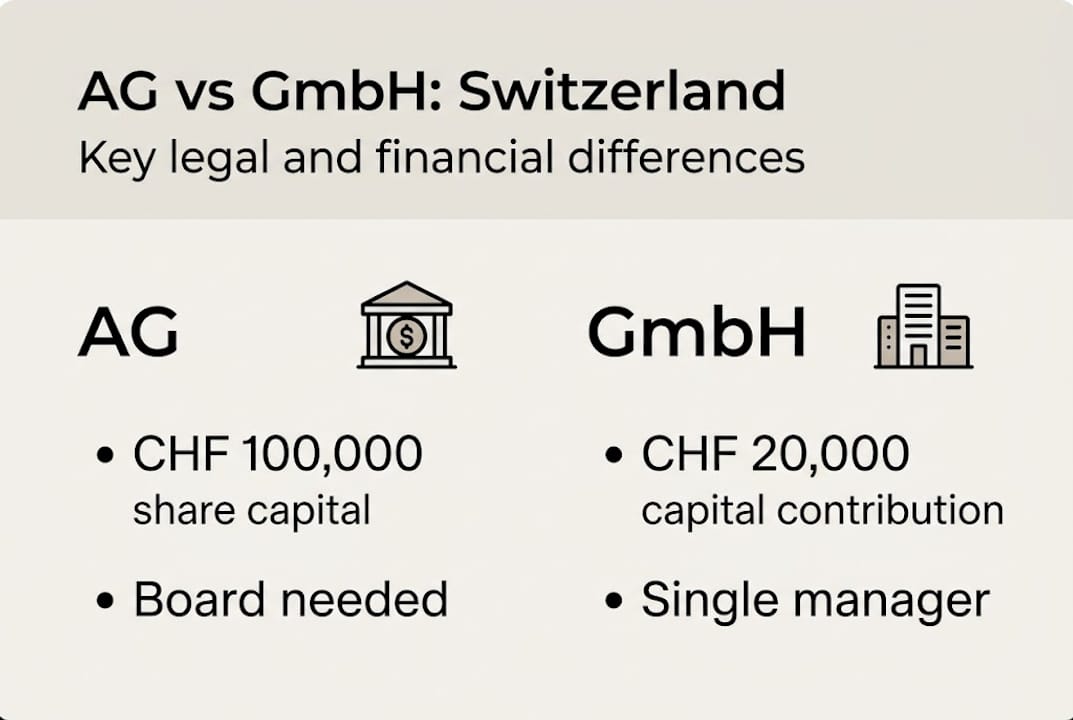
The minimum share capital difference alone is significant. An AG requires CHF 100,000 in share capital, while a GmbH only requires CHF 20,000. That’s a fivefold difference before you’ve hired a single employee.
Feature | AG | GmbH |
Minimum capital | CHF 100,000 | CHF 20,000 |
Minimum founders | 1 | 1 |
Share transferability | Freely transferable | Requires notarization and approval |
Shareholder privacy | Names not publicly listed | Names publicly registered |
Board structure | Mandatory board of directors | Managing directors (simpler) |
Audit requirement | Mandatory (limited audit for smaller AGs) | Optional for smaller firms |
Public credibility | High | Moderate |
Beyond the table, governance structure and audit requirements differ in ways that affect real operating costs. An AG must hold annual general meetings, maintain formal board minutes, and often engage an auditor. A GmbH has far fewer formal governance obligations, which reduces overhead.
Here are the factors international founders most commonly misunderstand:
Shareholder anonymity: AG shareholders are not listed publicly, which matters for high-net-worth individuals who value privacy
Share transfer rules: Selling or transferring GmbH shares requires a notarized deed and shareholder consent, making it harder to bring in new investors quickly
Voting rights: In a GmbH, each share carries one vote per CHF 100 of nominal value. In an AG, voting structures can be customized more flexibly
Tax treatment: Both structures are taxed similarly at the corporate level, but the AG’s structure can offer more flexibility for dividend planning
For global investors, the GmbH vs AG key points around control and transferability are often the deciding factor. If you plan to bring in co-founders or investors later, the AG’s share transfer flexibility is a significant operational advantage.
Formation process and requirements for AG and GmbH
Knowing the legal differences is one thing. Understanding how to actually get your company registered is where most foreign founders run into trouble.
The core steps are similar for both structures, but the AG involves more complexity:
Reserve your company name with the Swiss commercial register
Draft and notarize the articles of association (required for both AG and GmbH)
Deposit the minimum share capital into a blocked bank account
Obtain a notarized deed of incorporation from a Swiss notary
Register with the cantonal commercial register (Handelsregister)
Register for VAT if annual turnover exceeds CHF 100,000
Set up corporate bank account and unblock the capital deposit
All Swiss company formations require notarized articles of association and commercial register entry, without exception. This is non-negotiable and must be handled by a licensed Swiss notary.
Step | AG | GmbH |
Notarization required | Yes | Yes |
Minimum capital deposit | CHF 100,000 | CHF 20,000 |
Board appointment | Mandatory before registration | Managing director required |
Typical timeline | 3-4 weeks | 2-3 weeks |
Estimated setup cost | CHF 3,000-6,000+ | CHF 1,500-3,000 |
AGs demand a more complex board structure and typically involve higher startup costs than GmbH formations. The board must be formally constituted before registration, and at least one member must be domiciled in Switzerland.

For GmbH formation steps, the process is leaner. A single managing director can run the company, and the governance documentation is simpler. If you want to understand the full AG incorporation process, it’s worth reviewing the specific cantonal requirements, as they vary slightly.
Pro Tip: AGs require at least one Swiss-resident board member with signing authority. Many foreign founders try to appoint a nominee director to satisfy this rule. Make sure your nominee is a legitimate, qualified individual, not just a name on paper, or you risk regulatory scrutiny.
Common mistakes foreign founders make during formation include underestimating notary fees, failing to prepare certified translations of foreign identity documents, and choosing the wrong canton for registration without considering local tax rates.
Reviewing the GmbH legal steps and understanding how to set up a GmbH in detail before engaging a notary will save you significant time and money.
Choosing the right Swiss structure: Decision criteria and expert tips
With the requirements clear, the real question becomes: which structure actually fits your situation?
Here are the key decision criteria you should work through before committing:
Company size and growth stage: Early-stage bootstrapped ventures typically benefit from the lower capital requirement and simpler governance of a GmbH
Investor strategy: If you plan to raise external funding or bring in institutional investors, an AG’s share transferability and credibility make it the stronger choice
Privacy needs: High-net-worth founders who want ownership kept private should lean toward an AG
Exit planning: Planning to sell the business or list it publicly? An AG is far easier to restructure for those outcomes
Operational complexity: If you want to minimize administrative overhead, a GmbH demands less in terms of governance and reporting
Stakeholder perceptions: Clients in finance, real estate, or enterprise sectors often expect to deal with an AG
“The choice between AG and GmbH influences everything from control, tax planning, to external perceptions and capital-raising ability. International founders who treat this as a minor administrative decision often pay for it later through restructuring costs or missed investment opportunities.”
Consider two real-world scenarios. A tech startup with three co-founders and a plan to raise a Series A within two years should almost certainly choose an AG. The share structure is cleaner for investor term sheets, and the credibility factor matters when pitching Swiss or European VCs. A family-owned consulting firm with one or two principals, billing CHF 500,000 annually, has no reason to take on the capital burden and governance complexity of an AG. A GmbH serves that business perfectly.
Understanding the role of founders in AG governance is also worth studying before you commit. AG founders give up some informal control in exchange for structural flexibility, which is a trade-off that surprises many first-time Swiss company owners.
The Swiss corporate law impacts on both structures are deep and long-lasting. Future flexibility matters: converting from GmbH to AG is possible but involves legal costs, notary fees, and potential tax implications. Getting it right the first time is always cheaper.
Our perspective: Rethinking AG vs GmbH for global founders
The standard advice you’ll read online almost always defaults to “choose AG if you want to grow, GmbH if you want to stay small.” That framing is too simple and sometimes actively misleading.
We’ve worked with foreign founders who chose an AG because it sounded more prestigious, only to struggle with the CHF 100,000 capital requirement and mandatory governance costs in their first year. For a lightly capitalized startup, those obligations can drain working capital faster than a slow sales quarter.
The key differences AG vs GmbH that actually matter for overseas founders are rarely the ones featured in comparison articles. Residency rules, notary costs, and the practical difficulty of finding a qualified Swiss-resident director are the real friction points. Most founders discover these after they’ve already started the process.
Our honest recommendation: treat the AG vs GmbH decision as a strategic question, not a legal checkbox. If you’re planning international expansion or a funding round within three years, revisit your structure before you need to. Changing it later is possible but expensive. Getting proper legal and financial advice upfront is not a cost. It’s an investment that pays for itself the first time you avoid a costly mistake.
Get expert help for your Swiss company setup
Deciding between AG and GmbH is only the beginning. The real complexity starts when you factor in canton selection, banking setup, accounting obligations, and ongoing compliance requirements that vary depending on your structure and industry.
At RPCS Solutions, we specialize in Swiss company formation support for international founders who need more than a generic checklist. From initial structure advice to notarization, Swiss bank account setup, and Swiss accounting services, we handle the full setup so you can focus on running your business. Our team works with founders across industries and jurisdictions, and we understand the specific challenges that come with setting up in Switzerland from abroad. Reach out for a consultation and get a clear, personalized roadmap for your Swiss company.
Frequently asked questions
What is the minimum share capital to start an AG or GmbH in Switzerland?
The minimum share capital is CHF 100,000 for an AG and CHF 20,000 for a GmbH, both set by Swiss law.
Can a foreigner fully own a Swiss AG or GmbH?
Yes, foreigners can fully own both structures, but at least one director or managing officer must be a Swiss resident with signing authority.
Is an AG or GmbH better for raising external investment?
An AG is generally preferred by investors because it offers stronger investor protections and share transfers are far simpler than in a GmbH.
Which company type offers greater privacy for owners?
AG shareholders have more privacy since their names are not publicly listed, unlike GmbH owners whose details appear in the public commercial register.
How long does it take to incorporate an AG or GmbH?
Both structures typically take 2-4 weeks to incorporate, depending on document readiness and how quickly the commercial register processes your application.
Recommended
Comments