
Why Swiss Stability Attracts Crypto Investors in 2026
- 5 days ago
- 8 min read

TL;DR:
Switzerland is the most credible jurisdiction for crypto due to its clear laws, trusted institutions, and investor-friendly tax policies. Its regulatory framework, including the DLT Act and tiered FINMA licenses, provides legal certainty and institutional access for ventures. Private investors benefit from tax exemptions, and the growing ecosystem attracts major blockchain projects and venture capital.
Switzerland is the world’s most credible jurisdiction for cryptocurrency ventures, defined by legal clarity, institutional trust, and a tax framework that rewards long-term investors. The Financial Market Supervisory Authority (FINMA), the Federal Tax Administration (FTA), and the Distributed Ledger Technology Act (DLT Act) together form a regulatory architecture that no other European country has matched. Understanding why Swiss stability attracts crypto capital requires looking beyond the famous banking secrecy and into the specific laws, licensing tiers, and ecosystem data that make Switzerland the rational choice for serious entrepreneurs and investors.
Why Swiss stability attracts crypto: the financial foundation
Switzerland’s financial stability is not a marketing claim. It is a measurable condition built on centuries of monetary discipline, a strong franc, and a banking sector that survived multiple global crises without a systemic collapse. For crypto ventures, that stability translates into something concrete: access to banking infrastructure that most jurisdictions simply cannot offer.

FINMA licensed the first genuine crypto banks in Switzerland, including SEBA Bank and Sygnum Bank, giving digital asset businesses access to regulated custody, payment rails, and institutional counterparties. That licensing decision signaled that Switzerland treats crypto as a legitimate asset class, not a regulatory problem to be deferred. Institutional investors noticed immediately.
Swiss crypto investors prioritize trust over cost, preferring established cantonal banks and known providers even when fees are higher. That preference reflects a broader cultural disposition toward stability that benefits every crypto venture operating in the country. When your banking counterparty is a 150-year-old cantonal institution, counterparty risk drops to near zero.
The banking gap remains real, though. Swiss banks stay conservative despite regulatory progress, and crypto startups without a clear compliance record often struggle to open accounts. Operators need demonstrated long-term viability and strong operational compliance to secure banking relationships. That hurdle is high, but clearing it signals credibility to every institutional partner that follows.
Pro Tip: Before applying for a Swiss bank account as a crypto startup, prepare a full compliance package: AML policy, source-of-funds documentation, and a two-year business plan. Banks assess viability before they assess the technology.
How does Switzerland’s regulatory framework support crypto?
Switzerland’s regulatory clarity is the product of deliberate legislative design, not accident. The DLT Act, which came into force in 2021, created legal recognition for tokenized assets and established bankruptcy protections that no other major jurisdiction had codified at that point.
The DLT Act provides bankruptcy protection for digital assets by legally segregating client crypto holdings from the custodian’s estate in the event of failure. That single provision eliminates one of the most significant risks in crypto custody: the risk that your assets become part of a bankruptcy proceeding when your custodian fails. For institutional investors, that protection is not a nice feature. It is a prerequisite.
FINMA operates a three-tier licensing system that covers the full range of crypto business models:
Full banking license covers crypto banks that accept deposits, offer custody, and provide payment services at institutional scale.
Fintech license applies to businesses that hold client funds up to CHF 100 million without paying interest, suited to crypto payment processors and custody-light models.
DLT trading facility license governs regulated secondary markets for tokenized securities, with FINMA licensing the first DLT trading facility in 2025.
That tiered structure matters because it matches regulatory burden to business model. A startup building a tokenized bond platform does not face the same compliance requirements as a full crypto bank. That proportionality reduces friction for early-stage ventures while maintaining systemic integrity.
Switzerland’s DLT Act and FINMA licensing framework represent “regulation as product-market fit.” The law does not merely tolerate crypto. It creates the legal infrastructure that makes institutional-grade crypto finance possible. That distinction separates Switzerland from every jurisdiction that has issued guidance notes without legislative backing.
Switzerland also requires crypto businesses to comply with the Anti-Money Laundering Act (AMLA), with FINMA supervising compliance directly. Stablecoins face additional scrutiny under deposit-taking rules if they accumulate large reserves. That clarity on stablecoins, while demanding, removes the regulatory ambiguity that has paralyzed stablecoin projects in other jurisdictions.
What are the tax advantages for crypto investors in Switzerland?
Swiss tax policy on cryptocurrency is one of the most favorable in the world for private investors, but it comes with specific conditions that every investor must understand before trading.
Capital gains from crypto sales by Swiss private investors are generally tax-free under FTA Circular No. 36, provided the investor meets the safe harbor criteria. Those criteria include a holding period of more than six months and capital gains that do not exceed 50% of taxable income in the assessment year. Meeting those thresholds keeps an investor classified as a private investor rather than a professional trader.
The professional trader reclassification is the critical risk. Swiss crypto tax rules under Circular 36 assess holding period, transaction volume, use of leverage, and portfolio turnover. Breach any of those thresholds and the FTA reclassifies the investor as a professional trader retroactively. Professional traders pay income tax and social contributions on all gains, which can represent a dramatic increase in effective tax rate.
Investor type | Capital gains tax | Wealth tax on holdings | Social contributions |
Private investor (Circular 36 compliant) | Tax-free | Yes, declared annually | No |
Professional trader (reclassified) | Income tax rate | Yes, declared annually | Yes, retroactive |
Crypto holdings must be declared annually for wealth tax regardless of investor classification. The FTA publishes year-end exchange rates for major cryptocurrencies, which serve as the valuation basis. Investors holding significant portfolios should factor wealth tax into their annual planning, particularly in high-tax cantons.
The Crypto-Asset Reporting Framework (CARF), developed by the OECD and adopted by Switzerland, introduces automatic exchange of crypto account information between tax authorities starting in 2026. That framework closes the information gap that previously made offshore crypto holdings difficult to detect. Investors who have not yet declared holdings should treat CARF as a hard deadline for compliance.
Pro Tip: Track every transaction with software that exports FIFO or average-cost reports in Swiss franc values. The FTA requires franc-denominated records, and reconstructing historical data after the fact is significantly more expensive than maintaining it in real time.
How mature is Switzerland’s crypto ecosystem?
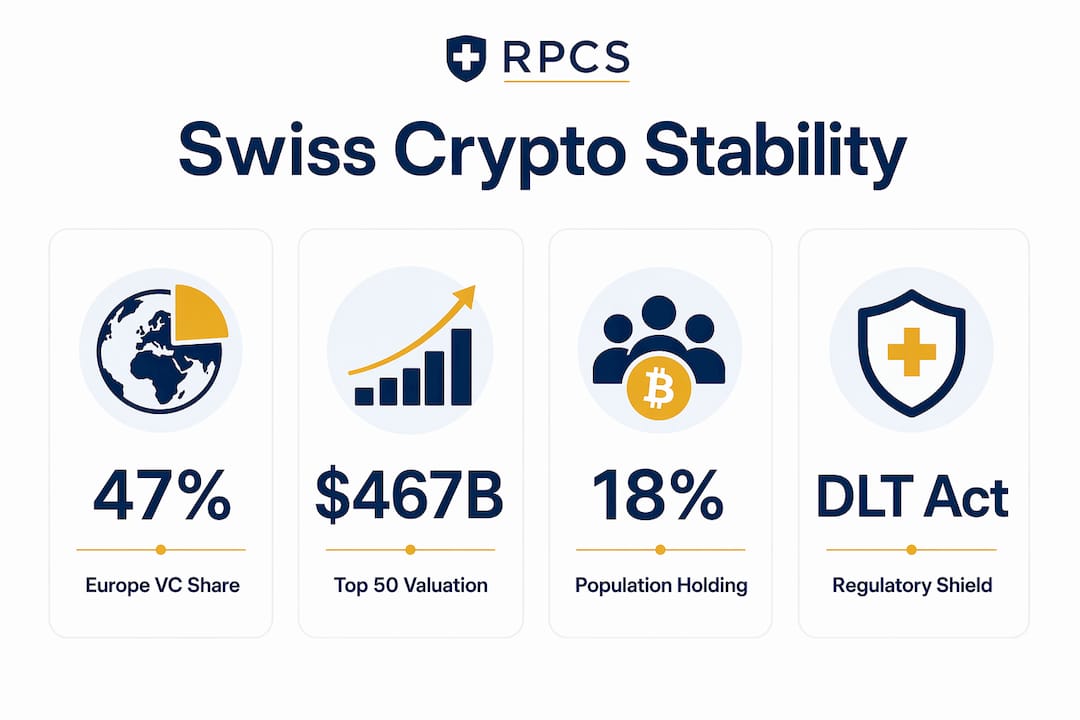
Switzerland’s crypto ecosystem is the most developed in Europe by venture capital volume and institutional participation. In 2025, Switzerland secured $728 million in blockchain venture funding across 31 deals, a 37% increase over 2024. That figure represents 47% of all European blockchain venture capital, a concentration that reflects investor confidence in Swiss legal and financial infrastructure.
The top 50 Swiss digital asset firms held a combined valuation of $467 billion by april 2026. That scale places Switzerland in a different category from any other European crypto hub. The depth of institutional capital available in Zug and Zurich creates network effects that benefit every new venture entering the market.
Zug, known internationally as Crypto Valley, hosts the highest density of blockchain foundations and token-issuing entities in the world. The Swiss foundation structure gives protocol projects a neutral legal entity that can hold assets, enter contracts, and employ staff without compromising the decentralization of the underlying protocol. That structure is why Ethereum, Cardano, and dozens of other major protocols chose Switzerland as their legal home.
About 18% of the Swiss population holds cryptocurrency as of Q1 2026, up 7 percentage points since 2024. Approximately 140,000 new investors entered the market between 2025 and 2026. The growth is real, though 70% of the Swiss population remains unlikely to invest in the next two years. That skepticism is not a weakness. It reflects the same risk-averse culture that makes Swiss institutions trustworthy counterparties.
The ecosystem’s current focus areas include regulated stablecoin infrastructure, tokenized securities on DLT trading facilities, and digital payment rails connecting Swiss banks to crypto networks. Each of those areas benefits directly from the Swiss fintech environment that FINMA and the Swiss National Bank have built over the past decade.
Key Takeaways
Switzerland’s combination of FINMA licensing, DLT Act bankruptcy protections, and FTA Circular 36 tax rules makes it the most institutionally credible jurisdiction for crypto ventures in Europe.
Point | Details |
Regulatory clarity | The DLT Act and FINMA’s three-tier licensing system give crypto businesses a defined legal path. |
Banking access | Swiss crypto banks like SEBA and Sygnum provide institutional custody, but startups must demonstrate compliance to qualify. |
Tax efficiency | Private investors pay no capital gains tax under FTA Circular 36 safe harbor, but professional trader reclassification carries retroactive income tax risk. |
Ecosystem scale | Switzerland captured 47% of European blockchain VC in 2025, with $728 million deployed across 31 deals. |
CARF compliance | Automatic crypto tax reporting begins in 2026, making proactive declaration the only viable strategy for investors. |
Switzerland’s institutional sequencing is the model others will copy
I have watched a lot of jurisdictions try to attract crypto capital by issuing favorable statements and then failing to back them with enforceable law. Switzerland did the opposite. It built the legal infrastructure first and let the market respond. The DLT Act’s bankruptcy protections are a perfect example. That provision required amending the Swiss debt enforcement and bankruptcy code, which is not a simple regulatory guidance note. It is a legislative commitment that took years to pass. That commitment is what separates Swiss crypto regulatory clarity from the aspirational frameworks you see elsewhere.
The institutional sequencing concept is what I find most underappreciated. Switzerland allows a crypto project to separate its protocol governance from its legal entity operations. The foundation holds assets and signs contracts. The protocol runs independently. That separation lets a project maintain a credible decentralization narrative while meeting every Swiss legal and financial supervision requirement. No other jurisdiction has codified that distinction as cleanly.
The banking gap is the honest counterpoint. I have seen well-funded projects with FINMA-compliant structures spend six to twelve months trying to open a basic business account. Swiss banks move slowly, and they apply their own internal risk frameworks on top of FINMA’s rules. Entrepreneurs who enter Switzerland expecting instant banking access will be disappointed. Those who prepare a complete compliance package and demonstrate long-term viability will eventually succeed. The wait is worth it, because a Swiss banking relationship opens doors globally that no other jurisdiction can match.
The bottom line is that Switzerland rewards preparation. Entrepreneurs who treat Swiss incorporation as a shortcut will struggle. Those who treat it as a long-term infrastructure decision will find that the stability they paid for compounds over time.
— Rolands
Setting up your Swiss crypto venture with Rpcs
Switzerland’s regulatory and tax advantages are real, but accessing them requires correct company formation, a registered business address, and banking relationships built on solid compliance foundations.

Rpcs specializes in Swiss company formation for international entrepreneurs and investors entering the Swiss crypto market. The team handles GmbH and AG incorporation, legal documentation, notarization, and registration with the Swiss Companies House. Rpcs also provides a registered business address in Switzerland, which satisfies FINMA and cantonal registration requirements for foreign-founded entities. For crypto ventures that need ongoing financial management, Rpcs offers accounting services tailored to Swiss regulatory standards. Contact Rpcs to structure your Swiss crypto venture correctly from the first day.
FAQ
What makes Switzerland the top European crypto hub?
Switzerland captured 47% of European blockchain venture capital in 2025, backed by FINMA licensing, the DLT Act, and a tax framework that exempts private investors from capital gains tax under FTA Circular 36.
How does the DLT Act protect crypto investors?
The DLT Act legally segregates client crypto holdings from the custodian’s estate in bankruptcy, meaning your assets are protected even if your Swiss crypto bank fails.
Are crypto gains tax-free in Switzerland?
Capital gains are tax-free for private investors who meet FTA Circular 36 safe harbor criteria, including a holding period over six months and gains below 50% of taxable income. Reclassification as a professional trader triggers retroactive income tax.
What is CARF and why does it matter for Swiss crypto investors?
CARF is the OECD’s Crypto-Asset Reporting Framework, adopted by Switzerland, which introduces automatic exchange of crypto account data between tax authorities starting in 2026. Undeclared holdings become visible to the FTA through this framework.
What is Crypto Valley and why do blockchain projects choose Zug?
Zug, known as Crypto Valley, offers Swiss foundation structures that allow blockchain protocols to hold assets and enter contracts legally while keeping the underlying protocol decentralized. Ethereum and dozens of major protocols established their legal entities there for exactly that reason.
Recommended
Comments