
Top tips for international entrepreneurs launching in Switzerland
- Mar 30
- 7 min read

Switzerland consistently ranks among the top five most competitive economies globally, yet many international entrepreneurs assume the incorporation process is too complex or restrictive for foreign founders. That assumption is wrong. Whether you’re setting up a GmbH (Gesellschaft mit beschränkter Haftung, a limited liability company) or an AG (Aktiengesellschaft, a joint-stock company), Switzerland offers a structured, transparent, and genuinely rewarding environment for building a serious business. This guide walks you through the key advantages, practical steps, compliance essentials, and asset protection strategies you need to launch and manage a Swiss company with confidence.
Table of Contents
Key Takeaways
Point | Details |
Switzerland’s business appeal | Stable economy, investor protection, and innovation make Switzerland a top destination for entrepreneurs. |
Efficient incorporation steps | A clear process streamlines legal entity selection, documentation, and registration for international founders. |
Compliance and management | Ongoing accounting, reporting, and audit requirements are essential for Swiss business success. |
Protecting assets | Banking, trademarks, and secure company addresses are vital for safeguarding your enterprise. |
Expert support advantages | Partnering with specialized local advisors simplifies every stage and ensures full legal compliance. |
Why Switzerland attracts global entrepreneurs
Switzerland’s appeal goes far beyond its reputation for banking secrecy and mountain scenery. The country delivers a stable political and economic environment that few jurisdictions can match, making it a reliable base for long-term business operations. Political neutrality, low corruption, and a rule-of-law tradition mean your investment is protected by a legal system that actually works.
The business climate advantages extend to taxation as well. Corporate tax rates vary by canton, but effective rates often fall between 12% and 18%, which is highly competitive by European standards. Switzerland also maintains an extensive network of double taxation treaties with over 100 countries, giving international entrepreneurs real flexibility in structuring cross-border operations.
Here’s what makes Switzerland stand out for global founders:
Political stability with a centuries-old democratic tradition
Strong investor protection under Swiss civil and commercial law
Access to EU markets through bilateral trade agreements
World-class infrastructure including logistics, finance, and digital connectivity
Top-tier talent pool with multilingual, highly educated professionals
Robust IP protection through the Swiss Federal Institute of Intellectual Property
“Switzerland’s combination of legal transparency, low corporate taxes, and global market access makes it one of the most strategically valuable jurisdictions for international business formation.”
The business establishment guide reinforces that Switzerland’s innovation ecosystem, particularly in fintech, pharma, and deep tech, creates genuine commercial opportunities beyond just tax efficiency. With Switzerland’s appeal established, let’s clarify the first essential steps for international entrepreneurs.
Core steps to establish your Swiss business
Now that you know Switzerland’s strengths, here are the concrete steps to establish your company efficiently. The process is more straightforward than most people expect, provided you prepare your documentation carefully.
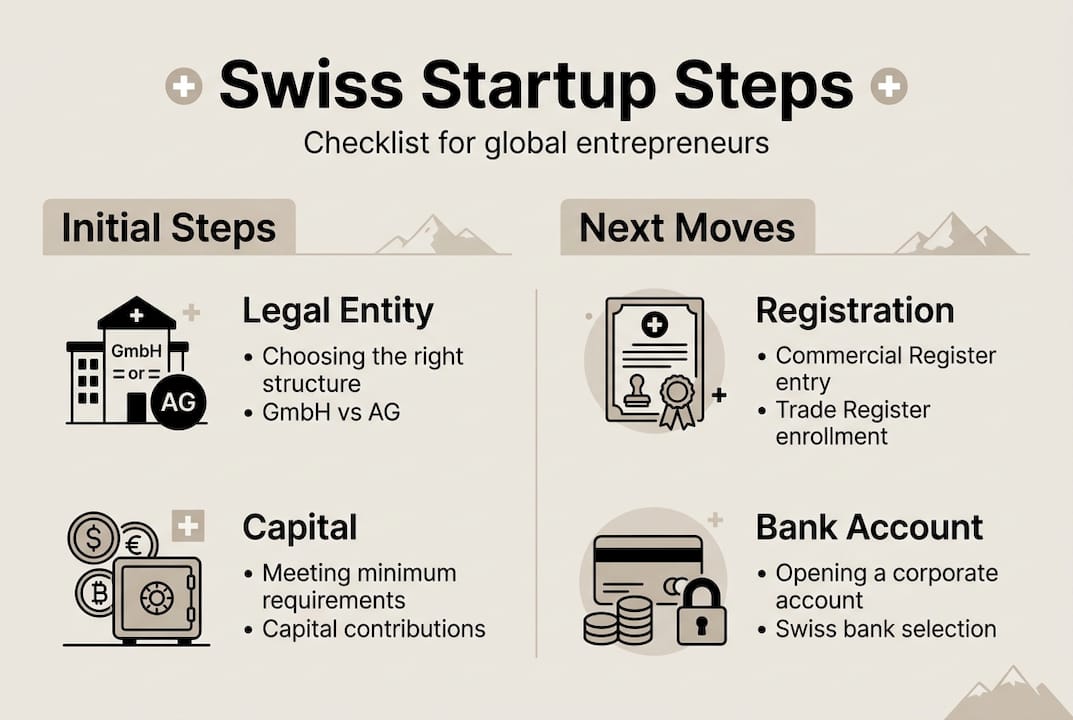
Step 1: Choose your legal entity. The AG and GmbH are the two dominant structures. The AG suits larger operations or companies planning to raise external investment. The GmbH works well for smaller, founder-led businesses.
Step 2: Meet capital and residency requirements. Foreign entrepreneurs must meet specific residency and entity requirements before registering. An AG requires a minimum share capital of CHF 100,000 (at least 50% paid in at formation). A GmbH requires CHF 20,000, fully paid in. At least one director must be a Swiss resident.

Step 3: Prepare your documents. You’ll need company statutes, shareholder agreements, and identity verification for all founders. Well-drafted company statutes are critical because they govern everything from profit distribution to board authority.
Step 4: Register with the Commercial Register. Registration is handled through the cantonal Commercial Register office. A notary must certify the founding documents for an AG.
Step 5: Open a corporate bank account. You’ll need a Swiss bank account to deposit share capital before registration is complete. This is a sequential requirement, not optional.
Step 6: Set up a registered business address. Every Swiss company must have a legal address in Switzerland. This can be a physical office or a professional registered address service.
Feature | AG | GmbH |
Minimum capital | CHF 100,000 | CHF 20,000 |
Liability | Limited to share capital | Limited to contribution |
Shares | Freely transferable | Restricted transfer |
Best for | Larger firms, investors | SMEs, startups |
Audit required | Yes (above thresholds) | Conditional |
Pro Tip: If you’re a non-resident founder, review the business immigration guide early in your planning. Residency requirements affect your timeline and the structure of your board, so addressing them upfront saves significant delays.
Navigating Swiss compliance and management essentials
Once your Swiss company is registered, understanding ongoing responsibilities is vital for sustainable growth. Swiss compliance is rigorous but predictable. If you build the right systems from day one, it becomes routine rather than burdensome.
Swiss accounting standards benefit startups by building investor confidence and ensuring transparency, which matters enormously when you’re seeking financing or entering partnerships. Swiss GAAP FER (Financial Reporting Standards) applies to most SMEs, while larger companies may need to follow IFRS.
Key ongoing compliance obligations include:
Annual financial statements prepared according to Swiss Code of Obligations
Corporate tax returns filed with cantonal and federal tax authorities
VAT registration if annual turnover exceeds CHF 100,000
Social security contributions for all employees, including founders on payroll
Board meeting minutes and shareholder resolutions properly documented
Audit requirements depend on company size. Ordinary audits apply to companies exceeding two of three thresholds: CHF 40 million in revenue, CHF 20 million in assets, or 250 full-time employees. Smaller companies may qualify for a limited audit or opt out entirely if all shareholders agree.
Obligation | Frequency | Applies to |
Financial statements | Annual | All companies |
Tax return filing | Annual | All companies |
VAT reporting | Quarterly/Annual | Turnover over CHF 100,000 |
Ordinary audit | Annual | Large companies |
Board minutes | Per meeting | All companies |
Pro Tip: The most common compliance mistake foreign founders make is underestimating Swiss payroll obligations. If you pay yourself a salary through your Swiss company, you must register with the cantonal compensation office and make AHV/IV/EO (social insurance) contributions from day one. The business compliance guide covers these obligations in detail.
Banking, trademarks, and protecting your assets
Successful management in Switzerland also depends on protecting finances and intellectual property. These two areas are often treated as afterthoughts, but they’re foundational to long-term business security.
Opening a Swiss business bank account has become more demanding in recent years due to enhanced due diligence requirements. Here’s what you’ll typically need:
Certified company documents including statutes and Commercial Register extract
Proof of identity for all beneficial owners and directors
Business plan explaining the company’s activities and revenue model
Registered Swiss business address confirmed in writing
Source of funds documentation for initial capital deposits
Your choice of bank matters. Traditional Swiss banks like UBS and Credit Suisse (now merged) offer prestige but have strict onboarding. Neobanks and fintech options provide faster setup for international founders. Review Swiss business banking options carefully before committing, as switching banks later is time-consuming.
On the intellectual property side, trademark registration is critical for protecting brand assets in Switzerland and internationally. The Swiss Federal Institute of Intellectual Property (IGE/IPI) handles domestic registrations, and Switzerland’s membership in the Madrid System allows you to extend protection to over 130 countries through a single application.
“Registering your trademark before launching publicly is not just a legal formality. It’s the difference between owning your brand and spending years in costly disputes to reclaim it.”
Understanding trademark importance goes beyond logos. It covers product names, slogans, and even distinctive packaging. Many founders delay this step and then discover a competitor has registered a similar mark first. Don’t let that happen to you.
For asset protection more broadly, consider using a professional registered address rather than your personal home address. This separates your private life from your business identity and adds a layer of credibility when dealing with Swiss banks and government authorities.
How RPCS Solutions supports international entrepreneurs
Navigating Swiss incorporation, compliance, banking, and trademark protection is manageable when you have the right partner. RPCS Solutions specializes in exactly this kind of end-to-end support for international founders.
From company formation help that covers legal documentation, notarization, and Commercial Register filing, to Swiss accounting standards compliance and ongoing bookkeeping, RPCS handles the operational complexity so you can focus on building your business. Need to open a corporate account? The bank account opening service guides you through documentation requirements and bank selection. Looking for a professional presence without a physical office? A secure Swiss business address gives your company the credibility it needs from day one. Book a consultation and get tailored guidance for your specific situation.
Frequently asked questions
What legal entity is best for foreign entrepreneurs in Switzerland?
The AG and GmbH are the primary company types for international founders, with the AG suiting larger or investor-backed ventures and the GmbH working well for founder-led SMEs. Both offer limited liability and strong legal protection.
What are the main compliance requirements after incorporation?
Swiss companies must maintain accurate accounting, meet reporting obligations, and file annual tax returns to stay compliant. Swiss accounting standards also require proper financial statements prepared under Swiss GAAP FER or IFRS depending on company size.
How do I open a business bank account in Switzerland?
You’ll need company documentation, proof of shareholder identity, and a registered Swiss business address to open a local account. Bank account opening also typically requires a business plan and source of funds documentation for compliance purposes.
Why is trademark registration important for Swiss companies?
Trademark registration protects brand assets and prevents unauthorized use by competitors, both domestically and across international markets through the Madrid System.
Are there minimum capital or residency requirements?
Yes. Minimum capital and residency requirements apply to both entity types: AGs require CHF 100,000 and GmbHs require CHF 20,000, and at least one director must be a Swiss resident regardless of where the founders are based.
Recommended
Comments