
Swiss GmbH setup guide for foreign entrepreneurs 2026
- 9 hours ago
- 8 min read

TL;DR:
Setting up a Swiss GmbH requires CHF 20,000 share capital and a Swiss-resident director.
The registration process involves notarization, bank account opening, and official commercial register entry.
The total setup time is 2 to 6 weeks with costs around CHF 21,000 to 25,000.
Setting up a Swiss GmbH as a foreign entrepreneur feels straightforward on paper until you hit the first wall: a Swiss bank refusing your account application, a notary asking for documents you didn’t know existed, or a name rejection from the Commercial Register. Switzerland’s reputation for stability and favorable tax treatment draws founders from every continent, yet the legal and administrative process is built with Swiss residents in mind. This guide gives you a precise, step-by-step checklist covering every requirement, document, cost, and timeline you need to get your GmbH registered and compliant in 2026, even if you’ve never set foot in Switzerland before.
Table of Contents
Key Takeaways
Point | Details |
Resident director needed | Foreign founders must appoint at least one Swiss-resident managing director. |
CHF 20,000 minimum capital | Share capital must be fully deposited in a special account before registration. |
Notary involvement mandatory | Company statutes must be notarized; no full digital process is allowed for GmbHs. |
Costs and timing | Expect CHF 21,000–25,000 setup costs and a 2–6 week timeline, often longer for foreigners. |
Key requirements for setting up a Swiss GmbH
Before you draft a single document, you need to understand what the Swiss legal system actually requires from foreign founders. Skipping this stage is the fastest way to waste money and time.
The foundation is money. The minimum share capital for a Swiss GmbH is CHF 20,000, fully paid-in before registration. This is not a pledge or a promise. The full amount must sit in a blocked bank account before the notary can certify your documents. No exceptions.
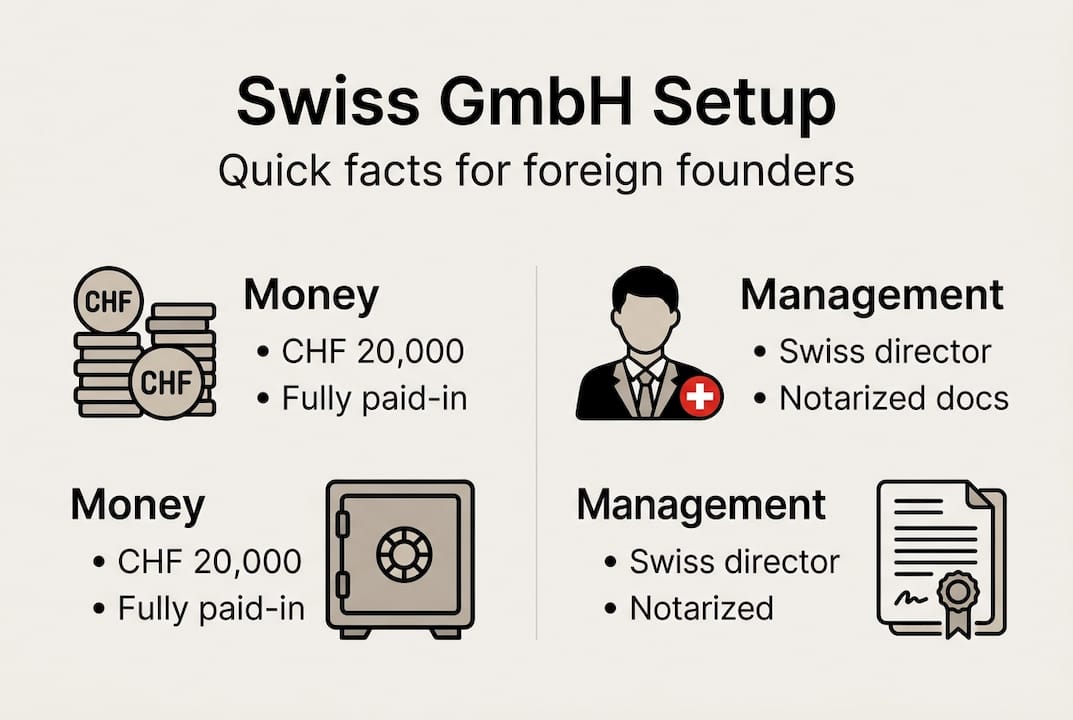
The second non-negotiable: at least one managing director must reside in Switzerland with a valid residence permit. This person can be a co-founder, an employee, or a professional nominee director. Their residency gives the Swiss authorities a local point of legal accountability. If you’re based abroad and have no Swiss-resident partner, a nominee director service fills this role.
Here’s what documents you’ll need to prepare upfront:
Valid passport or national ID for every founder and managing director
Proof of address (recent utility bill or bank statement, translated if not in German, French, or Italian)
Draft Articles of Association (Statutes), which define the company name, purpose, share capital, and management structure
Founders’ declaration confirming share ownership and capital payment
Signature specimens for managing directors
Your company name must be unique within Switzerland and comply with naming rules. The Commercial Register cross-checks your proposed name against all existing entries. Generic terms, geographic names, and names too similar to existing firms get rejected. Check the zefix.ch database before you fall in love with a name.
Requirement | Detail | Who arranges it |
Share capital | CHF 20,000, fully paid-in cash or in-kind | Founder(s) |
Swiss-resident director | Valid B, C, or L permit required | Founder or nominee |
Articles of Association | Drafted by lawyer or service provider | Legal counsel |
Company name | Unique, checked against ZEFIX | Founder / advisor |
Founder IDs | Certified copies for non-residents | Each founder |
Pro Tip: If you have no Swiss-based co-founder, engage a nominee director service early. Learning how to set up a GmbH with a nominee in place from day one prevents the most common foreign-founder bottleneck before it starts.
Step 1-3: From documents to capital contribution
Once prerequisites are in place, the real work begins. Here’s how to move swiftly through the first legal and financial steps.
Step 1: Draft the Articles of Association
The Articles of Association, known in German as Statuten, are the legal backbone of your GmbH. They must state the company name, registered address, business purpose, share capital amount, number and value of shares, and the rules governing management. Keep the business purpose broad enough to cover future activities but specific enough to satisfy the register. A professional familiar with preparing Swiss company documents will flag issues before they reach the notary.
Step 2: Notarize the documents
All founding documents must be notarized by a Swiss notary. This is non-negotiable. The notary verifies your identities, certifies the Articles, and records the founding act. If you can’t be present in Switzerland, you can grant a Power of Attorney (PoA) to a Swiss-based representative who appears on your behalf. The PoA itself must be authenticated, either through apostille or Swiss consulate certification in your home country. Allow extra time for this step if you’re managing it from abroad. Step 2 is drafted and notarized only once all founder identities are fully verified.

Step 3: Open a blocked bank account and deposit capital
A blocked bank account (German: Kapitaleinzahlungskonto) is a special account that holds your share capital until the Commercial Register confirms your registration. Opening this account and depositing CHF 20,000 is one of the hardest steps for foreign founders. Swiss banks apply strict know-your-customer rules, and opening any account as a non-resident can take two to four weeks, sometimes longer. Start this process in parallel with document preparation, not after.
Important: The bank releases the capital only after it receives official confirmation of registration from the Commercial Register. Until then, the funds are locked. Budget for this freeze when managing your cash flow.
Pro Tip: Prepare a clean, organized document package before your notary appointment. Missing a single certified copy means rebooking, paying again, and losing days. Run through the full notary process essentials checklist twice before you walk in.
Step 4: Commercial Register and official company launch
With capital deposited and documents notarized, it’s time for the final leap: registering for official recognition.
Your notary typically submits your registration application directly to the Cantonal Commercial Register (Handelsregisteramt). This submission includes:
Notarized Articles of Association
Founding declaration with capital confirmation
Bank confirmation of blocked capital deposit
Managing directors’ signature specimens
Declaration of acceptance from each managing director
Once the register receives a complete file, the registration takes 5 to 15 days. The actual processing time varies by canton. Zurich and Zug tend to be faster than smaller cantons. Digital submissions move quicker than paper-only ones.
When registration is confirmed, your company receives a UID number (Unternehmens-Identifikationsnummer), which functions as a unique business identifier. The UID and VAT number are issued at the point of registration. If your expected annual revenue exceeds CHF 100,000, VAT registration with the Swiss Federal Tax Administration is mandatory.
Document | Provided by | When needed |
Notarized Articles of Association | Notary | At submission |
Bank capital confirmation | Your bank | At submission |
Signature specimens | Managing directors | At submission |
Director acceptance declarations | Each director | At submission |
UID confirmation | Commercial Register | Upon registration |
Your GmbH is legally active the moment the register entry is published. From that point, your blocked bank account is released, your company can sign contracts, issue invoices, and begin business. Check key legal steps to confirm you’ve covered post-registration obligations like social insurance registration.
Use a company formation checklist to confirm nothing falls through the cracks after registration. Companies that skip post-launch compliance steps face fines and delayed permits.
Costs, timing, and in-kind setup options
Once your paperwork is in the system, let’s talk about the numbers. What should you actually budget?
Total setup costs run CHF 21,000 to 25,000, including capital, and the timeline ranges from 2 to 6 weeks. Here’s what makes up those costs:
Share capital deposit: CHF 20,000 (returned to company post-registration)
Notary fees: CHF 500 to 1,500 depending on complexity
Commercial Register fee: approx. CHF 600 to 800
Legal or formation service fees: CHF 1,000 to 3,000 for professional support
Translation and apostille costs: variable, often CHF 200 to 600 for foreign documents
The best case scenario is 2 to 3 weeks when a Swiss-resident founder is involved, banking is pre-arranged, and documents are clean. The worst case for foreign-only founders is 6 weeks or more, almost always due to bank delays.
For in-kind contributions (contributing equipment, IP, or property instead of cash), the process adds complexity. In-kind contributions require a valuation report certified by a licensed auditor. That report must accompany your registration documents.
Option | Speed | Cost impact | Complexity |
Cash deposit | Fast (1-2 weeks) | Fixed CHF 20,000 | Low |
In-kind contribution | Slow (4-8 weeks) | Variable + auditor fee | High |
The common GmbH formation mistakes almost always trace back to in-kind contributions with disputed valuations or incomplete auditor reports.
Pro Tip: For international founders, cash is the cleanest and most predictable path. In-kind contributions make sense only when you have a clear asset valuation and a licensed auditor ready to move quickly.
Our take: What most guides miss about Swiss GmbH setup
Most articles walk you through the steps and stop there. What they don’t tell you is that the Swiss GmbH setup process punishes small mistakes disproportionately.
A single mismatched character in a name across two documents can stall your registration for days. Banks run full compliance checks on foreign founders, and a vague or overly broad business purpose description raises flags. We’ve seen founders wait an extra three weeks simply because a utility bill was six days past the bank’s acceptable date range.
Over-documentation is not paranoia. It’s strategy. Bring more certified copies than you think you need. Translate everything even if the bank doesn’t explicitly ask. Confirm every detail with your bank compliance officer before submitting. The notary appointment is permanent and cannot be undone cheaply.
The single biggest bottleneck we see, consistently, is the bank account. Start there first. Not last.
Expert help for your Swiss GmbH setup
Knowing every step doesn’t eliminate the risk of a delay, an incorrect document, or a bank rejection that sets you back weeks. Foreign founders working without local support are statistically more likely to hit compliance issues that cost more to fix than they would have cost to prevent.

Our company formation services cover the full process from Articles of Association to notarization and Commercial Register submission. We handle bank account opening for foreign founders, including navigating compliance requirements that trip up most first-timers. Need a legal base? Our business address in Switzerland service gives your GmbH a credible Swiss presence from day one. Talk to our team and get your setup moving without the guesswork.
Frequently asked questions
How long does it take to set up a Swiss GmbH as a foreigner?
Setup typically takes 2 to 6 weeks, depending on how quickly your bank account is approved and whether your documents are complete on the first submission.
Is a Swiss resident director required for a GmbH?
Yes. At least one managing director must hold Swiss residence and a valid permit, either as a co-founder, employee, or professional nominee.
Can I use assets instead of cash for the share capital?
You can, but in-kind contributions require a certified valuation report from a licensed auditor, which adds time and cost. Cash is faster and simpler for most foreign founders.
When is my Swiss GmbH officially considered active?
Your GmbH becomes legally active once the Cantonal Commercial Register publishes your entry and a UID and VAT number are issued. Bank access and business operations can begin immediately after that confirmation.
Recommended
Comments