
Swiss Fiscal Advantages: Benefits for Global Investors
- Feb 5
- 7 min read
Updated: Feb 12

Choosing the right country for your business and investments can shape your long-term success, especially when every tax decision matters. Switzerland stands out for foreign entrepreneurs and high-net-worth investors from Asia and North America with its distinctive fiscal advantages and transparent legal frameworks. This guide reveals what truly makes Switzerland’s tax system unique, explains which benefits are real, and clarifies which advantages are misunderstood to help you plan strategically.
Table of Contents
Key Takeaways
Point | Details |
Swiss Tax System | Switzerland’s multilayered tax system offers low corporate tax rates and extensive tax treaty networks, enhancing financial strategies for investors. |
Corporate Tax Regimes | Various corporate tax regimes, including Holding and Mixed Company regimes, provide tailored tax benefits depending on business operations. |
Eligibility Criteria | High-net-worth individuals and companies must meet specific criteria focusing on residency status and economic contribution to qualify for fiscal benefits. |
Compliance and Risk | Investors should prioritize compliance with evolving regulations and develop flexible tax strategies to navigate risks associated with currency fluctuations and geopolitical uncertainties. |
Swiss Fiscal Advantages Defined and Debunked
Switzerland has long been recognized as a premier destination for global investors seeking strategic financial advantages. The country’s distinctive fiscal landscape offers a unique combination of tax benefits, regulatory stability, and economic transparency that sets it apart from traditional financial jurisdictions.
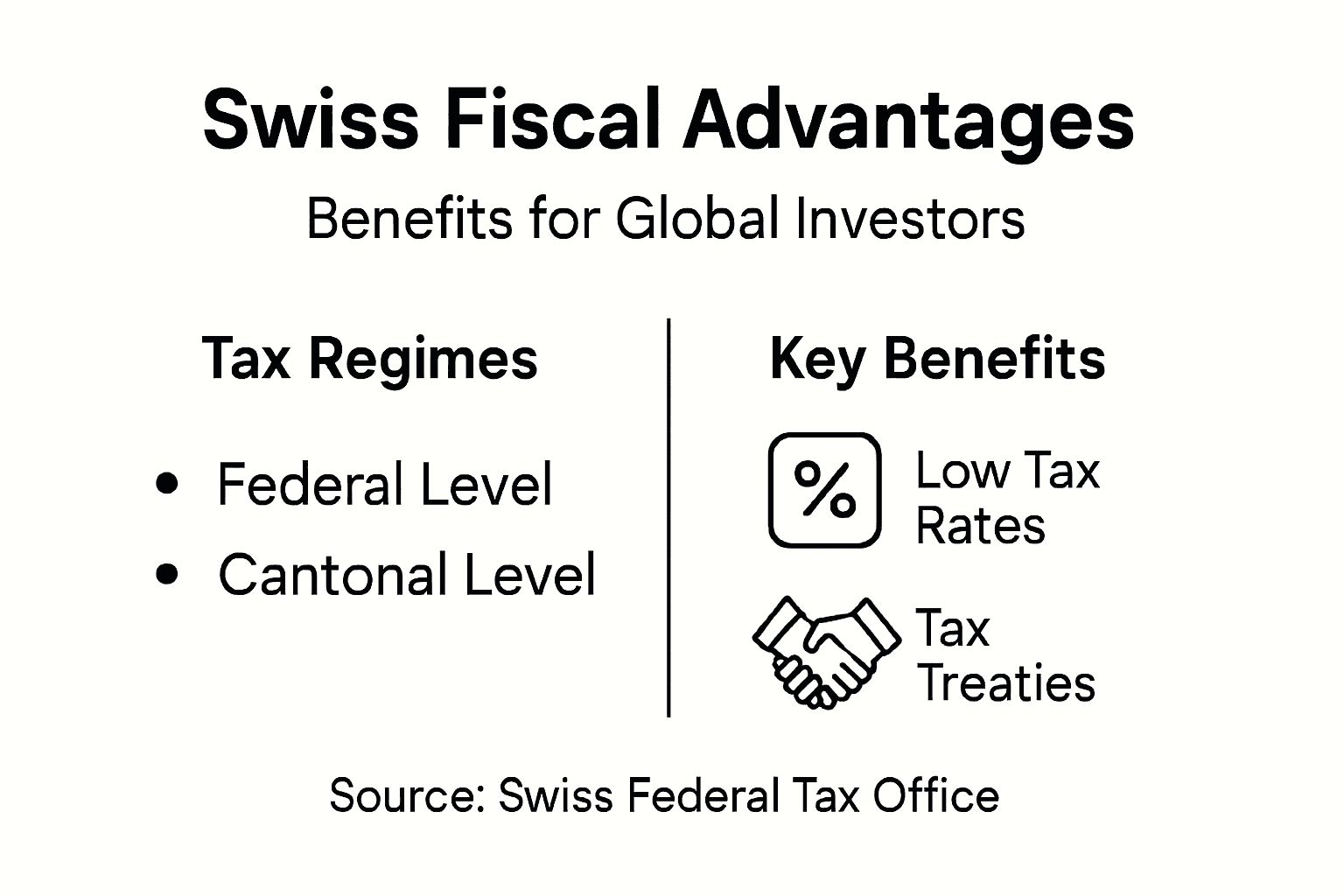
The Swiss tax system operates through a multilayered approach, integrating federal, cantonal, and local tax frameworks that create a remarkably competitive environment for businesses and high-net-worth individuals. Distinctive tax conditions make Switzerland an attractive hub for international financial strategies, with several key advantages:
Low Corporate Tax Rates: Federal and regional tax structures that minimize overall tax burden
Wealth Tax Mechanisms: Unique taxation models that provide significant financial flexibility
Tax Treaty Networks: Extensive international agreements reducing double taxation risks
Lump-Sum Taxation: Special provisions for wealthy foreign residents
What truly distinguishes Switzerland is its innovative approach to taxation. Unlike many countries that rely solely on income-based taxation, Switzerland employs a nuanced system that considers comprehensive expense-based models. This means wealthy individuals can potentially benefit from more favorable tax calculations based on living expenses rather than strict income reporting.
The Swiss fiscal environment is not about tax evasion, but strategic tax optimization. Investors can leverage transparent, legal mechanisms that provide legitimate financial advantages. The system prioritizes predictability, offering clear frameworks that allow precise financial planning without unexpected regulatory shifts.
Pro tip: Before establishing financial structures in Switzerland, consult with a certified tax professional who specializes in international wealth management to fully understand your specific tax implications.
Types of Swiss Corporate Tax Regimes
Switzerland’s corporate tax system is a sophisticated multilayered framework that offers remarkable flexibility for businesses seeking strategic financial optimization. Corporate tax structures are designed to provide competitive advantages across federal, cantonal, and local levels, creating an environment that attracts global investors and multinational corporations.
The Swiss tax regime encompasses several distinctive corporate taxation models:
Ordinary Corporate Tax Regime: Standard taxation approach for most businesses
Holding Company Regime: Special tax status with significant exemptions
Mixed Company Regime: Targeted benefits for companies with substantial international operations
Principal Company Regime: Favorable tax treatment for companies managing international subsidiaries
At the federal level, Switzerland maintains a consistent corporate tax rate of 8.5%, with combined effective tax rates ranging between 11% and 21% depending on the specific canton. Cantonal tax incentives play a crucial role in creating a competitive tax landscape, offering strategic subsidies and breaks for businesses in research, production, and other priority sectors.

What distinguishes Switzerland’s approach is its remarkable adaptability. The tax system allows for negotiated tax rulings, providing businesses with predictability and transparency. Companies can work directly with local tax authorities to establish clear, mutually understood tax frameworks that align with both national and international standards.
Here’s how Switzerland’s main corporate tax regimes differ across key factors:
Regime Type | Primary Focus | Typical Tax Rate Range | Key Eligibility |
Ordinary | Standard businesses | 11%-21% total | Operate in Switzerland |
Holding Company | Investment holdings | Lower than ordinary | 2/3 assets abroad |
Mixed Company | International trading | Variable, often reduced | 80% revenue overseas |
Principal Company | Central management | Negotiable, often favorable | Coordinates subsidiaries |
Pro tip: Consult with a Swiss tax specialist to understand which corporate tax regime best matches your specific business structure and international operational needs.
Key Criteria for Fiscal Benefits Eligibility
Navigating the intricate landscape of Swiss fiscal benefits requires a nuanced understanding of the specific eligibility criteria that govern both individual and corporate tax advantages. Fiscal benefit qualifications are designed to attract high-value international investors while maintaining rigorous standards of economic contribution and compliance.
For individual investors, the key eligibility criteria typically include:
Residency Status: Must be a high-net-worth foreign individual
Income Restrictions: No active local employment income
Minimum Wealth Thresholds: Substantial personal net worth requirements
Permanent Residence Commitment: Long-term settlement in Switzerland
Corporate fiscal benefits are equally sophisticated, with specific cantonal requirements that evaluate potential tax incentives based on multiple factors. Companies seeking advantageous tax treatment must demonstrate:
Economic value creation within Switzerland
Innovative business models
Commitment to research and development
Potential for job creation
Alignment with national economic priorities
The Swiss system distinguishes itself through its customized approach. Unlike many jurisdictions with rigid tax frameworks, Switzerland offers tailored fiscal benefits that can be negotiated based on the unique characteristics of individual investors and corporate entities. This flexibility allows for strategic tax optimization while maintaining transparency and legal compliance.
To quickly compare individual and corporate fiscal benefit eligibility in Switzerland:
Eligibility Factor | Individual Requirement | Corporate Requirement |
Residency/Location | Permanent Swiss settlement | Swiss economic activity |
Financial Threshold | High net worth required | Significant investment |
Income Restrictions | Limited local earned income | Value added in Switzerland |
Long-term Commitment | Intention to reside | Job creation, R&D focus |
Pro tip: Engage a specialized Swiss tax consultant who can comprehensively assess your specific financial profile and navigate the intricate eligibility requirements for maximum fiscal advantage.
Legal Framework Governing Tax Incentives
Switzerland’s tax incentive legal framework represents a sophisticated multilayered system designed to balance national economic interests with international compliance standards. Federal tax governance operates through a complex interplay of federal and cantonal regulations that provide strategic flexibility while maintaining transparency and economic integrity.
The key components of the Swiss tax incentive legal framework include:
Federal Oversight: Coordinated by the State Secretariat for International Finance
Cantonal Autonomy: Localized tax policy implementation
International Alignment: Compliance with OECD and global tax standards
Strategic Economic Development: Targeted incentives for innovative sectors
Regulatory mechanisms enable cantonal governments to design precise tax incentives that support critical economic objectives. These include targeted breaks for:
Research and development investments
Advanced manufacturing capabilities
Technology and innovation sectors
Professional training programs
Sustainable business practices
The Swiss approach distinguishes itself through remarkable adaptability. Unlike rigid tax systems, Switzerland’s legal framework allows for nuanced negotiation and customization of tax incentives. This flexibility enables individual cantons to create tailored economic strategies while maintaining a cohesive national approach that meets international regulatory requirements.
Pro tip: Engage a Swiss tax law specialist to navigate the intricate cantonal and federal tax incentive regulations specific to your business sector and investment profile.
Tax Planning, Compliance, and Risk Factors
Navigating the complex terrain of Swiss fiscal strategies requires a comprehensive understanding of tax planning intricacies and potential regulatory challenges. Effective tax management demands a sophisticated approach that balances strategic optimization with rigorous compliance requirements.
Key risk factors for global investors include:
Currency Fluctuation Risks: Potential financial exposure from exchange rate volatility
Regulatory Complexity: Evolving international tax standards and reporting requirements
Geopolitical Uncertainties: Potential policy shifts affecting tax frameworks
Cross-Border Compliance: Navigating multiple jurisdictional tax regulations
Economic Policy Changes: Potential impacts on existing tax incentive structures
Compliance strategies require proactive planning and deep understanding of both Swiss and international tax landscapes. Global investors must consider:
Transparent financial reporting mechanisms
Comprehensive risk management frameworks
Regular compliance audits
Adaptive tax planning approaches
Professional legal and financial consultation
The Swiss fiscal environment demands a nuanced approach that goes beyond traditional tax optimization. Successful investors understand that compliance is not just about minimizing tax liability, but about creating sustainable, legally sound financial structures that can withstand international scrutiny and evolving regulatory environments.
Pro tip: Develop a comprehensive tax strategy that includes regular expert consultations and maintains flexibility to adapt to changing international tax regulations.
Unlock the Power of Swiss Fiscal Advantages for Your Global Investments
Navigating Switzerland’s complex and unique tax regimes can pose a serious challenge for international investors aiming to maximize fiscal benefits while ensuring full compliance. The article highlights critical points such as diverse corporate tax structures, residency-based individual benefits, and multilayered legal frameworks that demand specialized knowledge and strategic planning. Without expert guidance, it is easy to feel overwhelmed by eligibility criteria, fluctuating tax incentives across cantons, and rigorous compliance requirements.
At rpcs.ch, we understand these pain points deeply. Our professional service platform is designed specifically to help entrepreneurs and high-net-worth individuals establish and manage Swiss companies such as GmbH and AG structures swiftly and confidentially. We provide end-to-end support with legal documentation, notarization, registration, banking setup, accounting, and ongoing compliance management — all tailored to leverage Switzerland’s favorable tax environment and international credibility. Discover how Swiss incorporation can turn these fiscal complexities into strategic advantages for your global business.
Are you ready to transform the intricacies of Swiss fiscal benefits into a clear path for growth and security Act now to partner with expert consultants who specialize in Swiss tax regimes and corporate frameworks Visit rpcs.ch today for personalized support that makes your Swiss company formation and management seamless and fully compliant.
Frequently Asked Questions
What are the key tax advantages for global investors in Switzerland?
Switzerland offers low corporate tax rates, unique wealth tax mechanisms, extensive tax treaty networks to reduce double taxation, and lump-sum taxation provisions for wealthy foreign residents, making it a favorable environment for investors.
How does the Swiss corporate tax regime differ from others?
The Swiss corporate tax system includes various regimes such as ordinary, holding, mixed, and principal company models, each designed to provide specific tax benefits depending on the nature and operations of the business.
What are the eligibility criteria for individual fiscal benefits in Switzerland?
To qualify for individual fiscal benefits, high-net-worth foreign individuals must have residency status, meet income restrictions, adhere to wealth thresholds, and commit to long-term residence in Switzerland.
What compliance challenges do global investors face when navigating Swiss taxes?
Investors must deal with currency fluctuation risks, regulatory complexities, cross-border compliance, and potential economic policy changes, requiring effective planning and risk management to maintain compliance.
Recommended
Comments