
Swiss Employment Law Overview for International Entrepreneurs
- 2 hours ago
- 10 min read

TL;DR:
Swiss employment law is embedded within the Swiss Code of Obligations, complemented by federal statutes and cantonal regulations, requiring compliance across multiple legal layers. International entrepreneurs must understand this multi-tiered system to avoid violations related to dismissal, minimum wages, and social insurance contributions. Proper preparation, including sector-specific agreements and cantonal variations, ensures legal compliance and avoids costly penalties or misunderstandings.
Swiss employment law is the set of legal rules defining employer-employee relationships in Switzerland, combining contract law principles with mandatory worker protections to regulate every aspect of employment in the country. Unlike jurisdictions with a dedicated labor code, Switzerland embeds employment law within the Swiss Code of Obligations (Articles 319 to 362), supplemented by federal statutes and sector-specific collective agreements. For international entrepreneurs setting up operations in Switzerland, this decentralized, multi-layered structure is the single most important thing to understand before hiring your first employee. Getting it wrong means exposure to abusive dismissal claims, cantonal minimum wage violations, and mandatory social insurance penalties.
What is a Swiss employment law overview and why does it matter?
Swiss employment law operates through three distinct layers: the Swiss Code of Obligations at the federal level, mandatory public law statutes like the Employment Act, and cantonal regulations that vary significantly by region. Swiss employment law prioritizes contractual freedom and decentralization, granting employers and employees flexibility to tailor agreements within mandatory public protections. This means you can customize many contract terms, but you cannot contract below the statutory floor.

The Swiss Code of Obligations governs the formation, content, and termination of employment contracts. The Employment Act (Arbeitsgesetz) covers health protection, working time, and special categories of workers. Collective Labour Agreements (GAV/CLA) and cantonal laws then add another layer on top. For an international entrepreneur, the practical implication is clear: compliance requires knowledge of all three layers simultaneously, not just the federal baseline.
The recognized industry term for this body of rules is Swiss labor law (Arbeitsrecht in German), and you will encounter both terms interchangeably in legal and business contexts. Understanding the full scope of Swiss labor regulations before you draft your first contract is not optional. It is the foundation of every compliant employment relationship you will build in Switzerland.
What are the main types and essential features of Swiss employment contracts?
Swiss employment contracts come in two primary forms: fixed-term contracts, which expire at a predetermined date, and indefinite contracts, which continue until one party terminates them with proper notice. Both are legally valid, but each carries distinct obligations and risks.
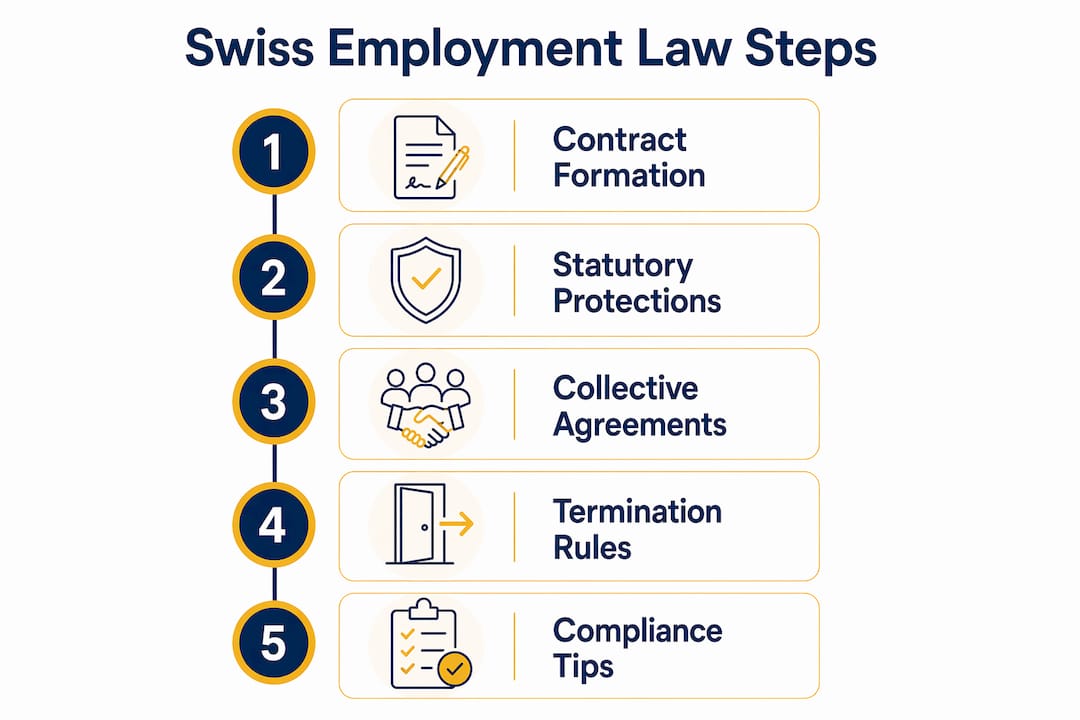
Certain provisions require written form to be valid, including restrictive covenants and deviations from statutory notice periods. While oral contracts are technically enforceable for basic employment terms, relying on them exposes both parties to disputes over what was actually agreed. Written contracts are the standard in Swiss business practice for good reason.
Key elements every Swiss employment contract should address:
Probationary period: The statutory maximum is one month, extendable to three months by written agreement. During probation, either party can terminate with seven days’ notice.
Notice periods: These are set by law and vary by length of service. Notice periods range from one month in the first year to three months after ten years of service.
Working hours: Standard full-time work is 45 hours per week in industrial and office roles, 50 hours in other sectors.
Salary and benefits: Must be specified clearly, including any variable components like bonuses.
Non-compete clauses: Only valid if agreed in writing, limited in geographic scope and duration, and tied to genuine business interests.
Pro Tip: Always draft Swiss employment contracts in the local cantonal language as well as English if your team is international. A contract that is only in English may create interpretation disputes in Swiss courts, which operate in German, French, or Italian depending on the canton.
Fixed-term contracts that are renewed repeatedly can be reclassified as indefinite contracts by Swiss courts, which then triggers full notice period and dismissal protection obligations. If you plan to use fixed-term arrangements, limit renewals and document the legitimate business reason for each term.
How do statutory protections and mandatory provisions shape Swiss employment law?
Swiss worker protection laws set a floor that no employment contract can undercut. The Employment Act (Arbeitsgesetz) is the primary federal statute governing health protection, working time, rest periods, and special categories of workers. Some provisions are mandatory and cannot be contracted out, regardless of what an employer and employee agree in writing.
The key statutory protections every employer must respect:
Working time limits: Maximum 45 or 50 hours per week depending on the sector, with mandatory daily rest periods of at least 11 consecutive hours.
Annual leave: Minimum leave entitlements are four weeks per year for employees over 20, and five weeks for employees under 20. Contracts can improve on this but cannot reduce it.
Health and safety: Employers must take all measures necessary to protect employee health and prevent workplace accidents. This obligation is both physical and psychological.
Anti-discrimination: Employers must prevent discrimination including gender-based discrimination under the Gender Equality Act (Gleichstellungsgesetz). Discrimination based on origin, religion, sexual orientation, and disability is also prohibited.
Maternity protection: Pregnant employees and breastfeeding mothers receive special protections under the Employment Act, including restrictions on night work and mandatory maternity leave of 14 weeks at 80% of salary.
Pro Tip: Switzerland’s Gender Equality Act requires employers with 100 or more employees to conduct and certify equal pay analyses every four years. If you are scaling toward that threshold, build pay equity tracking into your HR systems early. Retrofitting it later is significantly more complex.
Social insurance contributions are another non-negotiable obligation. Swiss employers must contribute to mandatory social insurance including accident insurance (SUVA or private insurer), pension funds (BVG/LPP), unemployment insurance, and health insurance. These contributions are statutorily regulated and represent a substantial portion of total employment costs, often adding 15 to 20 percent on top of gross salary. For a foreign entrepreneur budgeting a Swiss workforce, this is the number that most frequently causes financial surprises.
What roles do collective labor agreements and cantonal legislation play?
Collective Labour Agreements declared generally binding must be followed by all employers and employees in that sector, regardless of whether the employer is a member of the relevant employer association. This is the feature of Swiss labor regulations that catches the most foreign businesses off guard. You can be bound by a CLA you never signed and never knew existed.
The table below shows how federal law, collective agreements, and cantonal regulations interact:
Layer | Source | Overrides |
Federal law | Swiss Code of Obligations, Employment Act | Sets the statutory minimum floor |
Collective Labour Agreements (GAV/CLA) | Sector-specific agreements, some generally binding | Can exceed federal minimums; binding on all sector employers if declared generally binding |
Cantonal law | Canton-specific statutes and minimum wage ordinances | Applies within the canton; overrides private contracts where applicable |
Individual contract | Employer-employee agreement | Can exceed but never fall below any of the above layers |
On minimum wages, no federal minimum wage exists, but cantons including Geneva, Neuchâtel, Jura, Ticino, and Basel-City have implemented mandatory minimums. As of Q1 2026, these cantonal minimums override private contracts where applicable. Geneva currently holds the highest cantonal minimum wage in Switzerland. If you operate across multiple cantons, you must track each canton’s requirements separately. A payroll structure that is compliant in Zurich may be non-compliant in Geneva.
For businesses in construction, hospitality, cleaning, and several other sectors, generally binding CLAs set mandatory minimum wages, working hours, and notice periods that go well beyond the federal baseline. Checking CLA applicability before you hire in any sector is a compliance step that cannot be skipped.
What termination rules and employee protections apply under Swiss law?
Switzerland operates on a principle of freedom of dismissal. Swiss law permits termination without cause subject to notice periods, meaning an employer does not need to justify an ordinary dismissal. This is a significant difference from many European jurisdictions and gives Swiss employers considerable flexibility.
However, freedom of dismissal has clear limits:
Abusive dismissal: Termination is abusive if motivated by discriminatory or unfair reasons, such as the employee exercising a legal right, asserting a claim against the employer, or belonging to a protected group. Abusive dismissal compensation can reach up to six months’ salary, but critically, it does not invalidate the dismissal itself. The employee still leaves; the employer simply pays a penalty.
Protected periods: Dismissal is prohibited during illness (up to 30, 60, or 90 days depending on length of service), pregnancy and maternity leave, military service, and civil protection duty. A notice of termination served during a protected period is null and void.
Collective redundancies: Employers planning to dismiss 10 or more employees within 30 days must consult with employee representatives and notify the cantonal labor authority. Social plan obligations may apply depending on company size and the applicable CLA.
Reference letters: Swiss employees have a statutory right to a written reference letter (Arbeitszeugnis) upon request. It must be truthful but benevolent in tone. Issuing a negative reference without factual basis exposes the employer to liability.
For hiring employees in Switzerland, understanding the interplay between notice periods, protected periods, and abusive dismissal rules is the foundation of any defensible termination process.
What should international businesses know before hiring in Switzerland?
International entrepreneurs often misunderstand Switzerland’s lack of a comprehensive labor code. Compliance requires knowledge of a multi-layered system combining federal and cantonal laws with sector-specific agreements. The practical challenges for foreign businesses go beyond reading the statutes.
Key considerations for international operators:
Work permits: EU and EFTA nationals benefit from the Agreement on the Free Movement of Persons and can work in Switzerland with registration rather than a formal permit for most roles. Non-EU nationals require a work permit, and quotas apply. Understanding this distinction is critical before you recruit internationally. The Swiss immigration requirements for foreign employees differ substantially by nationality.
Social insurance enrollment: Every employee must be enrolled in the mandatory social insurance schemes from day one. Late enrollment creates retroactive liability for both contributions and penalties.
Data protection: Switzerland’s revised Federal Act on Data Protection (nFADP), which came into force in September 2023, imposes GDPR-comparable obligations on employers handling employee data. HR systems, payroll processors, and background check procedures must all comply.
Contract customization: A generic contract template downloaded from the internet will not reflect cantonal diversity, applicable CLAs, or Swiss-specific mandatory terms. Every contract should be reviewed by a Swiss-qualified legal professional before signing.
Pro Tip: If you are forming a GmbH or AG in Switzerland and plan to hire staff, address your employment contract templates and social insurance registrations at the same time as your company registration. Waiting until after formation creates a compliance gap that is difficult to close retroactively.
For foreign entrepreneurs in Switzerland, the combination of cantonal variation, CLA applicability, and social insurance obligations makes early legal advice the most cost-effective investment you can make.
Key takeaways
Swiss employment law compliance requires mastering three simultaneous layers: federal statutes, sector-specific collective agreements, and canton-specific regulations, with no single document containing all applicable rules.
Point | Details |
Federal foundation | The Swiss Code of Obligations (Articles 319-362) governs all employment contracts as the baseline legal framework. |
Mandatory protections | Statutory minimums on leave, working hours, and social insurance cannot be waived by contract, regardless of what parties agree. |
Cantonal variation | Minimum wages differ by canton; Geneva, Basel-City, and Ticino each set their own floors that override private contracts. |
Abusive dismissal risk | Termination without cause is permitted, but discriminatory or unfair dismissal triggers penalties of up to six months’ salary. |
CLA binding effect | Collectively bargained agreements declared generally binding apply to all sector employers, including those who never signed them. |
Why Swiss employment law rewards preparation over reaction
Most foreign entrepreneurs I work with arrive in Switzerland with one of two misconceptions. Either they assume Swiss employment law is as rigid as German or French labor law, or they assume that Switzerland’s business-friendly reputation means employment rules are loose and flexible. Both assumptions lead to expensive mistakes.
The reality is more nuanced. Switzerland genuinely does give employers significant freedom, particularly around termination. You can end an indefinite contract without stating a reason, which is something you cannot do in most of continental Europe. But the mandatory protections around dismissal timing, social insurance, and collective agreements are enforced with precision. Swiss labor authorities and courts do not give foreign employers a grace period for learning the rules.
What I have found works best for international businesses is treating Swiss employment law as a system to be mapped before the first hire, not after. That means identifying which CLAs apply to your sector, confirming cantonal minimum wages for every location you operate in, and building your contract templates around Swiss-specific mandatory terms rather than adapting contracts from another jurisdiction. The HR management process in Switzerland is manageable once you understand the structure. The cost of ignoring it is not.
One area I consistently see underestimated is the social plan obligation in collective redundancies. If your business scales and then needs to restructure, the consultation and notification requirements can add months to a process you assumed would take weeks. Build that into your operational planning from the start.
— Rolands
How Rpcs helps you set up and stay compliant in Switzerland
Forming a company in Switzerland is only the beginning. The employment obligations that attach to your first hire, from social insurance registration to contract drafting and cantonal compliance, require the same precision as your company formation documents.
Rpcs provides Swiss company formation services for GmbH and AG structures, with integrated support covering HR documentation, payroll setup, and ongoing legal compliance. For international entrepreneurs who need a registered address, a local director, or accounting services alongside their employment compliance framework, Rpcs offers a single point of coordination. You get local expertise without needing a local office from day one. Contact Rpcs to discuss your Swiss operational setup and get your employment compliance structure right from the start.
FAQ
What is Swiss employment law based on?
Swiss employment law is primarily based on the Swiss Code of Obligations (Articles 319 to 362), supplemented by the Employment Act, the Gender Equality Act, and sector-specific collective labour agreements. It does not have a single dedicated labor code.
Are employment contracts in Switzerland required to be in writing?
Oral contracts are legally valid for basic terms, but provisions like non-compete clauses and deviations from statutory notice periods must be in writing to be enforceable. Written contracts are standard practice and strongly recommended.
Can an employer in Switzerland fire an employee without a reason?
Yes. Swiss law permits ordinary termination without cause, provided the employer respects the applicable notice period. However, termination motivated by discriminatory or unfair reasons constitutes abusive dismissal and can result in penalties of up to six months’ salary.
Do cantonal minimum wages apply to all businesses in Switzerland?
Cantonal minimum wages apply to all employers operating within that canton, overriding any private contract that sets a lower rate. Cantons including Geneva, Basel-City, Neuchâtel, Jura, and Ticino each have their own mandatory minimums as of 2026.
What social insurance contributions must Swiss employers make?
Swiss employers must contribute to accident insurance, the occupational pension fund (BVG/LPP), unemployment insurance, and the AHV/IV/EO social security scheme. These contributions are mandatory from the first day of employment and are statutorily regulated.
Recommended
Comments