
Swiss corporate restructuring: What foreign investors must know
- 10 hours ago
- 9 min read

TL;DR:
Most foreign investors wrongly assume Swiss corporate distress automatically initiates court proceedings, which is not the case. Swiss restructuring primarily relies on early negotiations led by the company’s board, with courts stepping in only if private solutions fail. Building strong stakeholder relationships and understanding local legal expectations are crucial for successful restructuring outcomes in Switzerland.
Most foreign investors assume that corporate distress in Switzerland triggers an automatic, court-driven legal process similar to bankruptcy proceedings in the US or UK. That assumption is wrong, and it can cost you. Swiss corporate restructuring is primarily negotiator-led, relationship-driven, and resolved long before a judge gets meaningfully involved. Restructuring activity is increasing in Switzerland, reaching a six-year high in 2024, which means more international entrepreneurs are facing these situations without a clear roadmap. This article gives you that roadmap.
Table of Contents
Out-of-court restructuring: Board duties and early intervention
Court-supervised restructuring: The composition proceeding process
Swiss restructuring for foreign investors: Unique challenges and best practices
A fresh perspective: Why negotiation beats courtroom battles in Switzerland
How RPCS Solutions supports your Swiss restructuring journey
Key Takeaways
Point | Details |
Negotiation is central | Swiss restructuring is driven by stakeholder negotiations, not by court authority. |
Board action is required | Company boards have legal duties to act early when signs of distress appear. |
Moratorium phase matters | The composition moratorium allows time for analysis and agreement before a company faces liquidation. |
Foreign investor challenges | International entrepreneurs must coordinate locally and engage stakeholders for successful restructuring. |
Restructuring activity rising | Swiss debt restructuring cases recently hit a six-year high, showing growing relevance for business owners. |
Understanding Swiss corporate restructuring: The basics
To understand your options, let’s start with the basics.
Corporate restructuring in Switzerland is a set of measures designed to address company distress, governed by corporate law and the Swiss Debt Collection and Bankruptcy Act (DCBA). The DCBA is the primary statute that regulates formal insolvency and restructuring procedures. But here’s what surprises most foreign investors: the law actually encourages companies to solve their problems internally first.
Swiss restructuring falls into two broad categories:
Out-of-court restructuring: Board-driven measures taken before any court becomes involved. This can include renegotiating debt terms, selling assets, raising new capital, or operationally reorganizing the business.
Court-supervised restructuring: Formal proceedings initiated under the DCBA when out-of-court solutions fail or aren’t viable. This includes the composition proceeding (explained in detail below).
The key insight here is sequencing. Swiss law expects boards to act early and decisively. Courts step in only when private solutions break down. This is fundamentally different from systems where filing for court protection is the first instinct.
“Swiss corporate restructuring is not a single event. It is a decision-making process that begins with a board’s obligation to recognize distress and ends, ideally, without court involvement at all.”
Understanding this two-track system is essential before you make any decision about your Swiss subsidiary or investment. If you are thinking about broader exit scenarios, reviewing a solid company exit strategies framework can help you see where restructuring fits relative to other options like dissolution or liquidation. For more specific scenarios, the company liquidation guide and company dissolution steps provide practical comparisons.
Out-of-court restructuring: Board duties and early intervention
Now that you know the frameworks, let’s look at what boards must do before courts ever get involved.

In Switzerland, board members are not passive observers when a company faces financial difficulty. The law assigns them active duties the moment distress indicators appear. These indicators include over-indebtedness (liabilities exceeding assets), inability to pay debts as they fall due, and a deteriorating liquidity position that threatens ongoing operations.
Here’s a practical sequence of what boards are expected to do:
Recognize distress early. Management reporting should flag liquidity risk, not just profitability. Swiss boards are expected to monitor balance sheet health continuously, not just at year-end.
Commission an independent assessment. This typically means engaging a local auditor or restructuring advisor to prepare a going-concern analysis and assess both the causes and scope of distress.
Develop a restructuring plan. The plan should address the root causes, whether operational inefficiency, overleveraging, or market changes, and outline concrete corrective measures with timelines.
Communicate proactively with creditors. In Switzerland, voluntary creditor engagement before any court involvement can make or break a restructuring. Early transparency builds the goodwill you need for creditor cooperation.
Document every decision. This is critical. Timing and evidentiary expectations for moratorium applications, and the interaction between board duties under the Swiss Code of Obligations (CO) and later liability scrutiny, are directly tied to what was documented and when.
Pro Tip: If you are running a foreign-owned Swiss subsidiary, appoint at least one Swiss-resident board member with local restructuring experience. This is not just a legal convenience; it ensures real-time awareness of local regulatory expectations and lowers your liability exposure significantly.
Failing to act promptly carries serious consequences. Board members can face personal liability for losses suffered by creditors if distress was apparent and no action was taken. This is not a theoretical risk. Swiss courts have examined these timelines carefully in liability cases. Reviewing your board responsibilities guide before a crisis develops is far better than scrambling once distress is already visible.
Foreign owners often underestimate the administrative discipline Swiss law requires. Keeping your annual administration guide practices current and your corporate tax registration steps in order creates the documentation trail that protects board members and supports creditor trust in any restructuring conversation.
Court-supervised restructuring: The composition proceeding process
When board-driven options aren’t enough, here’s what happens if court intervention is required.
The formal Swiss procedure for court-supervised restructuring is the composition proceeding (Nachlassverfahren), and it begins with a phase called the composition moratorium. Think of the moratorium as a structured pause. The court grants the company temporary protection from creditor enforcement actions so that a realistic assessment and negotiation can occur.
Here’s how the process typically unfolds:
Provisional moratorium: The company applies to the court, which appoints a commissioner (an independent expert). The provisional moratorium typically lasts four months and can be extended.
Assessment and analysis: During the moratorium, the commissioner and management evaluate the company’s financial position, identify viable restructuring paths, and begin structured communication with creditors.
Stakeholder negotiation: This is the most intensive phase. Creditors, shareholders, and management negotiate the terms of a composition agreement. The agreement can involve debt reduction, extended repayment schedules, or asset transfers.
Court confirmation: If creditors approve the agreement by the required majority, the court confirms it. The confirmation makes the agreement binding on all creditors, including those who voted against it.
Liquidation outcome: If no agreement is reached, the proceeding shifts toward bankruptcy liquidation proceedings.
The numbers here tell a striking story. In 2024, 131 debt restructuring proceedings were registered in Switzerland, representing a 40% increase compared to 2023. That is the highest figure in six years. This surge reflects genuine financial stress across sectors, not just a statistical blip.
Phase | Typical duration | Key actor | Primary goal |
Provisional moratorium | Up to 4 months | Court-appointed commissioner | Assess and protect |
Creditor negotiation | Variable (weeks to months) | Management and creditors | Agree on restructuring terms |
Court confirmation | Weeks after vote | Court | Bind all creditors to agreement |
Failure scenario | Immediate | Court | Trigger bankruptcy proceedings |
If you are comparing Swiss restructuring to simpler scenarios like selling off the business, the company liquidation process outlines how formal liquidation differs from a negotiated restructuring exit. The distinction matters enormously for asset recovery timelines and creditor satisfaction.
Swiss restructuring for foreign investors: Unique challenges and best practices
Foreign investors face unique nuances. Here’s how to navigate them.
Switzerland’s restructuring framework is built on one foundational assumption: that sophisticated parties can negotiate effectively without heavy court direction. Swiss restructuring relies heavily on negotiating skills and coordination among stakeholders within the moratorium and composition framework, with courts having defined but comparatively limited intervention. For foreign investors used to court-led protection, this requires a mindset shift.
Here’s what makes Swiss restructuring genuinely different for international entrepreneurs:
High creditor autonomy. Swiss creditors have significant power to accept or reject restructuring terms. Unlike some jurisdictions where courts can cram down creditor objections, Swiss law gives creditors real leverage in negotiations. You need to treat them as partners, not adversaries.
Language and local expertise gaps. Proceedings often involve Swiss German or French documentation. Misunderstanding a creditor communication or a court filing can cost critical days in a time-sensitive moratorium phase.
Reputational stakes. Switzerland’s business community is small and interconnected. How a foreign investor handles distress signals travels fast. Transparent, early engagement protects your long-term standing far more than delaying uncomfortable conversations.
Tax and compliance continuity. Even during restructuring, Swiss authorities expect ongoing compliance with tax filings and accounting obligations. Letting these lapse creates additional legal exposure.
Here is a practical comparison of how Swiss restructuring characteristics affect foreign investors versus domestic ones:
Factor | Domestic companies | Foreign-owned Swiss entities |
Board experience with Swiss law | Usually present | Often limited, requires local advisors |
Creditor relationships | Established | May need to be built quickly |
Language of proceedings | Familiar | Potential barrier without local support |
Early warning systems | Internal metrics | May depend on Swiss-based management |
Court navigation | Familiar with local courts | Requires specialist legal guidance |
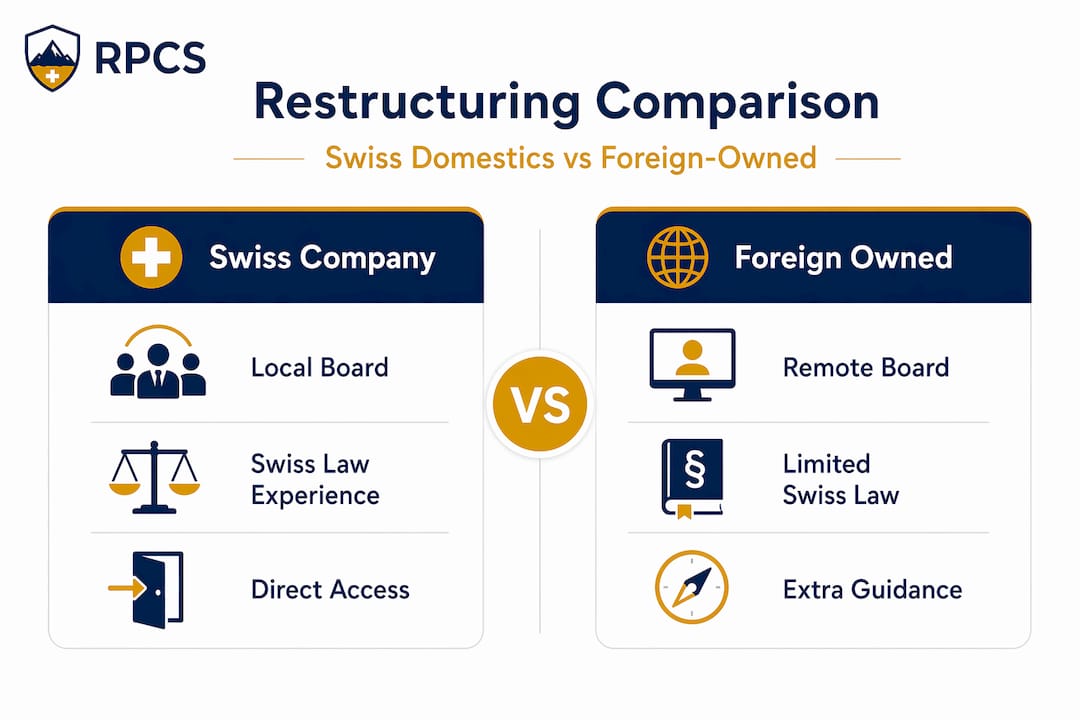
Understanding investment risks and tax benefits before distress occurs is part of smart foreign investor planning. The best outcomes in Swiss restructuring consistently involve foreign investors who took time to understand local norms before they needed them, not after.
Pro Tip: Before any distress appears, build relationships with at least one Swiss restructuring attorney and one local financial advisor. When you need them urgently, you will not have time to vet professionals from scratch.
Reviewing the complete foreign ownership rules guide and practical tips for foreign investors can sharpen your understanding of the legal landscape that shapes how Swiss creditors and courts view foreign-owned companies. If you are still in the formation stage, our company formation for investors guide explains how structure choices at founding affect your flexibility during any future restructuring.
A fresh perspective: Why negotiation beats courtroom battles in Switzerland
Having covered the mechanics and best practices, let’s reflect on what really works in Swiss restructuring.
Here is the contrarian truth that most legal articles won’t tell you directly: in Switzerland, the outcome of a restructuring is almost always determined before the court formally acts, not during formal proceedings. Swiss creditor autonomy is especially pronounced, and the parties who understand that build their restructuring strategy around relationships and communication, not legal filings.
We have seen foreign investors waste months and enormous legal fees waiting for court processes to solve problems that were fundamentally about trust. A creditor who feels blindsided by a sudden restructuring announcement will fight every procedural step. The same creditor, approached early and honestly, often becomes a constructive participant in finding a workable solution.
The data supports this. With 131 restructuring proceedings in 2024, a significant share of companies that successfully completed the composition proceeding did so because creditor negotiations reached agreement during the moratorium phase, not because courts forced a resolution.
This matters for how you prepare. Instead of focusing entirely on legal compliance checklists, invest equally in stakeholder mapping. Who are your major creditors? What do they actually care about, cash recovery speed, relationship preservation, or reputation? What communication style do they respond to? These questions determine success more than procedural expertise.
Switzerland’s model works precisely because it trusts sophisticated parties to find better solutions than any court could impose. Embrace that philosophy early, review your tips for foreign investors for relationship-building strategies, and you will navigate Swiss restructuring far more effectively than those who arrive at the table only when legally required to do so.
How RPCS Solutions supports your Swiss restructuring journey
Ready to take action? Here’s how RPCS Solutions makes restructuring easier for international entrepreneurs and investors.
Navigating Swiss corporate restructuring without local expertise is a significant risk that most foreign investors underestimate until they’re already under pressure. RPCS Solutions provides the on-the-ground support that international entrepreneurs need to stay compliant and make informed decisions at every stage.

Whether you are establishing a new Swiss entity, managing an existing company through difficulty, or preparing for a potential restructuring scenario, our company formation support ensures your legal structure is sound from day one. Our Swiss accounting services keep your financial documentation in the precise order that Swiss creditors and courts expect. And our company address services ensure your Swiss presence meets all local registration and compliance requirements throughout any restructuring process.
Frequently asked questions
How does Swiss restructuring differ from other countries?
Switzerland relies on negotiated agreements and less court intervention compared to many countries with court-centered processes. Swiss creditor autonomy is high and court-driven restructuring is comparatively limited, placing the burden of resolution on the parties themselves.
What triggers board duties in Swiss corporate restructuring?
Board duties begin when distress indicators arise, requiring immediate action and assessment to prevent liability scrutiny. Timing and evidentiary expectations for moratorium applications, and the interaction between board duties under the CO and later liability scrutiny, are central concerns once distress becomes apparent.
What is the composition moratorium in Swiss restructuring?
It is the provisional phase during court-supervised restructuring, allowing companies to analyze options and negotiate with stakeholders before a final agreement or liquidation. The composition proceeding begins with a moratorium, during which a court-appointed commissioner oversees the process.
Is Swiss restructuring activity increasing?
Yes, restructuring cases have surged recently, with a 40% increase in registered proceedings in 2024 compared to 2023, reaching the highest level recorded in six years.
Recommended
Comments