
Role of Swiss Corporate Law: Key Impacts for AG & GmbH
- Feb 7
- 7 min read
Updated: Feb 17

Choosing the right legal structure is often the first major decision for foreign entrepreneurs entering the Swiss market. Swiss corporate law, anchored in the Swiss Code of Obligations, creates a stable platform for both large and small ventures to operate securely and transparently. This article highlights the essential features of Swiss corporate law, explores AG and GmbH company types, and points out compliance duties and attractive tax benefits international founders can expect in Switzerland.
Table of Contents
Key Takeaways
Point | Details |
Swiss Corporate Law Purpose | Swiss corporate law aims to establish a transparent and flexible framework that fosters business innovation while protecting stakeholder interests. |
Corporate Structure Choices | Entrepreneurs can choose between AG and GmbH structures, each catering to different business scales and objectives. |
Company Formation Process | Establishing a company in Switzerland requires strict adherence to legal processes, including capital requirements and registration with the trade register. |
Compliance and Tax Benefits | Swiss corporate governance entails detailed compliance standards, while offering competitive tax benefits to attract international businesses. |
Defining Swiss Corporate Law and Its Purpose
Swiss corporate law represents a sophisticated legal framework that establishes the foundational rules governing business entities in Switzerland. Centrally located in the Swiss Code of Obligations, this comprehensive legal system defines the structural and operational guidelines for companies like AG (Aktiengesellschaft) and GmbH (Gesellschaft mit beschränkter Haftung).
The primary purpose of Swiss corporate law extends beyond mere regulatory compliance. It aims to create a robust, transparent, and flexible environment that supports business innovation while protecting stakeholder interests. Key objectives include:
Establishing clear legal frameworks for different company types
Defining shareholder and director rights and responsibilities
Ensuring financial transparency and accountability
Protecting investor and creditor interests
Promoting Switzerland’s reputation as a stable business destination
The legal structure intentionally balances regulatory oversight with business flexibility. Corporate entities in Switzerland gain distinct legal personalities, which means they can operate independently from their founders, enter contracts, own assets, and assume liabilities.

Under this framework, entrepreneurs can choose between two primary corporate structures: AG and GmbH. Each structure offers unique advantages tailored to different business scales and objectives. The AG typically suits larger enterprises requiring significant capital, while the GmbH provides a more flexible option for smaller businesses.
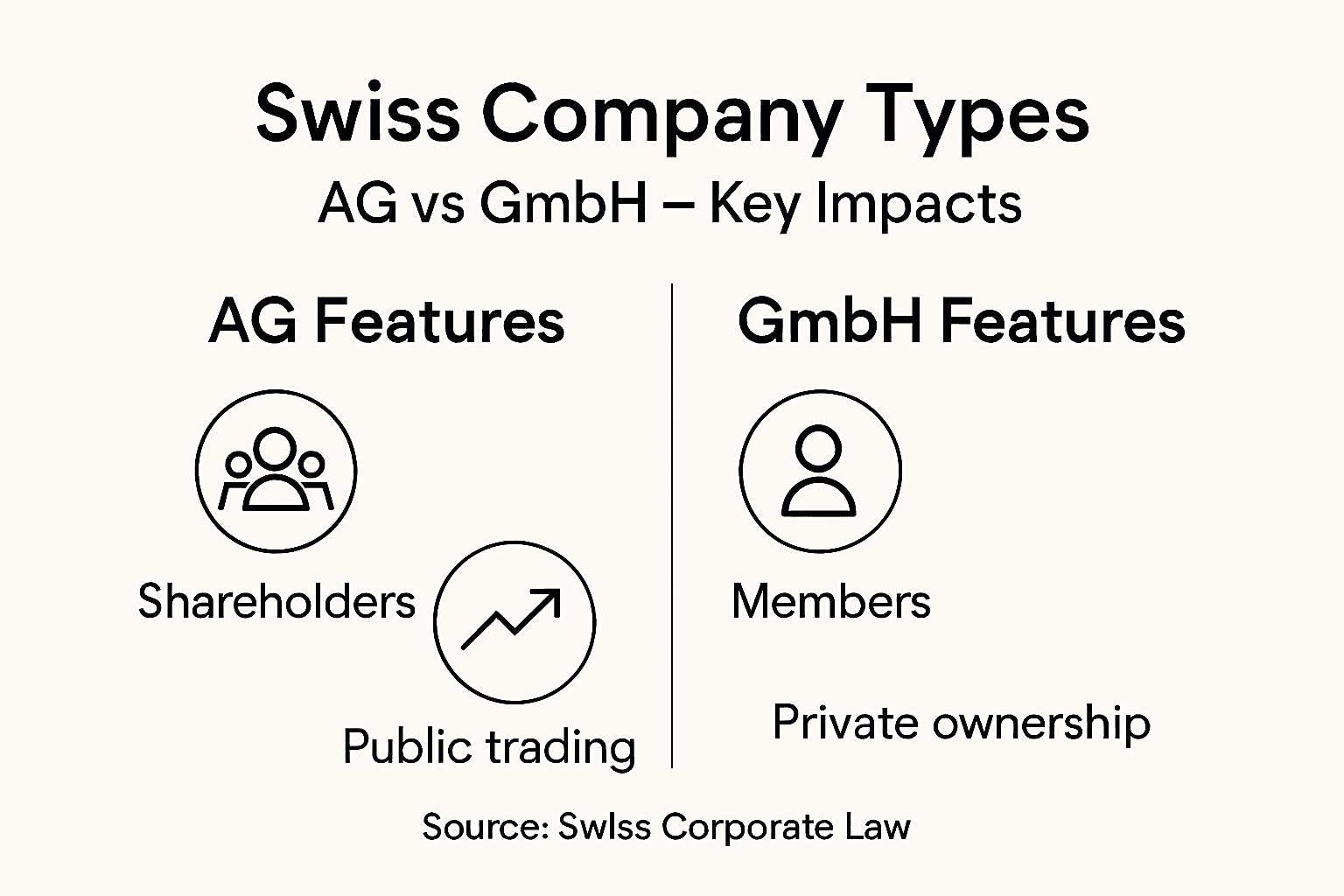
Pro tip: When establishing a Swiss company, carefully analyze the specific legal requirements and structural nuances of AG and GmbH to select the most appropriate entity for your business goals.
GmbH and AG: Types and Legal Structures
Swiss corporate law provides two primary legal structures for businesses: the Aktiengesellschaft (AG) and the Gesellschaft mit beschränkter Haftung (GmbH). These entities differ significantly in their legal characteristics, offering entrepreneurs flexible options for company formation.
The AG (Stock Corporation) is designed for larger enterprises seeking substantial capital investment. Key characteristics include:
Ability to issue publicly tradable shares
Minimum share capital requirement of 100,000 Swiss Francs
Option for anonymous shareholder participation
More complex governance structures
Greater potential for external investment
Suitable for larger companies and international expansion
In contrast, the GmbH (Limited Liability Company) provides a more intimate and flexible corporate structure. Its distinctive features are:
Lower minimum capital requirement (20,000 Swiss Francs)
More transparent ownership structure
Simpler management and administrative processes
Greater flexibility in shareholder agreements
Ideal for small to medium-sized businesses
More personalized corporate governance
The choice between AG and GmbH depends on the specific business goals, scale of operations, and long-term strategic vision of the entrepreneurial venture.
Both corporate structures offer limited liability protection, meaning shareholders are typically only responsible for their invested capital. This legal safeguard encourages business innovation by reducing personal financial risk for entrepreneurs.
Here is a side-by-side comparison of Swiss AG and GmbH corporate structures:
Criterion | AG (Stock Corporation) | GmbH (Limited Liability Co.) |
Typical Business Size | Large, multinational | Small to medium enterprise |
Ownership Disclosure | More private, can be anonymous | Fully disclosed |
Share Transferability | Easily transferable shares | Subject to shareholder approval |
Ideal Use Case | Raising capital, expansion | Flexible management structure |
Regulatory Complexity | Higher due to governance | Simpler, more direct oversight |
Pro tip: Consult with a Swiss corporate law specialist to thoroughly evaluate your business model and determine whether an AG or GmbH best aligns with your specific operational and financial objectives.
Swiss Law Requirements for Company Formation
Establishing a company in Switzerland involves a structured process guided by comprehensive legal requirements. Entrepreneurs can leverage online platforms like EasyGov for efficient registration, which streamlines the complex corporate formation procedures.
The foundational steps for company formation include:
Conducting thorough market analysis
Selecting an appropriate legal structure (AG or GmbH)
Preparing detailed articles of association
Securing minimum required capital
Opening a corporate bank account in Switzerland
Obtaining necessary business permits
Registering with the Swiss trade register
Regulatory Compliance demands meticulous attention to specific documentation and legal prerequisites. Foreign entrepreneurs must submit comprehensive paperwork demonstrating:
Proof of initial capital investment
Detailed business plan
Identity verification of founding shareholders
Notarized incorporation documents
Proof of Swiss business address
Tax identification details
Swiss corporate law prioritizes transparency and structured business establishment to maintain the country’s reputation for reliable and professional business environments.
Special considerations apply to regulated industries, which require additional authorizations beyond standard incorporation processes. Professional fields such as finance, healthcare, and legal services demand extra scrutiny and specific licensing requirements.
Pro tip: Engage a Swiss corporate legal specialist early in your company formation process to navigate complex regulatory requirements and ensure full compliance with local business regulations.
Below is a summary of key legal and compliance requirements for Swiss company formation:
Requirement | Importance for New Companies | Potential Challenge |
Swiss Trade Registration | Essential for legal existence | Delays if documents incomplete |
Notarized Documents | Proves legitimacy and compliance | Requires in-person or proxy action |
Swiss Bank Account | Needed for capital deposit | May require local representative |
Articles of Association | Defines company structure and rules | Needs careful legal drafting |
Tax Registration | Enables legal operation and reporting | Complicated for international founders |
Compliance, Tax Benefits, and Disclosure Rules
The Swiss corporate governance framework establishes rigorous standards for business operations, with recent reforms increasing flexibility in capital management and strengthening shareholder rights. These comprehensive regulations ensure transparency and accountability for AG and GmbH entities.
Key Compliance Requirements encompass multiple critical dimensions:
Mandatory annual general meetings
Detailed financial reporting standards
Comprehensive shareholder disclosure protocols
Regular auditing procedures
Transparent corporate governance practices
Strict adherence to Swiss Code of Obligations
Tax Benefits represent a significant advantage for Swiss corporate structures. The competitive taxation framework includes:
Preferential federal and cantonal tax rates
Attractive IP revenue incentive regimes
Strategic tax optimization opportunities
Potential holding company advantages
Favorable treatment for international businesses
Transparent tax calculation methodologies
Switzerland’s corporate tax system is designed to attract and retain international businesses by offering a balanced and competitive regulatory environment.
Disclosure rules demand meticulous documentation and reporting. Companies must provide comprehensive information about ownership structures, financial performance, and strategic objectives. Foreign entrepreneurs should anticipate extensive reporting requirements that prioritize transparency and investor protection.
Pro tip: Consult with a Swiss tax specialist to develop a comprehensive understanding of your specific corporate tax obligations and potential optimization strategies.
Risks, Common Pitfalls, and Exit Strategies
Navigating the complex landscape of Swiss corporate structures requires careful strategic planning and risk management. Entrepreneurs must develop comprehensive exit strategies that anticipate potential challenges and protect their business interests.
Common Risks and Pitfalls in Swiss corporate environments include:
Insufficient capital planning
Complex regulatory compliance requirements
Unexpected tax liability scenarios
Shareholder agreement complications
International transaction challenges
Inadequate succession planning
Misalignment of corporate governance structures
Exit Strategy Options present multiple pathways for business owners:
Direct business sale
Management buyout
Succession planning within family networks
Initial public offering (IPO)
Gradual equity transfer
Complete business liquidation
Strategic exit planning requires understanding legal procedures, tax implications, and stakeholder interests to maximize business value and minimize potential risks.
Successful exits demand meticulous preparation, including precise business valuation, thorough legal documentation, and strategic timing. Foreign entrepreneurs must navigate complex regulatory requirements while maintaining transparency and adhering to Swiss corporate law standards.
Pro tip: Engage professional legal and financial advisors at least 18-24 months before your planned exit to develop a comprehensive and legally sound transition strategy.
Simplify Your Swiss AG or GmbH Formation with Expert Support
Understanding the complexities of Swiss Corporate Law can be overwhelming whether you are choosing between an AG or GmbH structure or navigating strict compliance and disclosure rules. The challenge lies in ensuring your company formation meets all legal requirements without risking delays or costly mistakes. With critical concepts like shareholder rights, capital requirements, and detailed tax obligations at play, you need trusted guidance to protect your business interests and leverage Switzerland’s business-friendly environment.
Take control of your Swiss company formation today by partnering with RPCS. We specialize in assisting international entrepreneurs and investors with every step: from legal documentation and notarization to trade register registration and Swiss bank account opening. Benefit from our confidential, rapid setup process designed specifically for foreign clients. Visit https://rpcs.ch now and discover how our comprehensive solutions can make your Swiss business entity a reality without the typical complexities experienced by many startups. For tailored advice on choosing the right company structure and managing ongoing compliance, explore our expert services today.
Frequently Asked Questions
What is the purpose of Swiss corporate law?
Swiss corporate law establishes rules for business entities, aiming to create a transparent and flexible environment that supports innovation while protecting stakeholder interests.
What are the main differences between AG and GmbH in Switzerland?
The AG (Stock Corporation) is suited for larger enterprises with significant capital needs, while the GmbH (Limited Liability Company) is more flexible and ideal for small to medium-sized businesses with a lower capital requirement.
What are the key steps to form a company under Swiss corporate law?
Key steps include conducting market analysis, selecting a legal structure, preparing articles of association, securing required capital, opening a Swiss bank account, obtaining business permits, and registering with the Swiss trade register.
What are the compliance requirements for Swiss companies?
Swiss companies must hold annual general meetings, adhere to financial reporting standards, disclose shareholder information, and maintain transparency in corporate governance as stipulated by the Swiss Code of Obligations.
Recommended
Comments