
Swiss Company Tax Structure: Advantages for Investors
- Jan 11
- 7 min read
Updated: Jan 12

Switzerland draws investors from around the world by offering one of the most competitive corporate tax systems in Europe, with effective rates starting as low as 11.9 percent. For an American entrepreneur or investor, understanding these multilayered tax structures and strict compliance standards is critical before forming a Swiss GmbH or AG. Discover how Swiss federal, cantonal, and municipal regulations create remarkable opportunities for tax planning, risk management, and sustainable business growth.
Table of Contents
Key Takeaways
Point | Details |
Competitive Tax Environment | Switzerland’s multilayered corporate tax structure offers rates ranging from 11.9% to 20.5%, enabling businesses to optimize tax liabilities based on specific cantonal policies. |
GmbH vs. AG Structuring | The GmbH is suitable for small businesses offering flexible taxation, whereas the AG is designed for larger enterprises with more complex tax optimization opportunities. |
Strategic Incentives | Switzerland provides various tax incentives, including the Substance-based Income Exclusion and Patent Box regime, aimed at attracting international investments and fostering innovation. |
Compliance Requirements | Companies must adhere to rigorous reporting standards, including recent non-financial disclosures on ESG matters, necessitating expert guidance for compliance. |
Swiss Company Tax Structure Basics
Switzerland offers a highly sophisticated and competitive corporate tax structure that distinguishes itself from other European jurisdictions through its multilayered and strategically designed taxation system. Swiss corporate tax rules operate across three governmental levels: federal, cantonal, and communal, creating a nuanced approach to business taxation that provides significant advantages for international investors.
The federal corporate income tax rate remains consistently set at a flat 8.5%, while cantonal and municipal tax rates demonstrate remarkable variability. This decentralized taxation model enables different Swiss regions to establish unique tax policies, resulting in effective total tax rates ranging from approximately 11.9% to 20.5%. The strategic flexibility allows individual cantons to craft competitive tax environments designed to attract domestic and foreign business investments.
Key characteristics of the Swiss company tax structure include comprehensive profit-based taxation, where businesses are taxed exclusively on profits generated within Switzerland. Importantly, the system incorporates numerous deductions and exemptions that can substantially reduce a company’s overall tax burden. Multinational corporations and small to medium enterprises alike can benefit from this adaptable framework, which prioritizes economic attractiveness and strategic financial planning.
Pro tip: When establishing a Swiss company, carefully research different canton tax rates, as they can significantly impact your overall corporate tax liability and financial strategy.
Federal vs. Cantonal Taxation Explained
Switzerland’s taxation framework represents a unique model of fiscal federalism, where tax sovereignty is strategically distributed across multiple governmental levels. Unlike centralized tax systems, the Swiss approach allows cantons and municipalities significant autonomy in establishing their own tax policies, creating a dynamic and competitive fiscal landscape that attracts international businesses.
At the federal level, the Swiss government sets baseline tax regulations and imposes nationwide taxes with specific rate limitations. Each canton, however, maintains constitutional rights to develop independent tax laws and determine their own tax rates. This decentralized system means that a company operating in Zug might experience dramatically different effective tax rates compared to a similar entity in Geneva or Zurich, providing strategic opportunities for businesses to optimize their tax positioning.
The multilayered taxation structure encompasses three primary governmental levels: federal, cantonal, and municipal. While the federal corporate tax rate remains consistent, cantonal rates can vary substantially, sometimes offering significant tax incentives to attract businesses. This competitive approach allows regions to develop targeted economic strategies, effectively using taxation as a tool for regional economic development and business attraction.
Pro tip: Conduct comprehensive research on individual canton tax policies before establishing your company, as the variations can result in substantial differences in your overall tax liability and financial planning.
GmbH and AG: Tax Differences
Switzerland offers two primary business entity structures for investors: the GmbH (Limited Liability Company) and the AG (Stock Corporation), each presenting unique tax implications and strategic advantages. Key differences in tax structures make these entities attractive for different business models and investment strategies.

The GmbH typically appeals to smaller businesses and entrepreneurs due to its more flexible tax treatment and lower initial capital requirements. With minimum share capital of 20,000 Swiss francs and relatively straightforward taxation protocols, GmbH structures allow for more direct tax planning and potentially lower overall tax burdens. Shareholders in a GmbH benefit from limited personal liability while enjoying more streamlined accounting and reporting requirements compared to larger corporate entities.
In contrast, the AG (Stock Corporation) represents a more complex corporate structure designed for larger enterprises and institutional investors. AG entities require a minimum share capital of 100,000 Swiss francs and are subject to more comprehensive tax regulations. These corporations often attract international investors seeking a robust legal framework with clear governance structures. The AG’s taxation model allows for more sophisticated tax optimization strategies, including potential holding company advantages and more complex dividend distribution mechanisms.
Pro tip: Consult a Swiss tax professional to determine which entity structure best matches your specific business objectives and international tax planning requirements.
Here’s a comparison of the main differences between Swiss GmbH and AG entities:
Aspect | GmbH (Limited Liability Co.) | AG (Stock Corporation) |
Minimum Share Capital | 20,000 Swiss francs | 100,000 Swiss francs |
Investor Suitability | Entrepreneurs, small business | Large enterprises, institutional |
Tax Optimization | Simple planning, flexible | Advanced structures, holding options |
Governance | Informal, fewer requirements | Formal board structure, strict rules |
Common Regimes and Incentives
Switzerland offers a sophisticated array of tax incentives designed to attract international businesses and stimulate economic growth across different cantons. Corporate tax incentives vary strategically by region, providing companies with multiple opportunities for strategic tax optimization and financial planning.
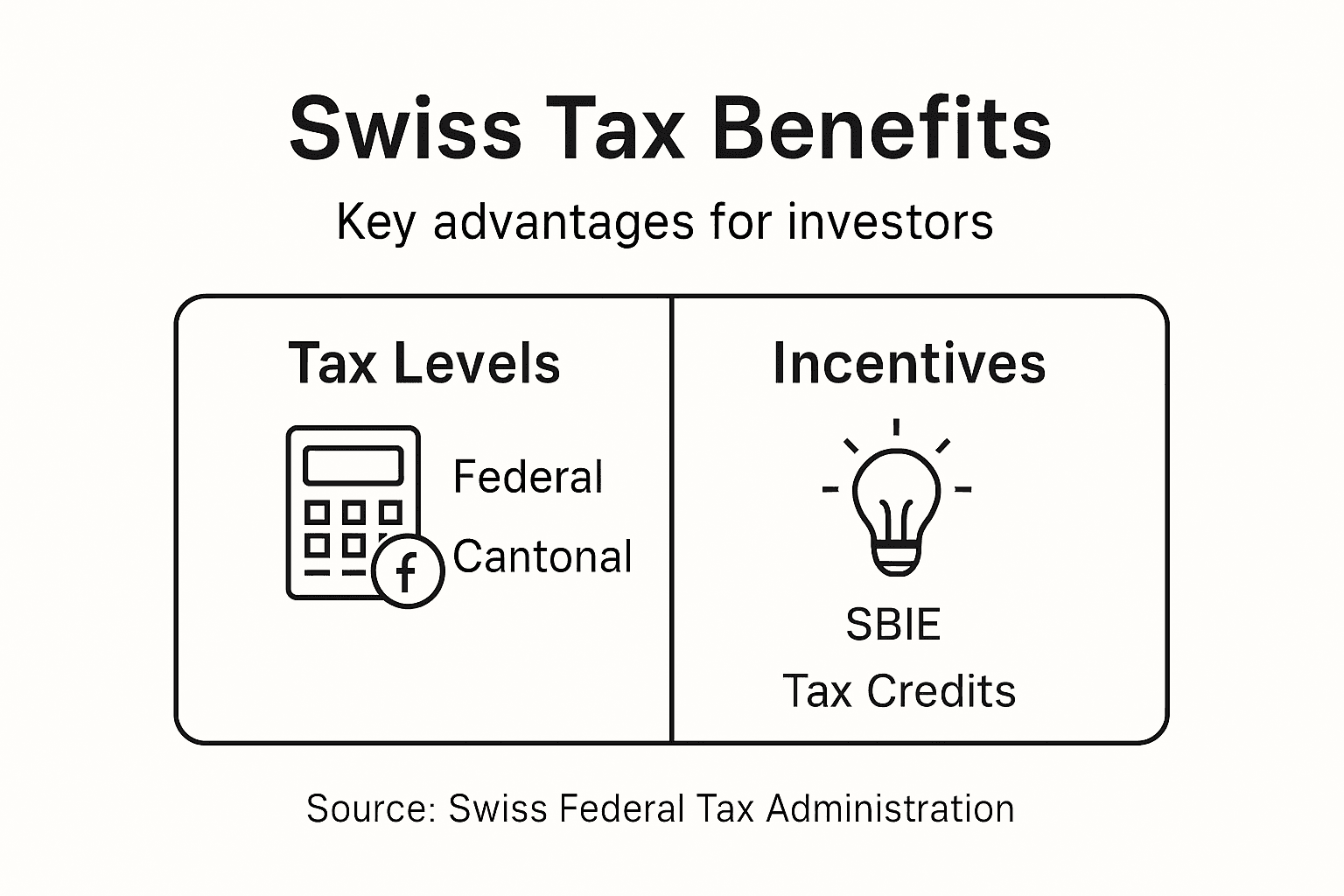
Key incentive mechanisms include the Substance-based Income Exclusion (SBIE), Qualified Refundable Tax Credits (QRTC), and targeted government grants. These tools are specifically engineered to encourage investment in critical economic sectors such as technology, research and development, and innovative industries. Patent box regimes, for instance, allow companies to benefit from reduced taxation on qualifying intellectual property income, creating a compelling environment for knowledge-based enterprises.
Canton-level tax incentives represent a particularly dynamic aspect of Switzerland’s approach. Different regions offer unique combinations of tax holidays, reliefs, and development-focused financial advantages. Some cantons provide significant tax reductions for new businesses, expanding companies, or enterprises operating in strategically important economic domains. These localized incentives create a competitive landscape where companies can strategically choose their operational base to maximize financial benefits.
Pro tip: Conduct comprehensive research on individual canton incentives and consult a local tax expert to identify the most advantageous tax regime for your specific business model and industry.
The following table summarizes key Swiss corporate tax incentives and their primary business impacts:
Incentive Mechanism | Purpose | Typical Beneficiary |
Substance-based Income Exclusion (SBIE) | Rewards real economic activity | Innovative companies, SMEs |
Patent Box Regime | Reduces tax on IP-related income | Tech and R&D sectors |
Qualified Refundable Tax Credits (QRTC) | Supports capital investment and expansion | Expanding firms, startups |
Canton-Level Tax Holidays | Attracts new or strategic businesses | New market entrants, industry leaders |
Reporting, Compliance, and Liability
Switzerland maintains rigorous corporate governance standards that demand meticulous annual reporting and compliance protocols. Companies operating within the Swiss legal framework must navigate a complex landscape of financial transparency, regulatory obligations, and comprehensive disclosure requirements that extend beyond traditional financial reporting.
Since 2022, large public interest companies (PIEs) have been subject to enhanced non-financial reporting mandates covering environmental, social, and governance (ESG) matters. These regulations, embedded in the Swiss Code of Obligations, require companies to provide transparent disclosures on critical issues including human rights, anti-corruption practices, and sustainability initiatives. Reporting must align with international standards such as the Task Force on Climate-related Financial Disclosures (TCFD), ensuring a comprehensive and standardized approach to corporate accountability.
The reporting landscape encompasses multiple dimensions, including financial statements like balance sheets, profit and loss accounts, and cash flow statements. Public companies and larger entities face additional non-financial reporting requirements that demand thorough documentation and strategic transparency. Compliance is not merely a legal obligation but a mechanism for building stakeholder trust, with potential penalties for missed deadlines or inaccurate reporting creating a strong incentive for meticulous corporate governance.
Pro tip: Engage a local Swiss accounting professional to help navigate the intricate reporting requirements and ensure full compliance with both financial and non-financial disclosure regulations.
Unlock the Full Potential of Switzerland’s Tax Advantages with Expert Support
Navigating the multilayered Swiss company tax structure can be complex and challenging. Between understanding federal and cantonal tax differences and choosing the right legal entity like GmbH or AG, you need trusted guidance to maximize your benefits and minimize risks. Key goals include strategic canton selection, leveraging tax incentives such as the Substance-based Income Exclusion and Patent Box Regime, and ensuring compliance with Swiss reporting standards.
Take control of your Swiss business setup and tax strategy with tailored solutions. https://rpcs.ch specializes in helping international investors overcome hurdles related to legal documentation, tax planning, and registration. We streamline your company formation process while ensuring you fully capitalize on Switzerland’s favorable tax environment and business incentives.
Discover how our comprehensive services around GmbH and AG company formation, coupled with ongoing accounting and legal support, can turn Swiss tax advantages into tangible growth for your venture. Visit RPCS official site today and take the first step toward informed, confident expansion in Switzerland.
Frequently Asked Questions
What are the key advantages of the Swiss company tax structure for investors?
The Swiss company tax structure offers a competitive corporate tax rate, a decentralized model with significant autonomy for cantons, and various deductions and exemptions that can reduce overall tax liability. This environment is particularly attractive for both multinational corporations and small to medium enterprises.
How do federal and cantonal tax rates affect my business in Switzerland?
Federal tax rates are set uniformly at 8.5%, but cantonal and municipal rates can vary widely, ranging from 11.9% to 20.5%. This variability allows businesses to choose locations with more favorable tax environments, which can significantly impact overall tax obligations.
What are the differences in tax treatment between GmbH and AG entities?
GmbH (Limited Liability Company) structures typically have lower capital requirements and simpler tax regulations, making them appealing for small businesses. In contrast, AG (Stock Corporation) structures are designed for larger enterprises and offer advanced tax optimization strategies, but require higher minimum capital.
What tax incentives are available for companies operating in Switzerland?
Switzerland offers several tax incentives such as the Substance-based Income Exclusion (SBIE), Patent Box regimes, and Qualified Refundable Tax Credits (QRTC). These incentives are designed to attract investment in key industries and encourage economic growth, providing opportunities for businesses to optimize their tax planning.
Recommended
Comments