
Swiss Company Dissolution Explained: Legal Steps and Risks
- Feb 9
- 8 min read
Updated: Feb 17

Many foreign technology and finance entrepreneurs are surprised when the Swiss company dissolution process becomes far more complicated than expected. The Swiss legal framework demands precise documentation, formal approvals, and strict timelines, making it easy to stumble over misunderstood regulations. This article clears up common myths about Swiss company dissolution, examines pivotal legal responsibilities, and breaks down the risks that can impact final outcomes for foreign-owned businesses.
Table of Contents
Key Takeaways
Point | Details |
Understand Legal Complexity | Swiss company dissolution involves intricate legal procedures; foreign entrepreneurs must fully comprehend the regulatory landscape to avoid legal risks. |
Engage Local Expertise | Consulting local Swiss legal and tax professionals can mitigate potential financial pitfalls and ensure compliance with regulations throughout the dissolution process. |
Document Thoroughly | Meticulous record-keeping and compliance with documentation requirements are essential for a successful and legally compliant dissolution. |
Anticipate Costs | Entrepreneurs should allocate a contingency budget of 15-25% above estimated dissolution costs to manage unexpected financial challenges effectively. |
Swiss company dissolution and common myths
Company dissolution in Switzerland involves far more complex legal procedures than many foreign entrepreneurs assume. Understanding the nuanced regulatory landscape is critical to navigating potential financial and legal risks effectively. Foreign business owners often enter the Swiss market without fully comprehending the intricate processes surrounding company document requirements.
Common misconceptions about Swiss company dissolution can lead entrepreneurs into significant financial and legal challenges. These myths frequently arise from incomplete understanding of Swiss corporate regulations and local legal frameworks. Key myths include:
Rapid Dissolution: Many believe Swiss company dissolution is a quick process
Low Cost Exit: Entrepreneurs often underestimate the financial implications
Straightforward Paperwork: Complex regulatory compliance is frequently misunderstood
Uniform Procedures: Dissolution processes vary significantly by company structure
The Swiss legal system requires meticulous documentation and adherence to specific regulatory protocols during company dissolution. Entrepreneurs must engage with commercial registries, tax authorities, and potentially creditors to ensure a legally compliant shutdown. Failure to follow precise procedures can result in substantial financial penalties and potential legal complications.

Specifically for foreign-owned entities, the dissolution process demands comprehensive financial reporting, tax clearances, and formal notifications to multiple government agencies. Each step requires precise execution and typically involves substantial administrative overhead. Companies must demonstrate complete settlement of all outstanding financial obligations before receiving official dissolution approval.
Pro tip: Engage a local Swiss legal professional specializing in corporate dissolution to navigate complex regulatory requirements and minimize potential financial risks.
Types of dissolution for AG and GmbH
In the Swiss corporate landscape, dissolution processes for Aktiengesellschaft (AG) and Gesellschaft mit beschränkter Haftung (GmbH) involve distinct legal mechanisms that require comprehensive understanding. These two primary corporate structures have unique dissolution pathways influenced by key points in Swiss corporate law.
For both AG and GmbH structures, dissolution can occur through multiple legal mechanisms:
Voluntary Dissolution: Initiated by shareholders through formal resolution
Compulsory Dissolution: Triggered by financial insolvency or regulatory non-compliance
Judicial Dissolution: Ordered by Swiss commercial courts
Merger-Related Dissolution: Result of corporate restructuring
Administrative Dissolution: Mandated by commercial registry
The dissolution process for an AG typically requires more complex procedures compared to a GmbH. An AG dissolution demands extensive shareholder meetings, detailed financial audits, and comprehensive documentation of asset liquidation. Creditors must be formally notified, and all outstanding financial obligations must be systematically settled before final dissolution can be approved.
For GmbH structures, the dissolution process is relatively more streamlined but still demands meticulous legal compliance. The managing directors must prepare comprehensive liquidation reports, settle all corporate debts, and obtain explicit shareholder approval. Specific steps include formal notification to tax authorities, settlement of all financial obligations, and submission of final financial statements to the commercial registry.
Swiss corporate dissolution is not a simple administrative task but a complex legal procedure requiring professional expertise and precise execution.
Pro tip: Consult a Swiss legal specialist experienced in corporate dissolution to ensure complete compliance and minimize potential financial and legal risks during the shutdown process.
Legal procedures and regulatory requirements
The Swiss legal framework for company dissolution involves intricate regulatory procedures that demand precise execution and comprehensive documentation. Legal dissolution processes require meticulous attention to multiple administrative and financial requirements that vary depending on the corporate structure and specific circumstances.
Key regulatory requirements for Swiss company dissolution include:
Shareholder Approval: Formal resolution requiring majority voting
Financial Audit: Comprehensive review of company’s financial status
Creditor Notification: Mandatory formal communication process
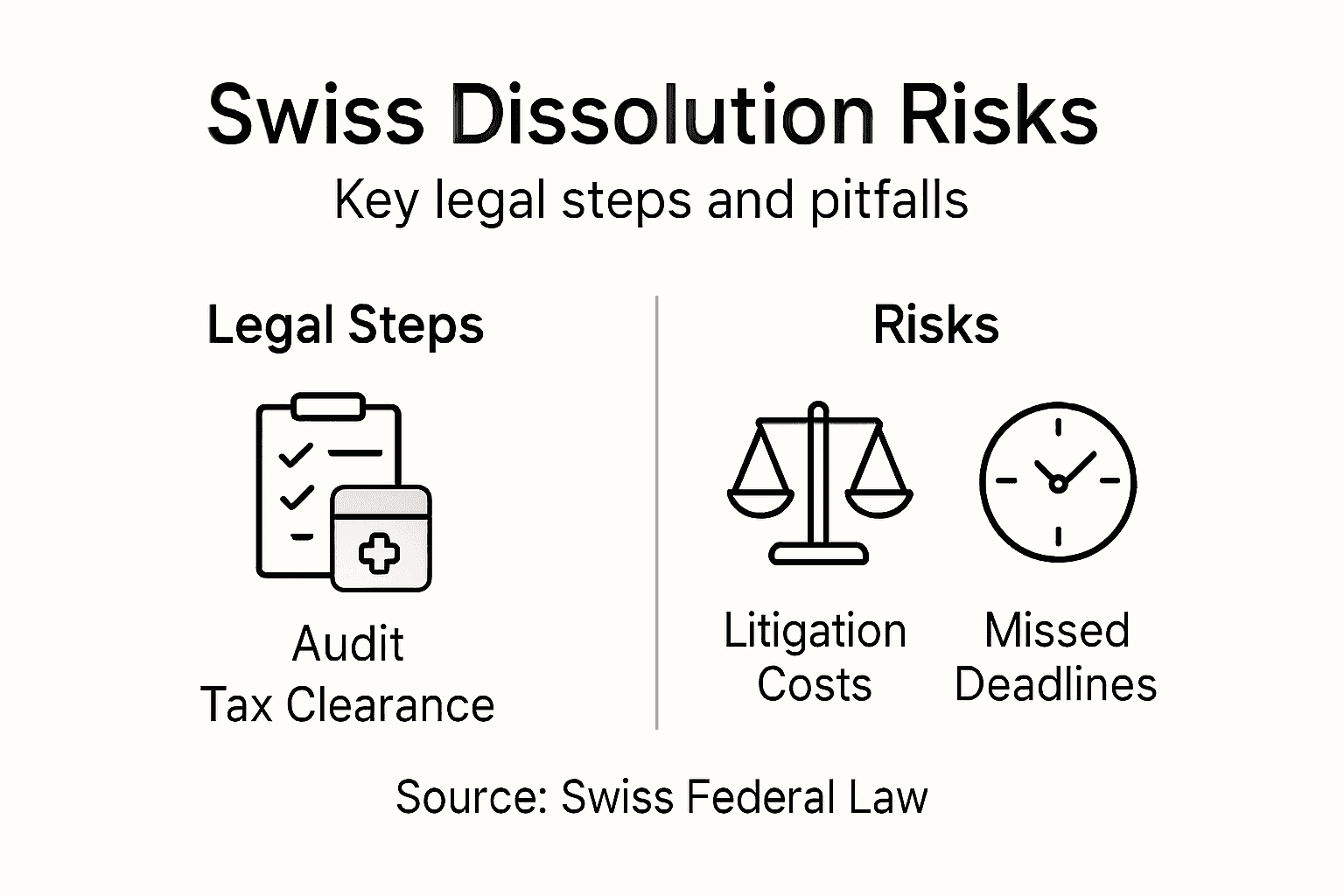
Tax Clearance: Obtaining official tax compliance certificate
Asset Liquidation: Systematic distribution of remaining corporate assets
Commercial Registry Deregistration: Final legal termination step
The dissolution procedure mandates extensive documentation and strict compliance with Swiss commercial regulations. Companies must prepare detailed liquidation reports that comprehensively outline financial positions, outstanding obligations, and asset distributions. These documents must be meticulously prepared and verified by independent financial professionals to ensure complete transparency and legal compliance.
Foreign-owned entities face additional regulatory scrutiny during the dissolution process. They must provide extra documentation demonstrating compliance with both Swiss federal regulations and international financial reporting standards. This includes detailed financial statements, proof of tax payments, and formal declarations from managing directors confirming the company’s financial status and reasons for dissolution.
Swiss regulatory authorities maintain stringent oversight of corporate dissolutions to prevent potential financial misconduct or unresolved liability issues.
Pro tip: Engage a Swiss legal specialist with specific expertise in corporate dissolution to navigate complex regulatory requirements and ensure seamless, compliant company shutdown.
Shareholder and liquidator roles and duties
In Swiss corporate dissolution, shareholders and liquidators play distinct yet interconnected roles that are critical to the legal and financial closure of a company. Legal dissolution processes define precise responsibilities that ensure systematic and compliant company shutdown.
Key roles and responsibilities include:
Shareholders:
Initiate formal dissolution resolution
Approve liquidation strategy
Review final financial reports
Authorize asset distribution plan
Liquidators:
Manage operational closure tasks
Contact and negotiate with creditors
Prepare comprehensive financial statements
Execute asset liquidation process
File mandatory regulatory reports
Shareholders retain ultimate decision-making power during dissolution, but liquidators become the operational executors responsible for implementing the comprehensive shutdown strategy. These appointed professionals must navigate complex legal requirements, ensuring all financial obligations are systematically resolved and regulatory compliance is meticulously maintained throughout the dissolution process.
Foreign-owned companies face additional scrutiny, with liquidators required to provide extensive documentation demonstrating transparent financial practices. They must coordinate with multiple governmental agencies, manage international financial reporting standards, and ensure complete financial accountability during the entire dissolution procedure.
Liquidators serve as the critical bridge between corporate closure and regulatory compliance, bearing substantial legal and financial responsibilities.
Pro tip: Select liquidators with specific expertise in Swiss corporate law and international financial regulations to minimize potential legal and financial risks during company dissolution.
Creditor claims, tax clearance, and timeline
The Swiss corporate dissolution process involves a structured approach to managing creditor claims and tax clearance with precise legal timelines that must be meticulously followed. This complex procedure ensures all financial obligations are systematically addressed before final company deregistration.
Typical timeline and critical steps include:
Creditor Notification Period:
Formal public announcement of dissolution
Statutory waiting period for creditor claims (typically 30-60 days)
Comprehensive documentation of all outstanding financial obligations
Tax Clearance Process:
Submit final tax returns
Obtain tax clearance certificate
Resolve any pending tax liabilities
Secure official confirmation from tax authorities
The creditor claims process requires companies to provide comprehensive public notice, allowing potential creditors a legally mandated window to file outstanding claims. During this period, the liquidator must carefully document and evaluate each claim, negotiate settlements, and prepare detailed financial records demonstrating the company’s ability to meet its financial responsibilities.
Foreign-owned companies face additional scrutiny during tax clearance, requiring extensive documentation of international financial transactions, proof of tax compliance, and detailed financial statements. Swiss authorities demand meticulous evidence of complete financial transparency and settlement of all tax obligations before granting final dissolution approval.
The dissolution timeline can range from 3-12 months, depending on the complexity of financial obligations and corporate structure.
Pro tip: Engage a Swiss tax specialist early in the dissolution process to streamline tax clearance and minimize potential delays in company deregistration.
Costs, risks, and pitfalls to avoid
Swiss company dissolution involves complex financial and legal considerations that can significantly impact a company’s final financial outcome. Legal dissolution processes reveal multiple potential risks that entrepreneurs must carefully navigate to minimize unexpected expenses and legal complications.
Key financial risks and potential pitfalls include:
Unexpected Litigation Costs:
Unresolved creditor disputes
Potential legal challenges from shareholders
Extended legal proceedings
Complex international transaction investigations
Compliance-Related Expenses:
Substantial administrative documentation fees
Professional advisory costs
Potential regulatory penalty assessments
Tax clearance and financial audit expenses
Foreign-owned companies face additional financial complexities during dissolution. International corporate structures often require more extensive documentation, multilingual legal support, and comprehensive financial investigations. These requirements can exponentially increase dissolution costs and extend the overall timeline, potentially trapping significant financial resources in prolonged administrative processes.
The most critical financial risks emerge from inadequate preparation and incomplete understanding of Swiss regulatory frameworks. Entrepreneurs must anticipate potential challenges, maintain meticulous financial records, and engage specialized legal professionals who understand the nuanced landscape of Swiss corporate dissolution.
Financial miscalculations during dissolution can result in unexpected costs exceeding 50% of initial estimated expenses.
Pro tip: Allocate a contingency budget of 15-25% above estimated dissolution costs to mitigate potential unexpected financial complications.
Navigate Swiss Company Dissolution with Confidence and Expert Support
Facing the complex legal steps and risks of Swiss company dissolution can feel overwhelming, especially without local expertise. Whether you are dealing with intricate creditor claims, tax clearance challenges, or the detailed regulatory requirements for AG and GmbH structures, these processes require precise execution to avoid costly pitfalls. If you want to secure a smooth, compliant company shutdown while minimizing unexpected expenses and legal risks, professional guidance is essential.

Discover how RPCS can be your trusted partner in managing Swiss company dissolution with turnkey solutions tailored for international entrepreneurs. Our team specializes in navigating Swiss corporate law complexities, from meticulous document management and shareholder negotiations to liquidator coordination and tax clearance strategies. Start your path to a seamless dissolution by visiting RPCS and learn about our full range of services designed to protect your interests and accelerate your company closure. Take control of the process today and avoid costly surprises by consulting experienced Swiss legal and financial experts who understand your unique challenges.
Frequently Asked Questions
What are the key steps involved in the dissolution of a Swiss company?
The key steps involve obtaining shareholder approval, conducting a financial audit, notifying creditors, securing tax clearance, liquidating assets, and deregistering with the commercial registry.
How long does the dissolution process typically take in Switzerland?
The dissolution timeline can range from 3 to 12 months, depending on the complexity of financial obligations and the corporate structure.
What are the common risks associated with Swiss company dissolution?
Common risks include unexpected litigation costs, compliance-related expenses, and potential financial miscalculations that could exceed initial estimated expenses by up to 50%.
Should foreign-owned companies expect additional complexities during dissolution?
Yes, foreign-owned companies face extra regulatory scrutiny and must provide extensive documentation, which can increase costs and extend the dissolution timeline.
Recommended
Comments