
Guide to Swiss business tax optimization in 2026
- Mar 6
- 12 min read

Many foreign entrepreneurs assume incorporating in Switzerland automatically delivers rock-bottom taxes. Reality tells a different story. Your tax burden depends heavily on canton selection, company structure, and substance requirements. This guide reveals how to navigate Switzerland’s complex tax landscape in 2026, helping you legally minimize your corporate tax burden while maintaining full compliance with evolving transparency regulations.
Table of Contents
Key takeaways
Point | Details |
Canton selection matters | Effective corporate tax rates range from 11.85% in Zug to over 20% in other cantons, directly impacting profitability. |
Structure affects liability | AG requires CHF 100,000 capital while GmbH needs CHF 20,000, each carrying distinct tax and compliance obligations. |
2026 brings digital mandates | Beneficial ownership registration and FTA ePortal digital filing are now mandatory for all Swiss companies. |
Substance requirements are strict | Swiss tax residency demands local directors, physical offices, and documented board meetings to secure tax benefits. |
Optimization is legal | Balancing salary and dividends within cantonal rules reduces total tax burden without crossing into illegal avoidance. |
Understanding the Swiss corporate tax environment and cantonal variations
Switzerland operates a three-tier tax system that creates both complexity and opportunity. Federal corporate tax sits at a flat 8.5% on net profits. Cantonal and municipal taxes add significantly to this base rate, creating wildly different effective tax rates depending on where you establish your company.
Cantonal tax competition is a fundamental feature of the Swiss tax system due to decentralized taxation at federal, cantonal, and municipal levels. Cantons actively compete for businesses by setting their own corporate tax rates and offering location-specific incentives. This competition creates substantial opportunities for tax optimization through strategic location selection.
The differences are dramatic. Zug offers an effective corporate tax rate of approximately 11.85%, making it Switzerland’s most tax-friendly canton for businesses. Zurich sits at around 19.61%, while Bern reaches 20.54%. For a company generating CHF 500,000 in annual profit, relocating from Bern to Zug could save over CHF 40,000 yearly in taxes.
Pro Tip: Download and compare cantonal tax tables before registering your company. The initial location decision locks in your tax rate for years, so analyze your specific business model against each canton’s effective rates and incentives.
Beyond headline rates, cantons offer varying deductions, credits, and special regimes. Some provide research and development tax credits, while others incentivize hiring local employees. Understanding these nuances helps you select a canton aligned with your business operations and financial goals.
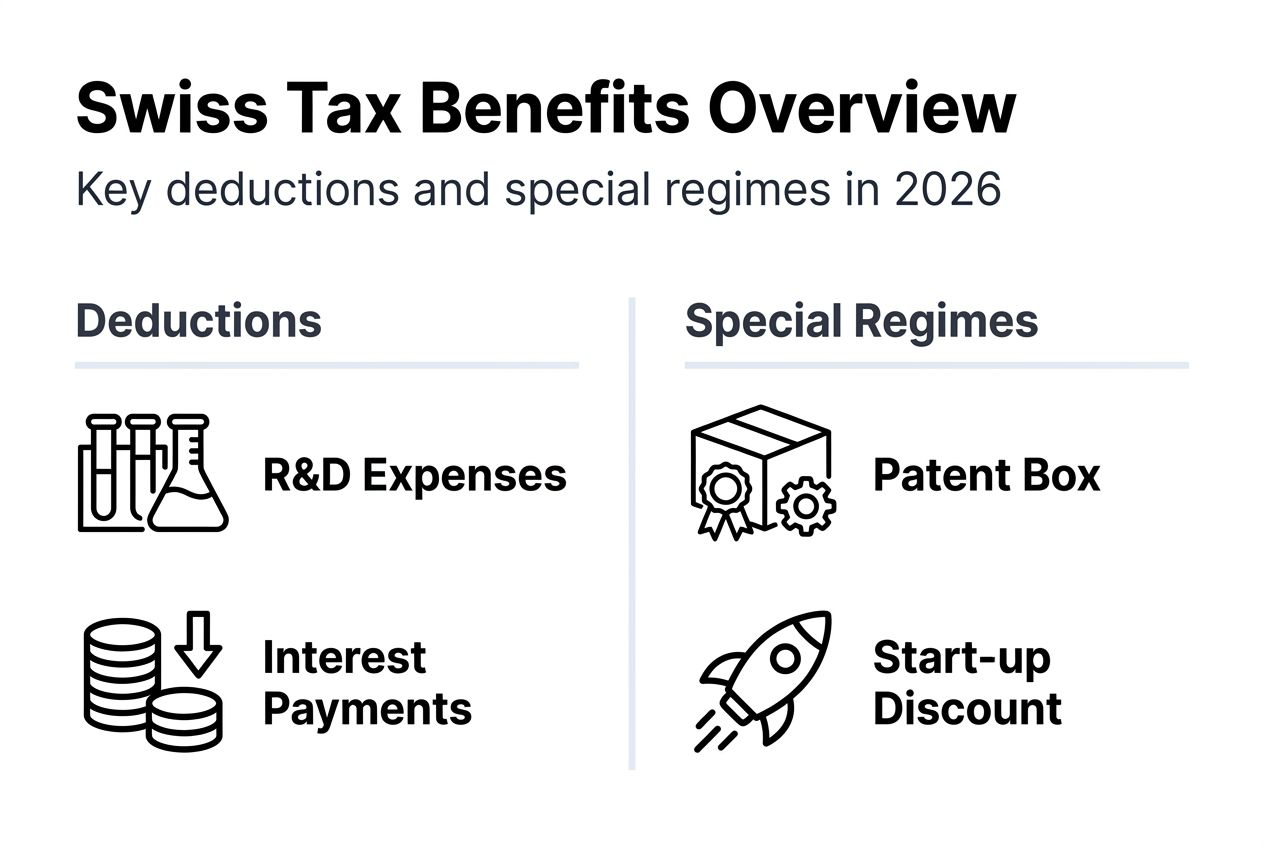
The Swiss company tax structure advantages extend beyond rates alone. Factors like access to international talent, proximity to clients, and quality of business infrastructure should influence your decision alongside pure tax considerations. Many entrepreneurs find that choosing a Swiss canton for your business requires balancing multiple operational and financial factors.
Canton | Effective Corporate Tax Rate | Key Advantage |
Zug | ~11.85% | Lowest overall tax burden |
Zurich | ~19.61% | International business hub |
Bern | ~20.54% | Government proximity |
Geneva | ~14.00% | Banking and finance center |
Swiss company structures and their tax implications
Your choice between AG (Aktiengesellschaft) and GmbH (Gesellschaft mit beschränkter Haftung) shapes your tax obligations, compliance burden, and operational flexibility. Both structures limit shareholder liability, but they differ significantly in capital requirements and governance complexity.

AG companies require minimum share capital of CHF 100,000, with at least CHF 50,000 paid in at formation. This structure suits larger enterprises, companies planning public offerings, or businesses seeking maximum credibility with international partners. AGs face more stringent reporting requirements and typically higher administrative costs. Tax treatment remains similar to GmbH at the corporate level, but dividend distributions and shareholder taxation differ.
GmbH companies need only CHF 20,000 minimum capital, fully paid at formation. This lower threshold makes GmbH the preferred choice for startups, small businesses, and foreign entrepreneurs testing Swiss market entry. Governance requirements are simpler, with fewer mandatory filings and lower ongoing compliance costs. The GmbH vs AG comparison reveals significant operational differences beyond capital requirements.
Pro Tip: Most foreign entrepreneurs establishing Swiss operations benefit from starting with a GmbH structure. Lower capital requirements preserve cash flow while delivering full tax optimization benefits and limited liability protection.
Both structures face identical federal corporate tax rates, but practical differences emerge in dividend taxation and ownership transfer complexity. AG shares transfer more easily, while GmbH ownership changes require notarized contracts. Understanding Swiss GmbH vs AG capital differences helps you make informed formation decisions.
Feature | AG | GmbH |
Minimum Capital | CHF 100,000 | CHF 20,000 |
Paid at Formation | CHF 50,000 | CHF 20,000 |
Best For | Large companies, public offerings | Startups, SMEs, foreign investors |
Governance Complexity | Higher | Lower |
Share Transfer | Easier | Requires notarization |
Key regulatory compliance and transparency requirements for 2026
Switzerland implemented sweeping transparency reforms in 2026 that fundamentally changed compliance obligations for all companies. These changes aim to combat money laundering, improve tax transparency, and align Swiss regulations with international standards. Foreign entrepreneurs must understand and implement these requirements to maintain their tax optimization benefits.
The LETA beneficial ownership register now requires all Swiss companies to disclose individuals holding 25% or more of shares or voting rights. Companies must register this information and update it within specific timeframes whenever ownership changes. Failure to comply results in penalties and potential loss of tax benefits.
Mandatory digital tax filing through the Federal Tax Administration ePortal replaced paper submissions in 2026. All VAT returns, withholding tax filings, and corporate tax declarations must flow through this digital system. The ePortal requires registration with two-factor authentication and digital signatures for authorized company representatives.
Enhanced anti-money laundering regulations tightened know-your-customer requirements for company formation and banking relationships. Swiss banking requirements for foreign investors now include enhanced due diligence, source of funds documentation, and ongoing transaction monitoring. These measures protect the integrity of Swiss financial systems while adding compliance steps for new companies.
Key 2026 compliance requirements:
Register beneficial owners in the LETA system within 60 days of formation
Submit all tax filings digitally through the FTA ePortal
Maintain enhanced documentation of ownership structure and control
Update beneficial ownership records within 30 days of any changes
Comply with enhanced anti-money laundering verification procedures
Retain digital and physical records for minimum 10-year periods
Digital filing procedure:
Register your company on the FTA ePortal using company registration number
Designate authorized signatories with digital certificates
Configure two-factor authentication for all portal users
Upload required tax forms according to cantonal deadlines
Monitor portal notifications for requests or confirmations
Archive digital receipts and confirmation documents
The 2026 regulatory and compliance updates extend beyond tax filing. Companies must adapt accounting systems, internal controls, and governance practices to meet new transparency standards while preserving operational efficiency.
Tax optimization strategies for expat entrepreneurs
Legally minimizing your Swiss tax burden requires understanding how different income types face different tax treatments. Strategic planning around salary, dividends, and corporate structure can significantly reduce your total tax liability while maintaining full compliance.
Balancing salary and dividends represents the most powerful optimization lever for owner-managers. Salary income faces social security contributions (approximately 12% split between employer and employee) plus progressive personal income tax. Dividends avoid social security but face corporate tax at the company level plus personal income tax on distribution. The optimal mix depends on your canton’s personal income tax rates, your total income level, and your social security coverage needs.
Maintaining Swiss corporate substance is non-negotiable for securing tax benefits. Tax authorities scrutinize whether companies operate genuinely in Switzerland or merely use a Swiss address for tax purposes. Real substance requires Swiss resident directors, physical office space, local bank accounts, and documented board meetings held in Switzerland. Companies lacking substance risk reclassification as tax-resident elsewhere, losing Swiss tax advantages entirely.
Swiss corporate substance and domicile benefits extend beyond pure tax considerations. Legitimate Swiss operations enhance credibility with international partners, improve access to European markets, and provide stable legal frameworks for contracts and intellectual property protection.
Cantonal tax incentives vary widely and change periodically. Some cantons offer reduced rates for new companies during initial years, R&D tax credits, or deductions for hiring local employees. Understanding and leveraging these programs requires staying current with cantonal tax policy changes and structuring your operations to qualify for available benefits.
Pro Tip: Review your salary to dividend ratio annually against current cantonal tax tables. As your business grows and personal income changes, the optimal balance shifts. What worked in year one may cost you significantly by year three.
Practical optimization tactics:
Structure compensation mix based on cantonal personal income tax brackets
Maintain minimum three Swiss resident directors for substance credibility
Document all board meetings with minutes noting Swiss location
Leverage cantonal R&D credits if your business qualifies
Time dividend distributions to optimize personal income tax years
Consider corporate pension contributions for tax-deductible retirement savings
Substance checklist for tax residency:
Secure physical office space with verifiable address
Appoint majority Swiss resident board members
Open Swiss bank accounts for all company transactions
Hold regular board meetings documented in Switzerland
Maintain Swiss telephone and internet services
Employ local staff or contractors where operationally appropriate
Generate substantive business activity from Swiss location
The benefits of Swiss residency for entrepreneurs extend into personal tax planning. Coordinating corporate structure with personal residency status can unlock additional optimization opportunities while providing access to Switzerland’s exceptional quality of life.
Impact of international tax reform on Swiss companies
The OECD Pillar Two global minimum tax framework reshaped international tax planning in 2026. Switzerland implemented these rules, requiring large multinational companies to pay at least 15% effective tax rate regardless of where they operate. This reform particularly affects Swiss companies with global operations and foreign parent companies with Swiss subsidiaries.
Pillar Two applies to multinational groups with consolidated revenue exceeding EUR 750 million in at least two of the four preceding years. Qualifying companies must calculate their effective tax rate in each jurisdiction and pay top-up taxes if any jurisdiction falls below the 15% minimum. Switzerland’s already moderate tax rates mean most Swiss-based companies face limited direct impact, but compliance requirements are substantial.
Enhanced reporting obligations require affected companies to file country-by-country reports detailing revenue, profits, taxes paid, and employee numbers in each jurisdiction. These reports feed into the global minimum tax calculations and increase transparency for tax authorities worldwide. Companies must implement sophisticated tracking systems to gather required data accurately.
For smaller companies and those below the EUR 750 million threshold, Pillar Two creates indirect effects. Increased global tax compliance costs may affect international partnerships, and treaty benefits could change as countries adjust bilateral agreements. Understanding how these reforms intersect with your specific business model helps you anticipate changes and adapt strategies proactively.
Key Pillar Two implications:
Applies to groups with EUR 750 million+ consolidated revenue
Requires 15% minimum effective tax rate in all jurisdictions
Demands country-by-country reporting with detailed profit attribution
Compliance deadlines began in 2026 with phased implementation
Swiss companies must align optimization with global minimum standards
Enhanced documentation and transfer pricing analysis required
The 2026 international tax reform impact extends beyond large multinationals. Treaty changes and increased scrutiny of cross-border transactions affect companies of all sizes operating internationally. Staying informed through Swiss tax advisory for international reforms ensures your company adapts smoothly to evolving global tax standards.
Common misconceptions in Swiss tax planning
Misunderstanding how Swiss taxes work costs foreign entrepreneurs thousands of francs annually. Clearing up these misconceptions helps you make better decisions and avoid expensive mistakes that undermine your tax optimization strategy.
Myth: All Swiss cantons offer the same low tax rates. Reality: Cantonal tax rates vary by nearly 10 percentage points. Zug’s 11.85% effective rate contrasts sharply with cantons exceeding 20%. Location choice directly impacts your tax burden, making canton selection one of your most important formation decisions.
Myth: Simply incorporating in Switzerland guarantees low taxes. Reality: Tax benefits require genuine Swiss substance. Companies lacking local directors, physical offices, and real operations risk tax authority challenges. Shell companies with Swiss addresses but no real activity lose tax advantages and face penalties.
Myth: Tax optimization involves illegal tax avoidance. Reality: Legal tax planning within Swiss regulations is perfectly legitimate. The line between legal optimization and illegal evasion lies in substance and transparency. Properly structured companies with real operations, accurate reporting, and documented decision-making optimize taxes legally.
Myth: GmbH and AG face identical tax treatment. Reality: While corporate tax rates apply equally, practical differences emerge in governance costs, dividend taxation complexity, and ownership transfer procedures. Structure choice affects your total tax and compliance burden significantly.
Myth: Once established, company structure cannot change. Reality: Swiss law allows restructuring, though the process involves costs and administrative steps. As businesses grow, converting from GmbH to AG or relocating to different cantons becomes possible, though planning these changes carefully minimizes disruption.
Understanding common Swiss tax planning misconceptions to avoid protects your investment and ensures your company structure delivers intended benefits. Working with experienced advisors who understand both Swiss tax law and international business needs helps you navigate complexity confidently.
Practical steps for setting up and maintaining tax-optimized Swiss companies
Translating tax knowledge into action requires following a structured approach to company formation and ongoing management. These steps guide you from initial planning through compliant operations that preserve your tax optimization benefits.
Formation steps:
Analyze your business model to determine whether AG or GmbH better suits your needs, capital availability, and growth plans
Research cantonal tax rates and incentives, selecting the canton offering optimal balance of tax benefits and operational advantages
Appoint at least one Swiss resident director, preferably a majority of board members, to establish credible substance
Prepare articles of association with legal counsel familiar with Swiss corporate law and your industry requirements
Open a Swiss bank account and deposit required share capital, obtaining confirmation for notarization
Complete notarized formation documents and submit to cantonal commercial register for approval
Register for VAT, withholding tax, and other applicable tax numbers through cantonal authorities
Register beneficial ownership information in the LETA system within required timeframes
Set up accounting systems compliant with Swiss GAAP standards and digital filing requirements
Establish corporate governance practices including regular board meetings documented in Switzerland
Ongoing maintenance for tax optimization:
File VAT returns quarterly or annually through FTA ePortal depending on turnover
Submit annual corporate tax returns by cantonal deadlines, typically March 31 following tax year
Hold and document regular board meetings in Switzerland with Swiss resident directors
Maintain physical office space and Swiss operational presence
Review salary to dividend mix annually against current tax tables
Update beneficial ownership register within 30 days of any ownership changes
Retain all financial records digitally and physically for minimum 10 years
Stay informed about cantonal tax policy changes and new federal regulations
Conduct annual compliance reviews ensuring substance requirements remain satisfied
The Swiss company formation services streamline these complex steps, providing expert guidance through each phase. Using a comprehensive company formation checklist ensures nothing falls through cracks during your setup process.
Whether setting up a GmbH in Switzerland or pursuing setting up a Swiss AG, partnering with experienced professionals familiar with both Swiss regulations and international entrepreneur needs accelerates your timeline while ensuring compliance from day one.
Optimize your Swiss company formation with RPCS Solutions
Navigating Switzerland’s complex tax landscape while ensuring full compliance with 2026 regulations requires specialized expertise. Foreign entrepreneurs face unique challenges understanding cantonal variations, maintaining substance requirements, and optimizing their tax structure within Swiss legal frameworks.

RPCS Solutions provides comprehensive Swiss company formation services designed specifically for international entrepreneurs and investors. Our team guides you through selecting the optimal company structure and canton for your business model, ensuring your foundation delivers maximum tax efficiency from day one. We handle everything from initial company formation checklist compliance through ongoing digital filing requirements and substance maintenance.
Whether you need help setting up a GmbH in Switzerland or require full-service AG formation, our experts ensure your company meets all 2026 transparency requirements while optimizing your tax position. We provide ongoing support for beneficial ownership registration, FTA ePortal filing, and strategic tax planning that keeps your Swiss business compliant and profitable.
FAQ
What is the difference between AG and GmbH in Swiss tax terms?
AG requires CHF 100,000 minimum capital and suits larger enterprises seeking maximum credibility and easier share transferability. GmbH needs only CHF 20,000 capital, making it ideal for startups and small businesses seeking lower formation costs. Both face identical federal corporate tax rates, but practical differences emerge in governance complexity, administrative costs, and dividend distribution procedures.
How do cantonal tax rates affect my Swiss company’s tax burden?
Cantonal tax rates vary dramatically, from approximately 11.85% in Zug to over 20% in some cantons when combined with municipal taxes. These differences directly impact your bottom line, potentially saving or costing tens of thousands of francs annually. Selecting the right canton at formation locks in your tax rate, making location one of your most important business decisions.
What new compliance requirements should I expect in 2026?
All companies must register beneficial owners in the LETA system and maintain current ownership information with updates within 30 days of changes. Digital tax filing through the FTA ePortal became mandatory for VAT, withholding tax, and corporate returns. Enhanced anti-money laundering rules require additional documentation during formation and ongoing banking relationships, with penalties for non-compliance affecting your tax benefits.
How can I optimize salary and dividends for tax efficiency?
Balancing salary and dividends requires analyzing your canton’s personal income tax rates against social security contributions and corporate tax. Salary faces social security (approximately 12% combined) plus progressive income tax, while dividends avoid social security but face corporate tax plus personal income tax on distribution. The optimal mix changes as your income level and canton rates shift, requiring annual review to maintain efficiency.
Recommended
Comments