
Swiss Business Confidentiality: 2026 Guide for Investors
- Mar 31
- 9 min read

Switzerland’s reputation for business confidentiality attracts international entrepreneurs, but the reality is more nuanced than many expect. While Swiss law provides stronger privacy protections than most jurisdictions, absolute secrecy no longer exists in today’s compliance-driven environment. Understanding what confidentiality actually means for your Swiss company, how recent legal reforms affect privacy structures, and where international obligations override local protections is essential for making informed decisions. This guide breaks down the legal framework, practical strategies, and realistic limits of Swiss business confidentiality for global investors in 2026.
Table of Contents
Key Takeaways
Point | Details |
Swiss privacy with compliance | Switzerland offers strong business confidentiality while meeting global transparency standards. |
Legal structure matters | Choosing the correct company type and managing documents are key to maintaining privacy. |
2025 law reforms | New rules restrict shell companies and clarify privacy protections for legitimate businesses. |
Strategic setup reduces risk | Working with local experts and using the right procedures help secure confidentiality and legal compliance. |
Why confidentiality matters in Swiss business
Switzerland’s tradition of business privacy remains a cornerstone of its appeal to international entrepreneurs. Unlike jurisdictions with public beneficial ownership registers, Switzerland maintains non-public UBO access, balancing privacy tradition with FATF and OECD compliance standards. This distinction matters significantly for investors seeking to protect competitive strategies, shield investment portfolios from public scrutiny, and maintain operational discretion.
For international business owners, confidentiality serves multiple strategic purposes:
Competitive protection: Keeping ownership structures private prevents competitors from tracking investment moves or strategic partnerships
Personal security: High-net-worth individuals reduce exposure to unwanted attention, solicitation, or security risks
Negotiation leverage: Private ownership details strengthen bargaining positions in mergers, acquisitions, and partnership discussions
Regulatory efficiency: Streamlined compliance processes with clear privacy boundaries reduce administrative burden
Many entrepreneurs mistakenly believe Swiss confidentiality means complete anonymity. This misconception creates unrealistic expectations and potential legal risks. Modern Swiss business privacy operates within a framework of international cooperation, anti-money laundering protocols, and tax transparency agreements.
Switzerland’s approach differs fundamentally from public register systems. While authorities maintain beneficial ownership information for compliance purposes, this data remains inaccessible to the general public, preserving legitimate business privacy without enabling illicit activity.
The practical value extends beyond simple privacy. Swiss confidentiality frameworks integrate with robust banking secrecy protections, creating comprehensive privacy ecosystems that few other jurisdictions can match. Understanding these systems helps international investors structure operations that maximize legitimate confidentiality while maintaining full legal compliance.

Legal framework: How Swiss law protects confidentiality
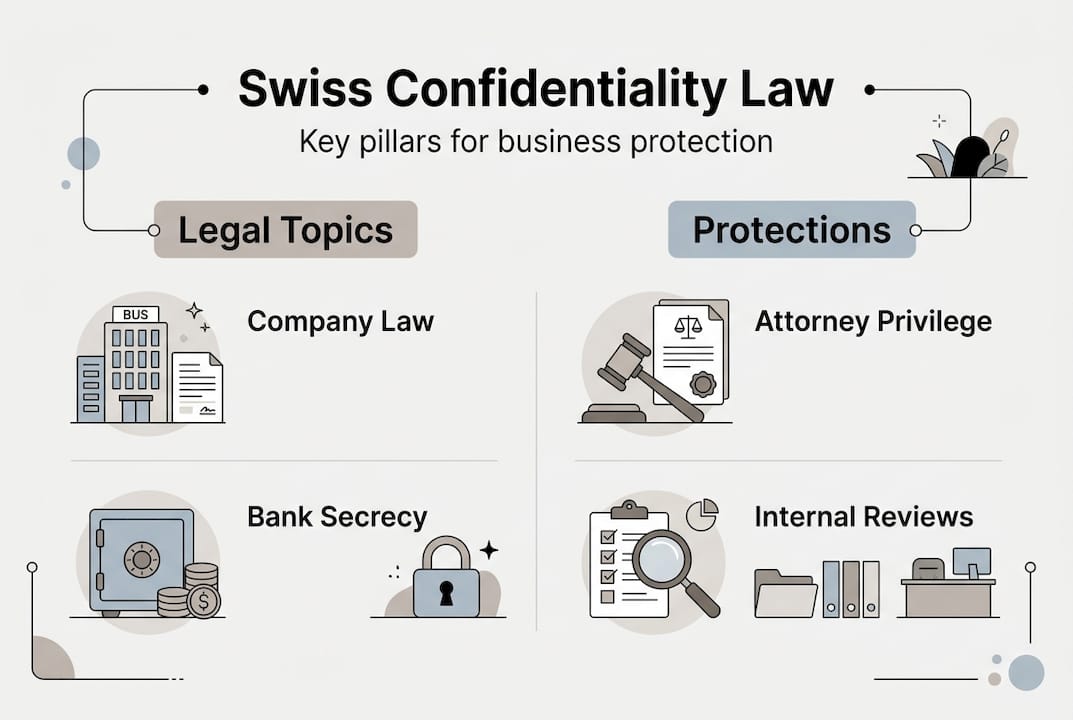
Swiss business confidentiality rests on multiple legal pillars, each serving distinct protective functions. The Swiss Code of Obligations establishes baseline privacy requirements for corporate structures, while FINMA regulations govern financial sector confidentiality standards. These frameworks create layered protections that vary by company type and information category.
Corporate information in Switzerland falls into three distinct categories: publicly accessible data, authority-accessible information, and fully protected details. The commercial register contains basic company information like legal name, address, and registered directors. Beneficial ownership data exists in federal registers accessible only to competent authorities, not the public. Internal corporate documents, strategic plans, and confidential communications receive the strongest protections.
Attorney-client privilege protections extend to internal investigations, allowing companies to conduct compliance reviews while maintaining confidentiality of findings. This legal shield proves particularly valuable when addressing potential regulatory issues or conducting due diligence on sensitive matters.
Company Type | Public Information | Authority Access | Protected Details |
GmbH | Name, address, managing directors | Beneficial owners, financial reports | Shareholder agreements, internal communications |
AG | Name, address, board members | Beneficial owners, major shareholders | Strategic plans, confidential contracts |
Branch Office | Parent company details, local representative | Financial links to parent | Operational strategies, client lists |
Different entity structures offer varying confidentiality levels. GmbH formations provide strong privacy for smaller operations, with managing directors listed publicly but shareholders remaining private except to authorities. AG structures require more disclosure for publicly traded shares but maintain privacy for bearer shares converted to registered form. Understanding these distinctions helps investors select appropriate structures for their confidentiality needs.
Key confidentiality protections include:
Director privacy: Only managing directors or board members appear in public registers, not all shareholders
Financial confidentiality: Annual accounts remain private for most small and medium companies
Operational secrecy: Business strategies, client relationships, and proprietary methods receive legal protection
Communication privilege: Attorney-client and certain business communications cannot be compelled in civil proceedings
These protections integrate with Swiss company documentation requirements and banking requirements, creating comprehensive privacy frameworks. For foreign investors, understanding how these elements work together proves essential for effective structuring.
Recent legal changes: Shell companies, transparency, and compliance
The 2025 company law reforms significantly altered Switzerland’s approach to corporate structures, particularly affecting shell companies and shelf entities. New provisions ban trading over-indebted shell companies with no activity or assets, while properly activated shelf companies remain permissible.
These changes target abusive structures without eliminating legitimate privacy tools. Over-indebted shell companies, defined as entities lacking operational activity and sufficient assets to cover liabilities, can no longer be transferred or sold. This prevents the practice of offloading problematic corporate vehicles to unsuspecting buyers. However, shelf companies maintained by formation agents with proper capitalization and activation procedures remain fully legal and useful.
Aspect | Before 2025 | After 2025 Reform |
Shell company trading | Permitted with minimal restrictions | Banned if over-indebted or inactive |
Shelf company use | Allowed without clear guidelines | Explicitly permitted if properly activated |
Beneficial ownership | Federal register, authority access only | Same privacy level maintained |
Confidentiality level | High for compliant structures | Unchanged for legitimate entities |
The reforms maintain Switzerland’s core confidentiality advantages while addressing international pressure for transparency. Unlike EU jurisdictions implementing public beneficial ownership registers, Switzerland preserved its non-public UBO access model. This distinction keeps Switzerland attractive for privacy-conscious investors who operate within legal boundaries.
Pro Tip: Structure your Swiss entity with clear operational purpose and adequate capitalization from day one. Shelf companies work well for rapid market entry, but ensure immediate activation with real business activity and proper funding to avoid any appearance of shell company characteristics.
Statistically, Switzerland stands apart from most developed economies in beneficial ownership transparency. While over 30 EU countries maintain public UBO registers, Switzerland’s federal register remains accessible only to competent authorities, preserving business confidentiality for legitimate operations.
These 2025 company law changes align with broader Swiss tax reforms that balance international compliance with maintaining Switzerland’s competitive advantages. Understanding this balance helps international investors structure entities that maximize privacy within evolving legal frameworks.
Practical strategies to maintain confidentiality
Maximizing confidentiality in Swiss business structures requires deliberate planning and ongoing attention to legal details. International investors can implement specific strategies that enhance privacy while maintaining full compliance with Swiss and international regulations.
Follow this framework for structuring confidential Swiss entities:
Select the appropriate entity type based on your confidentiality needs and operational requirements. GmbH structures offer stronger privacy for smaller operations, while AG formations suit larger ventures requiring multiple shareholders.
Appoint qualified Swiss resident directors who understand confidentiality obligations and can fulfill legal duties without compromising privacy. Avoid nominee arrangements that create compliance risks or pierce confidentiality protections.
Establish banking relationships with institutions experienced in international client confidentiality. Swiss banks maintain strong privacy standards but require proper documentation and compliance with anti-money laundering protocols.
Implement internal controls that protect confidential information through document management systems, access restrictions, and clear confidentiality policies for employees and contractors.
Conduct regular legal reviews with Swiss-qualified attorneys who can identify confidentiality risks and ensure ongoing compliance with evolving regulations.
Maintain proper corporate formalities including board minutes, shareholder resolutions, and financial records that demonstrate legitimate business operations rather than shell company characteristics.
Common pitfalls undermine confidentiality efforts and create legal exposure. Selecting nominee directors without proper vetting can result in compliance failures or unauthorized disclosure of confidential information. Improper document handling, including storing sensitive materials in unsecured locations or using unencrypted communications, creates unnecessary privacy risks. Failing to distinguish between personal and corporate affairs can pierce confidentiality protections and expose beneficial owners.
Pro Tip: When conducting internal investigations or compliance audits, engage Swiss-qualified attorneys to ensure findings remain protected under attorney-client privilege. This approach allows thorough review of potential issues while maintaining confidentiality even if regulatory scrutiny follows.
Legal best practices extend beyond initial formation. Regular consultation with counsel helps navigate changing regulations and maintain confidentiality as your business evolves. Internal controls should include clear protocols for handling confidential information, regular training for personnel with access to sensitive data, and incident response procedures for potential breaches.
IT security deserves particular attention in maintaining business confidentiality. Implementing robust IT consulting practices protects against data breaches, unauthorized access, and cyber threats that could compromise confidential business information. Encryption, access controls, and regular security audits form essential components of comprehensive confidentiality strategies.
These practical measures integrate with Swiss corporate governance requirements and compliance risk management, creating robust frameworks that protect confidentiality while supporting legitimate business operations.
Limits and international obligations: Where Swiss confidentiality stops
Swiss business confidentiality, while robust, operates within clear legal boundaries. Understanding where privacy protections end helps international investors maintain realistic expectations and avoid structures that create legal exposure rather than legitimate confidentiality.
Swiss authorities must disclose business data in specific circumstances:
Criminal investigations: When Swiss or foreign authorities investigate serious crimes, confidentiality protections yield to law enforcement needs
Money laundering cases: Financial institutions and companies must report suspicious transactions, overriding normal privacy protections
Court orders: Swiss courts can compel disclosure of confidential information when legally justified in civil or criminal proceedings
International tax exchange: Automatic exchange of information agreements require sharing specific financial data with treaty partners
Regulatory enforcement: FINMA and other regulators can access confidential information when investigating potential violations
Switzerland balances privacy tradition with international compliance obligations, particularly regarding FATF and OECD standards. While beneficial ownership information remains non-public, Swiss authorities share this data with foreign counterparts when legitimate requests meet legal requirements. This cooperation framework maintains Switzerland’s international standing while preserving business confidentiality for legitimate operations.
The gray area between legitimate confidentiality and problematic secrecy requires careful navigation. Structures designed primarily to hide beneficial ownership or evade tax obligations face increasing scrutiny, while privacy measures supporting genuine business purposes receive legal protection. The distinction often depends on operational substance, proper documentation, and transparent dealings with authorities.
International information exchange operates through multiple channels. Tax treaties enable sharing of financial information for tax purposes. Mutual legal assistance agreements facilitate cooperation in criminal matters. Automatic exchange of information protocols require Swiss financial institutions to report account details for foreign tax residents to their home countries.
Risk zones for international owners include structures lacking operational substance, arrangements designed primarily for tax evasion rather than legitimate planning, and entities that fail to maintain proper documentation of business purposes. These situations increase the likelihood that confidentiality protections will be overridden by regulatory or law enforcement action.
The practical reality is that Swiss confidentiality works best for legitimate business operations with clear economic purposes. Attempting to use Swiss structures for illegal activity or aggressive tax evasion not only fails but creates significant legal exposure. Understanding Swiss banking secrecy limits and implementing appropriate data protection policies helps maintain confidentiality within legal boundaries.
Confidential company setup: How our experts help
Navigating Swiss confidentiality requirements while maintaining full legal compliance requires specialized knowledge and experience. Many international investors underestimate the complexity of structuring entities that maximize legitimate privacy without creating regulatory risks or compliance failures.
Our team brings deep expertise in Swiss company formation, helping you implement confidentiality strategies that work within current legal frameworks. We understand how recent reforms affect structuring options and can guide you through entity selection, director appointments, banking relationships, and ongoing compliance requirements that protect your privacy interests.

The difference between effective confidentiality and problematic structures often comes down to proper implementation details. Our Swiss company formation services ensure your entity starts with appropriate confidentiality protections built into its foundation. We handle legal documentation, notarization, registration, and banking setup while maintaining your privacy throughout the process.
Ongoing support proves equally important. Our Swiss accounting services maintain confidentiality while ensuring your company meets all reporting requirements. We help you balance privacy needs with compliance obligations, providing expert guidance as regulations evolve and your business grows.
Whether you’re establishing your first Swiss entity or restructuring existing operations to enhance confidentiality, specialized guidance minimizes risks and maximizes the privacy advantages Switzerland offers. Contact us to discuss how we can help you achieve your confidentiality objectives within Switzerland’s legal framework.
Frequently asked questions
Are Swiss company ownership details publicly accessible?
No, beneficial ownership details remain non-public in Switzerland, accessible only to competent authorities rather than the general public. This contrasts sharply with many jurisdictions that maintain public beneficial ownership registers.
What changed for shell companies in Switzerland in 2025?
Trading over-indebted, inactive shell companies became prohibited in 2025, while properly activated and funded shelf companies remain fully legal. The reform targets abusive structures without eliminating legitimate privacy tools.
How can internal investigations remain confidential in Switzerland?
By engaging Swiss-qualified attorneys, companies ensure investigation findings receive attorney-client privilege protection, maintaining confidentiality even during regulatory scrutiny. This approach allows thorough compliance reviews without compromising sensitive information.
In what situations does Swiss law require disclosure of confidential data?
Disclosure becomes mandatory for criminal investigations, money laundering cases, court orders, international tax exchange agreements, and regulatory enforcement actions. Switzerland balances privacy with compliance obligations through these clearly defined exceptions to normal confidentiality protections.
Recommended
Comments