
Swiss Banking Secrecy Explained: Legal Impact Today
- Feb 11
- 7 min read
Updated: Feb 18

Choosing Switzerland for company formation means facing the challenge of balancing tax efficiency with the need for real privacy. For high-net-worth individuals and global tech or finance entrepreneurs, banking secrecy in Switzerland offers unique legal protections shaped by centuries of tradition. This article unpacks the actual scope of privacy, the limits under current regulations, and practical guidance for those seeking Swiss incorporation while navigating international transparency demands.
Table of Contents
Key Takeaways
Point | Details |
Swiss Banking Secrecy | Swiss banking secrecy protects client financial information but is not absolute, especially in cases involving legal investigations or compliance with international regulations. |
Regulatory Framework | Swiss banks are governed by a sophisticated regulatory framework aimed at balancing privacy with international transparency, requiring adherence to multiple legislative acts. |
International Cooperation | Global financial standards have reshaped Swiss banking practices, necessitating the sharing of client information with foreign tax authorities under agreements like the Common Reporting Standard (CRS). |
Compliance Challenges | Regulatory compliance is essential for Swiss banks, demanding robust systems to address common pitfalls such as inadequate risk management and weak customer due diligence processes. |
Defining Swiss Banking Secrecy and Privacy
Swiss banking secrecy represents a complex legal framework protecting client financial information through constitutional and legislative mechanisms. Historically rooted in professional discretion, this principle has evolved significantly over centuries, balancing individual privacy rights with international regulatory pressures.
The foundational concept of banking secrecy emerged from Switzerland’s commitment to protecting client confidentiality. Swiss banking secrecy dates back more than 300 years, with a pivotal moment occurring in 1934 when the Federal Act on Banks and Savings Banks criminalized unauthorized disclosure of customer bank information. This legislation transformed banking practices, establishing strict legal protections for financial data.
Key characteristics of Swiss banking secrecy include:
Strict professional obligations for bankers to maintain client confidentiality
Constitutional guarantees of personal privacy
Legal frameworks preventing unauthorized information sharing
Limitations on disclosure without specific legal requests
However, modern Swiss banking has adapted to international pressures. Banking privacy no longer provides absolute protection, particularly in cases involving:
Criminal investigations
Money laundering prevention
Tax evasion inquiries
Terrorism financing detection
Today, Swiss banks must balance traditional secrecy principles with global transparency requirements. While confidentiality remains important, banks now collaborate with international authorities to prevent financial crimes.

Pro tip: When considering Swiss banking, understand that privacy protections exist but are not absolute, and always consult professional legal advisors about current regulations.
Legal Foundations and Governing Regulations
The Swiss banking regulatory framework represents a sophisticated and comprehensive system designed to balance financial privacy with international transparency requirements. Swiss bank secrecy laws are primarily governed by multiple legislative acts that establish rigorous standards for financial institutions and their operational conduct.
Key legislative instruments in the Swiss banking regulatory ecosystem include:
Federal Act on Banks and Savings Banks
Financial Market Supervisory Authority Act (FINMASA)
Federal Act on Data Protection (FADP)
Financial Market Infrastructure Act
The primary regulatory body, the Swiss Financial Market Supervisory Authority (FINMA), plays a critical role in overseeing banking operations. Swiss banking regulations have evolved significantly post-2008 financial crisis to align with international standards and European Union directives.
Important regulatory focus areas include:
Licensing requirements for financial institutions
Capital and liquidity standards
Conduct and reporting obligations
Anti-money laundering protocols
Cross-border financial transparency
Non-compliance with these regulations can result in significant consequences, ranging from financial penalties to potential criminal prosecution. Swiss banks must maintain a delicate balance between protecting client confidentiality and meeting international regulatory expectations.
The Swiss banking regulatory framework aims to ensure stability, transparency, and conformity with global financial practices while maintaining the country’s renowned commitment to client privacy.
Pro tip: Always consult with legal and financial professionals who specialize in Swiss banking regulations to navigate the complex compliance landscape effectively.
Protected Information and Key Exceptions
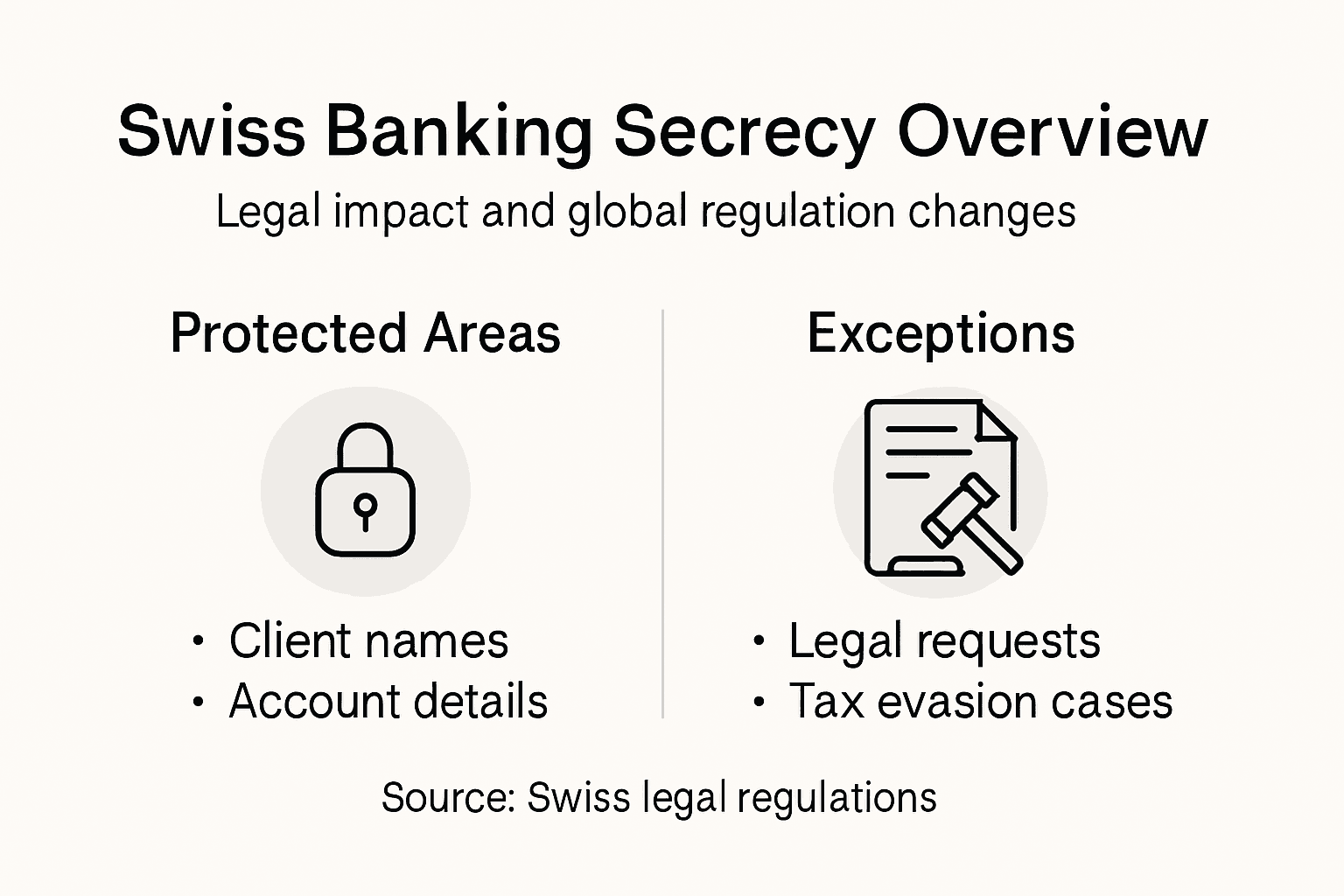
Swiss banking secrecy encompasses a comprehensive protection mechanism for client financial information. Bank secrecy protects customer data against unauthorized disclosure, safeguarding sensitive financial details with stringent legal provisions.
Types of protected information include:
Client identities
Account numbers and balances
Transaction records
Personal financial documentation
Investment portfolio details
Communication between bank and client
However, Swiss banking laws recognize critical exceptions where information disclosure becomes permissible. Bank secrecy can be lifted under specific legal circumstances, ensuring a balanced approach between individual privacy and broader societal interests.
Key exceptions for information disclosure involve:
Criminal investigations
Money laundering reporting
Court-ordered legal proceedings
Debt collection and bankruptcy cases
International tax compliance agreements
Explicit customer consent
Swiss banking regulations maintain a delicate balance between protecting individual financial privacy and supporting legal transparency requirements.
The disclosure process involves rigorous legal safeguards, typically requiring official documentation, court approvals, or specific regulatory mandates. Banks must meticulously document and justify any information release, ensuring compliance with both Swiss and international legal standards.
Compare key aspects of protected information versus exceptions in Swiss banking secrecy:
Aspect | Protected Information | Key Exceptions |
Client Privacy | Strong confidentiality enforced | Disclosure allowed for legal proceedings |
Data Security | Legal safeguards for all records | Reporting required for tax and crime investigations |
Access Control | Only authorized bank staff allowed | Court orders and international requests override controls |
Regulatory Influence | Swiss laws prioritize protection | Global agreements demand transparency |
Pro tip: Always obtain professional legal counsel when navigating complex Swiss banking disclosure scenarios to understand your specific rights and obligations.
International Agreements and Global Reporting
Global financial transparency has fundamentally transformed Swiss banking practices in recent years. Switzerland’s banking secrecy norms have gradually adapted to international pressures, marking a significant shift in cross-border financial reporting standards.
Key international frameworks that have reshaped Swiss banking include:
Common Reporting Standard (CRS)
Automatic Exchange of Information (AEOI)
OECD transparency guidelines
Bilateral tax information treaties
Financial Action Task Force (FATF) recommendations
The Federal Act on the International Automatic Exchange of Information in Tax Matters (AEOIA), introduced in 2015, represented a pivotal moment in Switzerland’s commitment to global financial transparency. Swiss banks now provide financial information to tax authorities under comprehensive international agreements.
Critical reporting mechanisms now require Swiss banks to:
Share account information with foreign tax administrations
Eliminate possibilities of anonymous accounts
Comply with multinational transparency standards
Report cross-border financial transactions
Validate client identities systematically
The era of absolute banking secrecy has effectively ended, replaced by a nuanced approach balancing individual privacy with global regulatory requirements.
These transformative changes mean that Swiss banks must now operate with unprecedented levels of international cooperation, fundamentally altering the traditional concept of banking confidentiality while maintaining robust legal protections for client information.
Here’s a summary of major international frameworks influencing Swiss banking transparency:
International Agreement | Purpose | Impact on Swiss Banking |
Common Reporting Standard (CRS) | Standardizes automatic tax info exchange | Requires banks to share global account data |
OECD Transparency Guidelines | Sets global financial disclosure rules | Increases cross-border reporting efforts |
FATF Recommendations | Prevents money laundering worldwide | Enforces stricter compliance practices |
Bilateral Tax Treaties | Enables country-to-country info sharing | Mandates disclosure to foreign tax authorities |
AEOIA (Swiss Law) | Governs automatic information exchange | Institutionalizes international cooperation |
Pro tip: Consult international tax specialists to understand how these reporting agreements might specifically impact your financial strategy.
Compliance Requirements and Common Pitfalls
Regulatory compliance represents a critical challenge for Swiss banking institutions, demanding meticulous attention to complex legal frameworks. Swiss banking institutions face rigorous regulatory requirements that encompass multiple dimensions of financial operations and institutional governance.
Key regulatory compliance areas include:
Licensing protocols
Capital adequacy standards
Liquidity management
Corporate governance frameworks
Anti-money laundering regulations
Risk management procedures
The Swiss Financial Market Supervisory Authority (FINMA) plays a central role in monitoring and enforcing these comprehensive regulatory standards, with significant consequences for institutions failing to meet established guidelines.
Common compliance pitfalls that banks must proactively address involve:
Weak customer due diligence processes
Inadequate risk management systems
Insufficient data protection protocols
Poor outsourcing control mechanisms
Limited transparency in financial reporting
Successful compliance requires continuous adaptation, proactive risk management, and a systematic approach to regulatory requirements.
The evolving regulatory landscape demands that Swiss banks maintain sophisticated compliance infrastructures, integrating advanced technological solutions and comprehensive staff training to navigate increasingly complex international financial regulations.
Pro tip: Invest in robust compliance management systems and regular staff training to stay ahead of emerging regulatory challenges.
Unlock Swiss Banking Privacy With Expert Corporate Support
Navigating the complex world of Swiss banking secrecy and evolving compliance demands can feel overwhelming. This article highlights key challenges like balancing stringent privacy laws with international transparency rules and managing sensitive financial information securely. If you want to ensure your Swiss company operates within these ever-changing legal frameworks while benefiting from confidential banking relationships, you need a trusted partner well-versed in both Swiss banking secrecy and corporate compliance.
At RPCS, we specialize in simplifying the formation and management of Swiss companies for international investors. Our comprehensive services cover everything from legal documentation and banking setup to ongoing administration — all designed to help you maintain confidentiality without compromising compliance. We understand the critical importance of privacy protections amid global reporting standards like CRS and AEOI.

Don’t risk delays or costly mistakes when setting up your Swiss entity. Visit RPCS now to access expert guidance on Swiss incorporation, banking relationships, and compliance best practices. Secure your business future in Switzerland with professionals who put privacy and regulatory precision first.
Frequently Asked Questions
What is Swiss banking secrecy?
Swiss banking secrecy is a legal framework that protects client financial information through constitutional and legislative mechanisms, ensuring confidentiality while allowing for specific exceptions under certain legal circumstances.
How has Swiss banking secrecy evolved in response to international pressures?
Swiss banking secrecy has adapted to global demands for financial transparency, particularly through compliance with international agreements like the Common Reporting Standard (CRS) and guidelines from the Financial Action Task Force (FATF).
What types of information are protected under Swiss banking secrecy laws?
Swiss banking secrecy laws protect various types of client information, including identities, account numbers, transaction records, and personal financial documentation, while also recognizing exceptions for legal disclosures.
What are the key exceptions to Swiss banking secrecy?
Key exceptions to Swiss banking secrecy include disclosures for criminal investigations, money laundering reporting, court-ordered proceedings, and situations where there is explicit customer consent.
Recommended
Comments