
Essential steps for business notarization in Switzerland
- 2 days ago
- 8 min read

TL;DR:
Notarization in Switzerland is a mandatory, legally significant step for company registration.
Complete, translated, and correctly signed documents are essential to avoid delays.
Engaging experienced local professionals helps ensure smooth, compliant Swiss company formation.
Forming a company in Switzerland is one of the most credible moves an international entrepreneur can make, but the notarization process stops many founders cold before they even get started. Miss a single document, show up with an untranslated passport, or misunderstand the notary’s role, and your timeline can slip by weeks. Switzerland’s legal framework for company formation is precise by design, and that precision protects you once you’re registered. This guide walks you through every stage of business notarization, from understanding what it legally means to what you do the morning after your notary appointment.
Table of Contents
Key Takeaways
Point | Details |
Swiss notarization is mandatory | Official notarization is essential for company formation in Switzerland. |
Preparation avoids delays | Gathering all required documents before your notary visit saves time and stress. |
Careful process leads to faster approval | Following the notarization steps precisely helps ensure rapid, compliant company registration. |
Expert help makes a difference | Professional advisors streamline the notarization and setup for international founders. |
What is business notarization in Switzerland?
Notarization in Switzerland is not a formality. It is a legally required step that gives your company’s founding documents official, enforceable status under Swiss law. A Swiss notary (called a Notar or notaire depending on the region) is a licensed public official, not just a witness. Their job is to verify identities, confirm that all parties understand what they’re signing, and certify that the documents comply with Swiss legal standards.
Swiss law requires official notarization for company formation, meaning you cannot simply file documents with a government office and expect them to be accepted. The notary acts as a gatekeeper between your intent to form a company and the state’s recognition of that company as a legal entity.
Why does this matter so much for international founders? Because the consequences of skipping or incorrectly completing notarization are serious. Your application to the Swiss Commercial Register will be rejected. You cannot open a corporate bank account. You have no legal standing to sign contracts, hire employees, or operate under a Swiss business name.
Here are the key situations that require notarization in Switzerland:
Founding a GmbH (Sarl): The articles of association and founding declaration must be notarized.
Founding an AG (SA): The incorporation deed, articles of association, and board resolutions require notarization.
Capital increases: Any change to share capital must go through a notary.
Amendments to founding documents: Structural changes to the company’s legal framework require re-notarization.
Transfer of shares in a GmbH: Unlike an AG, GmbH share transfers must be notarized.
Understanding the notary’s legal impact on your formation timeline is critical. A notary who finds a discrepancy in your documents will not simply wave it through. They will stop the process until it is corrected.
“The notary’s role in Swiss company formation goes beyond certification. They are legally responsible for ensuring every document they authenticate meets the requirements of Swiss federal and cantonal law.”
Before your first notary appointment, review a solid company formation checklist to make sure nothing is overlooked. The more prepared you arrive, the faster the process moves.
Required documents and prerequisites for notarization
Preparing the right documents before your notary appointment is where most international founders either save or lose significant time. Switzerland’s requirements are specific, and missing even one item means rescheduling.
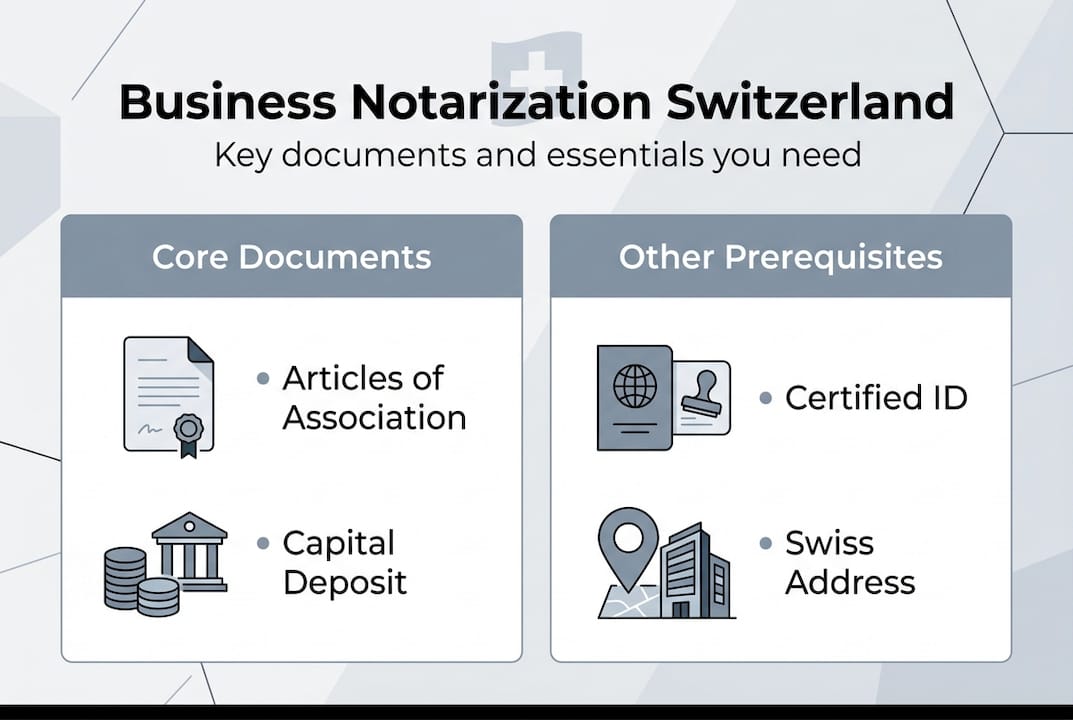
These are the legal documents required for Swiss company registration:
Articles of Association (Statuten/Statuts): The founding document outlining your company’s purpose, share structure, and governance rules.
Valid government-issued ID: Passport or national ID for every founder and director.
Proof of business address in Switzerland: A lease agreement, domiciliation contract, or similar document.
Capital deposit confirmation: A bank letter confirming that the minimum share capital has been deposited (CHF 20,000 for a GmbH, CHF 100,000 for an AG).
List of shareholders and directors: Full legal names, addresses, nationalities, and roles.
Founding declaration: A signed statement confirming the intent to establish the company.
For foreign founders, there is an additional layer. Any document not in German, French, Italian, or Romansh must be accompanied by a certified translation. This is not optional. The notary will not work with untranslated documents.
Document | Required for GmbH | Required for AG |
Articles of Association | Yes | Yes |
Capital deposit confirmation | Yes (CHF 20,000) | Yes (CHF 100,000) |
Certified ID copies | Yes | Yes |
Swiss business address proof | Yes | Yes |
Board resolution (if applicable) | No | Yes |
Beyond documents, there are structural prerequisites. At least one director of a GmbH or one board member of an AG must be a Swiss resident with signatory authority. This is a hard legal requirement, not a recommendation. Review the full company document requirements to understand how this affects your setup as a foreign founder.
Organize your documents in the order the notary will review them. Most notaries appreciate a clean folder with labeled sections. Bring originals and at least two certified copies of everything.

Pro Tip: Get your foreign documents apostilled and translated before you book the notary appointment. Apostille processing in some countries can take two to four weeks. If you wait until after booking, you risk paying rescheduling fees. Check the documents for 2026 company formation to confirm current requirements.
Step-by-step business notarization process
The Swiss notarization process is structured and must be followed in order. Skipping steps or arriving unprepared does not speed things up. It creates delays.
Prepare and finalize all documents. Before contacting a notary, every document must be complete, translated if necessary, and signed by the relevant parties. Incomplete documents are the single biggest cause of delays.
Choose a licensed Swiss notary. Notaries in Switzerland are cantonal officials. You must use a notary in the canton where your company will be registered. A Zurich company requires a Zurich notary.
Schedule your appointment. Contact the notary’s office with a summary of your formation type (GmbH or AG) and the number of founders. They will confirm what documents to bring and how long the appointment will take.
Attend the appointment in person. All founders or their authorized representatives must appear. The notary will verify identities, review every document, and read the articles of association aloud in many cantons.
Sign in the notary’s presence. Documents are signed at the appointment, not before. The notary certifies the signatures and applies their official seal.
Receive certified copies. The notary provides certified copies of all notarized documents. Keep these safe. You will need them for the Commercial Register filing.
For AG formations, the process is slightly more involved. Review the full AG incorporation steps to understand the additional board resolutions and subscription declarations required.
Step | GmbH | AG |
Notary appointment required | Yes | Yes |
Board resolution notarized | No | Yes |
Share subscription declaration | No | Yes |
Estimated appointment time | 1 to 2 hours | 2 to 3 hours |
Pro Tip: Send your draft articles of association to the notary before the appointment for a pre-review. Many notaries offer this at no extra cost. It catches errors early and can cut your appointment time significantly, making the faster notarization process a realistic outcome rather than a hope.
Post-notarization: What happens next?
The notary appointment is not the finish line. It is the starting point for your company’s official legal existence. What you do in the days immediately after notarization determines how quickly your business becomes fully operational.
After notarization, documents are filed with the Swiss Commercial Register (Handelsregister). This is the official government database of all Swiss companies. Registration typically takes five to ten business days once the filing is complete and correct.
Here is what to expect and do after your notary appointment:
File with the Commercial Register immediately. The notary often handles this filing on your behalf, but confirm this before leaving the appointment. If you file independently, use the certified copies provided by the notary.
Obtain your UID number. Once registered, your company receives a unique identification number (UID). This is required for tax registration, VAT applications, and most business contracts.
Open a corporate bank account. Swiss banks require your Commercial Register extract to open a business account. This is separate from the capital deposit account used during formation. Review your business address registration to ensure your domicile is correctly reflected in the register before approaching banks.
Register for VAT if applicable. If your projected annual turnover exceeds CHF 100,000, you must register for VAT with the Swiss Federal Tax Administration.
Set up accounting and compliance systems. Swiss law requires annual financial statements and, for larger companies, external audits.
“The window between notarization and Commercial Register filing is when most post-formation errors occur. Founders assume the notary handles everything, but in many cantons, the filing responsibility falls on the founders themselves.”
If issues arise after filing, such as a rejected application due to a name conflict or missing document, act immediately. Contact the notary for corrected certified copies. Delays at this stage can push back your bank account opening and first operational day by weeks. Solid document preparation advice before and after the appointment prevents most of these problems.
Why thorough notarization saves time and stress
Here is the perspective that most guides skip: international founders often treat notarization as a bureaucratic obstacle rather than a structural asset. That mindset is exactly what causes the costly delays they were trying to avoid.
When you rush notarization, you are not saving time. You are borrowing trouble. A rejected Commercial Register filing means a new notary appointment, new certified copies, and in some cases, a new capital deposit. The financial and emotional cost of doing it twice far exceeds the investment of doing it right the first time.
Mistakes in business notarization can lead to costly delays in opening your Swiss business. We have seen founders lose weeks because a single director’s ID was expired or a translation was not certified by an accredited translator.
The deeper truth is that why notary diligence matters is not just about legal compliance. It is about building a company on a foundation that holds. Swiss authorities, banks, and business partners all verify your Commercial Register entry. A clean, correctly notarized formation signals that you are a serious operator. That credibility is worth more than the time you might think you are saving by cutting corners.
For international founders especially, working with experienced local professionals is not a luxury. It is the most efficient path forward.
Make Swiss company formation easier with expert help
Understanding the notarization process is one thing. Executing it flawlessly from abroad, in a foreign legal system, with documents in multiple languages, is another challenge entirely.

At RPCS, we specialize in guiding international entrepreneurs through every stage of Swiss company formation help, from preparing your founding documents to coordinating your notary appointment and filing with the Commercial Register. We also support you in opening a Swiss bank account once your company is registered. Our team knows exactly what Swiss notaries and registration authorities expect, so you do not have to learn it through costly trial and error. Reach out to us and get your Swiss company formed correctly the first time.
Frequently asked questions
How long does business notarization take in Switzerland?
Business notarization in Switzerland typically takes one to three days once all documents are ready and the notary appointment is set. Documentation requirements and process complexity can either speed up or slow down that timeline.
Can I notarize Swiss company documents from abroad?
In most cases, at least one founder must attend the notary appointment in Switzerland, as in-person notarization is a legal requirement for Swiss company formation. Remote notarization is limited and subject to strict cantonal rules.
What happens if document translations are needed for Swiss notarization?
Documents in non-official languages require certified translations, which must be ready before your notary appointment to avoid delays. Preparations for document translations are a standard part of the formation process.
What are the consequences of incorrect or missing documents?
Incorrect or missing documentation can delay or prevent successful company registration with Swiss authorities. Document errors lead to significant timing setbacks and may require a completely new notary appointment.
Recommended
Comments