
Swiss Annual Reporting: Ensure Compliance & Optimize Ops
- Apr 26
- 8 min read

TL;DR:
Swiss annual reporting balances accountability with strong privacy protections for private companies.
Requirements vary by company size, with simplified reports for smaller entities under CHF 500,000 revenue.
Proper annual reporting enhances credibility with banks and investors, serving as a strategic business asset.
Many international entrepreneurs assume that filing an annual report in Switzerland means submitting a complex public document that anyone can scrutinize. That assumption is wrong, and acting on it leads to unnecessary anxiety and missed opportunity. Swiss annual reporting is, in fact, a well-structured framework that balances accountability with meaningful privacy protections. Most private companies never expose their financials to the public. Once you understand how the Swiss system actually works, including who must comply, what gets filed, and what you can use these reports for strategically, annual reporting shifts from a perceived burden into a genuine operational asset.
Table of Contents
Key Takeaways
Point | Details |
Swiss law rules reporting | All Swiss entities must produce annual financial statements under the Swiss Code of Obligations. |
Privacy for most companies | Unlike some countries, Swiss annual reports are not typically public, favoring confidentiality. |
Deadlines drive compliance | Prepare annual reports within 6 months post year-end, and file tax returns 6-9 months after. |
Size and structure matter | Reporting rules and requirements vary for small businesses, branches, and large corporations. |
Reports fuel optimization | Annual reporting isn’t just compliance; it unlocks insights for tax and business strategy. |
What is Swiss annual reporting? Key principles and legal foundations
Swiss annual reporting is not a single document but a collection of financial and narrative disclosures that together form the Geschäftsbericht, or annual report. At its core, it includes three mandatory components: the balance sheet, the profit and loss statement (P&L), and notes to the financial statements. These documents together must give a true and fair view of the company’s financial position, not just a technical summary.
The legal foundation for this is the Swiss Code of Obligations (CO). Specifically, Swiss annual reporting obligations are governed by Articles 957 through 963b of the CO, which require all companies to prepare annual financial statements providing a true and fair view of financial position. Article 958 CO defines the core standard: financial statements must be prepared in accordance with accepted commercial principles and must reflect the actual state of the company’s assets, liabilities, and results.
Who is actually obliged? The obligation applies broadly. Swiss companies of all legal forms fall under the CO’s reporting requirements, including Aktiengesellschaft (AG) and Gesellschaft mit beschränkter Haftung (GmbH) structures. Branches of foreign companies operating in Switzerland are also covered. Sole proprietors and partnerships are subject to simplified rules in certain cases, which we will cover shortly.
A key timing requirement that many founders miss: the annual report must be prepared within six months after the financial year ends. For companies with a December 31 year-end, that means completion by June 30. Missing this window creates legal risk and can complicate tax filings.
Component | What it covers |
Balance sheet | Assets, liabilities, equity at year-end |
P&L statement | Revenue, costs, net profit or loss |
Notes | Accounting policies, disclosures, contingencies |
Management report (large cos) | Business review, outlook, risk summary |
“The annual report is not simply a compliance checkbox. It is the primary instrument through which Swiss law holds companies accountable to their shareholders, creditors, and the broader business environment.”
For companies with operations across borders, understanding Swiss accounting requirements from the outset prevents costly corrections later.
Who needs to comply and what are the main requirements?
Not every business in Switzerland faces identical obligations. The Swiss framework is tiered, which is actually good news for smaller operators. Understanding the precise category your company falls into determines how much reporting effort you actually need to invest.
Here is a breakdown of entities and their typical obligations:
AG (Aktiengesellschaft): Full annual financial statements required; ordinary or limited audit depending on size
GmbH (Gesellschaft mit beschränkter Haftung): Full financial statements required; audit threshold same as AG
Sole proprietors and partnerships: Simplified reporting permitted if annual revenue is below CHF 500,000
Branches of foreign companies: Must report following the parent company structure and Swiss CO requirements
Foundations and associations: Subject to audit if they operate commercially or meet size thresholds
Listed companies: Additional disclosure obligations via SIX Swiss Exchange rules apply on top of CO requirements
Simplified reporting for smaller entities covers sole proprietors and partnerships with revenue under CHF 500,000. These entities may prepare income and expenditure accounts instead of full balance sheets, significantly reducing the documentation burden.

One point that surprises many foreign entrepreneurs: there is no general public filing requirement for private Swiss companies. You do not submit your annual report to the Commercial Register (ZEFIX) for public viewing. The report is kept internally, made available to shareholders, and retained for a mandatory period of 10 years along with supporting documents. This privacy element is a genuine structural advantage, not a loophole.
A separate requirement exists for large companies under Articles 964a through 964c CO. These rules mandate non-financial reporting covering environmental, social, and governance (ESG) topics, but they only apply to public companies or those meeting specific size thresholds.
Pro Tip: Even if your company qualifies for simplified reporting, preparing a full balance sheet voluntarily demonstrates professionalism to banks and investors. It can accelerate loan approvals and build credibility faster than the minimum legal standard alone.
For a practical overview of compliance steps, including what documents to gather and when, planning your reporting calendar at least 90 days before year-end makes execution far smoother. Companies operating as foreign entities should also review accounting standards for foreign companies to understand how Swiss standards interact with IFRS or US GAAP.
Step-by-step walkthrough: Preparing and approving the annual report
Knowing the rules is one thing. Executing the process cleanly is another. Here is a practical roadmap that works for both AG and GmbH structures.
Close your books (Month 1 after year-end): Finalize all journal entries, reconcile bank accounts, and clear any intercompany transactions. Clean books are the foundation.
Draft the financial statements (Month 1 to 2): Prepare the balance sheet, P&L, and notes. Apply Swiss GAAP FER or CO-based standards as applicable to your company size.
Internal review and adjustment (Month 2 to 3): Management reviews for accuracy. Adjust any accruals, depreciation entries, or provisions that were estimated mid-year.
Audit or review engagement (Month 3 to 4): If your company is subject to ordinary or limited audit, the auditor receives the draft now. Address findings promptly.
Board approval (Month 4 to 5): The board of directors formally approves the financial statements before presenting them to shareholders.
Shareholder or general meeting approval (by Month 6): Annual reports must be approved by shareholders or the general meeting within 6 months of the financial year-end. Minutes must be documented and retained.
Tax return filing (Month 6 to 9): Tax authorities in each canton set their own deadlines, typically within 6 to 9 months post year-end. The annual report is the source document for all tax calculations.
Process element | Standard reporting (AG/GmbH) | Simplified reporting (small sole prop/partnership) |
Financial statements required | Balance sheet, P&L, notes | Income and expenditure account only |
Audit required | Yes (limited or ordinary) | No |
Shareholder approval | Required at GM | Not always required |
Retention period | 10 years | 10 years |
Tax filing basis | Full financial statements | Simplified accounts |
For a fuller annual administration guide, including templates and canton-specific tax filing tips, planning shareholder meetings at least two to three weeks before the six-month deadline avoids last-minute approval scrambles. You can also find detailed guidance on reporting standards for entrepreneurs if you are managing cross-border structures.
Leveraging annual reporting for tax optimization and strategic insights
Most founders treat the annual report as the finish line. The smarter move is to treat it as the starting line for the next business year.
Swiss tax returns are filed annually per canton using annual report data, with companies required to file within 6 to 9 months after their financial year ends. This means that every decision you made in your annual report, including asset valuations, depreciation choices, and provision levels, directly shapes your taxable income. That gives you meaningful, legal control over your tax position if you plan in advance.
Here are the key mistakes that cost companies real money:
Ignoring depreciation elections: Swiss CO allows flexibility in depreciation rates. Many companies default to the minimum without realizing higher depreciation reduces taxable income in high-revenue years.
Missing provision opportunities: Provisions for doubtful receivables or legal risks, when documented properly, are deductible. Skipping them is leaving money behind.
Failing to reconcile Swiss GAAP with tax rules: The two are related but not identical. Small adjustments between book and tax income can generate meaningful savings.
Late filing penalties: Canton Zurich, for example, issues extension requests that must be submitted proactively. Missed deadlines generate fines and interest.
The business tax optimization guide explains how to structure your accounts to maximize legitimate deductions within Swiss law.
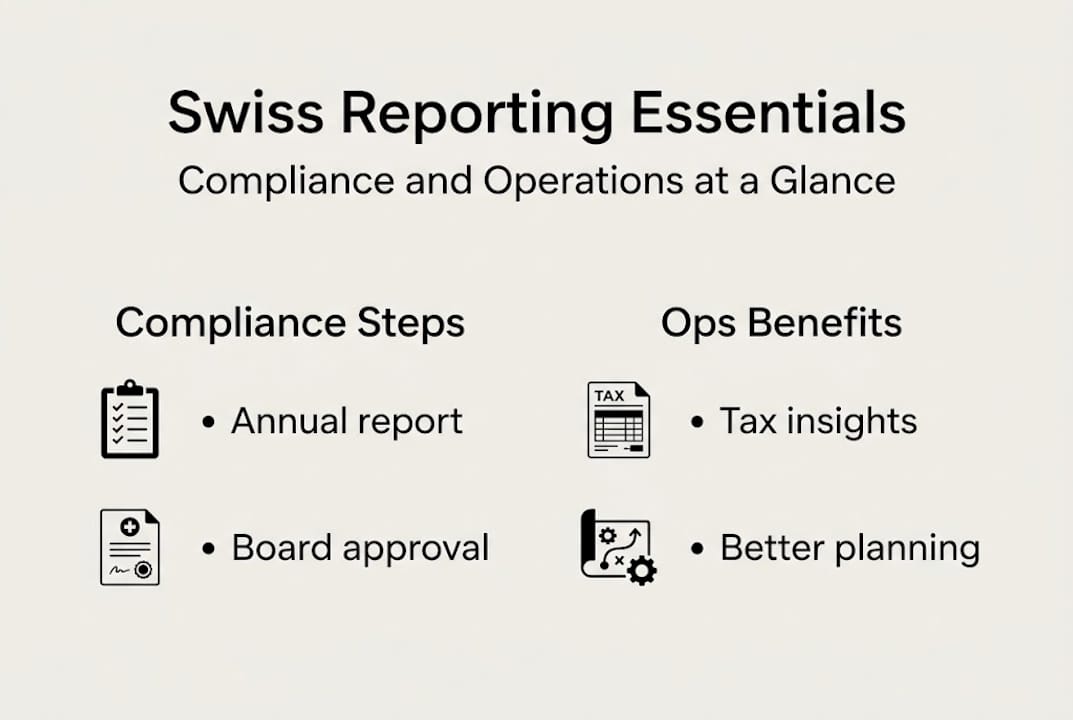
Statistic to keep in mind: Companies that file their cantonal tax returns within the 6 to 9 month window and proactively request extensions when needed avoid penalties that can range from CHF 500 to several thousand francs per occurrence.
Pro Tip: Use your annual report as a quarterly performance benchmark, not just a year-end artifact. Comparing actual results against your internal projections mid-year lets you adjust strategy before the numbers are locked. For full guidance on corporate tax registration, especially for newly incorporated entities, setting up the right cantonal account from day one prevents registration delays.
Why Swiss annual reporting uniquely empowers global entrepreneurs
Most articles about Swiss annual reporting focus exclusively on process: what forms to file, what deadlines to meet. That framing misses the larger story.
In our experience guiding international founders through Swiss reporting cycles, the entrepreneurs who extract the most value are those who recognize what the Swiss framework is actually designed to do. It is built for controlled accountability. You are accountable to your shareholders and tax authority, but not to the general public. That is a deliberate design choice, and it is a structural advantage for entrepreneurs who value operational confidentiality.
Smaller companies get genuine flexibility. The simplified reporting tier for entities below CHF 500,000 in revenue is not a lesser version of compliance. It is a thoughtful legislative choice that reduces administrative load for companies that do not pose systemic risk.
The counter-intuitive insight is this: the discipline of preparing a clean, well-structured annual report makes your company more competitive, not just more compliant. Swiss banks, institutional partners, and foreign investors treat a Swiss annual report as a credibility signal. It speaks to governance maturity in a way that companies incorporated in lower-reputation jurisdictions simply cannot replicate. You can explore the accounting standards benefits for startups to see how early-stage companies use proper reporting as a financing accelerator. The annual report is not bureaucracy. It is infrastructure.
How we help you master Swiss annual reporting
If you want to turn annual reporting from a chore into an advantage, RPCS Solutions is built exactly for that.
Our Swiss-based team handles everything from bookkeeping setup and financial statement preparation to shareholder meeting documentation and cantonal tax filing coordination. We work with AG and GmbH structures across all Swiss cantons, serving international founders who need audit-proof, deadline-compliant reporting without having to navigate the Swiss legal system alone. Whether you are just getting started with Swiss accounting support or exploring your options for full-service company formation services, we can build the right operational foundation for your Swiss entity from day one.
Frequently asked questions
Who must file an annual report in Switzerland?
All incorporated companies such as AG and GmbH, branches of foreign companies, and certain associations must prepare annual reports under Articles 957 to 963b of the Swiss Code of Obligations, with requirements varying by entity size and type.
Are Swiss annual reports public?
For most private Swiss companies, annual reports are not public. Only listed companies must disclose their financials publicly per SIX Swiss Exchange rules; private AG and GmbH entities retain full confidentiality.
What is the deadline for preparing and filing Swiss annual reports?
Annual reports must be prepared within 6 months after the financial year ends and approved at the general meeting; cantonal tax returns using that data are then due within 6 to 9 months depending on the canton.
What happens if my Swiss company earns less than CHF 500,000?
Sole proprietors and partnerships with revenue below CHF 500,000 may use simplified income and expenditure accounting and are exempt from full balance sheet and audit requirements under the CO.
Recommended
Comments