
Mastering Ongoing Swiss Company Administration Process
- Feb 21
- 9 min read
Updated: Mar 2

Launching a Swiss GmbH or AG can feel like navigating an unfamiliar maze for global founders and investors. Legal compliance and efficiency are not just buzzwords—they are the foundation behind every successful Swiss operation. Whether you are building your corporate structure, managing records, or meeting tax requirements, understanding the intricate rules of Swiss company administration helps you avoid costly missteps while keeping your business in good standing.
Table of Contents
Quick Summary
Main Insight | Detailed Explanation |
1. Establish Legal Structure Early | Choose the appropriate company type (GmbH or AG) based on your business needs and ensure compliance with Swiss regulations from the start. |
2. Maintain Accurate Corporate Records | Implement systematic record-keeping for all business activities and transactions to prevent compliance issues and facilitate audits. |
3. Understand Tax Obligations | Register for VAT and know filing deadlines to avoid penalties; collaborate with accountants to ensure accurate reporting and compliance. |
4. Regularly Audit for Compliance | Conduct quarterly internal audits to identify gaps and align procedures with legal requirements, ensuring ongoing regulatory compliance. |
5. Optimize Processes Continuously | Streamline business operations by identifying inefficiencies and updating your procedures to maintain compliance and improve efficiency over time. |
Step 1: Establish Legal and Financial Foundations
You’re about to build the backbone of your Swiss operation. This step determines whether your company operates legally, stays compliant, and avoids costly penalties down the road.
Start by understanding Switzerland’s legal framework. Your GmbH or AG must follow specific corporate structures outlined in Swiss law. Access Swiss federal legal texts to review the exact requirements for your chosen entity type. This isn’t optional—it’s your foundation.
Here’s a quick comparison of Swiss company types and their operational requirements:
Company Type | Minimum Capital Requirement | Registration Complexity | Suitable For |
GmbH | CHF 20,000 | Moderate | Small businesses |
AG | CHF 100,000 | High | Large corporations |
Sole Proprietor | None | Low | Freelancers and micro firms |
This table illustrates the major company structures to help you decide which fits your business needs best.
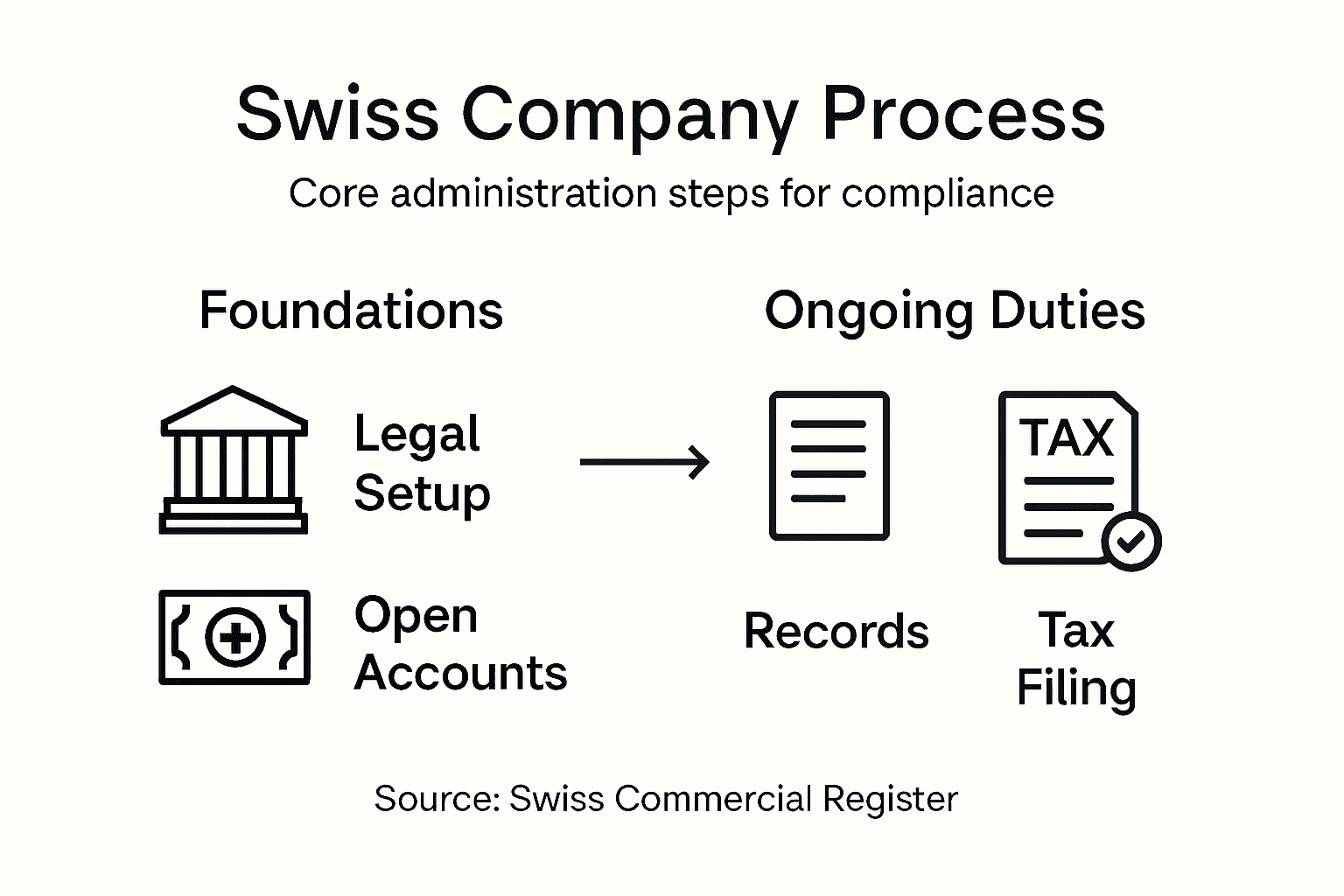
Next, determine your company’s registered address. Switzerland requires all companies to maintain a physical presence. This doesn’t mean renting expensive office space. A business address in Switzerland can be a virtual office, mail handling service, or professional address. What matters is that it’s legitimate and compliant with cantonal regulations.
Your Swiss bank account comes next. Most international entrepreneurs open accounts simultaneously with company registration. Here’s what you need:
Company registration documents
Proof of director identity and residence
Details of beneficial owners
Business plan or proof of funds
Tax identification documentation
Banks will verify these materials thoroughly. Plan for 2-4 weeks from application to account activation. Some banks move faster if you work with formation service providers.
Now address the financial side. Even before your first transaction, you need accounting services for Swiss companies in place. Swiss law requires companies to maintain detailed records and file annual accounts. Starting early prevents compliance headaches. Your accountant should understand Swiss GAAP and cantonal tax requirements.
Review Switzerland’s corporate tax rates for your canton. They vary significantly—from roughly 11% to 22% combined federal and cantonal rates. Your canton choice at formation directly impacts your ongoing tax obligations.
Document everything formally. Create bylaws, shareholder agreements, and director appointment records. Hire a qualified company director in Switzerland—whether that’s yourself (if you’re resident) or a Swiss resident director—who understands ongoing compliance obligations. Many international founders use Swiss nominee director services to maintain compliance while staying flexible.
Your legal and financial foundation determines every subsequent decision. Getting this right eliminates chaos later.
Check recent legislative changes affecting your business. Recent amendments like Swiss business law updates introduce new compliance requirements effective in 2026, including investment screening considerations.
Pro tip: Engage your accountant and director during formation, not after. They’ll catch compliance issues early and structure your accounts optimally for your specific business model.
Step 2: Maintain Accurate Corporate Records
Accurate records are your company’s legal lifeline. Swiss authorities, auditors, and stakeholders rely on them to verify every decision, transaction, and business activity your company undertakes.
Start with a systematic approach to record creation and storage. Records management principles establish that you must capture documents as they’re created, not retroactively. This means implementing processes immediately, not scrambling later. Your records should document:
All shareholder meetings and board decisions
Financial transactions and invoices
Employee contracts and payroll records
Tax filings and government correspondence
Corporate governance documents
Organize your records by category and date. Swiss law requires you to retain most business documents for a minimum of 10 years. Create a filing system—whether digital or physical—that makes retrieval straightforward during audits or legal inquiries.

Digital storage is increasingly standard for Swiss companies. Use cloud-based solutions that provide version control and access logs. Your system should show who accessed what and when. This creates accountability and meets compliance requirements.
Ensure your records reflect actual business activity. Backdating documents or creating false entries exposes you to serious legal consequences and tax penalties. Every entry should match supporting evidence. Invoice dates should align with delivery dates, expense reports with receipts.
Implement ISO 30300 standards for record governance to establish formal control over document creation and maintenance. These international standards help Swiss companies demonstrate they meet global best practices for record-keeping.
Conduct quarterly audits of your records. Verify that nothing’s missing, that files are accessible, and that your system still works for your growing business. As your company scales, your record-keeping approach needs adjustment.
Accurate records are evidence of integrity. They protect you when audited and prove your company operates legitimately.
Assign one person responsibility for records management. This accountability prevents documents from getting lost or misfiled. Your accounting services for Swiss companies should oversee financial records specifically.
Pro tip: Implement your records system before you need it, not during an audit. Starting strong saves countless hours when regulators or investors request documentation.
Step 3: Fulfill Tax and Regulatory Obligations
Tax compliance isn’t optional for Swiss companies. Failing to meet deadlines or misreporting creates penalties, audit triggers, and damage to your business reputation that takes years to rebuild.
Understand your basic tax obligations immediately. Your company must file corporate income tax returns annually at both federal and cantonal levels. Switzerland participates in international tax cooperation standards, meaning information about your accounts and transactions is shared globally. This isn’t a threat if you’re operating legitimately, but it demands accuracy.
Start by identifying your tax deadlines for the current year. Most Swiss companies file by June 30th following the fiscal year end, though some cantons allow extensions. Missing these deadlines triggers automatic penalties of 5-20% of the unpaid tax amount. Mark these dates in your calendar immediately.
Register for VAT if your annual turnover exceeds 100,000 Swiss francs. Once registered, you’ll submit quarterly or annual VAT returns depending on your volume. VAT compliance requires precise tracking of domestic and foreign sales, which is why your accounting system must categorize transactions correctly.
Your obligations include:
Federal corporate tax returns
Cantonal and municipal tax filings
VAT registration and reporting
Withholding tax on employee salaries
Annual financial statements (balance sheet and profit/loss)
Social security contributions for employees
Work with accounting services for Swiss companies that understand your canton’s specific rules. Tax rates vary between cantons (11-22% combined rates), and deductions differ too. A specialized accountant ensures you’re not overpaying or missing legitimate savings.
File electronically whenever possible. Swiss authorities require digital submission for most tax documents. Your accountant will handle this, but verify they’re using certified filing systems to avoid rejection delays.
Keep all supporting documentation for seven years minimum. Receipts, invoices, bank statements, and expense records prove your reported numbers. During audits, authorities review these details extensively. Organized, complete documentation saves enormous headaches.
Tax compliance protects your company’s credibility and prevents costly audits. Think of it as insurance against business disruption.
Schedule quarterly tax planning meetings with your accountant. These prevent surprises when bills are due and identify optimization opportunities throughout the year. Waiting until December for planning is too late.
Pro tip: File taxes early rather than at deadline. Early filing reduces audit risk and gives you months to address any questions before penalties accrue.
Step 4: Verify Compliance and Optimize Procedures
Compliance isn’t a one-time event. Your Swiss company needs ongoing verification and regular procedure refinements to stay ahead of regulatory changes and operational inefficiencies.
Begin by conducting internal compliance audits quarterly. Review your current processes against Swiss legal requirements and your company’s policies. Ask yourself: Are we following our own procedures? Are those procedures still aligned with current law? Spot gaps before authorities do.
Establish a compliance management system using structured frameworks. ISO 37301:2021 compliance standards provide a proven methodology for maintaining effective control systems within organizations. This standard helps you document procedures, identify risks, and demonstrate to stakeholders that your governance is robust.
Your compliance verification should cover:
Corporate governance and board decisions
Financial reporting accuracy
Tax filing completeness
Data protection and privacy compliance
Employment law adherence
Anti-corruption and sanctions screening
Document everything. Create a compliance calendar showing all deadlines, filing requirements, and audit schedules. Assign responsibility for each task to specific people. Without clear ownership, deadlines slip and documents disappear.
Optimize your procedures by identifying bottlenecks. Which processes take too long? Which create confusion? Which fail occasionally? Target these for improvement. Maybe your expense approval process takes three weeks when it could take three days. Maybe your document filing system wastes time searching for old contracts.
Implement responsible business practices aligned with Swiss human rights due diligence standards. These standards address supply chain ethics, labor practices, and environmental responsibility. They’re not just regulatory requirements—they build trust with customers and investors.
Schedule annual compliance reviews with your director, accountant, and legal advisor. Discuss regulatory changes effective in the coming year. Adjust procedures proactively. This prevents emergency scrambles when new rules take effect.
To streamline your compliance efforts, here’s a summary of key ongoing obligations for Swiss companies:
Obligation | Frequency | Responsible Role | Potential Penalty |
Corporate tax filing | Annual | Accountant/Director | Fines, audit trigger |
Record retention | Ongoing | Records manager | Legal action, fines |
VAT reporting | Quarterly/Annual | Accountant | Tax penalties |
Compliance audit | Quarterly | Internal compliance specialist | Operational disruption |
This table helps identify the critical tasks and those responsible, reducing compliance risk.
Optimized procedures reduce costs, minimize errors, and make audits straightforward. Efficiency and compliance reinforce each other.
Use technology to simplify compliance. Automated alerts for filing deadlines, digital document management systems, and accounting software that categorizes transactions correctly all reduce manual effort and human error.
Pro tip: Create a compliance improvement log where you document issues discovered and solutions implemented. Over time, this log becomes your roadmap for continuous enhancement and proves to auditors that you’re actively managing compliance.
Simplify Your Swiss Company Administration Today
Managing ongoing company obligations in Switzerland demands precision, compliance, and expert guidance. From maintaining accurate corporate records to navigating complex tax filings and ensuring continuous compliance verification, the challenges are clear. If you want to avoid costly penalties or delays, it is vital to establish strong administrative foundations supported by professional assistance.

Take control of your Swiss business journey with the tailored solutions at RPCS. Whether you need support with company formation documentation, Swiss bank account setup, or reliable accounting services for Swiss companies, our platform offers comprehensive services designed especially for international entrepreneurs and investors. Start streamlining your administration and safeguarding your company’s future now by visiting RPCS. Ensure every step of your Swiss company’s administration process is seamless, compliant, and optimized for success.
Frequently Asked Questions
What are the key steps to establishing a legal foundation for a Swiss company?
To establish a legal foundation, register your company type, secure a physical address, and open a Swiss bank account. Start by reviewing the company structures and their requirements to choose one that fits your business model.
How can I ensure accurate record-keeping for my Swiss company?
Implement a systematic approach to record creation and storage, documenting everything from shareholder meetings to financial transactions. Create and maintain a filing system that organizes records by category and date to facilitate easy retrieval during audits.
What are the ongoing tax obligations for a Swiss company?
Your company must file corporate income tax returns annually at both federal and cantonal levels and register for VAT if turnover exceeds 100,000 Swiss francs. Mark your tax deadlines on a calendar to avoid penalties that can range from 5% to 20% of unpaid amounts.
How often should compliance audits be conducted for my Swiss company?
Conduct internal compliance audits quarterly to ensure adherence to Swiss laws and your own company’s policies. Regular audits help you spot gaps and adjust procedures before authorities find discrepancies.
What is the role of a compliance management system in ongoing Swiss company administration?
A compliance management system helps maintain effective controls by documenting procedures, identifying risks, and demonstrating governance to stakeholders. Establish this system early to streamline compliance efforts and reduce the risk of penalties or operational disruptions.
Recommended
Comments