
Role of Notaries in Swiss Company Formation: Key Legal Impact
- Jan 24
- 15 min read
Updated: Jan 27

Forming a Swiss company is never just a paperwork exercise for technology sector founders with global ambitions. The reality is that Swiss notarization acts as a safeguard transforming ordinary documents into official, legally binding instruments recognized by Swiss authorities. For international entrepreneurs and investors, understanding public notarization in Swiss law is crucial not only for legal compliance but also for smooth business banking and future-proof credibility. This guide explains how the Swiss notarization process protects your interests and streamlines your Swiss GmbH setup.
Table of Contents
Key Takeaways
Point | Details |
Importance of Notarization | Notarization is a mandatory and essential step for forming a GmbH in Switzerland, ensuring legal validation of documents. |
Role of Swiss Notaries | Swiss notaries actively guide the documentation process, verifying authenticity and compliance with legal standards. |
Costs and Risks | Inadequate notarization can lead to registration delays and increased costs; understanding notary fees upfront is crucial. |
Common Pitfalls | Foreign entrepreneurs often misunderstand which documents require notarization, leading to either over- or under-notarization, which can have legal repercussions. |
What Is Notarization in Swiss Company Setup
When you’re forming a Swiss company as an international entrepreneur or investor, notarization isn’t just paperwork you check off a list. It’s a fundamental legal requirement that transforms your company documents from ordinary contracts into legally binding, officially recognized instruments. Public notarization in Swiss law is a legal act where a notary public certifies contracts or documents, making it mandatory for significant legal transactions like company formation. For technology sector founders and business investors, this process represents a critical checkpoint where Swiss law ensures your company structure is legitimate, properly documented, and protected from future disputes.
The notarization process itself is more interactive than many entrepreneurs expect. A Swiss notary doesn’t simply rubber stamp your documents. Instead, the notary reads the contract aloud, clarifies any questions you or your co-founders might have, and verifies that everything aligns with Swiss legal requirements. This face-to-face element serves a real purpose: it prevents misunderstandings that could derail your company down the road. When you’re setting up a GmbH or AG structure, the notary confirms the validity and authenticity of your company incorporation documents, making them legally binding and recognized by Swiss authorities. This is especially important when working with nominee directors, establishing a registered business address in Switzerland, or opening a Switzerland bank account, as these elements require documented proof of legitimacy.
What makes notarization distinct in the Swiss context is that it creates an official record. When your notary certifies your articles of association, shareholder agreements, or founder declarations, you’re not just getting a signature. You’re obtaining a certified document that carries the weight of Swiss legal authority. This matters enormously when you’re working with international partners, dealing with regulators, or eventually trying to access Switzerland bank accounts or accounting services for Swiss companies. The certified nature of your documents removes ambiguity. Banks, government agencies, and regulatory bodies recognize notarized documents as authentic without requiring additional verification. For business owners in the technology sector especially, this efficiency is valuable. You spend less time justifying your company structure and more time actually building your business.
Pro tip: Schedule your notarization appointment early in your company formation timeline and bring all original identification documents and supporting materials with you, as Swiss notaries require complete documentation in a single session to avoid delays that could slow your Swiss company registration process.
Types of Swiss Notarial Systems and Differences
Switzerland’s notarial system differs significantly from what you might encounter in other countries, and understanding these differences is crucial when forming your company. Switzerland operates under a civil law tradition where notaries function as official state officers rather than private practitioners who simply witness signatures. This distinction matters for your company formation because Swiss notaries have genuine legal authority to validate documents, prevent fraud, and ensure compliance with Swiss law. Unlike common law jurisdictions where notaries have limited power, a Swiss notary actively participates in the legal process. They don’t just observe, they guide, advise, and authenticate. When you’re preparing incorporation documents for a GmbH or AG, your notary becomes a gatekeeper ensuring everything aligns with Swiss regulatory requirements.
The cantonal system creates meaningful variations in how notarization works across Switzerland. Each canton maintains its own notarial regulations, though the federal government sets baseline standards. This means the process in Zurich might have slightly different procedures than in Geneva or Bern, though the core function remains constant. Some cantons employ more specialized notaries for commercial matters, while others use general practitioners. The important thing for you to know is that notaries are regulated professionals who must meet strict educational and ethical requirements. They carry professional liability insurance and operate under government oversight. When you’re establishing a registered address in Switzerland, the notary certifying your documents must be officially recognized in the canton where your company will be registered.
Another key difference is that Swiss notaries maintain official registries and archives of documents they certify. This creates a permanent legal trail for your company formation documents. If disputes arise years later, the notary’s official records provide undeniable proof of what was certified and when. For international entrepreneurs setting up Swiss company formation services or hiring a Swiss director, this archival function provides significant protection. Your founding documents remain officially recorded in the notary’s archive, accessible for verification by authorities or future stakeholders. This systematic approach reflects Switzerland’s broader commitment to legal certainty and transparent record-keeping, which contributes to Switzerland’s reputation as a stable business environment.
The cantonal variations also affect timing and costs. Some cantons have streamlined electronic notarization processes, while others maintain more traditional procedures. Working with experienced service providers who understand your specific canton’s notarial system can significantly accelerate your company registration timeline. The notary’s role remains essential regardless of these procedural differences, but knowing which system applies to your situation helps you plan more accurately.
Pro tip: Request a notary who specializes in commercial company formations rather than a generalist, as specialized notaries understand GmbH and AG structures intimately and can spot potential compliance issues before they delay your Swiss company registration.
Here’s a quick comparison of Swiss notaries versus notaries in common law jurisdictions:
Aspect | Swiss Notary (Civil Law) | Common Law Notary |
Legal Authority | Certifies, advises, and validates | Witnesses signatures only |
Role in Business | Active legal expert, guides process | Passive observer |
Regulatory Oversight | Government regulated, official | Often privately licensed |
Document Recordkeeping | Maintains permanent legal archives | May not archive documents |
Why Notarization Is Required for GmbH Formation
Notarization isn’t optional when you’re forming a GmbH in Switzerland. It’s a legal mandate backed by Swiss corporate law. The reason is straightforward: a GmbH is a limited liability company that requires ironclad proof of legitimate formation. Without notarization, your company documents lack the legal weight needed for official recognition. Swiss authorities won’t register your company without certified proof that your founding documents are authentic and comply with Swiss law. When you’re setting up a GmbH, the notary’s certification becomes the bridge between your private intentions and official state recognition. This requirement protects not just you, but also your creditors, employees, and any parties doing business with your company. Everyone involved needs assurance that your company actually exists as a legal entity with proper governance structures.
The notarization requirement addresses a fundamental risk in company formation: fraud prevention. Think about what happens without notarization. Someone could fabricate articles of association, falsify shareholder signatures, or misrepresent capital contributions. This creates chaos for legitimate business operations. A notary prevents these scenarios by directly witnessing signature, verifying identity, confirming understanding of the documents, and ensuring capital is genuinely available. For your GmbH specifically, the notary certifies your articles of association, which form the constitutional foundation of your company. These documents define your ownership structure, governance rights, capital contributions, profit distribution, and decision-making processes. Getting these wrong creates immediate problems with tax authorities, banks, and regulatory agencies. The notary’s involvement ensures accuracy from the start.
Swiss law also uses notarization as a quality control mechanism for business formation. The notary acts as a legal expert who spots problems before they become expensive headaches later. If your articles of association violate Swiss law, contain ambiguous language, or fail to address crucial governance issues, a competent notary will flag these problems during the notarization session. You get to fix issues while documents are still in draft form, not after you’ve submitted them to the Commercial Register. This proactive role differs from passive witnessing. Your notary is genuinely invested in creating a legally sound company structure. For international entrepreneurs, this quality control function proves invaluable. Many founders come from countries with different corporate structures and regulatory frameworks. A Swiss notary ensures your GmbH complies with local requirements you might not fully understand.
The notarization requirement also establishes clear liability and accountability. Once your documents are notarized, there’s an official record of who signed what, when, and under what circumstances. If disputes arise later, the notary’s certification provides undeniable proof. This matters enormously when you’re working with international investors, multiple founders, or complex capital structures. The notary’s involvement creates transparency that protects everyone involved and strengthens your company’s credibility with banks, regulators, and business partners.
Pro tip: Prepare all your GmbH founding documents in their final form before your notarization appointment, then arrive with completed signature pages and original identification, allowing the notary to focus on substantive verification rather than document corrections that could delay your registration.
Core Duties of Notaries During Incorporation
When you walk into a notary’s office with your GmbH incorporation documents, you’re not entering a bureaucratic rubber-stamp operation. A Swiss notary has specific, legally defined duties that go far beyond simply witnessing signatures. Understanding what your notary actually does helps you prepare properly and get maximum value from the notarization process. The notary’s core responsibility is to authenticate the documents and the people signing them. This means verifying that everyone present is genuinely who they claim to be, that they understand what they’re signing, and that they’re doing so of their own free will without coercion. For your GmbH formation, this authentication function is critical because it creates a legal shield around your company’s founding documents.

One essential duty is document verification and legal compliance review. Your notary doesn’t just glance at your articles of association. They conduct a thorough examination to confirm your documents comply with Swiss law, contain all mandatory provisions, and don’t contain language that would violate regulations. If your articles fail to address required governance elements, include illegal provisions, or contain ambiguous terms that could later cause disputes, your notary will identify these issues and require corrections before notarization. This proactive quality control prevents you from submitting defective documents to the Commercial Register. Your notary also verifies that all necessary parties are present and that the documents have proper formatting, correct numbering, and complete information. For technology sector founders working with complex cap tables or multiple international investors, this verification step proves invaluable in catching structural problems early.
Another core duty involves witness and identity verification. Your notary must confirm the identity of every person signing the incorporation documents. They’ll examine your passport or national identification card and verify it’s authentic and current. They ensure you’re the actual shareholder or founder, not someone forging signatures. They also confirm you have the legal authority to sign on behalf of any entities involved. If you’re hiring a Swiss nominee director or working through corporate structures, the notary verifies these arrangements are properly documented and legitimate. This identity verification step creates an auditable trail proving exactly who signed what documents and when. Banks and regulatory authorities rely on this verification when they later review your company’s legitimacy.
Your notary also has a duty to explain the documents and answer questions. During the notarization session, the notary will read your articles of association aloud, explain the implications of key provisions, and answer questions you have about the company structure or governance rights. This explanation function ensures you truly understand what you’re agreeing to. Many international entrepreneurs come from different legal systems where limited liability companies work differently. Your notary’s explanations bridge this knowledge gap. They’ll clarify how profit distribution works under Swiss law, how shareholder decisions get made, what happens if you want to add new members, and how dissolution procedures function. You shouldn’t feel rushed. A proper notarization takes time because clarity matters.
Finally, your notary must maintain confidentiality and create official records. Everything discussed during notarization is confidential. The notary creates an official record of the notarization in their archives, recording who was present, what documents were authenticated, when the notarization occurred, and any relevant details about the process. This record becomes part of Switzerland’s permanent legal documentation system. If questions arise years later about your company’s legitimate founding, these notarial records provide conclusive proof.
Pro tip: Arrive at your notarization appointment with all documents in their final form, bring original identification plus one certified copy of your passport, and bring a list of specific questions about your GmbH structure so the notary can address your concerns directly during the session rather than requiring follow-up communications.
Legal Risks and Costs in Notarial Processes
Notarization comes with real financial and legal consequences that deserve careful attention. The costs vary substantially depending on your canton, the complexity of your documents, and the specific services required. In Zurich, you might pay between 500 and 1,500 Swiss Francs for a straightforward GmbH incorporation notarization, while Geneva or Bern could be higher or lower depending on local fee structures and the notary’s experience level. These aren’t trivial expenses, but they’re necessary investments in legal certainty. What’s more important than the absolute cost is understanding what you’re paying for and avoiding the far more expensive mistakes that occur when notarization is handled improperly. Costs in notarial services can be significant depending on the type of transaction and canton, so getting clarity on fees upfront helps you budget accurately for your company formation.
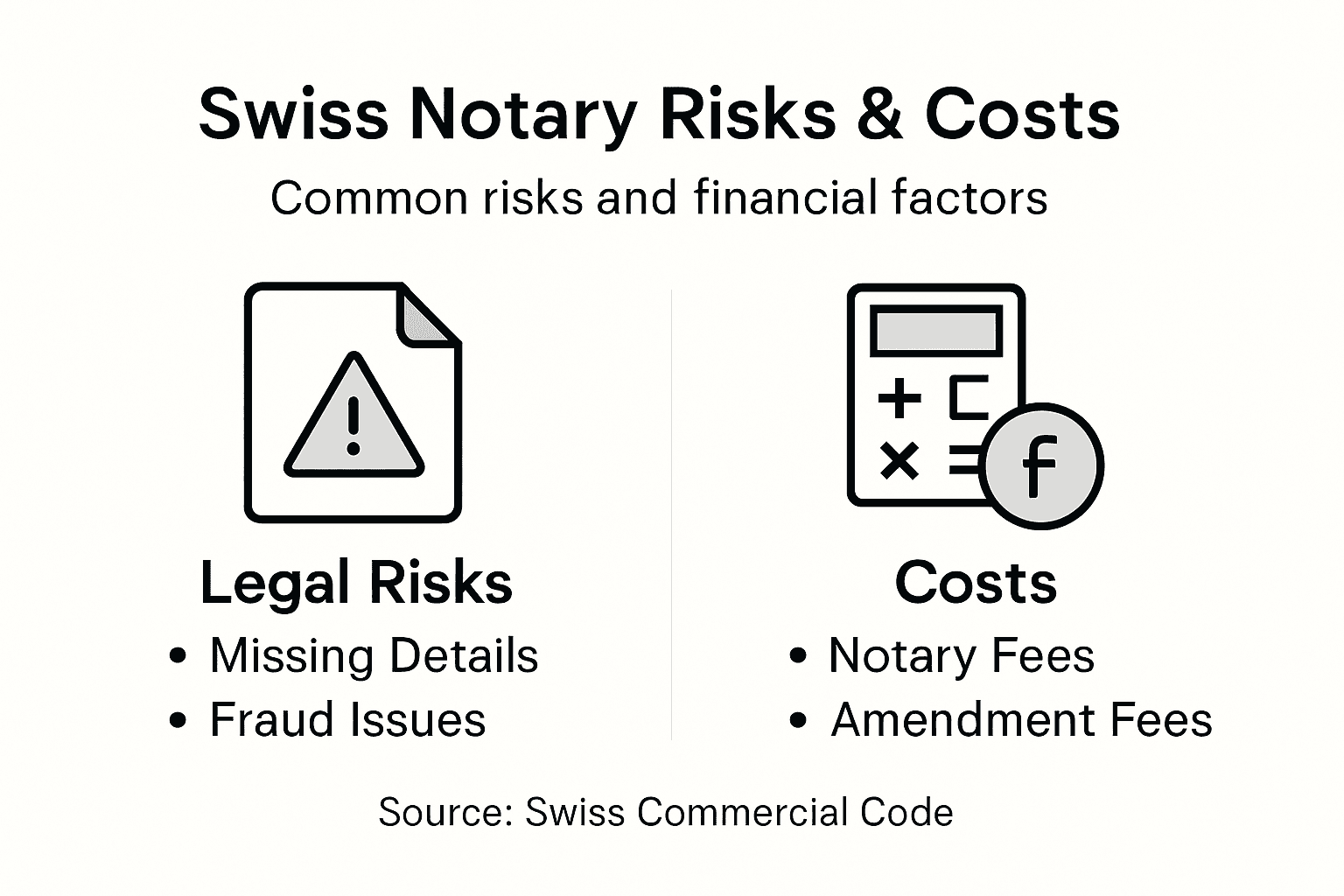
The legal risks of inadequate notarization are substantial and worth taking seriously. If your documents aren’t properly notarized, the Swiss Commercial Register can refuse your application entirely. This creates delays measured in weeks or months, not days. You can’t establish your business address in Switzerland, open a Switzerland bank account, or hire employees until your company is officially registered. Beyond registration delays, improper notarization creates vulnerability to later challenges. Creditors, business partners, or even your own co-founders could later claim your company wasn’t legitimately formed, that signatures were forged, or that you didn’t understand what you were signing. These challenges are expensive to defend against and can damage your company’s credibility. For technology sector startups seeking investor funding, having your company’s legitimacy questioned is a nightmare scenario. Investors conduct due diligence on company formation documents. If notarization issues emerge, it complicates funding rounds and raises concerns about your operational competence.
Another critical risk involves incomplete or non-compliant documentation. If your articles of association lack mandatory Swiss law provisions or contain language that violates regulations, a sloppy notary might certify them anyway. Your documents then get rejected by the Commercial Register, requiring expensive corrections and renotarization. You’re paying twice for the same work and losing months of valuable time. The notary bears some liability for this failure, but that doesn’t help you recover lost time and opportunity. This risk escalates dramatically when you’re working across multiple jurisdictions or with complex ownership structures. If you’re establishing a Swiss AG for international operations or working with nominee director arrangements, the notary’s expertise in these specialized structures becomes crucial.
Cost optimization requires strategic planning. Not every document requires notarization. Understanding when notarization is mandatory versus optional helps you avoid paying for unnecessary certification while ensuring you notarize everything legally required. Your articles of association and founder’s declaration absolutely require notarization. Shareholder agreements might not require formal notarization if they’re not filed with authorities, though you should verify this with your notary. Internal governance documents have different requirements than public filings. The cost of getting this wrong far exceeds the cost of asking your notary for clarity upfront.
One often overlooked risk involves subsequent amendments and modifications. After your company is registered, you might need to modify your articles of association, add shareholders, change your registered address, or adjust capital contributions. Many of these modifications also require notarization. If you use an inexperienced notary the first time, you’ve probably chosen someone convenient rather than excellent. Using the same notary for future amendments builds continuity and reduces the risk of conflicts with your original founding documents. This is why many entrepreneurs work with professional service providers who have established relationships with trusted notaries.
Pro tip: Get a detailed cost quote in writing from your notary before your appointment, specifying what services are included, and ask explicitly whether any documents beyond your articles of association and founder declaration will require separate notarization to avoid surprise charges after your session.
Common Pitfalls for Foreign Technology Entrepreneurs
Foreign technology entrepreneurs entering the Swiss business landscape make predictable mistakes during company formation, and many involve notarization. The first major pitfall is underestimating the importance of the notarization process itself. Coming from startup cultures where speed and minimal formality are valued, many tech founders view notarization as bureaucratic overhead rather than a critical legal safeguard. They rush through the appointment, don’t ask clarifying questions, and assume the notary is simply rubber-stamping their documents. This attitude costs them dearly when regulatory issues emerge or investors scrutinize their company formation documents. Your notary isn’t an obstacle to getting started. They’re protecting your company’s legal foundation. Taking the notarization process seriously from the beginning prevents far more expensive problems later.
Another common mistake involves incomplete document preparation before notarization. Many foreign entrepreneurs haven’t worked through all the details of their Swiss company structure. They arrive at the notary’s office with draft articles of association that haven’t been finalized, unclear capital contribution arrangements, or undefined shareholder roles. The notary then spends hours explaining what needs to change and why. You’re paying for wasted time, and worse, you’re delaying your company registration. The notary can’t certify incomplete or defective documents. This is where avoiding common Swiss business setup mistakes becomes crucial during the notarization planning phase. Spend time getting your documents right before you schedule your appointment. Know exactly how much capital each founder is contributing, understand your profit distribution arrangements, and clarify decision-making authority before you meet with your notary.
A particularly expensive pitfall involves not selecting a notary with commercial expertise. Some foreign entrepreneurs choose the cheapest or most convenient notary without verifying their experience with technology company formations or international ownership structures. You might hire a notary who primarily handles real estate transactions or estate planning. When you present a complex cap table with multiple international investors or nominee director arrangements, they lack the expertise to spot structural issues or advise on tax implications. You end up with certified documents that create problems down the road. The cost difference between a notary experienced in commercial formations and a generalist is minimal. The difference in quality is enormous. For technology sector founders especially, where ownership structures are often complex and international, working with a specialist notary is non-negotiable.
Foreign entrepreneurs also frequently misunderstand which documents require notarization versus which ones don’t. They either over-notarize, paying unnecessary fees for documents that don’t legally require certification, or under-notarize, skipping notarization for documents that actually need it. Shareholder agreements, intellectual property assignments, and technology licensing arrangements have different notarization requirements than articles of association. Get clear written guidance from your notary about what must be notarized and what’s optional. Some documents benefit from notarization even when not legally required, simply because it creates stronger legal proof. Your notary should explain these distinctions clearly during your initial consultation.
Review this summary of typical legal documents and their notarization requirements in Swiss company formation:
Document Type | Notarization Req.? | Impact if Notarized |
Articles of Association | Mandatory | Essential for registration |
Shareholder Agreement | Often optional | Adds legal clarity |
Founder Declaration | Mandatory | Confirms legitimacy |
Tech/IP Assignment | Optional | Strengthens ownership proof |
One final pitfall involves using a notary without strong English capabilities when you’re working in English. Swiss notaries operate in multiple languages, but language proficiency varies significantly. If your notary’s English is weak and your documents are in English, misunderstandings happen. Key provisions get misinterpreted. Your questions don’t get answered accurately. You end up with certified documents that don’t truly reflect your intentions. Don’t assume fluency. Confirm during your initial contact that the notary speaks English at a level appropriate for reviewing complex legal documents.
Pro tip: Schedule a preliminary consultation with your chosen notary before your formal notarization appointment, bringing draft articles and describing your ownership structure and capital arrangement in detail so the notary can identify potential issues and suggest improvements you can make before the actual notarization session.
Ensure Your Swiss Company Formation Is Legally Secure and Efficient
Navigating the complex notarization requirements and legal duties in Swiss company formation can feel overwhelming, especially for international entrepreneurs eager to launch quickly and confidently. Key challenges like meeting canton-specific notarial regulations, ensuring articles of association compliance, and authenticating shareholder identities demand expert guidance. Without proper support, costly delays, legal risks, and document rejections can threaten your business start.

Take control now with professional assistance from RPCS, where we specialize in simplifying the entire incorporation journey—including notarization compliance and document verification—so you can avoid these pitfalls. Our team helps you prepare flawless GmbH or AG filings, coordinates experienced commercial notaries familiar with Swiss law, and ensures your company registration meets all official requirements. Start your Swiss company formation process with confidence by visiting RPCS main site and discover tailored solutions for setting up a GmbH that protect your investment and accelerate your business goals today.
Frequently Asked Questions
What is the purpose of notarization in Swiss company formation?
Notarization is a legal requirement that certifies company documents, transforming them into legally binding instruments recognized by Swiss authorities, essential for company formation.
How does the notarization process work in Switzerland?
The Swiss notary reads and verifies the contract, confirms identities, answers questions, and ensures compliance with Swiss law, rather than merely witnessing signatures.
Why is notarization mandatory for forming a GmbH in Switzerland?
Notarization is mandatory to ensure that founding documents are authentic, comply with legal standards, and protect all parties involved in the business formation process from future disputes.
What are the potential legal risks of inadequate notarization during company incorporation?
Inadequate notarization can lead to delays in company registration, disputes about the company’s legitimacy, and costly corrections if the documents do not comply with legal requirements.
Recommended
Comments