
How to maintain Swiss company compliance: step-by-step
- 56 minutes ago
- 8 min read

TL;DR:
Ongoing compliance with Swiss laws is essential to avoid fines and reputation damage.
Key obligations include annual financial filings, governance updates, data protection, and beneficial ownership records.
Successful foreign entrepreneurs treat compliance as a strategic asset and seek expert local support.
Running a Swiss company from abroad carries real stakes. Miss a filing deadline, skip a required disclosure, or mishandle data protection rules, and you could face heavy fines, operating restrictions, and lasting damage to your company’s reputation. Many international founders discover these requirements only after something goes wrong. This guide walks you through every critical layer of Swiss company compliance, from governance frameworks and annual obligations to data protection and the most common traps foreign entrepreneurs fall into. Follow these steps and you will protect your investment, satisfy Swiss authorities, and build a business that stands on solid legal ground.
Table of Contents
Key Takeaways
Point | Details |
Swiss compliance essentials | Fulfill legal, governance, reporting, and privacy obligations to keep your company secure. |
Step-by-step process | Use clear, actionable checklists and deadlines for reliable compliance year-round. |
Anticipate common mistakes | Stay proactive to avoid late filings, data breaches, and audit risks. |
Cultural buy-in counts | Long-term success depends on making compliance part of your company culture, not just a checklist. |
Understanding Swiss company compliance requirements
Compliance, in the Swiss corporate context, means consistently meeting all legal, regulatory, and governance obligations that apply to your company structure. It is not a one-time setup task. It is an ongoing responsibility that touches every part of how your business operates.
Switzerland uses a “comply or explain” model for corporate governance. This means companies either follow the Swiss Code of Best Practice or publicly explain why they have chosen a different approach. For listed companies, disclosure obligations fall under SIX Exchange rules. Larger firms also face ESG and non-financial reporting requirements, which have grown significantly in recent years as sustainability standards tighten globally.
Recent legislative changes have added new layers. Transparency requirements around beneficial ownership and revised governance rules now apply to a broader range of companies. Even smaller GmbH and AG structures held by foreign investors must stay current with these updates. Reviewing your Swiss corporate governance guide regularly is one of the smartest habits you can build.
“Ongoing compliance is not a legal checkbox. It is the foundation of trust that Swiss authorities, banks, and business partners extend to your company.”
Here is a summary of the core documents and obligations every Swiss company should track:
Obligation | Frequency | Applies to |
Annual financial statements | Yearly | All companies |
Shareholder meeting minutes | Yearly (minimum) | GmbH and AG |
Commercial register updates | As changes occur | All companies |
ESG/non-financial reporting | Yearly | Large companies |
Beneficial ownership records | Ongoing | All companies |
Data protection compliance | Ongoing | All companies |
The core pillars of Swiss company compliance include:
Governance: Board structure, decision-making records, and director duties
Financial reporting: Accurate accounts, audits where required, and tax filings
ESG obligations: Non-financial disclosures for qualifying firms
Data protection: Adherence to the nFADP and related privacy rules
Commercial register: Timely updates to company details and leadership
Anti-money laundering: Beneficial ownership transparency and due diligence
Understanding these governance basics for entrepreneurs early prevents costly surprises later. The more proactive you are, the less reactive firefighting you will face.
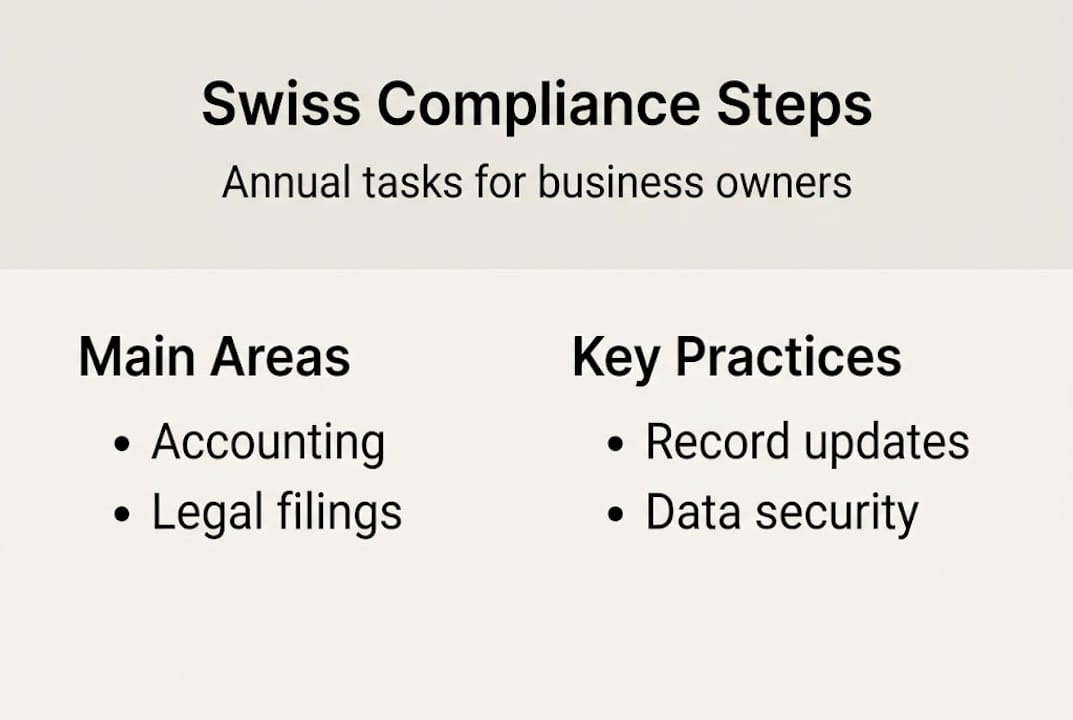
Essential steps to maintain compliance: a practical checklist
Knowing the framework is one thing. Executing it consistently is another. Here is a numbered checklist that covers the primary actions your Swiss company must take to stay in good standing.
Hold annual general meetings (AGMs): Swiss law requires at least one AGM per year. Document all decisions with signed minutes.
File annual financial statements: Prepare and approve accounts within six months of the financial year end.
Update the commercial register: Report any changes to directors, shareholders, or company address promptly.
Maintain beneficial ownership records: Keep an internal register of individuals who ultimately own or control the company.
Submit tax declarations: File corporate income tax and VAT returns on time to avoid penalties.
Review and renew contracts: Audit key supplier and employment agreements annually to ensure legal validity.
Conduct a compliance self-audit: At least once per year, review all obligations against your actual practices.
Following the annual reporting steps for each of these tasks keeps your company aligned with corporate governance obligations under Swiss best practice recommendations.
Pro Tip: Create a shared compliance calendar with automated reminders set 30 and 7 days before each deadline. This single habit eliminates most late-filing risks without adding significant administrative burden.
When it comes to managing these tasks, foreign founders typically choose between two approaches:
Approach | Pros | Cons |
In-house management | Full control, immediate access | Requires local expertise, higher error risk |
Outsourced to specialists | Expert knowledge, reduced risk | Ongoing service cost |
Hybrid model | Balanced control and expertise | Requires clear role definition |
For most international entrepreneurs, outsourcing at least the technical compliance tasks (accounting, filings, register updates) to a local partner is the most reliable path. Your Swiss company compliance checklist should be reviewed alongside your annual administration guide to make sure nothing slips through the gaps.

Integrating compliance into your regular business rhythm, rather than treating it as a separate annual panic, is what separates well-run Swiss companies from those that accumulate problems quietly.
Data protection and privacy in the Swiss context
Beyond general obligations, Swiss law also imposes strict data protection standards that must not be overlooked. The revised Federal Act on Data Protection, known as the nFADP, came into full effect in September 2023 and applies to every company processing personal data in Switzerland, including foreign-run entities.
The nFADP aligns closely with GDPR but has its own local requirements. You must notify the Federal Data Protection and Information Commissioner (FDPIC) in the event of a data breach. You must also conduct Data Protection Impact Assessments (DPIAs) for any high-risk processing activities. Transparency toward data subjects is mandatory.
Key obligations under the nFADP include:
Privacy notices: Inform individuals clearly about how their data is collected and used
DPIAs: Assess risk before launching any high-risk data processing activity
Breach notification: Report significant data breaches to the FDPIC without undue delay
Data processor agreements: Formalize contracts with any third party handling personal data on your behalf
Data subject rights: Respond to access, correction, and deletion requests within legal timeframes
Cross-border transfers: Ensure adequate protection when transferring data outside Switzerland
The compliance risks of ignoring these rules are real. Violations can result in fines of up to CHF 250,000 for individuals, and reputational damage in Switzerland’s relationship-driven business culture can be even more costly.
Pro Tip: Build a data protection checklist into your onboarding process for every new employee and vendor. This ensures that privacy obligations are embedded from day one rather than retrofitted after a problem surfaces.
If your company already complies with GDPR, you have a strong foundation. But do not assume full equivalence. Swiss law has specific local nuances, particularly around FDPIC notifications and the scope of DPIAs, that require separate attention.
Common compliance pitfalls and how to avoid them
Armed with the essentials, it is equally vital to know what tripwires to watch out for. Even experienced founders can fall into these traps, especially when managing a Swiss entity remotely.
The most frequent mistakes include:
Late or missed filings: Annual accounts, tax returns, and register updates submitted past deadlines
Incomplete board documentation: Decisions made informally without proper written records
Weak beneficial ownership records: Failing to keep the internal register current as ownership changes
Overlooking ESG thresholds: Growing companies that cross reporting thresholds without realizing new obligations apply
Ignoring data protection updates: Treating nFADP compliance as a one-time setup rather than an ongoing process
Poor contract management: Expired or legally outdated agreements with employees and suppliers
“Swiss enforcement authorities are increasing scrutiny on foreign-held companies. The era of assuming small oversights go unnoticed is over.”
The penalties for non-compliance can include serious financial penalties and business restrictions that affect your ability to operate, bank, and contract in Switzerland. The risk is not theoretical.
Pro Tip: Use a compliance management tool such as a structured project management platform to assign ownership of each obligation to a specific person with a due date. Compliance without accountability is just a document sitting in a folder.
Building a compliance-first culture starts at the board level. When directors treat governance as a leadership responsibility rather than an administrative task, the whole organization follows. Schedule a quarterly compliance review as a standing agenda item in board meetings. Use your annual administration guide as a reference point and cross-check against known compliance risks that affect foreign-run entities specifically.
Regular self-audits, at minimum once per year and ideally twice, give you the chance to catch gaps before regulators or counterparties do.
The real-world secret to seamless Swiss compliance
Here is something most compliance guides will not tell you: the checklist is the easy part. The hard part is cultural buy-in.
We have seen international founders build technically perfect compliance systems that collapse within 18 months because no one in the organization actually owns the responsibility. A shared calendar and a folder of templates mean nothing if the board treats compliance as someone else’s problem.
Swiss regulations also evolve. The companies that get caught out are almost always those that set up their compliance framework once and assumed it would hold. New transparency rules, updated ESG thresholds, and revised data protection guidance all require active monitoring. Founders who engage with governance insights specific to international operators consistently outperform those who rely on generic advice.
The most successful foreign-run Swiss companies we work with share one trait: their leadership treats compliance as a strategic asset, not a cost center. They use it to build credibility with Swiss banks, attract local partners, and signal reliability to regulators. That mindset shift is what separates companies that thrive in Switzerland from those that merely survive.
Expert support for Swiss compliance success
Maintaining Swiss company compliance on your own, from abroad, is possible but genuinely difficult. The regulatory landscape is detailed, deadlines are firm, and the consequences of gaps are serious.
At RPCS, we support international founders and investors with the full range of compliance needs. From company formation and governance setup to ongoing Swiss accounting and bookkeeping, our team provides the local expertise you need to stay fully compliant without the stress of navigating Swiss law alone. Whether you need a complete compliance program or targeted support for specific obligations, we are here to help you protect your Swiss investment and operate with confidence.
Frequently asked questions
What are the top obligations for Swiss company compliance?
Maintaining proper governance, filing annual financial statements, keeping commercial register records current, and adhering to data protection laws are the core obligations. Swiss corporate governance rules follow a “comply or explain” standard under the Swiss Code of Best Practice.
How does Swiss data protection differ from the EU’s GDPR?
The nFADP aligns closely with GDPR but requires breach notifications specifically to the FDPIC and has its own DPIA requirements, meaning you cannot simply copy your EU compliance program and assume it covers Switzerland.
What happens if a Swiss company is non-compliant?
Non-compliance penalties can include significant fines, restrictions on business operations, and reputational damage that affects banking relationships and partnerships in Switzerland.
Who is responsible for compliance in a Swiss company?
The board of directors and senior management carry primary legal responsibility. Under the Swiss Code of Best Practice, governance accountability sits firmly at the leadership level, not with administrative staff.
Which annual tasks must be prioritized to avoid compliance issues?
Holding the AGM, approving and filing financial statements, updating company records, and conducting a governance review are the key annual obligations that every Swiss company must complete each year without exception.
Recommended
Comments