
How to Secure Swiss Business Confidentiality in 2026
- May 25
- 9 min read

TL;DR:
Effective Swiss business confidentiality depends on precise contracts, strict internal policies, data compliance, and operational discipline. Legal protections are fragmented, so companies must implement layered safeguards like clear NDAs, detailed trade secret registers, and robust data security measures. Regular audits, staff training, and swift breach responses are essential to maintain confidentiality and mitigate risks in Swiss corporate operations.
Switzerland has earned its reputation as the gold standard for business privacy, but knowing how to secure Swiss business confidentiality requires more than opening a company and hoping the legal system does the heavy lifting. The reality is that confidentiality in Swiss business depends on a layered approach: precise contracts, strict internal policies, data protection compliance, and day-to-day operational discipline. This guide gives you exactly that. Whether you are forming a new GmbH, managing an AG, or restructuring an existing Swiss operation, every section delivers specific, workable steps that hold up under Swiss law.
Table of Contents
Key Takeaways
Point | Details |
Swiss law is fragmented | Trade secret protection relies on multiple statutes, so internal policies and contracts must fill the gaps. |
NDAs are enforceable but must be precise | Broadly worded confidentiality clauses are difficult to enforce; specificity in scope and duration is critical. |
FADP compliance is non-negotiable | The revised Federal Act on Data Protection, effective September 2023, imposes strict obligations on data handling. |
Operational discipline matters daily | Predictable internal routines and access controls prevent accidental disclosures more reliably than legal text alone. |
Audit regularly | Confidentiality programs require scheduled reviews to stay current with legal changes and internal shifts. |
How to secure Swiss business confidentiality: the legal foundation
Understanding the legal terrain is the first step. Switzerland does not have a single, consolidated trade secret law. Instead, protection is fragmented across criminal provisions, unfair competition rules, and sector-specific regulations. Article 162 of the Swiss Criminal Code criminalizes disclosure of trade secrets, but pursuing claims through litigation is resource-intensive and outcomes are unpredictable.
This structural gap is precisely why confidentiality best practices in Swiss incorporation demand contract-level precision. The law provides a floor, not a ceiling.
NDAs and confidentiality clauses
NDAs are enforceable legal instruments in Switzerland, but courts scrutinize vagueness. An NDA that says “all business information is confidential” will not perform well in a dispute. Effective agreements name the specific categories of protected information, define the obligations of each party, set a realistic duration, and identify applicable law and jurisdiction. Do not skip the jurisdiction clause. For cross-border operations, specifying Swiss law and Swiss courts removes ambiguity before a problem ever arises.
Data protection obligations under the revised FADP
The revised FADP, which took effect in September 2023, aligns Swiss data protection standards with GDPR but introduces Swiss-specific obligations. Controllers and processors must implement technical and organizational safeguards, conduct data protection impact assessments for high-risk processing, and appoint a data protection advisor where required.
One often-overlooked provision: companies with fewer than 250 employees are generally exempt from maintaining records of processing activities, unless they handle sensitive personal data or run high-risk profiling. Knowing where you fall in this threshold matters for how you structure your compliance program.
Here is a quick reference for the core legal pillars every Swiss company should understand:
Legal instrument | Primary scope | Key limitation |
Article 162 SCC | Criminal protection of trade secrets | Requires proving willful disclosure |
Swiss Unfair Competition Act | Civil protection against misappropriation | Narrow interpretation by courts |
Federal Act on Data Protection (FADP) | Personal data processing and transfer | Applies to personal data, not all business secrets |
Non-Disclosure Agreements | Contractual confidentiality obligations | Only as strong as the drafting quality |
Swiss banking secrecy vs. business confidentiality
A critical distinction for entrepreneurs: Swiss banking secrecy, reinforced by Article 47 of the Banking Act, protects client information held by banks from third-party disclosure. It does not extend automatically to general business operations. The privacy advantages in Switzerland within financial services are real, but you cannot rely on them to protect your trade secrets, partnership negotiations, or internal data. Those require separate, deliberate measures.

Building your confidentiality infrastructure
Before you can protect anything, you need to define what you are protecting. Many companies skip this step and then find themselves unable to enforce NDAs because they cannot prove what was actually secret. Start with a written trade secret register: a document that identifies each category of confidential information, explains why it qualifies for protection, and records who has access.
Key elements of a strong confidentiality infrastructure:
Internal confidentiality policy. A written policy communicated to all employees and contractors that defines confidential information, acceptable use, and consequences for breach.
Access controls. Apply the need-to-know principle. Segment data so that employees only access what their role requires. Role-based access systems in your IT environment enforce this at the technical level.
Narrowly worded employment clauses. Swiss law requires precision in non-compete and confidentiality agreements. Overly broad clauses are routinely reduced or invalidated by courts. Scope, duration, and geographic reach must all be defensible.
Secure digital infrastructure. Encrypted communications, secure file sharing with access logging, and multi-factor authentication are baseline requirements. Physical security, including locked document storage and visitor policies, should not be an afterthought.
Employee training. Staff are the most common source of accidental disclosure. Regular training that covers real scenarios, not just policy documents, creates the behavioral habits that prevent leaks.
Pro Tip: When onboarding a new hire or contractor, conduct a confidentiality briefing before they access any systems. A five-minute conversation outlining what is protected and why is more effective at preventing casual disclosure than a lengthy handbook they will never re-read.
A useful resource for understanding how this connects to your broader Swiss company compliance obligations is worth reviewing alongside these steps.
Day-to-day execution: protecting confidentiality in operations
Having policies in place is necessary but not sufficient. Maintaining business secrecy in Switzerland requires integrating confidentiality into how the company actually runs.
Conduct thorough due diligence on partners and vendors. Before sharing any sensitive information with a potential partner, run AML and KYC checks as a defensive intelligence step, not just a regulatory formality. Fraudulent or high-risk partners are one of the leading vectors for confidential information leaks.
Use staged disclosure in negotiations. Share only what is necessary at each phase. Use tiered NDAs that expand disclosure obligations as negotiations progress toward a definitive agreement.
Create operational routines during sensitive events. Research on managing confidentiality during high-stakes transactions like mergers or acquisitions shows that predictable activity patterns reduce inadvertent leaks. When employees see unusual activity, they talk. Consistent routines reduce the signals that trigger speculation and offhand comments.
Manage cross-border data transfers carefully. When transferring personal data out of Switzerland, adequate safeguards are required, including EU Standard Contractual Clauses with a Swiss addendum or participation in the Swiss-US Data Privacy Framework for US recipients.
Log and monitor access to sensitive information. Access logs serve two purposes: they deter misuse and create an audit trail if a breach occurs. Pair monitoring with a clear incident escalation process so the right people are notified within hours, not days.
Protect against third-party trade secret contamination. When hiring from competitors or acquiring companies, avoid absorbing confidential information that belongs to another business. Contamination risk in hiring and M&A scenarios is a real liability, and Swiss courts have held companies responsible for knowingly benefiting from stolen secrets.
Pro Tip: For joint ventures or licensing arrangements, negotiate a separate Data Room Protocol governing who can access what documents, when, and in what format. This document becomes critical evidence if a dispute arises later.
Common pitfalls and how to respond to breaches
Even well-managed companies run into confidentiality problems. Knowing where failures typically occur helps you build stronger defenses.
The most frequent gaps include:
Over-reliance on verbal agreements. In Switzerland, verbal confidentiality commitments exist in a gray zone. Courts can recognize them but proving what was said, and by whom, is extremely difficult.
Failing to update agreements after scope changes. A partnership that begins as a pilot often expands. The original NDA rarely covers the expanded scope, leaving significant information unprotected.
Inadequate offboarding procedures. Departing employees and contractors are a top source of post-employment leaks. Formal offboarding that includes return of materials, system access revocation, and a confidentiality reminder tied to existing obligations is non-negotiable.
Insufficient documentation of what constitutes a trade secret. Without a documented register, it is nearly impossible to prove in court that a specific piece of information was actually treated as confidential.
“Companies are advised to designate a responsible officer and have enforcement protocols ready for events of leaks or trade secret misappropriation.” Source: CMS Law Firm, Trade secret laws in Switzerland
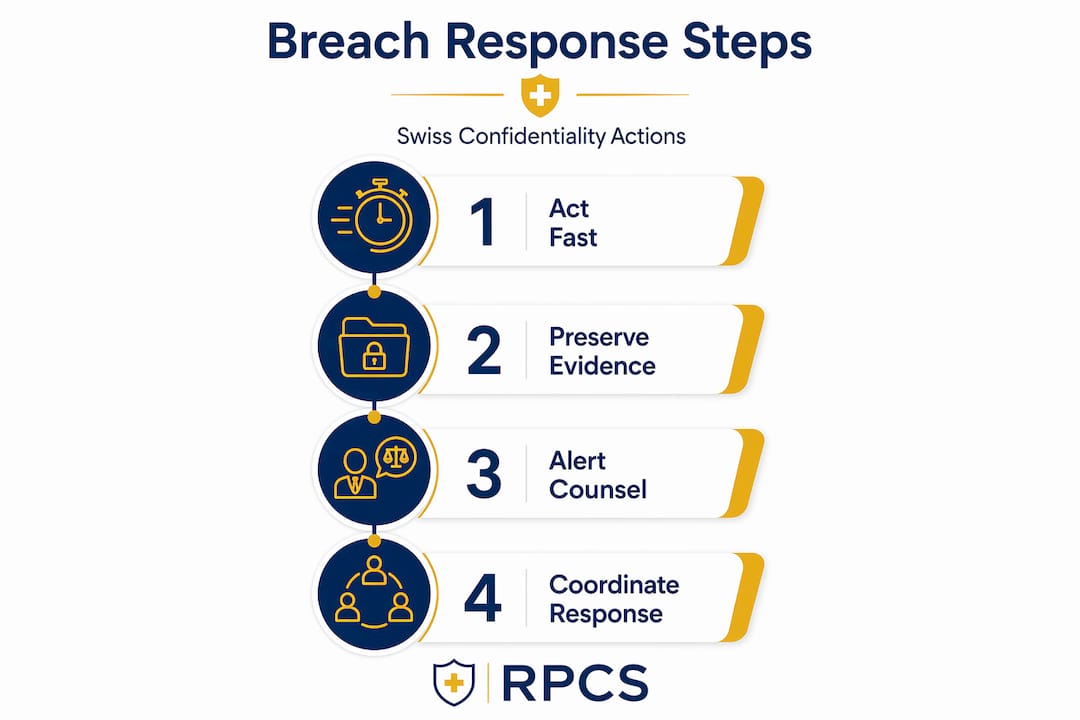
When a breach does occur, speed is the decisive factor. Designate a confidentiality response coordinator in advance. This person coordinates with legal counsel, IT, and management. Swiss courts can grant ex parte emergency measures to prevent further distribution of misappropriated information, but those motions require immediate action and documented evidence. The window to act effectively is narrow.
For companies holding intellectual property in Swiss structures, understanding trade secret safeguards for IP adds another layer of protection when combined with the operational steps above.
Verifying and maintaining confidentiality over time
A confidentiality program is not a one-time setup. The role of confidentiality in Swiss companies evolves as the business grows, regulations change, and the team turns over. Regular verification keeps the program functional.
Practical steps for ongoing maintenance:
Annual confidentiality audits. Review your trade secret register, access logs, NDA inventory, and incident records each year. Identify gaps in coverage and update agreements where scope has changed.
Monitor FADP and related regulatory updates. The revised FADP is still generating guidance from the Federal Data Protection and Information Commissioner (FDPIC). Assign someone, internally or externally, to track changes and flag what requires a policy update.
Collect employee feedback. Staff who work with confidential data daily often identify practical weaknesses that management does not see. Quarterly check-ins with department heads surface these early.
Update your data processing agreements. If you work with processors or subprocessors, verify annually that their technical and organizational safeguards still meet FADP standards. Vendor relationships change, and so do their security practices.
Document everything. Retention schedules, processing logs, audit results, and training records form the paper trail that demonstrates good-faith compliance if regulators or courts ever ask.
Maintenance activity | Recommended frequency | Owner |
Trade secret register review | Annually | Legal or compliance officer |
NDA and contract audit | Annually or after major deals | Legal counsel |
Employee confidentiality training | Bi-annually | HR with legal input |
IT access control review | Quarterly | IT/security lead |
FADP regulatory update review | Ongoing, formal review bi-annually | Compliance officer |
My honest take on what actually protects confidentiality
I have worked with enough international entrepreneurs setting up Swiss companies to say this plainly: the businesses that experience the most damaging confidentiality breaches are almost never the ones with weak legal documentation. They are the ones that treated confidentiality as a setup task rather than an operating standard.
What I have seen consistently is that the best-protected companies build confidentiality into their culture before they need it defensively. They do not wait until a partner acts badly or an employee walks out with a client list. They have already made confidentiality the default behavior because everyone on the team understands the stakes.
The Swiss business confidentiality framework gives you legal tools, but tools require skilled hands. I have watched clients with excellent NDAs lose months of work recovering from breaches because they had no incident response protocol. I have also watched much smaller companies sail through serious challenges because they had documented everything meticulously.
My advice is to treat confidentiality as a strategic asset, not a compliance obligation. The companies that internalize this distinction are the ones that actually benefit from what Switzerland offers. They win because their partners trust them, their information stays protected, and their legal position is unassailable when problems arise.
— Rolands
Protect your Swiss company with Rpcs

Building a confidential, legally sound Swiss company requires getting the structure right from day one. Rpcs specializes in Swiss company formation for international entrepreneurs and investors, covering GmbH and AG incorporation with confidentiality measures built into every stage. From legal documentation and AML/KYC compliance to registered address services that protect your privacy, Rpcs handles the details that determine whether your Swiss structure actually holds up. You can also open a Swiss bank account through Rpcs to add another layer of financial privacy to your operations. If you are serious about securing your Swiss business interests, explore what Rpcs can do for your specific situation.
FAQ
What are the main laws governing confidentiality in Swiss business?
Swiss trade secret protection is spread across Article 162 of the Swiss Criminal Code, the Unfair Competition Act, and the Federal Act on Data Protection. There is no single statute, so contracts and internal policies carry significant legal weight.
Are NDAs legally enforceable in Switzerland?
Yes. Swiss courts recognize NDAs as binding instruments, but enforcement depends heavily on precise drafting. Agreements must specify what information is protected, for how long, and under what circumstances to hold up in a dispute.
What does the revised FADP require for Swiss companies?
The revised Federal Act on Data Protection, in effect since September 2023, requires technical and organizational safeguards for personal data, data protection impact assessments for high-risk processing, and specific compliance steps for cross-border data transfers.
How should a company respond to a confidentiality breach in Switzerland?
Act immediately. Designate a response coordinator in advance, preserve all evidence, and consult legal counsel within hours. Swiss courts can grant emergency measures to stop further dissemination, but these require prompt action and documented proof.
Does Swiss banking secrecy protect general business information?
No. Swiss banking secrecy under Article 47 of the Banking Act applies to client information held by banks. It does not extend to a company’s trade secrets, operational data, or commercial negotiations. Those require separate contractual and policy-level protections.
Recommended
Comments