
How to Open Swiss Branch Office: Complete Legal Guide
- Jan 14
- 7 min read
Updated: Jan 19

Over 60 percent of foreign-owned companies in Switzerland are run by American or European entrepreneurs who recognize the country’s strict legal standards and robust financial infrastructure. For those in finance or technology, the process of opening a Swiss branch goes far beyond basic paperwork. Getting this right means understanding everything from business license regulations to complex tax rules. This guide highlights the crucial steps to help ambitious investors launch legally compliant Swiss branches as efficiently as possible.
Table of Contents
Quick Summary
Key Insight | Explanation |
1. Understand Swiss Legal Requirements | Thoroughly assess business licenses and compliance needs to ensure legal operation. |
2. Prepare Accurate Documentation | Collect and notarize required corporate documents to validate your business entity. |
3. Navigate Registration Process | Submit detailed incorporation paperwork to cantonal authorities for proper registration. |
4. Establish Banking Connections | Open a Swiss business account following rigorous documentation and verification processes. |
5. Ensure Ongoing Compliance Reviews | Conduct regular checks to maintain compliance with Swiss regulations post-launch. |
Step 1: Assess Business and Legal Requirements
Opening a Swiss branch office requires careful legal preparation and understanding of complex regulatory landscapes. Entrepreneurs must systematically evaluate their business structure, compliance needs, and strategic objectives before initiating the incorporation process.
The first critical assessment involves determining your specific business license requirements. Switzerland maintains stringent regulations governing foreign corporate entities, which means you will need to thoroughly document your business intent, projected operations, and corporate governance framework. Key elements include verifying your company type alignment with Swiss legal standards, understanding tax implications, and preparing comprehensive documentation demonstrating financial stability and operational legitimacy.
Your assessment should encompass multiple dimensions beyond basic registration. Evaluate your target industry sector regulations, required capital investments, potential tax structures, and compliance protocols. Research Swiss corporate law nuances specific to your business domain, considering factors like shareholder compositions, reporting obligations, and potential restrictions on foreign ownership. Consulting with Swiss legal professionals who specialize in international business formations can provide granular insights into navigating these complex requirements.
Pro Tip: Allocate sufficient time for thorough legal research and preparation, as premature or incomplete assessments can significantly delay your Swiss branch office establishment process.
Here is a summary of regulatory focus areas for establishing a Swiss branch office:
Focus Area | Why It Matters | Business Impact |
Legal Structure | Ensures compliance with Swiss law | Avoids legal complications |
Tax Implications | Defines tax liabilities and obligations | Impacts firm profitability |
Shareholder Composition | Meets local ownership regulations | Mitigates investment barriers |
Documentation Accuracy | Satisfies official filing requirements | Enables smooth approvals |
Notarization Procedures | Validates foreign documents legally | Prevents registration delays |
Step 2: Prepare Required Documentation and Notarization
Successfully preparing documentation for a Swiss branch office demands meticulous attention to detail and comprehensive understanding of Swiss regulatory requirements. Your goal in this stage is to compile a precise set of legal documents that demonstrate your company’s legitimacy and operational readiness.

The documentation process begins with gathering fundamental corporate papers. You will need to prepare Swiss accounting requirements alongside comprehensive corporate records. Essential documents typically include articles of incorporation, detailed business plans, proof of financial solvency, shareholder agreements, and corporate registration certificates. Each document must be translated into either German, French, or Italian and authenticated by an official Swiss notary.
Notarization represents a critical validation step for foreign entities establishing Swiss branch offices. Professional notaries will carefully review your documentation to ensure compliance with Swiss legal standards. They will verify the authenticity of corporate seals, signatures, and supporting financial statements. Pay particular attention to preparing accurate capitalization documentation, shareholder registry details, and comprehensive corporate governance frameworks that align with Swiss regulatory expectations.
Pro Tip: Consider engaging a local Swiss legal professional who can guide you through nuanced documentation requirements and help streamline the notarization process.
Step 3: Register Branch with Swiss Authorities
Registering your branch office with Swiss authorities represents a pivotal milestone in establishing your legal corporate presence in Switzerland. This critical process requires precise documentation and strict adherence to federal and cantonal regulatory frameworks.
The registration process begins with preparing comprehensive Swiss company registration documents. You will need to submit detailed incorporation paperwork to the commercial registry of the specific canton where your branch will operate. This typically involves presenting your notarized corporate documents, proof of initial capital investment, shareholder information, and a comprehensive business plan demonstrating your operational strategy and economic contribution to the Swiss market.
Each canton has unique registration protocols, so understanding local administrative nuances is crucial. Your submission must include precise corporate governance documentation, including detailed information about directors, authorized representatives, and the scope of your branch operations. Professional registration typically requires submission of original documents in an official Swiss language (German, French, or Italian), along with certified translations if your original documents are in another language. The commercial registry will meticulously review your application to ensure complete compliance with Swiss corporate law.
The following table highlights key differences between Swiss federal and cantonal registration processes:
Feature | Federal Level | Cantonal Level |
Legal Standards | Unified corporate framework | Local administrative nuances |
Language Requirement | German, French, Italian | Depends on canton |
Required Documents | Company statutes, solvency | Local governance details |
Review Process | Standard for all branches | May request additional details |
Pro Tip: Allocate additional time and budget for potential administrative queries or requests for supplementary documentation during the registration process.
Step 4: Set Up Banking and Administrative Services
Establishing banking and administrative infrastructure is a critical step in solidifying your Swiss branch office operations. This process requires strategic planning and meticulous attention to regulatory compliance and financial management protocols.
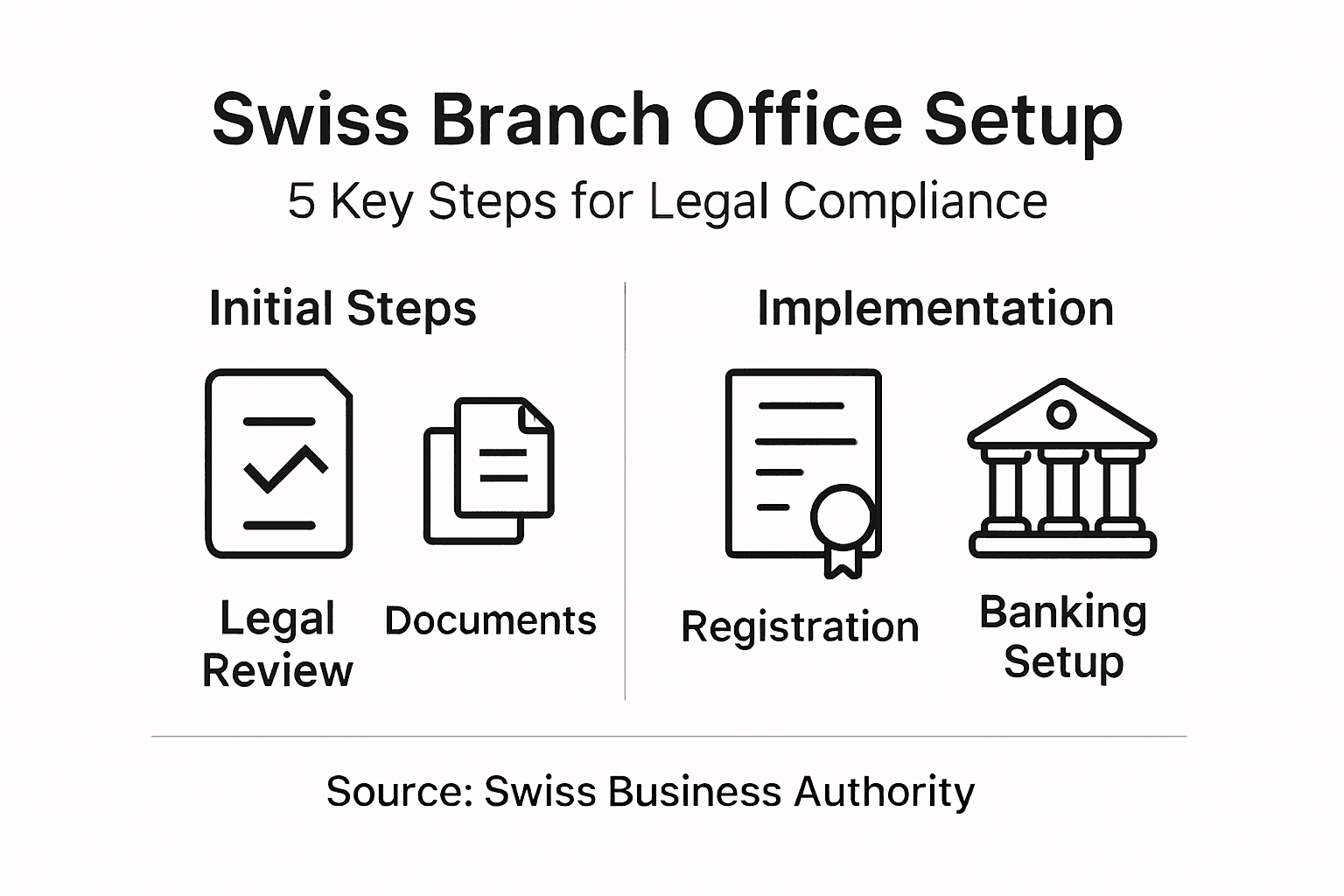
Your first priority will be establishing a Swiss business bank account, which demands comprehensive documentation and strict adherence to Swiss banking regulations. Swiss financial institutions maintain rigorous due diligence standards, requiring extensive corporate documentation including proof of business registration, shareholder information, detailed business plans, and identification documents for all authorized signatories. Expect an intensive verification process that may involve multiple rounds of documentation review and potential in person interviews with bank representatives.
Administrative services setup involves more than just banking. You will need to establish payroll systems, implement Swiss accounting standards, secure local tax identification numbers, and potentially engage local administrative support services. Consider hiring a Swiss accounting firm specializing in international branch office management to help navigate complex regulatory requirements. These professionals can assist with critical tasks such as monthly financial reporting, tax compliance, and ensuring your administrative infrastructure meets all Swiss regulatory standards.
Pro Tip: Select a banking partner with demonstrable experience supporting international corporate branches to streamline your administrative setup process.
Step 5: Verify Compliance and Launch Operations
The final stage of establishing your Swiss branch office involves comprehensive compliance verification and strategic operational launch. This critical phase ensures your organization meets all regulatory standards and is positioned for successful market entry.
Your compliance verification process will require meticulously reviewing all documentation through the lens of Swiss company registration requirements. This involves conducting a thorough internal audit to confirm that every aspect of your corporate structure aligns with Swiss legal frameworks. You will need to cross reference your corporate documents, validate tax identification numbers, verify banking credentials, and ensure all required governmental registrations are accurately completed and current.
Launching operations demands a systematic approach that balances regulatory adherence with operational efficiency. This includes finalizing employment contracts for local staff, establishing communication protocols with Swiss regulatory agencies, configuring accounting and reporting systems to meet Swiss standards, and developing a comprehensive compliance monitoring strategy. Consider engaging local legal and financial consultants who can provide ongoing guidance during your initial operational period to help navigate potential regulatory complexities and minimize compliance risks.
Pro Tip: Schedule periodic compliance reviews during your first year of operations to proactively identify and address any potential regulatory gaps or emerging compliance challenges.
Simplify Your Swiss Branch Office Setup with Expert Support
Opening a Swiss branch office involves complex challenges such as navigating legal structure requirements, mastering notarization procedures, and ensuring full compliance with cantonal and federal regulations. You may feel overwhelmed by the precise documentation standards, rigorous banking setups, and ongoing administrative demands necessary for a smooth launch. At RPCS, we understand these pain points and specialize in transforming these complexities into a streamlined process tailored specifically for international entrepreneurs.

Take advantage of our comprehensive services that cover every essential step from legal documentation and notarization to banking and administrative support. With our in-depth knowledge of Swiss company law and regulatory frameworks, we help you avoid costly delays and compliance risks. Don’t let confusing requirements hold back your market entry. Visit RPCS now to gain a trusted partner that ensures rapid setup, full legal compliance, and a confident start for your Swiss branch office.
Frequently Asked Questions
What business license requirements do I need to consider when opening a Swiss branch office?
To open a Swiss branch office, you must assess the specific business license requirements that apply to your industry. Gather documentation that outlines your business intent and operational plans to ensure compliance with Swiss regulations.
How do I prepare the necessary documentation for a Swiss branch office?
Start by compiling essential corporate papers, such as your articles of incorporation, business plans, and proof of financial solvency. Ensure that these documents are translated into one of the official Swiss languages and authenticated by a notary before submission.
What is the registration process for a Swiss branch office?
To register your Swiss branch office, submit comprehensive incorporation paperwork to the commercial registry in the canton where your branch will operate. This includes notarized documents, proof of initial capital investment, and governance details.
How can I ensure compliance once my Swiss branch office is operational?
Conduct a thorough compliance verification by reviewing all documentation to confirm alignment with Swiss legal frameworks. Schedule periodic compliance reviews within the first year of operations to identify any potential regulatory gaps early.
What banking requirements should I be aware of for my Swiss branch office?
When setting up your Swiss branch office, you must establish a Swiss business bank account, which requires extensive documentation. Prepare to present your business registration details and identification for all authorized signatories to meet banking regulations.
Recommended
Comments