
Foreign ownership rules in Switzerland: Complete 2026 guide
- 2 hours ago
- 10 min read

TL;DR:
Foreigners can own 100% of Swiss companies without sector restrictions in standard structures.
Swiss law requires at least one Swiss-resident director regardless of ownership nationality.
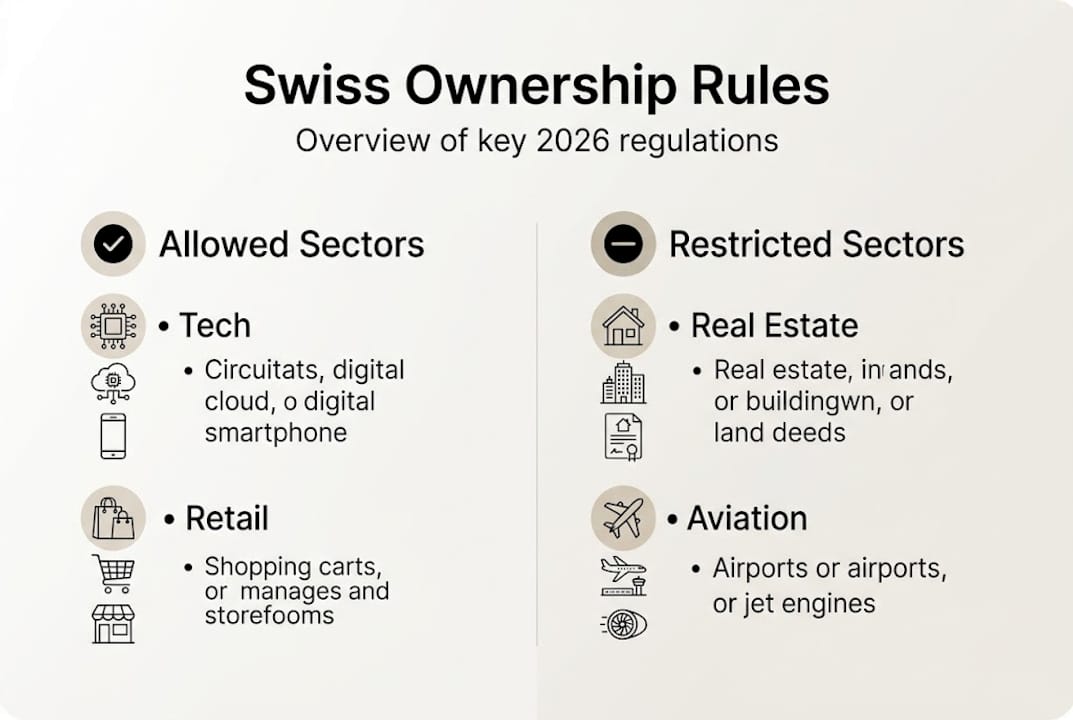
Sector-specific rules apply to banking, telecom, aviation, nuclear energy, and real estate via Lex Koller.
Switzerland has a well-earned reputation as one of the world’s most open destinations for foreign business ownership. Unlike many countries that cap foreign shareholding or require local partners, Switzerland allows foreigners to own 100% of a Swiss company outright. But beneath that open-door policy, a layer of sector-specific rules, residency requirements, and a brand-new investment screening law creates real complexity. If you are planning to incorporate or invest in Switzerland, understanding exactly where the rules are simple and where they get nuanced could save you significant time, money, and legal headaches.
Table of Contents
Key Takeaways
Point | Details |
100% foreign ownership allowed | Switzerland lets foreigners fully own standard companies, with no general shareholding limits. |
Swiss-resident director needed | At least one Swiss-resident director or board member is required for GmbH and AG companies. |
Sector-specific rules exist | Sensitive sectors like banking, telecom, and real estate have additional ownership or licensing restrictions. |
New screening for state investors | The new Investment Control Act affects state-linked foreign investors in critical sectors, not most private investors. |
Compliance standards rising | Recent transparency and tax reforms mean that proper compliance is essential for foreign company owners. |
What is allowed: Overview of foreign ownership in Swiss companies
The baseline rule is straightforward. Foreign-owned companies in Switzerland operate under an open policy, with no general restrictions on foreign shareholders in standard structures like the GmbH (limited liability company) or AG (stock corporation). You can own every single share. There is no minimum or maximum threshold for foreign investors, and no requirement to bring in a Swiss partner just to satisfy a nationality rule.
This stands in sharp contrast to many other jurisdictions. In parts of Southeast Asia, foreign ownership is capped at 49% in key sectors. Several Gulf states require a local sponsor. Even within the EU, certain countries impose golden share rules or sector-based nationality requirements. Switzerland simply does not have those general barriers.
Here is a quick comparison to put it in perspective:
Jurisdiction | Foreign ownership cap | Local partner required? | Residency for shareholders? |
Switzerland | None (standard companies) | No | No |
Germany | None (most sectors) | No | No |
UAE (mainland) | 49% historically (varies) | Often yes | No |
India | Sector-dependent (up to 100%) | Sometimes | No |
China | Sector-dependent (often capped) | Often yes | No |
Key points for foreign investors considering Switzerland:
Shareholders can be individuals or corporations of any nationality
No Swiss residency is required for shareholders
Both GmbH and AG are fully accessible to 100% foreign-owned structures
Dividends and capital can be repatriated freely, subject to withholding tax rules
Voting rights are not restricted based on nationality
“Switzerland maintains an open policy for foreign ownership of businesses with no general restrictions on foreign shareholders in standard companies like GmbH or AG.”
For deeper context on how ownership structure intersects with governance, the Swiss company statutes for foreign owners are worth reviewing before you draft your articles of incorporation. You can also find a broader overview in the Swiss company formation guide if you are still deciding between structures. For a detailed look at foreign ownership rules in Switzerland from a legal practice perspective, Chambers provides authoritative guidance.
Core legal requirements: Setting up a GmbH or AG as a foreigner
Having established the general openness, now let’s break down how foreigners actually start a Swiss company and what legal requirements must be met.
The two main structures are the GmbH and the AG. Both are respected internationally and offer limited liability. The key differences come down to capital, governance, and flexibility. According to the Swiss company formation process 2026, the minimum capital for a GmbH is CHF 20,000 (fully paid in), while an AG requires CHF 100,000 (with at least CHF 50,000 paid up at formation). Both require at least one Swiss-resident director or board member.
Structure | Minimum capital | Capital paid at formation | Swiss-resident director required? |
GmbH | CHF 20,000 | 100% (fully paid) | Yes |
AG | CHF 100,000 | At least CHF 50,000 | Yes |
The formation process follows a clear sequence:
Draft the articles of incorporation and define the share structure
Notarize the founding documents before a Swiss notary
Deposit the share capital into a blocked bank account
Register with the Commercial Registry (Handelsregister) in the relevant canton
Obtain a VAT number if turnover will exceed CHF 100,000 annually
Set up ongoing accounting and appoint an auditor if required
For company structure requirements and detailed formation steps, reputable local sources provide useful checklists.
The Swiss-resident director requirement catches many foreign founders off guard. It does not mean you lose control. You can remain the sole shareholder and ultimate decision-maker. But at least one person who legally resides in Switzerland must be listed as a managing director or board member with signing authority. This person acts as the local point of contact for Swiss authorities.

Pro Tip: If you do not personally know a Swiss resident willing to serve as director, professional domiciliary and director mandate services are widely available. Just make sure the provider is reputable and that the arrangement is properly documented in your governance structure. Review Swiss corporate law for AG and GmbH to understand what obligations come with that role.
Another common mistake is underestimating the timeline for bank account setup. Swiss banks conduct thorough due diligence on foreign-owned companies, and the process can take several weeks. Plan ahead. Understanding Swiss governance basics before you start will help you anticipate what documentation banks and registries will request.
Where limitations apply: Sensitive sectors and real estate
Beyond the standard company rules, not all industries are equal. Here’s where you need to be aware of exceptions that limit or condition foreign ownership.
The good news is that most businesses, from tech startups to consulting firms to trading companies, face no sector-based restrictions. The limitations are targeted and specific. According to sectoral restrictions under Swiss law, the sectors that require special licenses or carry ownership conditions include:
Banking and financial services: Regulated by FINMA; licenses are required and fit-and-proper assessments apply to significant shareholders
Telecommunications: Certain infrastructure and spectrum licenses have conditions
Aviation: Operating licenses and safety certifications involve nationality and residency checks
Nuclear energy: Strict federal licensing with security vetting
Media broadcasting: Concession rules may apply
“Sector-specific restrictions exist in banking, telecom, aviation, and nuclear energy. Lex Koller restricts foreign ownership of real estate, not businesses.”
The most well-known restriction is the Lex Koller law. This federal law limits the ability of foreigners to purchase residential real estate in Switzerland. It does not, however, prevent foreigners from owning Swiss companies. The distinction matters. If your Swiss company purchases commercial property for its own operational use, Lex Koller generally does not apply. But if you try to buy a Swiss chalet or apartment as a foreign private investor, you will face strict permit requirements and cantonal quotas.
Pro Tip: If your business model involves real estate in any form, get a legal opinion before you structure anything. The line between commercial and residential use, and between direct and indirect ownership, can be surprisingly technical under Lex Koller.
For ongoing compliance in regulated sectors, reviewing compliance best practices will help you build the right internal processes from day one.
The new Investment Control Act: Screening state-linked and sensitive acquisitions
While general rules are open, Switzerland’s new law introduces an important caveat for state-linked investors and deals in critical sectors.
The Swiss Investment Control Act (known by its German abbreviation IPG, or in English as ISA or FISA) came into effect in 2026. It represents a meaningful shift in Swiss FDI policy, though its scope is deliberately narrow. The Investment Control Act introduces targeted screening for foreign state-owned or state-controlled investors that seek to acquire decisive influence in sensitive sectors.
Here is how the new law compares to similar regimes:
Feature | Swiss ISA/FISA | US CFIUS |
Scope | State-controlled investors only | Broader (includes private foreign investors) |
Trigger | Decisive influence in sensitive sectors | Any covered transaction |
Passive/minority stakes | Generally exempt | Subject to review in some cases |
Review timeline | 30 days initial, up to 90 days extended | 45 days standard, up to 90 days |
The review process works as follows:
Determine if the investor is state-controlled (government ownership, state financing, or direction)
Identify whether the target operates in a sensitive sector (critical infrastructure, defense, health, energy, water, digital infrastructure)
File a notification with the relevant Swiss authority before completing the transaction
Await clearance within the statutory review window
Receive approval, conditions, or prohibition based on national security assessment
For private entrepreneurs and corporate investors without state backing, this law is largely irrelevant to day-to-day incorporation. The key insight is that Switzerland remains highly attractive for foreign investors with no ownership caps in non-sensitive sectors, but new FDI screening adds a review layer for state-linked control acquisitions. If you are a sovereign wealth fund or a company with significant government ownership, you need to factor this into your transaction timeline. For everyone else, it is useful context rather than a direct obstacle. Review Swiss tax optimization reforms alongside this to understand the full 2026 regulatory landscape.
Compliance, transparency, and practical tips for foreign investors
With the legal and regulatory frameworks clear, foreign founders and investors should focus on practical compliance and success tips.
Switzerland has raised its compliance bar in recent years. Recent reforms like the transparency register and the minimum tax for multinationals increase compliance obligations but also deter shell companies and protect Switzerland’s international reputation. For serious investors, this is actually a good thing. It means the jurisdiction stays credible.
Here are the most important compliance areas to get right:
Beneficial ownership register: Switzerland now requires disclosure of ultimate beneficial owners (UBOs) for all companies. Keep this information current.
Director residency: Confirm your Swiss-resident director arrangement is properly documented and that the person genuinely fulfills the role.
Capital adequacy: Do not undercapitalize your company. Swiss courts and creditors take this seriously.
Tax registration: Register for corporate income tax, VAT (if applicable), and withholding tax on dividends from the start.
Annual reporting: File financial statements and comply with audit requirements based on your company size.
Pro Tip: Open your Swiss bank account before you finalize the commercial registry registration. Some cantons require proof of capital deposit before they will complete the registration. Understanding Swiss banking requirements in advance will prevent delays.
Compliance area | Key action | Common mistake |
Director residency | Appoint a Swiss-resident director | Using a non-resident director |
Share capital | Deposit full amount before notarization | Partial payment at setup |
UBO register | File beneficial owner details | Missing the filing deadline |
VAT registration | Register if revenue exceeds CHF 100,000 | Late registration, penalties |
Annual accounts | File within statutory deadline | Ignoring audit thresholds |
Switzerland’s stability, low corporate tax rates (often 12 to 15% effective depending on canton), and international treaty network still make it one of the best places in the world to incorporate. The new compliance requirements are manageable when you plan for them from the beginning.
What most guides miss about Swiss foreign ownership rules
Most articles about Swiss foreign ownership stop at the headline: “foreigners can own 100%.” That is true. But it is also incomplete in ways that matter.
The real risk for foreign founders is not the ownership rules themselves. It is the gap between registration and genuine compliance. We have seen companies incorporate successfully and then stumble on director mandate quality, banking delays, or sector licensing they did not anticipate. Switzerland rewards preparation. It does not reward shortcuts.
State-linked investors face a genuinely new landscape in 2026. The Investment Control Act signals that Switzerland is aligning with global FDI screening norms while keeping its doors open to private capital. That is a smart policy, but it means sovereign-backed investors need legal counsel before they approach sensitive sector targets.
For private entrepreneurs, the bigger opportunity is this: Switzerland’s rising compliance standards are filtering out low-quality incorporations. If you set up properly, with real governance and real substance, you gain credibility that competitors in looser jurisdictions simply cannot match. Reviewing corporate governance rules for founders is not just a legal checkbox. It is a strategic advantage.
Compliance is not a burden. It is the price of admission to one of the world’s most respected business addresses.
Get expert help with Swiss company formation and compliance
Navigating Swiss ownership rules, director requirements, and sector regulations is manageable when you have the right partner.

At RPCS, we specialize in helping foreign entrepreneurs and investors set up and manage Swiss companies correctly from day one. From Swiss company formation services including notarization, commercial registry filing, and director mandates, to ongoing compliance support, our team handles the details so you can focus on your business. We also assist with opening a Swiss bank account as part of a fully integrated setup process. If you are ready to establish your Swiss presence with confidence, we are here to make it straightforward.
Frequently asked questions
Can a foreigner own 100% of a Swiss company?
Yes, foreigners can own 100% of a Swiss GmbH or AG. Switzerland maintains an open policy for foreign shareholders with no general ownership restrictions in standard company structures.
Do Swiss companies need a resident director if owned by foreigners?
Yes, both GmbH and AG must have at least one director or board member who resides in Switzerland. This is a legal requirement regardless of where the shareholders are based, as confirmed by Swiss formation rules.
What sectors restrict foreign ownership in Switzerland?
Banking, telecom, aviation, nuclear energy, and residential real estate under Lex Koller have sector-specific rules. Most other industries face no restrictions, as outlined in the Swiss FDI regime.
Who is affected by the Swiss Investment Control Act?
The law targets foreign state-controlled investors seeking decisive influence in critical sectors. Passive minority investors and private entrepreneurs are generally exempt, per the Investment Control Act scope.
What are the practical compliance steps for foreigners opening a Swiss business?
Foreigners must pay in the minimum share capital, appoint a Swiss-resident director, register with the commercial registry, and comply with transparency and tax requirements introduced under recent Swiss reforms.
Recommended
Comments