
Company Statutes Switzerland: Key Rules for Foreign Owners
- Feb 15
- 8 min read
Updated: Feb 23

Setting up a company in Switzerland brings unique challenges for foreign investors, especially when it comes to understanding the rules that shape daily business operations. Clear and legally mandated company statutes form the backbone of every GmbH and AG, outlining everything from share capital to management duties. Getting these requirements right can mean the difference between smooth company registration and frustrating delays. This guide breaks down what foreign entrepreneurs must know about Swiss statutes for stress-free business setup.
Table of Contents
Key Takeaways
Point | Details |
Company Statutes Are Essential | Company statutes serve as the foundational legal framework for corporations in Switzerland, outlining governance, operational procedures, and shareholder rights. |
GmbH and AG Offer Distinct Structures | Entrepreneurs must choose between GmbH and AG based on capitalization, shareholder structure, and governance complexity to align with their business goals. |
Compliance Is Critical | Foreign entrepreneurs must ensure compliance with Swiss corporate regulations to avoid personal liability and potential legal penalties. |
Legal Expertise Is Recommended | Engaging a Swiss legal professional is essential for drafting statutes and navigating the complexities of Swiss corporate law. |
What Are Company Statutes in Switzerland?
Company statutes in Switzerland represent the foundational legal document that defines a corporation’s fundamental operational and governance framework. These critical documents serve as the primary constitutional blueprint for both stock corporations (AG) and limited liability companies (GmbH) operating within the Swiss business landscape.
According to official Swiss business regulations, company statutes must comprehensively outline several key elements:
Company’s official name and registered business address
Specific corporate purpose and strategic objectives
Total share capital structure
Details of voting rights and shareholder arrangements
Governance body compositions and responsibilities
Official communication and announcement procedures
These statutes are not merely administrative documents but legally mandated instruments that require public notarization. They establish the fundamental rules governing how a company will operate, make decisions, and interact with stakeholders. Foreign entrepreneurs must understand that these statutes represent more than paperwork - they are the legal DNA defining a company’s entire operational ecosystem.
The statutes must be meticulously drafted to comply with Swiss corporate law, addressing potential scenarios like shareholder disputes, leadership transitions, and capital restructuring. They provide a clear roadmap for corporate governance, ensuring transparency and legal compliance for both domestic and international business entities.
Pro tip: When preparing company statutes in Switzerland, always consult a local legal professional to ensure comprehensive and legally compliant documentation.
Types of Statutes: GmbH and AG Compared
Switzerland offers two primary corporate structures for entrepreneurs: the Gesellschaft mit beschränkter Haftung (GmbH) and the Aktiengesellschaft (AG). Swiss corporate legal structures present distinct approaches to business organization, each with unique statutory requirements tailored to different business scales and objectives.
The primary differences between GmbH and AG statutes include:
Capital Requirements
GmbH: Minimum capital of 20,000 Swiss francs
AG: Minimum capital of 100,000 Swiss francs
Shareholder Structure
GmbH: Limited to 50 shareholders, more restrictive transfer rules
AG: Can have unlimited shareholders, easier share transferability
Governance Mechanisms
GmbH: Simpler management structure, typically one managing director
AG: Requires a full board of directors and more complex governance
GmbH statutes are typically more suitable for smaller businesses and closely held enterprises, emphasizing member management and direct operational control. These statutes prioritize flexibility and lower administrative overhead, making them attractive for small to medium-sized entrepreneurial ventures.

In contrast, AG statutes are designed for larger corporations seeking to raise significant capital through public or private share offerings. They provide a more structured governance framework, with mandatory provisions for shareholder meetings, board compositions, and detailed reporting requirements. The AG structure offers greater credibility for international investors and supports more complex corporate expansion strategies.
Here’s a side-by-side summary of GmbH and AG to help entrepreneurs quickly assess which company type suits their business goals:
Characteristic | GmbH (LLC) | AG (Stock Corporation) |
Minimum Capital Needed | 20,000 CHF | 100,000 CHF |
Shareholder Anonymity | Lower, all listed | Higher, possible through shares |
Typical Company Size | Small to medium | Medium to large |
Credibility with Investors | Moderate | High, globally recognized |
Flexibility to Restructure | High, easy for founders | Moderate, stricter rules |
Suitable For | Private ownership | Public or large investors |
Pro tip: Consult a Swiss corporate law specialist to determine which statutory structure best aligns with your specific business goals and operational requirements.
Legal Framework: Swiss Company Law Essentials
Switzerland’s corporate legal system presents a sophisticated and structured approach to business regulation, designed to provide clarity, stability, and protection for both domestic and international entrepreneurs. Swiss legal entities operate within a comprehensive regulatory framework that balances economic flexibility with robust governance standards.
Key elements of the Swiss company law framework include:
Regulatory Oversight
Federal level governance through Swiss Code of Obligations
Cantonal registration and compliance requirements
Strict adherence to transparency and reporting standards
Corporate Governance Principles
Mandatory shareholder protections
Clear delineation of director responsibilities
Comprehensive financial reporting requirements
Rigorous audit and compliance mechanisms
The Swiss legal system distinguishes itself through its nuanced approach to corporate structures. Unlike many jurisdictions, Switzerland offers multiple corporate forms that provide entrepreneurs with strategic flexibility while maintaining high standards of legal and financial accountability. The regulatory environment prioritizes investor confidence, with detailed statutes governing everything from initial company formation to ongoing operational requirements.
Foreign investors will find the Swiss legal framework particularly attractive due to its predictability and strong rule of law. The system provides clear pathways for international businesses, with well-defined processes for company registration, taxation, and corporate governance. This approach minimizes regulatory uncertainty and creates a stable environment for long-term business planning and investment.
Pro tip: Engage a Swiss legal specialist to navigate the nuanced requirements of company formation and ensure full compliance with local regulations.
Drafting Articles and Registration Requirements
Drafting articles of association represents a critical initial step for establishing a company in Switzerland, requiring meticulous attention to legal details and regulatory compliance. Company formation requirements mandate comprehensive documentation that serves as the foundational legal framework for your business.
Key components that must be included in the articles of association are:
Company Identification
Official company name
Registered business address
Legal corporate structure (AG or GmbH)
Company identification number
Statutory Requirements
Detailed corporate purpose
Initial share capital specifications
Shareholder rights and obligations
Governance and management structure
Procedures for shareholder meetings
Dividend distribution rules
The registration process involves several critical steps that foreign entrepreneurs must navigate carefully. Companies must submit notarized articles of association to the Commercial Register, providing comprehensive documentation that demonstrates compliance with Swiss corporate regulations. This process typically requires submitting authenticated documents, proof of initial capital investment, and detailed corporate governance information.
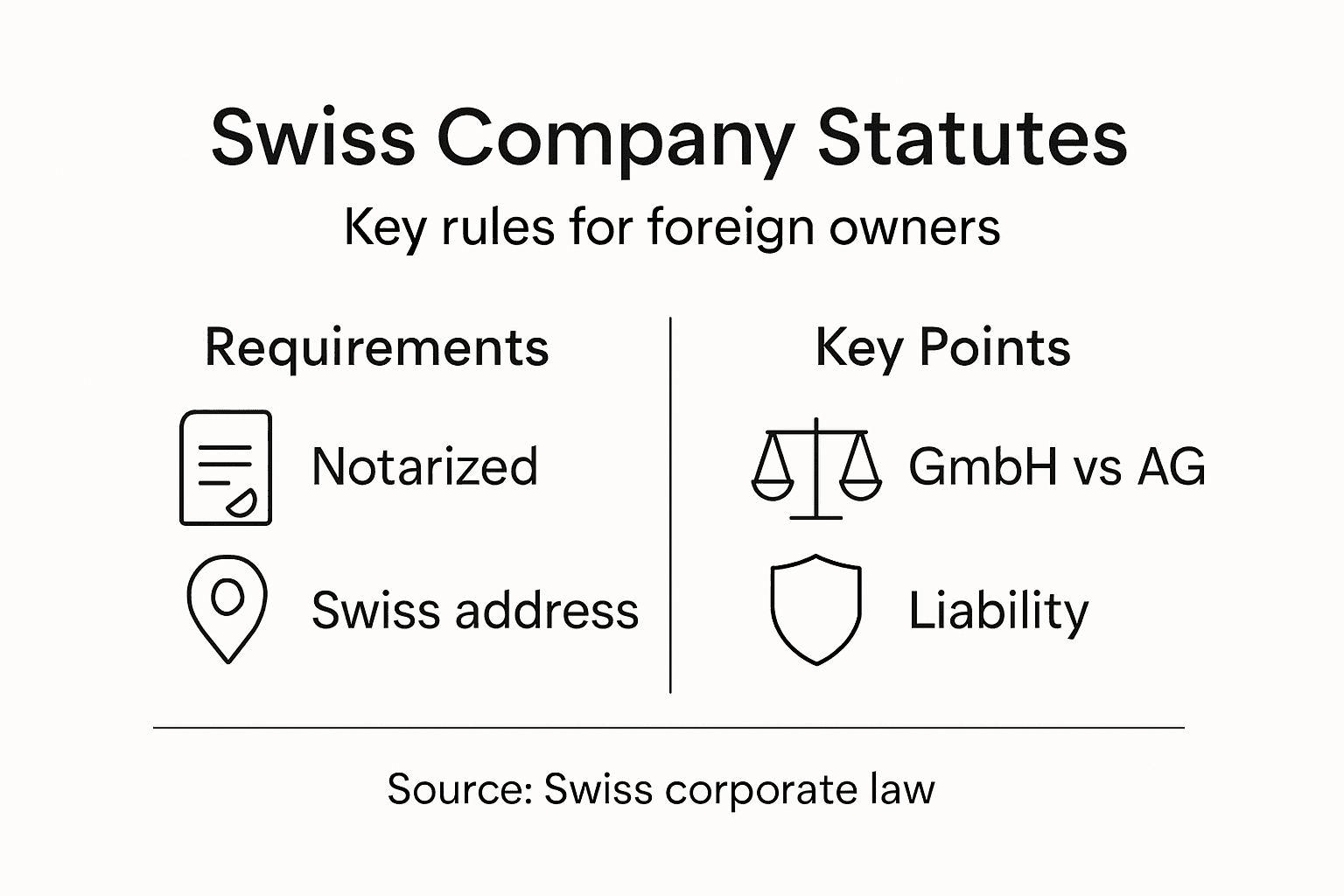
Foreign investors should understand that the Swiss registration process is designed to ensure transparency and legal integrity. The Commercial Register conducts thorough reviews of submitted documents, verifying that all statutory requirements are met before granting official corporate status. This rigorous approach provides both legal protection and credibility for newly established businesses operating within the Swiss commercial ecosystem.
Pro tip: Engage a local Swiss notary and legal consultant to ensure your articles of association meet all regulatory requirements and are prepared with maximum precision.
Rights and Duties Under Swiss Statutes
Swiss company law establishes a comprehensive framework that precisely defines the rights and responsibilities of shareholders and directors. Recent legal reforms have enhanced transparency and accountability within corporate governance structures, providing clear mechanisms for protecting stakeholder interests.
Key rights for shareholders include:
Participation Rights
Attend and vote in general meetings
Add agenda items for discussion
Request special company examinations
Access comprehensive company records
Receive timely financial reports
Director Accountability Mechanisms
Duty to act in company’s best interest
Mandatory disclosure of potential conflicts
Maintain accurate financial documentation
Implement robust internal control systems
Ensure regulatory compliance
The Swiss statutory framework distinguishes itself through its nuanced approach to corporate governance. Directors are not merely administrators but fiduciaries with extensive legal obligations. They must navigate complex responsibilities that balance shareholder interests, corporate performance, and regulatory compliance. This approach reflects Switzerland’s commitment to maintaining high standards of corporate integrity and transparency.
Foreign investors should recognize that these rights and duties are not theoretical constructs but legally enforceable provisions. The statutes provide multiple avenues for shareholders to protect their interests, including judicial review mechanisms and detailed procedural guidelines for addressing potential misconduct or governance failures.
Pro tip: Engage a Swiss corporate legal specialist to thoroughly understand the intricate rights and duties embedded in your specific company statutes.
Risks, Liabilities, and Compliance Mistakes
Foreign entrepreneurs operating in Switzerland face a complex landscape of legal risks and potential compliance challenges. Corporate law compliance demands meticulous attention to statutory requirements and ongoing regulatory obligations that can significantly impact business operations.
Critical compliance risks for foreign owners include:
Regulatory Compliance Risks
Incomplete statutory documentation
Improper company registration processes
Failure to update corporate records
Neglecting mandatory reporting requirements
Mismanagement of share capital
Potential Liability Exposure
Personal financial responsibility for directors
Potential legal action from shareholders
Penalties for non-compliance with Swiss corporate laws
Risks of business license revocation
Potential criminal liability for serious violations
The Swiss legal system imposes stringent accountability mechanisms that extend beyond traditional corporate governance models. Directors and shareholders can face personal liability for systemic compliance failures, making it crucial to understand and meticulously implement all statutory requirements. This approach reflects Switzerland’s commitment to maintaining high standards of corporate transparency and legal integrity.
Foreign investors must recognize that compliance is not a one-time event but an ongoing process. Regulatory frameworks evolve, and companies must continuously adapt their internal processes, documentation, and governance structures to remain fully compliant. Proactive engagement with local legal experts and regular compliance audits are essential strategies for mitigating potential risks.
The following table summarizes the main compliance risks foreign owners frequently encounter, along with their potential business impact:
Compliance Risk Area | Possible Consequence | Business Impact |
Incomplete documentation | Registration rejection | Delayed market entry |
Not updating records | Legal penalties | Damaged business reputation |
Failing reporting duties | Fines and audits | Financial losses, scrutiny |
Capital mismanagement | Personal director liability | Loss of investment, lawsuits |
Ignoring reforms | Criminal prosecution | Forced closure, asset seizure |
Pro tip: Conduct annual comprehensive compliance reviews with a Swiss corporate law specialist to identify and address potential regulatory vulnerabilities.
Simplify Your Swiss Company Formation and Stay Compliant with Expert Support
Navigating the complex requirements of company statutes in Switzerland can be overwhelming, especially for foreign owners unfamiliar with local legal frameworks. From drafting meticulous articles of association to ensuring full compliance with shareholder rights and governance rules, every step demands precision and expert insight. Common challenges include meeting strict capital requirements, managing legal liabilities, and avoiding costly compliance mistakes that could delay your market entry or expose you to penalties.

Take control of your Swiss business journey today with comprehensive solutions from rpcs.ch. Our professional platform specializes in helping international entrepreneurs establish GmbH and AG companies quickly and correctly. Benefit from tailored legal guidance, notarization services, efficient registration, and ongoing corporate management designed to protect you from compliance risks and support hassle-free operation. Don’t let complex statutes hold your business back. Visit rpcs.ch now and secure your path to a successful Swiss company setup and lasting regulatory compliance.
Frequently Asked Questions
What are company statutes in Switzerland?
Company statutes in Switzerland are legal documents that outline the operational and governance framework of a corporation, such as a stock corporation (AG) or limited liability company (GmbH). They serve as the constitutional blueprint for the company.
What key elements must be included in Swiss company statutes?
Swiss company statutes must include the company’s official name, registered address, corporate purpose, share capital structure, voting rights, governance responsibilities, and communication procedures, among other elements.
What are the differences between GmbH and AG statutes in Switzerland?
The key differences between GmbH and AG statutes include capital requirements (GmbH: 20,000 CHF; AG: 100,000 CHF), shareholder structures, governance mechanisms, and suitable company size, with GmbH being more flexible for small businesses and AG designed for larger corporations.
What are the potential risks and compliance mistakes for foreign entrepreneurs in Switzerland?
Foreign entrepreneurs may face risks such as incomplete documentation, improper company registration, and failing to update corporate records. These can result in legal penalties, financial liabilities, or potential business license revocation.
Recommended
Comments