
Role of Company Secretary in Switzerland: Key Duties
- Jan 29
- 8 min read

Establishing a Swiss GmbH or AG is a bold step, but the finer points of compliance can quickly become a challenge for even the most seasoned fintech founders. Understanding the critical role of the company secretary is essential, as this professional goes far beyond administrative work to act as a strategic pillar in Swiss corporate governance. This guide gives foreign entrepreneurs and investors clear insight into company secretarial responsibilities, showing how strong governance ensures both legal compliance and operational efficiency.
Table of Contents
Key Takeaways
Point | Details |
Company Secretaries are Strategic Professionals | In Switzerland, company secretaries play a crucial role in governance, ensuring compliance and providing advisory services rather than just administrative support. |
Diverse Types of Secretarial Roles | Company secretarial positions in Switzerland vary, including internal, external, and hybrid roles, with structured appointment procedures to ensure competence. |
Legal Frameworks for GmbH and AG | Understanding the distinct legal requirements for GmbH and AG structures is essential for compliance and successful business operations in Switzerland. |
Importance of Compliance Management | Proactive compliance management is vital to mitigate risks related to documentation and regulatory adherence, safeguarding organizational integrity. |
Company secretary explained in Swiss context
In the intricate landscape of Swiss corporate governance, the company secretary plays a nuanced and critical role that goes far beyond traditional administrative functions. Company secretarial responsibilities in Switzerland represent a strategic governance position that demands precision, legal acumen, and deep understanding of regulatory frameworks.
The role of a company secretary in Switzerland is fundamentally different from administrative stereotypes. Governance pillars in European contexts demonstrate that Swiss company secretaries serve as pivotal links between corporate boards, shareholders, and regulatory authorities. Their duties encompass multiple critical dimensions:
Ensuring comprehensive statutory compliance
Managing intricate board documentation and procedures
Serving as an official communication bridge with regulatory bodies
Maintaining comprehensive corporate records
Providing strategic governance advisory services
Unlike some jurisdictions where the role might be considered peripheral, Swiss corporate structures integrate the company secretary as a core governance professional. They are responsible for navigating complex legal requirements specific to Swiss corporate law, which demands extensive knowledge of both national regulations and international business standards.
Company secretaries in Switzerland are not mere record-keepers, but strategic governance professionals who ensure organizational integrity and regulatory alignment.
The professional must possess robust understanding of Swiss corporate legislation, banking regulations, and international business protocols. This requires continuous professional development and a proactive approach to evolving regulatory landscapes.
Pro tip: When establishing a Swiss company, consider engaging a company secretary with specialized certification in Swiss corporate governance to ensure comprehensive compliance and strategic guidance.
Types and appointment procedures for secretaries
In the Swiss corporate landscape, company secretaries can be categorized into distinct types with specific appointment mechanisms that align with the country’s rigorous governance standards. Corporate secretarial roles in Switzerland are not one-size-fits-all but tailored to meet specific organizational requirements and legal frameworks.
Corporate secretarial services in Switzerland encompass multiple appointment models that provide flexibility for businesses. The primary types of company secretaries include:
Internal Company Secretaries: Full-time professionals employed directly by the organization
External Professional Secretaries: Independent experts contracted to provide specialized governance support
Hybrid Secretarial Professionals: Professionals who split responsibilities between internal governance and external consulting
The appointment procedures for company secretaries in Switzerland are meticulously structured, involving several critical steps:
Verify professional qualifications and certifications
Conduct comprehensive background checks
Evaluate governance expertise and regulatory knowledge
Assess potential conflict of interest scenarios
Obtain board approval for appointment
Swiss corporate regulations mandate that company secretaries demonstrate exceptional professional competence. This typically requires advanced legal or business administration qualifications, profound understanding of Swiss corporate law, and proven experience in governance roles.
Effective company secretary appointments in Switzerland prioritize professional integrity, specialized knowledge, and strategic governance capabilities.
External service providers often play a crucial role in facilitating these appointments, offering comprehensive support in identifying, vetting, and onboarding qualified professionals who meet stringent Swiss corporate governance standards.

Pro tip: Consider engaging specialized corporate governance consultants to streamline the company secretary selection process and ensure compliance with Swiss regulatory requirements.
Legal requirements for Swiss GmbH and AG
The Swiss corporate landscape presents two primary business entity structures - GmbH (Gesellschaft mit beschränkter Haftung) and AG (Aktiengesellschaft) - each with distinct legal requirements that demand meticulous compliance. Understanding these structural nuances is crucial for international entrepreneurs seeking to establish a robust presence in Switzerland.
Swiss corporate law frameworks outline comprehensive governance standards that differ significantly between GmbH and AG entities. The primary distinctions include:
Capital requirements
Shareholder structures
Reporting obligations
Governance complexity
Operational flexibility
For GmbH structures, legal requirements typically involve:
Minimum capital of 20,000 Swiss francs
At least one Swiss resident director
Detailed articles of association
Mandatory commercial registry registration
Annual financial statement submissions
In contrast, AG entities face more stringent regulatory frameworks:
Minimum capital of 100,000 Swiss francs
More complex board structure requirements
Mandatory external auditing
Comprehensive shareholder disclosure rules
Stricter corporate governance protocols
Swiss corporate regulations prioritize transparency, accountability, and robust governance across both GmbH and AG structures.
While appointing a company secretary is not a statutory requirement, maintaining proper administrative documentation and ensuring regulatory compliance remains critically important. Companies must demonstrate meticulous record-keeping, strategic decision-making documentation, and adherence to Swiss corporate governance standards.
Here’s a concise comparison of Swiss GmbH and AG legal frameworks:
Criterion | Swiss GmbH | Swiss AG |
Minimum Capital | 20,000 CHF | 100,000 CHF |
Director Location | Must have Swiss resident | Swiss resident preferred |
Audit Requirements | Not always mandatory | External audit required |
Governance Structure | Simple board, fewer rules | Complex board, stricter laws |
Reporting Complexity | Moderate | High |
Pro tip: Engage local legal professionals specializing in Swiss corporate law to navigate the intricate regulatory landscape and ensure full compliance for your GmbH or AG structure.
Core responsibilities and governance duties
In the sophisticated realm of Swiss corporate governance, company secretaries shoulder extensive strategic responsibilities that extend far beyond traditional administrative functions. These professionals serve as critical architectural pillars maintaining organizational integrity and regulatory compliance.
Company secretary governance responsibilities encompass three fundamental domains of corporate management:
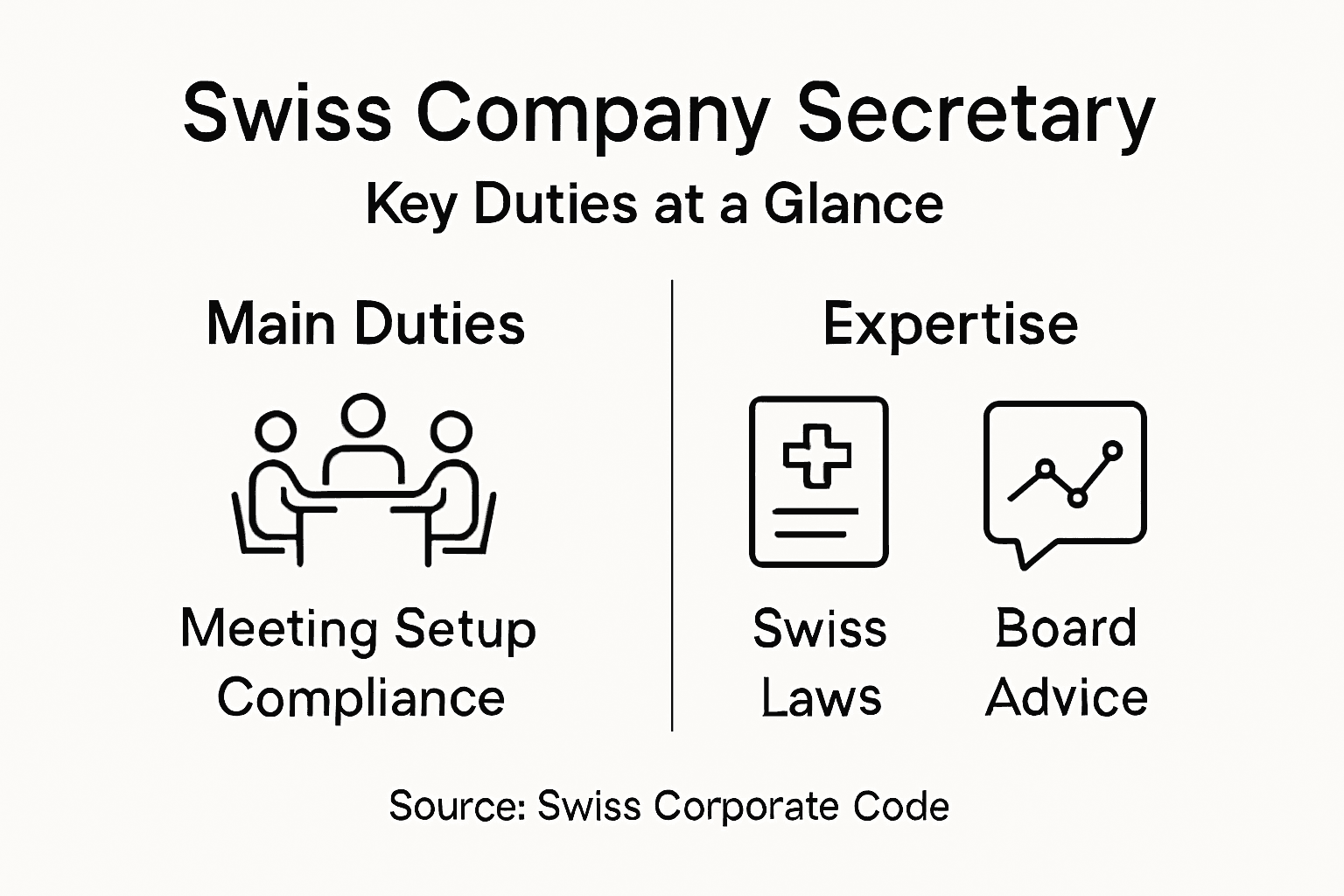
Strategic board support and advisory services
Comprehensive regulatory compliance management
Formal documentation and record-keeping
The core governance duties of a company secretary in Switzerland include:
Organizing and managing formal board meetings
Preparing precise meeting minutes and documentation
Ensuring legal and regulatory adherence
Maintaining statutory corporate records
Supporting strategic decision-making processes
Managing shareholder communication channels
Beyond these standard responsibilities, Swiss company secretaries must demonstrate exceptional professional competence. Their role demands intricate understanding of corporate law, financial regulations, and governance best practices specific to the Swiss business environment.
The company secretary functions as an indispensable governance guardian, bridging strategic oversight and operational execution.
Typically, these professionals provide critical advisory services to board members, helping them navigate complex legal landscapes, interpret regulatory changes, and maintain highest standards of corporate transparency and accountability.
Pro tip: Develop a comprehensive compliance tracking system that allows real-time monitoring of regulatory requirements and governance standards.
Risks, benefits, and outsourcing options
Navigating the complex landscape of corporate secretarial services in Switzerland requires a strategic approach that balances organizational risks with potential operational advantages. Understanding the nuanced considerations of in-house versus outsourced models becomes critical for international businesses seeking efficient governance solutions.
Corporate secretarial outsourcing advantages present multiple strategic benefits for Swiss companies:
Reduced administrative overhead
Access to specialized governance expertise
Cost-effective compliance management
Enhanced privacy protection
Continuity of professional services
The potential risks associated with company secretary functions include:
Compliance failures
Inadequate governance documentation
Communication gaps with regulatory authorities
Potential conflicts of interest
Loss of institutional knowledge
Outsourcing options typically fall into three primary categories:
Full Outsourcing: Complete delegation of secretarial functions to professional service providers
Hybrid Models: Partial outsourcing with retained internal oversight
Professional Support Services: Supplementary expert guidance and periodic consultation
Effective corporate secretarial management requires a balanced approach that combines professional expertise with strategic organizational alignment.
Professional service providers specializing in Swiss corporate governance can mitigate risks by offering comprehensive compliance tracking, expert regulatory interpretation, and seamless administrative support tailored to specific organizational needs.
The table below summarizes major risks and benefits of outsourcing Swiss secretarial functions:
Aspect | Outsourcing Benefits | Outsourcing Risks |
Cost | Reduces overhead | Potential hidden fees |
Expertise | Access to specialized knowledge | Possible lack of company context |
Continuity | Reliable service continuity | Risk of provider turnover |
Compliance | Consistent regulatory updates | Reliance on external vigilance |
Pro tip: Conduct a thorough due diligence assessment of potential corporate secretarial service providers, evaluating their track record, regulatory expertise, and alignment with your specific business requirements.
Common mistakes and compliance pitfalls
Navigating the intricate compliance landscape of Swiss corporate governance demands meticulous attention to detail and proactive risk management. Compliance vulnerabilities can emerge through seemingly minor administrative oversights that potentially expose organizations to significant legal and financial consequences.
Common secretarial compliance mistakes represent critical areas of potential organizational risk:
Inaccurate statutory record maintenance
Delayed annual return submissions
Incomplete board meeting documentation
Inadequate shareholder communication protocols
Poor regulatory reporting practices
The most prevalent compliance pitfalls for Swiss companies include:
Failing to update corporate registries promptly
Neglecting mandatory financial reporting deadlines
Inconsistent board meeting minute documentation
Inadequate conflict of interest disclosures
Non-transparent shareholder communication channels
Potential consequences of these compliance failures range from administrative penalties to more severe legal repercussions that can dramatically impact organizational reputation and operational continuity.
Proactive compliance management represents the cornerstone of sustainable corporate governance in the Swiss business ecosystem.
Companies must implement robust internal control mechanisms, leverage professional expertise, and maintain continuous education on evolving regulatory landscapes to mitigate potential compliance risks effectively.
Pro tip: Develop a comprehensive compliance checklist with strict accountability protocols and regular internal audit mechanisms to preemptively identify and address potential governance vulnerabilities.
Simplify Your Swiss Company Governance with Expert Support
Navigating the complex role of a company secretary in Switzerland requires expertise in statutory compliance, corporate documentation, and strategic governance. Many international entrepreneurs face challenges aligning with Swiss legal requirements for GmbH and AG structures while ensuring flawless board management and regulatory adherence. Common pain points include managing intricate administrative duties, maintaining timely regulatory filings, and selecting qualified corporate secretarial professionals to avoid costly compliance risks.
Take control of your Swiss company’s governance today by leveraging the specialized services at RpcS. Our platform offers comprehensive support for company formation and ongoing administrative management tailored to Swiss corporate law. Whether you struggle with legal documentation, board meeting organization, or compliance monitoring, our expert team helps you stay ahead with rapid setup, confidentiality, and reliable governance solutions. Visit RpcS now to discover how our seamless service can ensure your Swiss GmbH or AG meets all regulatory demands with confidence and ease.
Frequently Asked Questions
What are the key responsibilities of a company secretary in Switzerland?
The key responsibilities of a company secretary in Switzerland include organizing board meetings, ensuring compliance with legal and regulatory requirements, maintaining corporate records, and providing strategic governance advisory services.
How does the role of a company secretary differ from an administrative position?
Unlike traditional administrative roles, company secretaries in Switzerland serve as essential governance professionals, managing statutory compliance, intricate board procedures, and strategic communication with regulatory authorities.
What qualifications are typically required for a company secretary in Switzerland?
A company secretary in Switzerland generally requires advanced legal or business administration qualifications, extensive knowledge of Swiss corporate law, and relevant experience in governance roles.
What are the potential risks of not having a company secretary?
The potential risks of not having a company secretary include compliance failures, inadequate governance documentation, communication gaps with regulatory bodies, and increased legal liabilities for the organization.
Recommended
Comments