
Company Merging Switzerland: Tax Efficiency and Growth
- Jan 30
- 8 min read
Updated: Feb 12

Every ambitious business owner knows that choosing the right jurisdiction is crucial when planning a corporate merger. Switzerland stands out as an ideal destination, blending a resilient economy with remarkable flexibility and strong legal protections for company mergers. Entrepreneurs from Europe and Asia can expect clear statutory procedures, options for tailored transaction structures, and built-in safeguards for assets and shareholders. This guide empowers you to understand how Swiss law supports efficient mergers while maximizing stability, growth potential, and tax advantages.
Table of Contents
Key Takeaways
Point | Details |
Merge Types | Understanding the different merger types (Horizontal, Vertical, Conglomerate, Market Extension) is crucial for strategic planning and addressing integration challenges. |
Legal Compliance | Engage specialized legal counsel to navigate Switzerland’s regulatory landscape and ensure compliance with merger laws. |
Tax Efficiency | Develop a tax optimization strategy early in the merger process to maximize financial benefits and minimize liabilities. |
Risk Management | Conduct thorough due diligence to identify potential risks, ensuring robust strategies for mitigating unforeseen liabilities and integration complexities. |
Company Merging in Switzerland Explained
Company mergers in Switzerland represent a strategic pathway for businesses seeking growth and operational optimization in one of Europe’s most stable economic environments. The Swiss legal framework provides robust mechanisms for corporate restructuring, offering entrepreneurs significant flexibility in merger transaction structures.
Under the Swiss Merger Act, companies have two primary merger approaches:
Merger by Combination: Creates a brand new legal entity where merging company shareholders collectively form a new corporate structure
Merger by Absorption: Existing company absorbs another, with shareholders of the acquired company becoming shareholders of the acquiring entity
The Swiss merger process offers remarkable contractual freedom, allowing businesses to design transactions tailored to their specific strategic objectives. Unlike many jurisdictions with rigid regulatory frameworks, Switzerland provides a flexible environment that supports complex corporate restructuring.
Key considerations for successful company mergers in Switzerland include:
Comprehensive asset and liability transfer documentation
Statutory compliance with the Swiss Code of Obligations
Sector-specific regulatory evaluation (particularly in banking and telecommunications)
Detailed shareholder agreement negotiations
Tax efficiency planning
Pro tip: Engage specialized Swiss legal counsel early in the merger process to navigate complex regulatory nuances and optimize your transaction structure.
Types of Mergers and Key Differences
Swiss corporate law recognizes multiple merger strategies that enable businesses to optimize their organizational structures and achieve strategic objectives. Understanding these merger transaction types is crucial for entrepreneurs seeking to navigate complex corporate restructuring scenarios.
The primary types of corporate mergers in Switzerland include:
Horizontal Mergers: Transactions between companies operating in the same industry or market segment
Vertical Mergers: Combining companies at different stages of the production or supply chain
Conglomerate Mergers: Mergers between businesses in unrelated industries, typically for diversification purposes
Market Extension Mergers: Combining companies that sell similar products in different markets
Each merger type presents unique strategic advantages and challenges. Horizontal mergers often aim to reduce competition and increase market share, while vertical mergers focus on operational efficiency and supply chain optimization. Conglomerate mergers provide opportunities for risk diversification and expanded business portfolios.

Here’s how the main merger types differ in strategic focus and typical challenges:
Merger Type | Main Strategic Goal | Business Integration Challenge |
Horizontal Merger | Market share expansion | Overlapping operations and resources |
Vertical Merger | Supply chain optimization | Aligning functions across stages |
Conglomerate Merger | Diversification | Integrating unrelated businesses |
Market Extension Merger | Geographic market growth | Adapting to new market environments |
Key differentiating factors among merger types include:
Strategic objectives
Industry alignment
Operational integration complexity
Potential synergy opportunities
Regulatory considerations
Successful mergers require comprehensive due diligence and strategic alignment beyond mere financial considerations.
Pro tip: Conduct thorough market and cultural compatibility assessments before finalizing any merger strategy to maximize long-term success and minimize integration challenges.
Legal Framework and Compliance in Switzerland
Switzerland’s corporate merger landscape is governed by a sophisticated legal framework designed to protect business interests while maintaining market integrity. Merger regulations in Switzerland encompass multiple legislative instruments that provide comprehensive guidance for corporate restructuring.
Key legislative frameworks governing mergers include:
Swiss Merger Act: Primary legislation defining merger procedures
Swiss Code of Obligations: Establishes foundational corporate governance rules
Financial Market Infrastructure Act: Regulates public company transactions
Cartel Laws: Ensures fair market competition during mergers
Companies must navigate complex compliance requirements across different regulatory domains. The Swiss legal system emphasizes protecting minority shareholder rights and maintaining transparent corporate processes. Regulatory oversight involves multiple governmental bodies, including the Swiss Competition Commission and the Takeover Board, which monitor merger activities to prevent anti-competitive practices.
This table summarizes the major regulatory bodies and their key roles in Swiss mergers:
Regulatory Body | Primary Responsibility | Importance in Mergers |
Swiss Competition Commission | Monitors competition and antitrust issues | Prevents monopolistic mergers |
Takeover Board | Oversees public company mergers | Ensures transparency |
Financial Market Supervisory Authority | Regulates financial sector deals | Approves sensitive transactions |
Important compliance considerations for corporate mergers involve:
Detailed financial disclosure requirements
Mandatory shareholder notification protocols
Sector-specific regulatory approvals
Comprehensive documentation of transaction details
Adherence to competition law restrictions
Foreign investors must pay special attention to additional regulatory constraints, particularly in sensitive sectors like banking and real estate.
Pro tip: Engage specialized Swiss legal counsel with expertise in merger regulations to ensure full compliance and minimize potential regulatory risks.
Step-By-Step Process for Company Merging
Navigating the company merger process in Switzerland requires a systematic and strategic approach. Swiss merger procedures involve comprehensive legal and administrative steps designed to ensure smooth business integration and regulatory compliance.
The fundamental stages of a Swiss company merger include:
Initial Strategic Planning: Evaluating merger compatibility and strategic objectives
Due Diligence: Comprehensive financial and operational assessment
Merger Agreement Preparation: Drafting detailed legal documentation
Shareholder Approval: Obtaining consent from all stakeholders
Regulatory Filing: Submitting required documentation to commercial registers
The merger process demands meticulous attention to legal and financial details. Companies must prepare extensive documentation demonstrating the transaction’s strategic rationale, financial implications, and potential impact on shareholders and employees. This includes comprehensive financial statements, asset transfer plans, and detailed integration strategies.
Critical steps in the merger process involve:
Conducting thorough financial and legal investigations
Negotiating merger terms and conditions
Preparing comprehensive merger documentation
Obtaining regulatory and shareholder approvals
Executing asset and liability transfers
Completing commercial register filings
Successful mergers require transparent communication and strategic alignment across all organizational levels.
Pro tip: Engage specialized Swiss legal and financial advisors early in the merger process to ensure comprehensive compliance and minimize potential operational risks.
Tax Advantages and Financial Implications
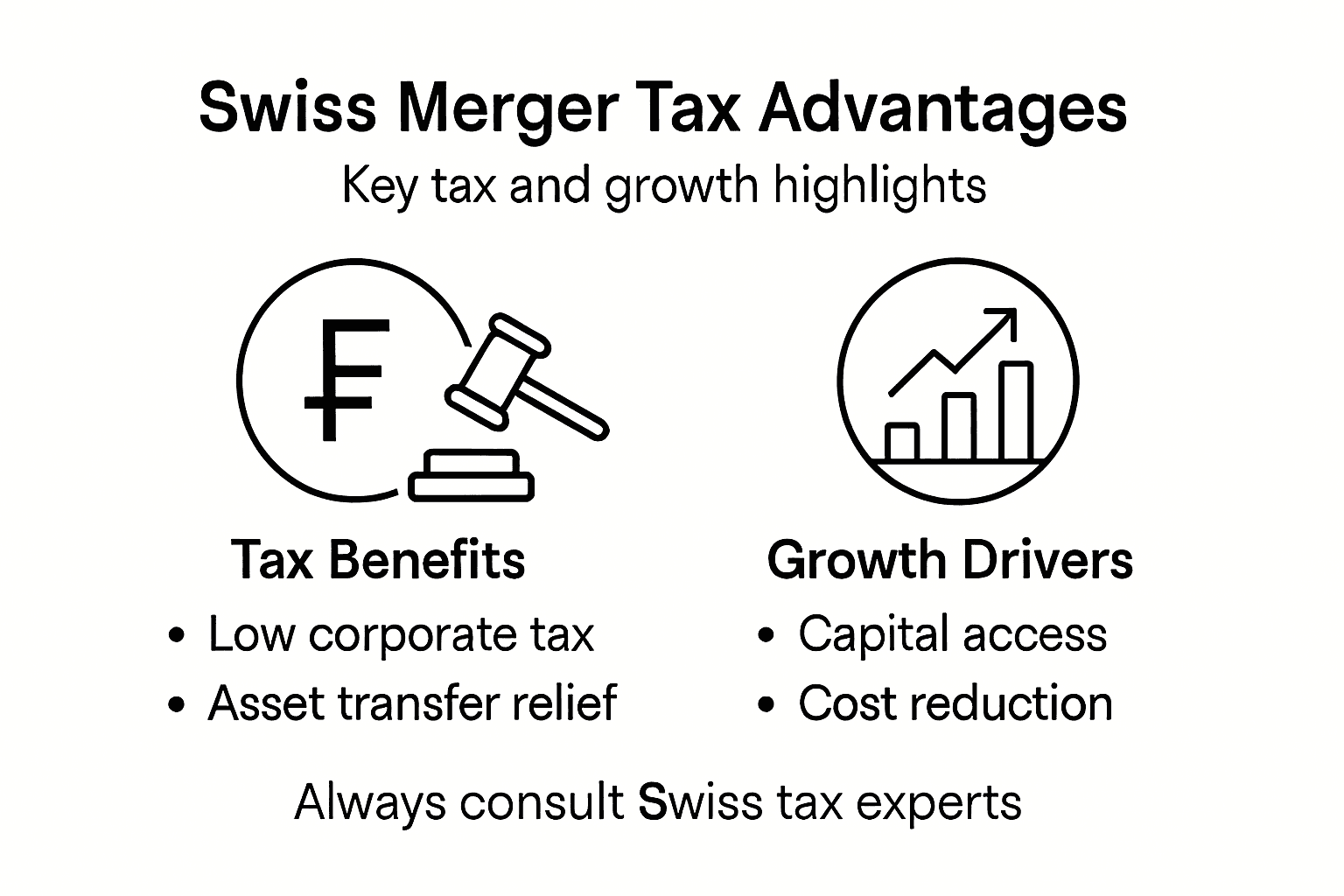
Swiss corporate mergers offer sophisticated tax optimization strategies that provide significant financial benefits for businesses. Tax-efficient merger mechanisms enable companies to strategically manage their fiscal responsibilities while maximizing operational synergies.
Key tax advantages in Swiss corporate mergers include:
Tax-Neutral Asset Transfers: Allowing seamless movement of assets without immediate tax charges
Strategic Restructuring Options: Enabling flexible corporate reorganization
Deferred Tax Treatments: Minimizing immediate tax liabilities
Favorable Capital Gains Regulations: Reducing tax burdens on corporate transactions
The Swiss tax framework provides multiple strategies for minimizing tax exposure during mergers. Companies can leverage different transaction structures such as share deals and asset deals, each carrying unique tax implications. Careful planning allows businesses to optimize their financial outcomes by strategically selecting the most advantageous merger approach.
Critical financial considerations in merger transactions involve:
Comprehensive tax planning assessment
Evaluation of share versus asset deal structures
Analysis of potential VAT implications
Detailed documentation of asset transfers
Strategic timing of corporate restructuring
Sophisticated tax planning is essential for maximizing the financial potential of corporate mergers in Switzerland.
Pro tip: Consult specialized Swiss tax experts to develop a nuanced merger strategy that minimizes tax liabilities and maximizes financial efficiency.
Risks, Liabilities, and Common Pitfalls
Company mergers in Switzerland, while strategically advantageous, involve complex legal and financial risks that require meticulous management. Corporate merger risks necessitate comprehensive due diligence and strategic planning to mitigate potential challenges.
Significant risks in Swiss company mergers include:
Regulatory Compliance Challenges: Navigating complex Swiss legal frameworks
Financial Integration Complexities: Aligning disparate financial systems
Cultural Compatibility Issues: Managing organizational cultural differences
Unexpected Liability Transfers: Unforeseen legal and financial obligations
Tax Optimization Constraints: Potential unexpected tax implications
Entrepreneurs must conduct thorough investigations to identify potential hidden liabilities. This involves comprehensive financial audits, detailed legal reviews, and in-depth assessments of each company’s operational and financial health. Understanding potential risks allows businesses to develop robust mitigation strategies and negotiate more favorable merger terms.
Critical areas requiring extensive risk assessment include:
Comprehensive financial statement analysis
Detailed intellectual property evaluations
Employee contract and obligation reviews
Historical legal dispute investigations
Potential cross-border regulatory complications
Successful mergers demand proactive risk management and strategic foresight beyond traditional financial calculations.
Pro tip: Engage specialized Swiss legal and financial experts to conduct exhaustive due diligence and develop comprehensive risk mitigation strategies before finalizing any merger agreement.
Maximize Growth and Tax Efficiency in Swiss Company Mergers
Navigating the complexities of company merging in Switzerland requires expertise in legal frameworks, tax optimization, and strategic planning. Many businesses struggle with aligning their merger objectives while ensuring compliance with Swiss regulations and achieving tax neutrality. Understanding concepts like asset transfers, tax-efficient restructuring, and shareholder negotiations is critical to avoid costly pitfalls and unlock your company’s full growth potential.
At rpcs.ch, we specialize in guiding international entrepreneurs and investors through every phase of Swiss company formation and merger processes. Our professional services cover everything from legal documentation and financial compliance to tax planning, creating a seamless path toward your strategic merger goals. Benefit from our tailored support designed to help you overcome regulatory challenges and maximize tax advantages.

Take control of your merger strategy today with expert support from rpcs.ch. Visit our platform to discover comprehensive solutions for company formation, legal guidance, and ongoing management tailored to the Swiss market. Don’t let complex merger procedures slow your growth. Start now and optimize your Swiss corporate journey with proven specialists at your side.
Frequently Asked Questions
What are the main types of mergers recognized in Swiss corporate law?
The primary types of mergers in Switzerland include horizontal mergers, vertical mergers, conglomerate mergers, and market extension mergers. Each type serves different strategic goals and comes with its own set of challenges.
How can companies optimize their tax liabilities during a merger in Switzerland?
Companies can achieve tax optimization through tax-neutral asset transfers, strategic restructuring options, deferred tax treatments, and favorable capital gains regulations. Careful planning helps minimize tax exposure during mergers.
What are some common risks associated with company mergers in Switzerland?
Common risks include regulatory compliance challenges, financial integration complexities, cultural compatibility issues, unexpected liability transfers, and tax optimization constraints. Conducting thorough due diligence is crucial to identify and mitigate these risks.
What legal frameworks govern company mergers in Switzerland?
The main legal frameworks include the Swiss Merger Act, the Swiss Code of Obligations, the Financial Market Infrastructure Act, and cartel laws, all of which provide comprehensive guidelines for corporate restructuring and protect shareholder rights.
Recommended
Comments