
Why Choose a Swiss Canton for Your Company
- Feb 14
- 9 min read
Updated: Feb 23

Securing a competitive edge demands more than just vision. For ambitious Asian and European executives and entrepreneurs, Switzerland’s distinct cantonal system offers unmatched flexibility when launching a tech venture. Each canton sets its own rules for tax regimes and compliance, allowing founders to select environments tailored to their strategic goals. This guide reveals how Swiss incorporation delivers rapid compliance, robust governance, and powerful tax optimization—critical for tech startups aiming for sustained growth in a global market.
Table of Contents
Key Takeaways
Point | Details |
Canton Selection | Entrepreneurs should evaluate tax rates, regulatory environments, and industry clusters when choosing a canton for company formation. |
Corporate Structures | Understanding the different Swiss corporate structures, such as GmbH/Sàrl and AG/SA, is crucial for aligning business strategies with legal requirements. |
Tax Optimization | Each canton offers varying tax rates and incentives, making it essential for companies to analyze these fiscal landscapes for optimal financial positioning. |
Legal Compliance | Adhering to Swiss legal requirements is vital for successful company establishment, including proper documentation and ongoing compliance with regulations. |
Swiss Cantons and Company Formation Basics
Switzerland’s unique cantonal system provides international entrepreneurs with extraordinary opportunities for strategic company formation. Each canton offers distinct advantages for business registration, creating a complex yet flexible landscape for corporate establishment.
The 26 Swiss cantons represent semi-autonomous administrative regions with significant independence in business regulations, tax structures, and corporate governance. This decentralized approach means entrepreneurs can strategically select a canton that best matches their specific business objectives. Some key considerations include:
Tax optimization potential across different cantonal jurisdictions
Local regulatory environments and business-friendly policies
Proximity to specific economic clusters or industry networks
Corporate registration costs and administrative requirements
Access to specialized talent pools and regional economic strengths
Entrepreneurs considering Swiss company formation must carefully evaluate company registration nuances specific to each canton. Factors like corporate tax rates, registration fees, and bureaucratic efficiency vary significantly between regions like Zug, Geneva, and Zürich.
Moreover, the Swiss federal system allows each canton considerable autonomy in creating business-friendly frameworks. This means companies can leverage regional specializations - whether in finance, technology, or international trading - by selecting the most appropriate cantonal environment.
Cantonal Selection Strategies
Successful international entrepreneurs typically conduct comprehensive research before selecting a specific Swiss canton. Critical evaluation criteria include:
Corporate tax rate differentials
Regulatory compliance complexity
Local economic ecosystem
Infrastructure and connectivity
Talent availability in specialized sectors
Switzerland’s cantonal system offers unparalleled flexibility for international business registration, making it a premier destination for strategic corporate establishment.
Pro tip: Consult with local Swiss corporate formation experts who understand the nuanced differences between cantonal business environments to maximize your strategic positioning.
Major Types of Swiss Corporate Structures
Switzerland offers a diverse range of corporate structures designed to accommodate various business needs and entrepreneurial strategies. Understanding these structures is crucial for international investors seeking to establish a robust legal and financial foundation in the Swiss market.
The most prominent Swiss corporate entities include two primary corporate types: the Limited Liability Company (GmbH/Sàrl) and the Public Limited Company (AG/SA). Each structure presents unique characteristics tailored to different business scales and objectives.
Limited Liability Company (GmbH/Sàrl)
Key features of the GmbH/Sàrl structure include:
Minimum capital requirement of CHF 20,000
Ideal for small to medium-sized enterprises
Flexible management structure
Lower administrative complexity
Relatively quick and straightforward establishment process
Public Limited Company (AG/SA)
The AG/SA offers distinct advantages for larger business operations:
Minimum capital requirement of CHF 100,000
Suitable for substantial corporate enterprises
Ability to issue publicly tradable shares
Enhanced shareholder anonymity
More complex governance requirements
Beyond these primary structures, Switzerland also recognizes additional corporate entities that cater to specific business models:
Here’s how the main Swiss corporate structures compare:
Structure Type | Minimum Capital | Shareholder Transparency | Ideal Business Scale |
GmbH/Sàrl | CHF 20,000 | Direct shareholder disclosure | Small to medium-size firms |
AG/SA | CHF 100,000 | Enhanced anonymity for shareholders | Large multinational companies |
Sole Proprietorship | No required minimum | Ownership fully public | Solo entrepreneurs |
Holding Company | Varies by company type | Depends on corporate form | Parent firms, multi-industry holdings |
Sole Proprietorships
General Partnerships
Limited Partnerships
Branch Offices
Holding Companies
Swiss corporate law provides exceptional flexibility, allowing entrepreneurs to select structures that precisely match their strategic business objectives.
Pro tip: Consult with a Swiss corporate law specialist to determine the most advantageous corporate structure for your specific business model and long-term growth strategy.
Taxation and Incentives by Canton
Switzerland’s cantonal tax system represents a sophisticated framework of competitive regional incentives designed to attract international businesses and entrepreneurial investments. Each of the 26 Swiss cantons offers unique tax structures and economic advantages, creating a dynamic landscape of fiscal opportunities for strategic corporate positioning.

Corporate Tax Landscape
The variation in cantonal tax rates creates a compelling environment for businesses seeking optimal financial strategies. Key taxation considerations include:
Federal corporate tax rate of approximately 8.5%
Cantonal tax rates ranging from 11.5% to 16.4%
Additional municipal tax supplements
Potential tax holidays for new businesses
Research and development tax credits
Lowest Tax Jurisdictions
Some cantons have distinguished themselves as particularly attractive tax environments:
Zug: Often called the “Swiss Tax Haven” with extraordinarily low rates
Schwyz: Competitive corporate tax structures
Appenzell Innerrhoden: Minimal tax burden for corporations
Nidwalden: Attractive tax incentives for international companies
Basel-City: Specialized tax breaks for innovative industries
Switzerland’s cantonal tax system allows unprecedented flexibility, enabling companies to strategically optimize their fiscal positioning across different regions.
International companies must carefully analyze the nuanced tax implications of each canton. Factors beyond direct tax rates - such as infrastructure, talent pool, and regulatory environment - play crucial roles in determining the most advantageous location.
Pro tip: Engage a specialized Swiss tax consultant who can perform a comprehensive analysis of cantonal tax structures tailored to your specific business model and growth objectives.
Legal Compliance and Setup Requirements
Establishing a company in Switzerland requires meticulous adherence to a comprehensive legal framework designed to ensure transparency, financial integrity, and robust corporate governance. International entrepreneurs must navigate a complex landscape of regulatory requirements that demand precision and strategic planning.
The foundation of Swiss company formation begins with critical legal documentation requirements. Articles of Association represent the cornerstone of corporate establishment, encompassing several mandatory elements:
Precise company name specification
Defined business purpose
Registered office location
Detailed share capital information
Corporate governance structure
Director and Residency Requirements
Swiss corporate law mandates specific provisions for company leadership and representation:
Minimum of one Swiss-resident director
Mandatory registration in the Commercial Register
Compliance with corporate governance standards
Necessary insurance registrations
Regular financial reporting obligations
Swiss legal frameworks prioritize transparency, requiring comprehensive documentation and strict adherence to regulatory standards for all corporate entities.
Foreign entrepreneurs must pay particular attention to the nuanced legal landscape. Beyond basic registration, companies must demonstrate ongoing compliance through:
Annual financial statement submissions
Regular tax reporting
Maintenance of proper corporate records
Adherence to Swiss employment regulations
Compliance with international reporting standards
Pro tip: Engage a local Swiss legal expert specializing in corporate formation to ensure comprehensive compliance and navigate the intricate regulatory requirements effectively.
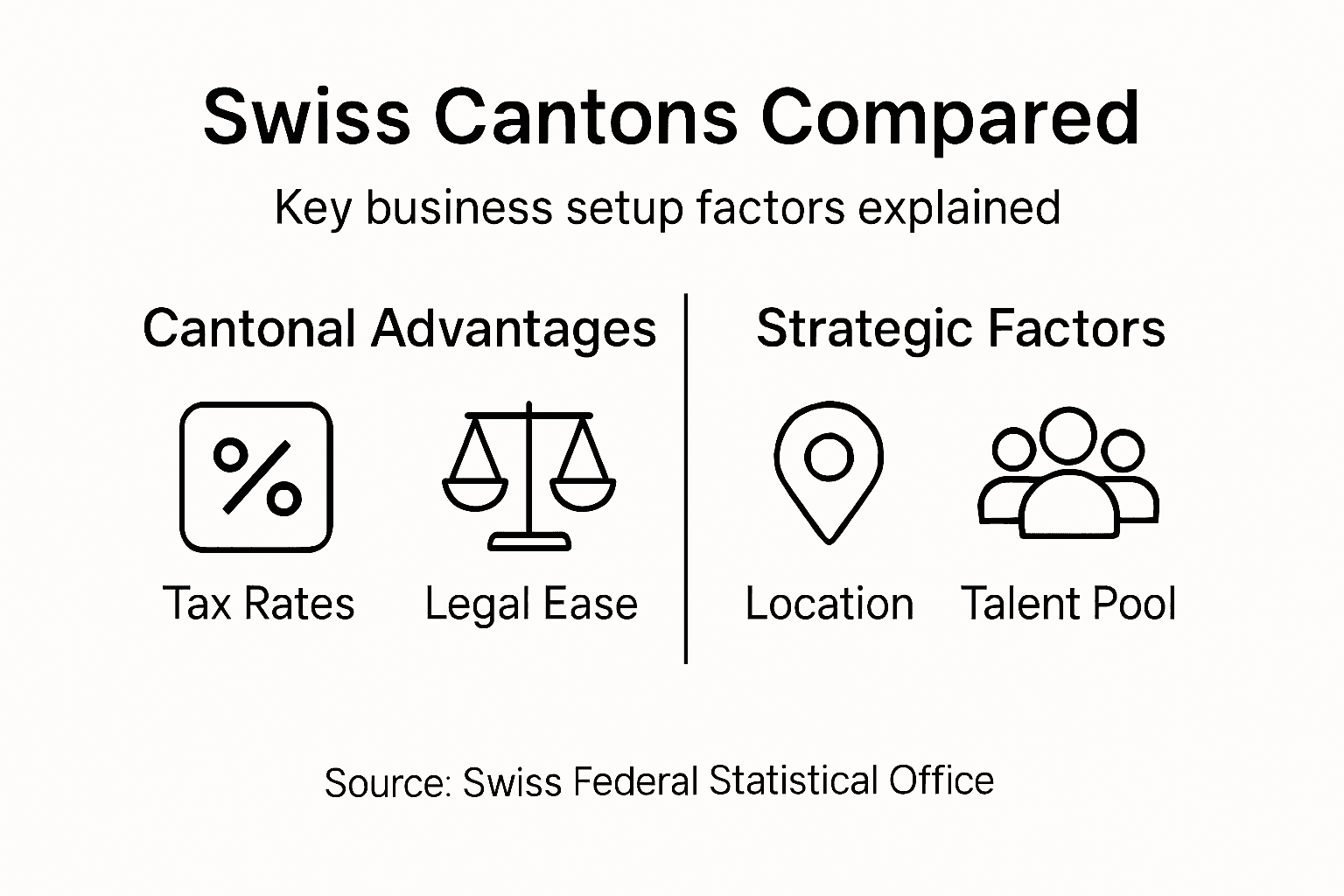
Strategic Factors: Location, Talent, and Innovation
Switzerland represents a sophisticated ecosystem for international businesses, offering far more than favorable tax structures. The strategic interplay of geographic positioning, exceptional talent pool, and robust innovation infrastructure creates a compelling environment for forward-thinking enterprises seeking sustainable global competitiveness.
Location Advantages
Swiss geographic positioning provides unparalleled strategic benefits for international companies:
Central European location with exceptional transportation networks
Direct access to major European economic markets
Multilingual business environment
Advanced telecommunications infrastructure
Proximity to leading research institutions
Talent and Human Capital
The Swiss talent landscape distinguishes itself through several critical dimensions:
World-class technical and engineering education
High percentage of multilingual professionals
Rigorous vocational training systems
Exceptional work productivity standards
Strong emphasis on continuous professional development
Switzerland’s commitment to innovation and human capital development creates an unparalleled ecosystem for sophisticated international businesses.
Innovation Ecosystem
Switzerland consistently ranks among the world’s most innovative environments, characterized by:
Significant investment in research and development
Strong collaboration between academia and industry
Advanced patent registration processes
Supportive regulatory frameworks for technological advancement
Robust venture capital and startup infrastructure
Pro tip: Conduct comprehensive due diligence on regional innovation clusters and talent networks specific to your industry before finalizing your Swiss business location strategy.
Comparing Swiss Cantons for Company Setup
Switzerland’s 26 cantons represent a complex ecosystem of business opportunities, each offering unique strategic advantages for international entrepreneurs. Understanding the nuanced differences between these regional jurisdictions is critical for making an informed company establishment decision.
Top Performing Cantons
Some Swiss cantons have emerged as particularly attractive destinations for corporate registration:
Zug: Known as the “Crypto Valley” with exceptional tech infrastructure
Zürich: Global financial hub with extensive international connections
Geneva: International organizations and diplomatic ecosystem
Basel: Strong pharmaceutical and life sciences cluster
Schwyz: Extremely business-friendly tax environment
Comparative Evaluation Criteria
Entrepreneurs should assess cantons across multiple strategic dimensions:
Corporate tax rates
Regulatory complexity
Industry-specific ecosystem strengths
Talent pool availability
Infrastructure quality
Cost of business operations
International connectivity
Each Swiss canton offers a unique combination of strategic advantages, making comprehensive research essential for optimal location selection.
The selection process requires deep understanding of each canton’s specific characteristics. Factors like proximity to research institutions, existing industry clusters, and local government support can significantly impact long-term business success.
Review key strategic factors when selecting a Swiss canton:
Decision Factor | Impact on Business | Why It Matters |
Tax Regime | Affects net profit | Lower rates improve competitiveness |
Talent Pool | Drives innovation and productivity | Access to skilled employees crucial |
Infrastructure | Supports operations and growth | Reliable transport and digital connectivity |
Industry Clusters | Accelerates business expansion | Easier networking and partnerships |
Key Comparative Metrics
Critical considerations when comparing cantons include:
Speed of business registration
Local talent availability
Digital infrastructure quality
Startup ecosystem maturity
Cost of office space
Language capabilities
Networking opportunities
Pro tip: Conduct an in-depth analysis of at least three cantons that align with your specific industry and business model before making a final location decision.
Unlock the Full Potential of Swiss Canton Company Formation with Expert Support
Choosing the right Swiss canton for your company involves navigating complex factors such as tax optimization, legal compliance, and access to specialized talent pools. The article highlights key challenges like understanding distinct cantonal tax regimes, selecting the ideal corporate structure, and adhering to residency and documentation requirements. These pain points can overwhelm international entrepreneurs who lack local knowledge but seek to leverage Switzerland’s unique business advantages including confidentiality, rapid setup, and strategic location.
That is where RPCS comes in. Our professional service platform specializes in simplifying the entire process of company formation in Switzerland. From guiding you through choosing between GmbH or AG structures to handling notarization, registration, banking setup, and ongoing administrative support, we ensure a stress-free experience tailored to your business goals. With deep expertise in Swiss corporate law and cantonal distinctions, we empower you to make informed decisions that maximize your fiscal benefits and growth potential.
Take action now to gain unmatched clarity and confidence in establishing your Swiss company. Visit RPCS and explore our comprehensive services to unlock seamless company formation and ongoing support.
Start your Swiss company journey with trusted experts who understand every nuance of cantonal advantages and legal compliance. Connect with us today at https://rpcs.ch and secure your strategic foothold in one of the world’s most dynamic business environments.
Frequently Asked Questions
What are the advantages of registering a company in a Swiss canton?
Choosing a Swiss canton for company registration offers various advantages, including favorable tax rates, business-friendly regulations, access to talent pools, proximity to industry clusters, and efficient corporate registration processes.
How do corporate tax rates differ among Swiss cantons?
Corporate tax rates in Swiss cantons can vary significantly, with some cantons offering rates as low as 11.5% and others up to 16.4%. This diversity allows businesses to strategically select a location that aligns with their financial goals.
What are the key corporate structures available for businesses in Switzerland?
Switzerland offers several corporate structures, with the most common being the Limited Liability Company (GmbH/Sàrl) and the Public Limited Company (AG/SA), each designed for different business needs regarding capital requirements and governance complexity.
How can entrepreneurs ensure legal compliance when establishing a company in Switzerland?
To ensure legal compliance, entrepreneurs should familiarize themselves with required documentation, appoint Swiss-resident directors, register in the Commercial Register, and maintain ongoing compliance with financial reporting and regulatory standards.
Recommended
Comments