
Swiss corporate governance guide: build compliance and trust
- Mar 27
- 8 min read

Swiss corporate governance is not what most international entrepreneurs expect. The popular image of Switzerland as a secretive financial haven misses a far more important reality: Swiss corporate law is rigorous, modern, and increasingly transparent. Recent reforms have modernized the framework, emphasizing shareholder rights and disclosure obligations that rival any major jurisdiction. If you are building or acquiring a business in Switzerland, understanding these rules is not optional. It is the foundation of investor trust, legal standing, and long-term operational success.
Table of Contents
Key Takeaways
Point | Details |
Swiss law is evolving | Recent reforms bring more transparency, shareholding rights, and ESG requirements. |
Boards face stricter rules | Independence, gender diversity, and clear lines of responsibility are now expected for directors. |
Say-on-pay boosts accountability | Annual binding votes on executive compensation are now mandatory for all Swiss listed firms. |
ESG reporting is crucial | Larger companies must report on environmental, social, and human rights risks or explain non-compliance. |
Best practices attract investors | Following the Swiss Code of Best Practice signals credibility to international stakeholders. |
Understanding Swiss corporate governance: Main sources and principles
Swiss corporate governance draws from several distinct legal sources, and knowing which applies to your company is the first practical step. The primary sources are the Swiss Code of Obligations (CO), financial market laws, and the SIX Exchange listing rules for publicly traded companies. FINMA, the Swiss Financial Market Supervisory Authority, adds another regulatory layer for financial sector entities. Together, these create a layered system where statutory law sets the floor and best-practice guidelines raise the ceiling.
The Swiss Code of Best Practice (SCBP), published by economiesuisse, is the governance benchmark most boards reference. It is non-binding but widely observed, operating on a comply-or-explain basis. That means companies either follow its recommendations or publicly explain why they do not. This approach gives boards flexibility while keeping accountability visible to investors and regulators.
Three principles run through the entire Swiss governance model: transparency, shareholder primacy, and board accountability. Unlike the EU’s two-tier board structure or the US model with its heavy reliance on litigation, Switzerland favors a board-centric approach. The board holds both strategic oversight and ultimate legal responsibility, even when daily management is delegated. This is a critical distinction for foreign entrepreneurs who may be used to cleaner separations between governance and management.
Feature | Switzerland | European Union | United States |
Board structure | Unitary, board-centric | Two-tier (common) | Unitary |
Governance code | SCBP (comply-or-explain) | Country-specific codes | NYSE/NASDAQ rules |
Say-on-pay | Binding annual vote | Advisory in most states | Advisory (say-on-pay) |
ESG reporting | Mandatory above thresholds | CSRD mandatory | SEC rules (evolving) |
Dispute resolution | Arbitration preferred | Court-based | Court and arbitration |
For international founders, the Swiss company law changes introduced between 2023 and 2026 are especially relevant. They affect everything from capital requirements to shareholder rights, and staying current is not a one-time task.
Key corporate bodies and their roles in Swiss companies
Every Swiss Aktiengesellschaft (AG, the Swiss equivalent of a corporation) operates through three mandatory bodies. Shareholders’ meetings, the Board of Directors, and statutory auditors are all legally required and each carries distinct, non-delegable responsibilities.
Here is how the responsibilities break down in practice:
Shareholders’ meeting: Approves annual accounts, elects and removes board members, votes on capital changes, and since 2023, holds binding votes on executive compensation.
Board of Directors: Holds ultimate legal responsibility for the company. Even when daily operations are delegated to management, the board cannot delegate its core duties, including financial oversight, risk management, and regulatory compliance.
Statutory auditors: Provide independent verification of financial statements. Larger companies require an ordinary audit; smaller ones may qualify for a limited audit or, in some cases, opt out entirely.
Pro Tip: For listed companies, appointing a majority of non-executive, independent directors is not just best practice. It signals credibility to institutional investors and reduces the risk of governance disputes.
The Swiss board of directors role is broader than many foreign founders realize. Board members carry personal liability for certain failures, including late filing of insolvency proceedings or misleading financial disclosures. Understanding Swiss company directorship before appointing anyone to your board is essential, not just a formality. You should also clarify company secretary responsibilities early, since this role supports board administration and regulatory filings in ways that directly affect compliance.

Corporate body | Core function | Key legal duty |
Shareholders’ meeting | Ownership decisions | Approve accounts, elect board |
Board of Directors | Strategic oversight | Ultimate legal accountability |
Statutory auditors | Financial verification | Independent audit and reporting |
Board composition, independence, and diversity requirements
Who sits on your board matters as much as what they do. Switzerland’s governance standards have become significantly more demanding on both independence and diversity, and the trend is accelerating.
The SCBP recommends that a majority of board members be independent, with the Chair and CEO roles held by separate individuals. Independence means no current or recent executive role, no material business relationship with the company, and no connection to a major shareholder. For foreign-owned companies, this often requires bringing in genuinely independent Swiss-resident directors rather than appointing trusted associates from the home country.
On gender diversity, the rules are now concrete. Large listed companies must reach 30% women on boards by 2031, with transitional targets already in effect. This is not a soft aspiration. Companies that fall short must explain the gap and outline a plan to close it.
The scale of impact is significant. 87% of Swiss boards have been affected by stricter governance requirements introduced through recent reforms. That figure tells you this is not a niche concern for large multinationals. It touches the vast majority of companies operating under Swiss corporate law.
Key independence and composition standards to know:
No dual roles: Chair and CEO must be separate individuals for listed companies
No insider majority: A majority of directors must meet independence criteria
Diversity targets: 30% women on boards and 20% in executive management for large listed firms by 2031
Self-evaluation: Boards are expected to assess their own performance annually
Ongoing education: Directors should maintain current knowledge of legal and market developments
Pro Tip: Even if your company is not yet listed, structuring your board with independence and diversity in mind from day one makes future fundraising, listing, or acquisition processes significantly smoother.
For detailed guidance on structuring your board correctly, review Swiss directorship composition and the legal standards around board independence in Switzerland.
Recent reforms: Say-on-pay, ESG, transparency, and shareholder rights
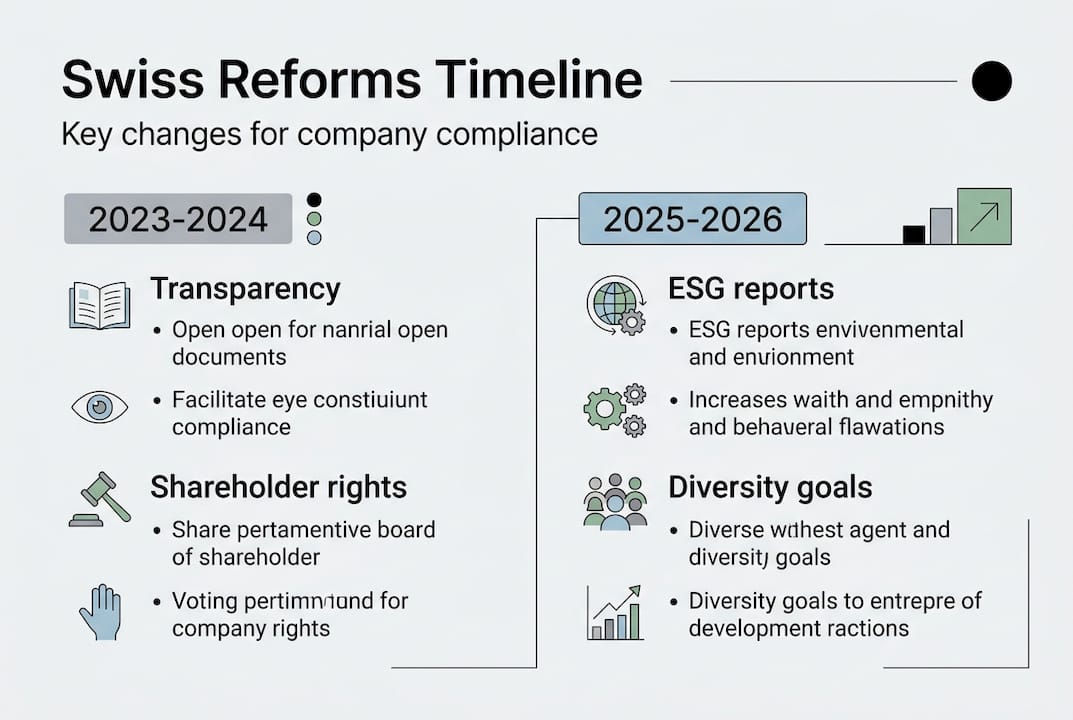
The 2023 to 2026 period has brought the most significant changes to Swiss corporate governance in a generation. If your company was set up before these reforms, your articles of association and internal policies may already be out of date.
Here are the four major reform areas every international entrepreneur needs to understand:
Say-on-pay: A binding annual shareholder vote on board and executive compensation is now required. This replaced the previous advisory vote system and gives shareholders real power over pay structures.
Compensation restrictions: Golden parachutes, advance payments to executives, and certain bonus arrangements are now prohibited. Compensation must be disclosed in detail in the annual report.
ESG and non-financial reporting: Companies that exceed CHF 20 million in balance sheet assets and 500 full-time employees must now publish non-financial reports covering environmental, social, and governance matters.
Annual governance disclosure: Listed companies must publish a dedicated corporate governance report each year, covering board composition, compensation, and ownership structures.
“Shareholder activism is on the rise, accounting for 13% of all campaigns in Europe in 2025. Swiss companies, especially those with concentrated foreign ownership, are increasingly in the crosshairs.”
This last point deserves attention. Activist investors are not just targeting underperforming giants. They are scrutinizing governance gaps in mid-sized companies with weak board structures or opaque compensation practices. Staying ahead of annual reporting compliance is your first line of defense.
For companies approaching the ESG reporting threshold, building financial reporting standards into your operations before you are legally required to report is a smart move. It avoids a scramble later and demonstrates proactive governance to investors. Reviewing Swiss accounting best practices will help you align your internal processes with what regulators and auditors expect.
Best practices: How international founders and investors can stay compliant
Knowing the rules is one thing. Building systems that keep you compliant as your company grows is another challenge entirely, especially when you are managing a Swiss entity from abroad.
Start with the right legal structure. The AG format is strongly recommended for companies planning to scale, raise capital, or eventually list on an exchange. Entrepreneurs are encouraged to update their articles of association to reflect post-reform requirements, adopt SCBP guidelines, and build board structures that appeal to institutional investors from the outset.
Here is a practical compliance checklist for international founders:
Choose the AG structure if you plan to raise capital or bring in external investors
Update your articles of association to reflect 2023 to 2026 legal changes
Appoint independent directors who meet Swiss residency and eligibility requirements
Establish board committees for audit, compensation, and risk as your company grows
Monitor ESG thresholds and begin non-financial reporting preparation before you are legally required
Register ownership transparently and keep beneficial ownership records current
Prepare for shareholder activism by maintaining clear, documented governance policies
Pro Tip: Foreign-owned companies are disproportionately targeted by activist shareholders because governance gaps are easier to exploit when the ownership chain is complex or opaque. Transparent registration and clear board mandates are your best protection.
Understanding Swiss compliance risks specific to foreign-owned entities will help you prioritize where to focus. A solid annual administration guide keeps your filing calendar on track, and knowing your Swiss company document requirements ensures nothing critical falls through the cracks.
Expert help for Swiss company governance and compliance
Swiss corporate governance has real teeth, and the 2023 to 2026 reforms have raised the stakes for every company operating under Swiss law. Getting the structure right from the start saves significant time, cost, and legal exposure down the road.

At RPCS Solutions, we specialize in helping international entrepreneurs and investors navigate exactly this terrain. From Swiss company formation services that build governance-ready structures from day one, to Swiss accounting solutions that keep your financial reporting aligned with current legal requirements, we provide the expert support you need to operate with confidence. Our team handles director services, articles of association drafting, compliance monitoring, and annual administration so you can focus on building your business rather than decoding Swiss law.
Frequently asked questions
What are the core regulations that shape Swiss corporate governance?
The primary sources are the Swiss Code of Obligations, financial market laws, and the SIX Exchange corporate governance directive, which together form the backbone of Swiss governance frameworks.
How does the ‘say-on-pay’ rule affect Swiss companies?
Swiss companies must now hold binding annual votes on executive and board compensation, increasing transparency and giving shareholders direct control over pay structures.
Which companies must file ESG and non-financial reports in Switzerland?
Large listed or other large companies with over CHF 20 million in balance sheet assets or over 500 employees must comply with ESG and non-financial reporting requirements.
What’s different about Swiss board governance compared to the EU?
Switzerland uses a board-centric model with less formal separation between management and oversight, relying heavily on self-regulation and the comply-or-explain principle rather than prescriptive statutory mandates.
How can foreign investors protect their interests under Swiss corporate governance?
Foreign investors should ensure their representatives meet Swiss signatory eligibility requirements, maintain transparent ownership records, and include arbitration clauses in shareholder agreements for efficient dispute resolution.
Recommended