
Swiss Company Documents: Legal and Banking Essentials
- Jan 27
- 11 min read

Launching a Swiss company can feel complex when every document matters for legal status and investor confidence. For international founders in fintech or e-commerce, clarity on compliance is essential. Swiss Law on Accounting and Financial Reporting requires annual financial statements and strict documentation, shaping how GmbH and AG companies maintain transparency. Here, you will discover the key paperwork and procedures that secure your company’s standing and support smooth growth.
Table of Contents
Key Takeaways
Point | Details |
Understanding Swiss Company Documents | Important documents like Articles of Association and Commercial Register Entry are essential for legal compliance and credibility with authorities. |
Choosing the Right Legal Structure | Selecting between GmbH and AG impacts personal liability, tax responsibilities, and governance complexity. |
Importance of Notarization and Compliance | Notarization authenticates foundational documents; ongoing compliance requirements must be met to avoid penalties. |
Organized Document Management | Maintain systematic records for easy access during audits and ensure all communication with banks and regulators is timely to avoid issues. |
Swiss company documents and what they mean
When you establish a company in Switzerland, you’ll encounter a specific set of documents that form the backbone of your legal and financial obligations. Understanding what these documents are and why they matter is critical for maintaining compliance and credibility with Swiss authorities and banking institutions.
Swiss company documents such as financial statements, balance sheets, and management reports are governed by the Swiss Law on Accounting and Financial Reporting. Every legal entity, whether a GmbH or AG, must produce these documents annually to demonstrate financial transparency. These aren’t optional extras. They’re mandatory records that show regulators, creditors, and potential investors exactly where your company stands financially.
Your Articles of Association form the constitutional document of your company. This document outlines governance rules, shareholder rights, and operational procedures. When you’re establishing a Swiss AG or GmbH, this document gets registered with the Swiss Companies House and becomes a matter of public record. Foreign entrepreneurs often overlook how detailed these need to be, but they’re worth getting right from the start.
The Commercial Register Entry is your company’s official registration with Swiss authorities. It includes your company name, registered address, business purpose, share capital, and director information. This public entry provides legal proof that your company exists and operates legitimately. When opening a Swiss bank account or entering contracts with other businesses, you’ll reference this registration constantly.
Corporate Board Meeting Minutes document decisions made by your company’s leadership. Whether you’re approving financial statements, changing directors, or making major operational decisions, these minutes create a legal record. Banks reviewing your account activity or tax authorities examining your operations will request these documents. They protect both you and your company by establishing clear decision-making trails.
Your Tax Registration Certificate proves your company is registered with Swiss tax authorities. This differs from your commercial registration and covers both federal and cantonal tax obligations. Foreign entrepreneurs establishing operations here need this certificate to comply with local tax requirements and to demonstrate legitimate business status when banking relationships are being evaluated.
Pro tip: Maintain organized filing systems for all documentation, whether physical or digital, and keep copies of your registered address documentation separate from operational records, since banks and tax authorities request these frequently.
Here’s a quick reference for what core Swiss company documents do and why they matter:
Document Name | Main Purpose | Who Requires It | Business Impact |
Articles of Association | Define governance and operations | Swiss authorities, banks | Establishes company rules and structure |
Commercial Register Entry | Prove legal company registration | Banks, regulators, partners | Enables contracts and account openings |
Board Meeting Minutes | Record management decisions | Tax authorities, banks | Creates a legal trail for company actions |
Tax Registration Certificate | Demonstrate tax compliance | Tax authorities, banks | Required for proper tax registration |
Financial Statements | Show financial performance annually | Regulators, investors | Ensures transparency and compliance |
Types of Swiss legal entities and key distinctions
Choosing the right legal structure for your Swiss company is one of the most important decisions you’ll make. The entity type you select determines your personal liability, tax obligations, administrative burden, and access to financing. Switzerland offers several options, each designed for different business scenarios and risk profiles.
Swiss legal entities include sole proprietorships, partnerships, limited liability companies, and corporations. The most common structures for foreign entrepreneurs are the GmbH (limited liability company) and the AG (corporation). Each offers distinct advantages depending on your business goals, capital structure, and long-term vision.
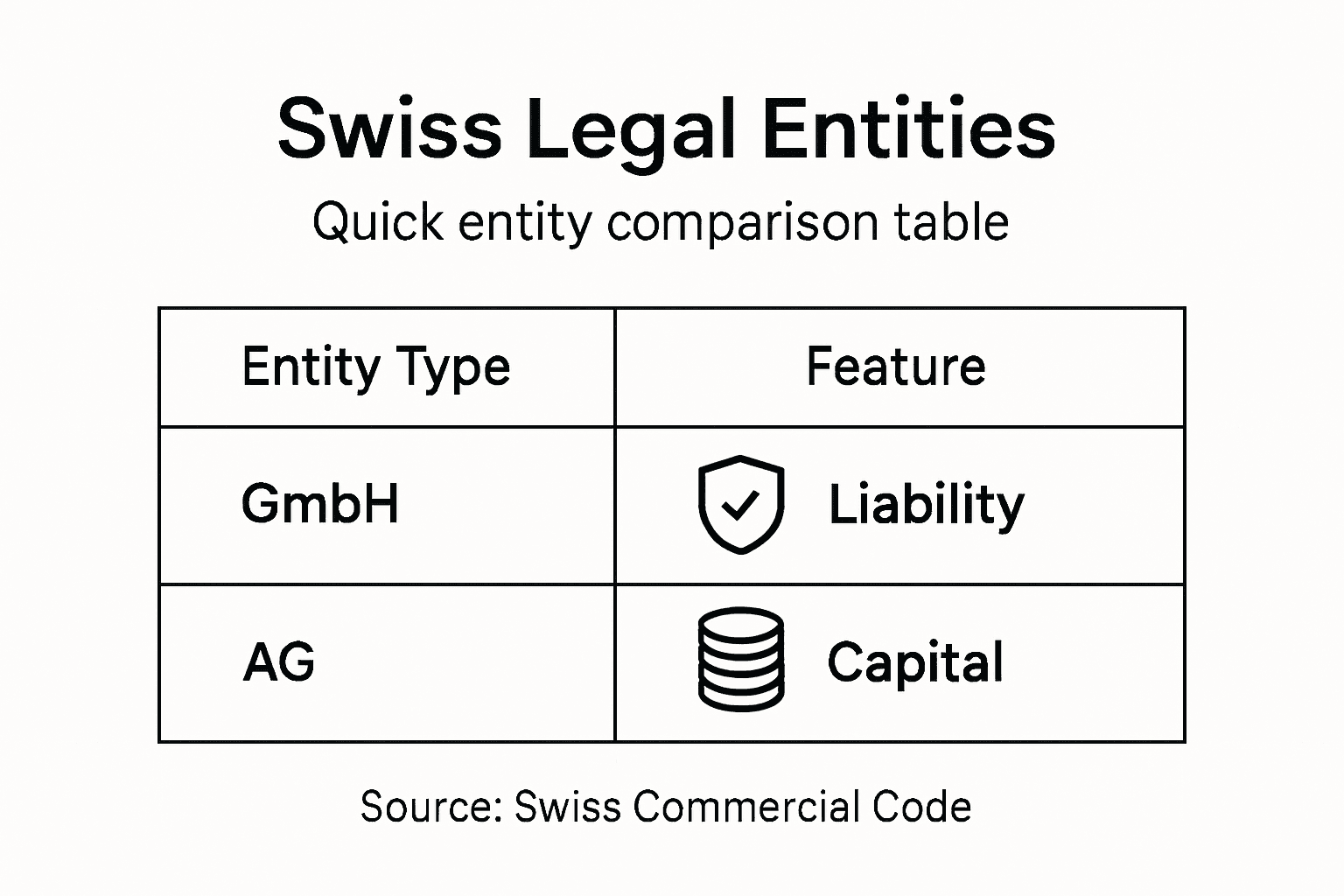
A GmbH (Gesellschaft mit beschränkter Haftung) limits your personal liability to your investment. You can establish one with as little as 20,000 Swiss francs in capital, making it accessible for startups and small operations. The GmbH works well for e-commerce and fintech ventures because it provides credibility while keeping administrative overhead manageable. Banks view GmbH structures favorably for account opening purposes.
An AG (Aktiengesellschaft) is a corporation requiring a minimum of 100,000 Swiss francs in capital. This structure suits larger operations, ventures seeking external investment, or companies planning significant growth. The AG offers more flexibility in share structures and is better positioned for equity financing rounds. Many fintech companies scale into AG structures as they mature.
The critical distinction lies in liability protection. Both GmbH and AG shield your personal assets from business debts and claims. By contrast, sole proprietorships and partnerships expose your personal wealth to unlimited liability. This difference alone makes corporate structures far more attractive for entrepreneurs managing financial risk.
Governance requirements also differ. GmbHs operate with simpler management structures, while AGs require more formal governance including a Board of Directors and shareholder assemblies. If you’re hiring a company director in Switzerland or establishing a resident director position, the AG structure typically demands more formal oversight.
Pro tip: Evaluate your capital position and growth timeline before deciding between GmbH and AG, since the capital requirement difference and governance complexity can significantly impact your early-stage operations and future financing options.
Here’s how Swiss company types compare on capital, liability, and governance:
Legal Entity | Minimum Capital Required | Liability Protection | Governance Complexity |
Sole Proprietorship | None | No separation from owner | Simple management |
Partnership | None | Generally unlimited | Moderate complexity |
GmbH (LLC) | CHF 20,000 | Personal liability limited | Fewer formalities |
AG (Corporation) | CHF 100,000 | Personal liability shielded | Formal board, assemblies |
Essential formation and registration paperwork
The paperwork required to launch your Swiss company is extensive but straightforward once you understand the sequence. Getting this right from day one prevents costly delays and ensures your company operates with full legal standing from the moment you open your doors.
Your Articles of Association form the foundation of everything else. This document defines your company’s purpose, governance structure, share capital, and shareholder rights. You’ll draft this with your legal advisor, and it must comply with Swiss law. Once completed, the articles require notarization before submission to authorities. This isn’t a simple formality; notaries verify the document’s authenticity and the parties’ legal capacity.

Capital deposit documentation proves you have sufficient funds to establish your company. For a GmbH, you need minimum capital of 20,000 Swiss francs, while an AG requires 100,000 Swiss francs. You’ll deposit this in a blocked bank account and receive a certificate confirming the deposit. Banks won’t release these funds until the company is officially registered, protecting creditors and ensuring legitimate capitalization.
The Commercial Register submission requires articles of association, founding documents, and proof of capital. Each canton maintains its own commercial register office, and you must submit documents to the office in your company’s canton. Business names undergo uniqueness checks, and the office verifies compliance with all structural requirements specific to your chosen entity type.
Shareholder declarations confirm the individuals behind your company. These documents identify all shareholders, their share percentages, and voting rights. Some cantons require additional proof documents depending on shareholder residency or business activities. If you’re appointing a nominee director or Swiss resident director, their declarations must accompany the registration package.
Once everything is notarized and bundled, submit to the Commercial Register office in your canton. Processing typically takes 5 to 10 business days. After approval, you receive your official registration certificate, which you’ll need for opening a Swiss bank account and establishing business credibility.
Pro tip: Prepare all notarization appointments at once rather than spreading them across weeks, since each step depends on the previous one, and delays compound throughout the formation timeline.
Notarization, approval, and public registry process
Notarization is where your company becomes legally real. This isn’t a rubber stamp procedure. A Swiss notary reviews every document, verifies signatures, and confirms that all parties have legal capacity to establish the company. Only after this authentication step can your company move forward with official registration.
Swiss company formation requires public notarization of foundation deeds and articles of association. The notary doesn’t just witness signatures; they draft documents to ensure compliance with Swiss commercial law, provide legal guidance, and then file the application directly with the commercial register. This integrated approach prevents errors that could delay your registration by weeks or months.
Once notarized, your documents move to the cantonal commercial register office. This office conducts a thorough review verifying that everything meets legal requirements. They check business name uniqueness, confirm capital deposits, validate shareholder information, and ensure your articles comply with Swiss corporate law. This verification process typically takes 5 to 10 business days.
After approval, the company receives a registration number and public announcement in the Swiss Official Gazette of Commerce. This publication is critical. It officially notifies the public that your company exists and can conduct business. From this moment, your company has full legal standing to sign contracts, open bank accounts, and operate commercially.
The public registry entry includes your company name, registration number, registered address, business purpose, share capital amount, and director information. This information remains accessible to anyone searching the commercial register. Banks use it to verify your company’s legitimacy when opening accounts. Business partners reference it during due diligence.
Any future changes to your articles require the same notarization and registration process. If you change directors, modify share structures, or update your business address, these amendments must go through notarization and public registry updates. This creates an auditable trail of corporate changes.
Pro tip: Request written confirmation from the commercial register office that your registration is complete before attempting to open a Swiss bank account, since banks require official registration documentation rather than just notarized copies.
Bank account setup and proof of capital requirements
Opening a Swiss bank account for your new company is non-negotiable. Without it, you cannot legally deposit your share capital or conduct business. Swiss banks have strict requirements, but understanding them upfront prevents frustrating delays and rejections.
Capital deposit comes first. Your company must hold its minimum required capital in a blocked bank account before registration. For a GmbH, that’s 20,000 Swiss francs; for an AG, it’s 100,000 Swiss francs. The bank freezes these funds until your company receives its official commercial register entry. Only then can the company access the capital. This protection ensures creditors that the company is genuinely capitalized.
Banks require proof of identity, proof of address, and origin of funds for both individual and corporate accounts. For companies specifically, you’ll submit your articles of association, commercial register extracts, and shareholder identification documents. Foreign entrepreneurs often encounter additional requests depending on their nationality or business sector. Fintech companies, for instance, face heightened due diligence because of regulatory concerns.
Your commercial register extract proves your company legally exists. Banks won’t proceed without this official document. Even if your registration is pending, banks need written confirmation that your application is under review. Some banks request certified copies rather than originals, so clarify requirements before scheduling your appointment.
Director identification matters. If you’ve hired a Swiss resident director or nominee director, banks will verify their credentials and background. They’ll request identification documents, proof of Swiss residency, and sometimes banking references. This verification typically takes 2 to 5 business days.
Origin of funds documentation shows where your capital comes from. Banks want evidence that funds aren’t connected to money laundering, sanctions violations, or criminal activity. Provide bank statements showing the transfer, business documents explaining the source, or investment agreements if capital comes from investors.
Once your account opens and capital deposits successfully, you’ll receive confirmation documentation. Present this to your canton’s commercial register office to complete company registration. Without it, your registration cannot finalize.
Pro tip: Contact your intended bank before finalizing your commercial registration application, since some Swiss banks have specific requirements that might affect your documentation preparation timeline.
Ongoing compliance and mistakes to avoid
Registration day isn’t your finish line. Swiss companies face continuous compliance obligations that demand attention throughout their existence. Understanding what’s required prevents costly penalties and protects your company’s operational status.
Companies operating in Switzerland must maintain compliance with financial reporting, tax obligations at federal and cantonal levels, labor laws, and environmental regulations. These requirements overlap and interact in complex ways. A mistake in one area cascades into problems elsewhere. For example, incorrect accounting practices lead to tax filing errors, which trigger audits and penalties.
Annual accounting obligations start immediately. Every company must maintain detailed financial records and prepare annual financial statements. Even if you’re profitable, you must file these documents. The Swiss Code of Obligations specifies exact formats and deadlines. Missing the deadline results in fines, and repeated violations can lead to operational restrictions.
Tax compliance runs on a separate schedule. Federal taxes due annually, but cantons often have different deadlines and requirements. Some cantons demand quarterly filings; others operate on annual cycles. Foreign entrepreneurs often miss canton-specific requirements because they focus only on federal obligations. This mistake can trigger back taxes, interest charges, and penalties.
Director changes require immediate notification. If you replace your company director or hire a new Swiss resident director, you must update the commercial register within 14 days. Delays create legal liability and complicate future banking relationships. Banks flag companies with outdated director information as potential compliance risks.
Common mistakes include failing to maintain separate accounting records, mixing personal and business finances, or delaying required notifications to authorities. Another frequent error is underestimating labor law requirements when you hire employees. Switzerland has strict regulations about working hours, overtime, social insurance contributions, and employment contracts. Violations result in significant fines and back pay obligations.
Document retention matters. Keep financial records for at least 10 years. When regulators audit your company, they expect organized, accessible documentation. Poor record management appears suspicious even if nothing improper occurred.
Pro tip: Engage an accounting services firm specializing in Swiss companies during your first year of operation, since their guidance on canton-specific requirements and filing schedules prevents costly compliance mistakes before they happen.
Simplify Your Swiss Company Formation and Compliance
Navigating Swiss company documents such as the Articles of Association, Commercial Register submissions, and board meeting minutes can feel overwhelming, especially for international entrepreneurs facing strict legal and banking requirements. Common challenges include ensuring proper notarization, meeting capital deposit rules, and satisfying ongoing compliance demands like tax registrations and financial reporting. Missing even a single detail might delay your registration or complicate bank account openings.

Take control of these essential steps with expert guidance from RPCS, your trusted partner for seamless Swiss company formation and management. We specialize in supporting GmbH and AG setups, ensuring your legal documents are flawlessly prepared and submitted. With our rapid notarization and registration services, you avoid costly delays and meet all Swiss authority and bank demands confidently. Visit RPCS today and secure comprehensive assistance that demystifies Swiss corporate procedures and safeguards your business success from incorporation through ongoing compliance.
Frequently Asked Questions
What are the essential Swiss company documents?
The essential documents include Articles of Association, Commercial Register Entry, Board Meeting Minutes, Tax Registration Certificate, and Financial Statements. Each document serves a specific purpose in demonstrating compliance and transparency to Swiss authorities and banking institutions.
How do I register my company in Switzerland?
To register your company in Switzerland, you must draft your Articles of Association, prove your capital deposit, and submit your registration application to the Commercial Register office in your canton. This includes notarization of documents and verification by local authorities.
What is the significance of the Tax Registration Certificate?
The Tax Registration Certificate is crucial as it proves your company’s registration with tax authorities. It covers federal and cantonal tax obligations, essential for compliance with local tax requirements and establishing banking relationships.
What mistakes should I avoid when managing compliance for my Swiss company?
Common mistakes include failing to keep separate accounting records, missing tax filing deadlines, not updating director information with the commercial register, and underestimating labor law requirements. These errors can lead to fines and operational restrictions.
Recommended
Comments