
Swiss Company Annual Administration Guide for Compliance
- Feb 14
- 8 min read
Updated: Feb 23

Setting up a GmbH in Switzerland offers unmatched advantages for tech investors, but the road to compliance begins with one critical step. Swiss law demands that companies retain and systematically organize their annual reports and financial statements for ten years, proving that meticulous record-keeping is non-negotiable. For foreign founders, mastering these compliance standards not only accelerates company formation but secures your reputation with Swiss authorities and international partners.
Table of Contents
Quick Summary
Key Point | Explanation |
1. Maintain Accurate Documentation | Compile detailed financial statements, performance reports, and audit documentation for regulatory compliance and transparency. |
2. Timely Regulatory Filing | Submit accurate tax reports and necessary disclosures by local deadlines to avoid penalties and maintain compliance. |
3. Organize Corporate Resolutions | Document meeting minutes, resolutions, and signatures to uphold corporate governance and accountability. |
4. Verify Submission Completeness | Reconcile financial records and verify all relevant documents are accurate before submission to tax authorities. |
5. Conduct a Comprehensive Compliance Review | Ensure all records are complete and comply with legal requirements for long-term archiving and protection. |
Step 1: Prepare mandatory annual documentation
Preparing mandatory annual documentation represents a critical compliance requirement for Swiss companies. Your goal is to compile comprehensive records that demonstrate your business’s financial health and operational performance for the entire fiscal year.
To successfully prepare your annual documentation, you’ll need to gather several key components. Swiss law requires meticulous record-keeping for all business transactions and financial statements. Here are the essential documents you must compile:
Financial Statements: Detailed balance sheets and income reports
Business Performance Report: Comprehensive overview of yearly operations
Shareholder Communications: Letters explaining company performance and strategic outlook
Audit Documentation: Independent verification of financial records
The documentation process involves systematic collection and verification of financial data. Start by working closely with your accounting team to ensure every transaction is accurately recorded and categorized. Pay special attention to maintaining original vouchers, accounting records, and ensuring all documents are properly signed and dated.
Retention of these documents is legally mandated for a minimum of ten years, so organize them systematically from the beginning.
Companies must prepare these documents in either written or electronic format, ensuring they remain readable and authentic throughout the mandatory retention period. Electronic storage is acceptable, but you must guarantee the documents can be reproduced in their original form if requested.

Below is a comparison of written vs electronic document management for Swiss companies:
Storage Type | Advantages | Risks | Best Practice |
Written | Original documents, trusted | Physical damage, hard to share | Keep secure, use fireproof safe |
Electronic | Easy access, searchable | Tech failures, authenticity | Use encrypted cloud with backups |
Pro tip: Invest in a robust digital document management system that automatically timestamps and secures your annual documentation, reducing potential compliance risks.
Step 2: Complete regulatory filing and reporting
Completing regulatory filing and reporting represents a critical phase in maintaining your Swiss company’s legal compliance and financial transparency. Your objective is to systematically submit all required documentation to relevant Swiss governmental authorities.
Swiss federal regulations mandate comprehensive financial reporting across multiple domains for corporate entities. The filing process involves several crucial steps:
Tax Reports: Detailed annual tax declarations
Financial Statements: Comprehensive annual financial documentation
Sustainability Disclosures: Environmental and social impact reports
Compliance Declarations: Verification of statutory requirements
Your regulatory filing strategy should focus on precision and timeliness. Begin by gathering all necessary financial records, ensuring they align with the Swiss Code of Obligations and current reporting standards. This involves meticulously documenting income, expenses, assets, and liabilities with utmost accuracy.
Timely and accurate reporting is not just a legal requirement but a fundamental aspect of maintaining your company’s financial credibility.
Different cantons may have specific additional reporting requirements, so consult local regulatory bodies to confirm exact filing protocols. Electronic submission is increasingly preferred, but always maintain secure backup copies of all documentation.
Pro tip: Create a comprehensive filing checklist and set internal deadlines at least one month before official submission dates to avoid last-minute compliance challenges.
Step 3: Organize shareholder and board resolutions
Organizing shareholder and board resolutions is a critical component of maintaining your Swiss company’s legal and governance standards. Your primary objective is to document, preserve, and manage corporate decision-making processes with precision and transparency.
Corporate governance practices require meticulous resolution documentation to ensure legal compliance and institutional memory. The organization of these resolutions involves several key elements:
Meeting Minutes: Detailed records of discussions and decisions
Resolution Documentation: Formal written statements of corporate actions
Signature Verification: Authentic signing by authorized representatives
Secure Storage: Protected digital and physical document preservation
Begin by establishing a systematic approach to capturing and storing corporate decisions. Each resolution should clearly outline the context, participants, voting results, and specific actions approved during shareholder or board meetings. Pay close attention to the legal requirements for documenting these critical corporate governance moments.
Effective resolution organization is not just a bureaucratic exercise but a fundamental mechanism for maintaining corporate accountability and transparency.
Recent developments suggest increasing adoption of virtual and hybrid meeting formats, which require additional diligence in documentation and authentication processes. Ensure your resolution management system can accommodate both traditional and digital meeting environments.
Pro tip: Implement a centralized digital document management system that automatically timestamps and securely archives all shareholder and board resolutions, creating an auditable and tamper-evident record of corporate decision-making.
Step 4: Verify accounting and tax submissions
Verifying accounting and tax submissions is a critical process that ensures your Swiss company remains compliant with federal and cantonal tax regulations. Your primary goal is to meticulously review and validate all financial documentation before final submission to tax authorities.
Swiss tax authorities require comprehensive submission verification to prevent potential penalties and ensure accurate financial reporting. The verification process involves several key steps:
Financial Record Reconciliation: Cross-check all accounting entries
VAT Declaration Review: Validate value-added tax calculations
Income and Expense Verification: Confirm accuracy of financial statements
Supporting Document Authentication: Validate all supplementary documentation
Start by conducting a thorough internal audit of your financial records. This means systematically reviewing every transaction, ensuring that each entry is correctly categorized, properly documented, and aligns with Swiss accounting standards. Pay special attention to potential discrepancies that could trigger further investigation by tax authorities.
Meticulous verification is your first line of defense against potential tax compliance issues and unexpected financial audits.
Utilize digital tools and platforms that can help streamline the verification process. Many cantons, like Zurich, offer online systems that facilitate secure and accurate tax declaration submissions, providing additional layers of support for your verification efforts.
Pro tip: Develop a comprehensive verification checklist that you review at least twice before final submission, and consider engaging a professional tax consultant to provide an additional layer of review and expertise.
Step 5: Review compliance and finalize records
Reviewing compliance and finalizing records represents the critical concluding phase of your Swiss company’s annual administration process. Your objective is to comprehensively validate all documentation, ensuring full adherence to regulatory standards and preparing your records for long-term archival.
Swiss law mandates rigorous record retention standards that extend beyond simple document storage. The final review process encompasses several essential verification steps:
Document Completeness: Confirm all required records are present
Authenticity Verification: Validate signatures and original documentation
Compliance Cross-Check: Ensure alignment with Swiss Code of Obligations
Archival Preparation: Organize records for ten-year mandatory retention
Begin by conducting a systematic, line-by-line review of your entire documentation set. This means meticulously examining financial statements, corporate resolutions, tax submissions, and audit reports to guarantee absolute accuracy and regulatory compliance. Pay special attention to potential gaps or inconsistencies that could compromise your company’s legal standing.
Thorough final review is your ultimate safeguard against potential regulatory challenges and ensures your company’s ongoing operational integrity.
Develop a comprehensive checklist that covers all aspects of record compliance, from formatting requirements to substantive content validation. Digital archiving solutions can help streamline this process, providing secure, easily retrievable documentation that meets Swiss legal standards.
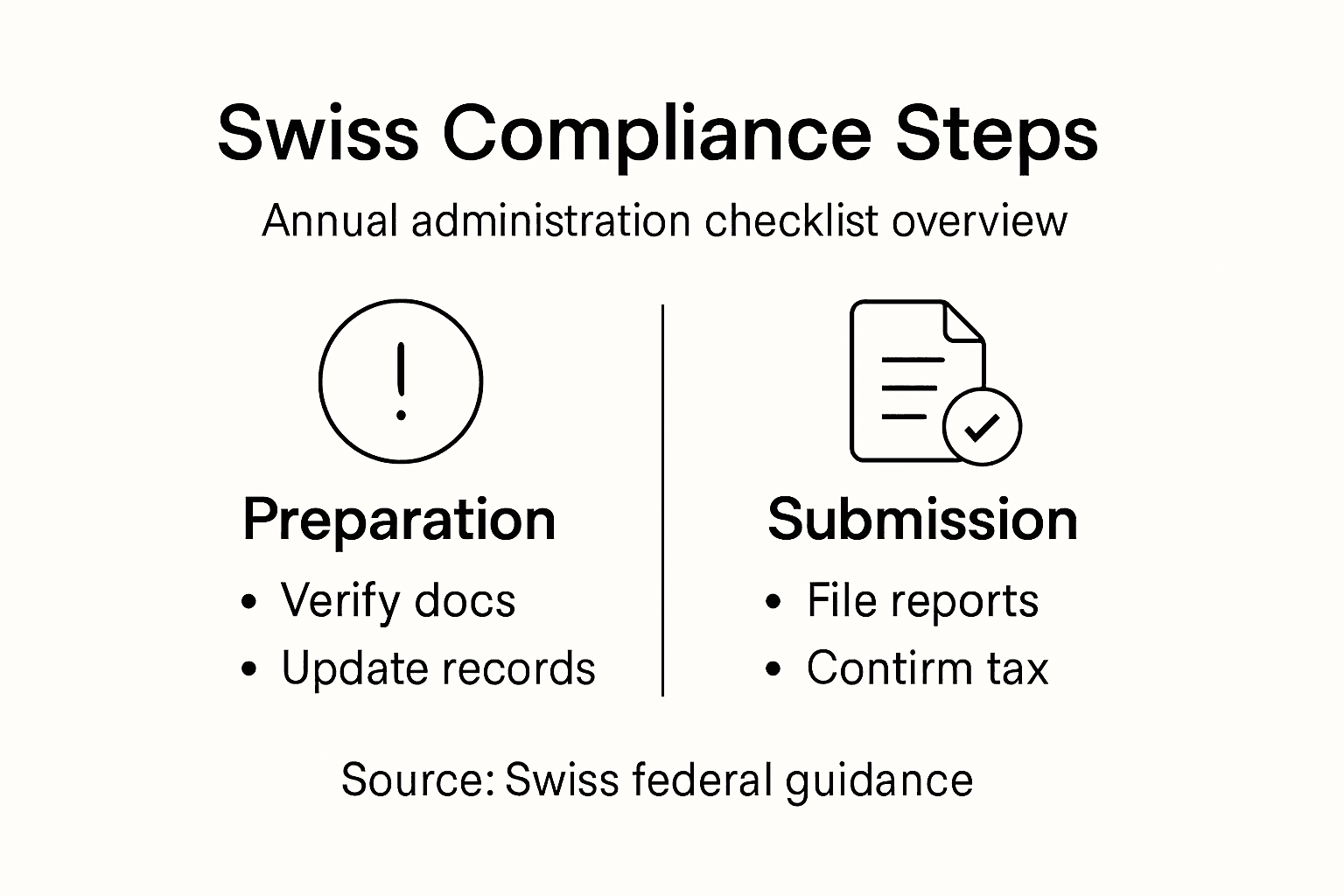
Pro tip: Create a digital and physical backup of all critical documents, using encrypted cloud storage and secure physical archives to ensure multiple layers of record protection and accessibility.
Here’s a summary of Swiss company annual compliance phases and their priorities:
Phase | Core Focus | Common Pitfalls |
Documentation Preparation | Accurate financial and ops records | Missing or unsigned documents |
Regulatory Filing | Timely submissions, full alignment | Late or incomplete filings |
Resolution Organization | Transparent corporate decisions | Incomplete meeting records |
Tax Verification | Internal audit and reconciliation | Entry discrepancies |
Compliance Review | Final check and secure archiving | Gaps in legal requirements |
Master Swiss Company Compliance with Expert Support
Preparing mandatory annual documentation, completing regulatory filings, and organizing shareholder resolutions require precision and a deep understanding of Swiss legal standards. Many international entrepreneurs face challenges such as document authenticity, timely submissions, and complex tax verification. These hurdles can put your company at risk of penalties or regulatory delays.
At rpcs.ch, we specialize in guiding you through every phase of Swiss company administration. Our comprehensive services cover legal documentation, notarization, registration, and ongoing compliance support to keep your records accurate and secure. Whether you need help with tax submissions, board resolutions, or finalizing archival records, our professional team ensures your company meets all Swiss regulatory requirements seamlessly. Take advantage of our expertise in accounting, legal guidance, and corporate management designed especially for foreign clients navigating Swiss laws.

Don’t let complex compliance procedures slow you down. Start streamlining your Swiss company administration today with rpcs.ch. Visit our website to discover how our tailored services can simplify your corporate governance and protect your business future. Act now to ensure your Swiss company stays compliant and competitive.
Frequently Asked Questions
What mandatory documentation do I need to prepare for my Swiss company?
To comply with regulations, you need to prepare Financial Statements, a Business Performance Report, Shareholder Communications, and Audit Documentation. Start gathering these documents immediately to ensure all records reflect your company’s financial health over the past fiscal year.
How can I ensure timely regulatory filing and reporting for my company?
To ensure timely filing, create a checklist of required documents like Tax Reports and Financial Statements. Set internal deadlines at least one month before official submission dates to avoid any last-minute challenges.
What should I include in meeting minutes and resolution documentation for my company?
Include detailed records of discussions, voting outcomes, and specific actions taken during shareholder or board meetings. Organize these documents systematically to maintain a clear record of corporate decision-making.
How do I verify my accounting and tax submissions before submission?
Verify your accounting and tax submissions by conducting a thorough internal audit, cross-checking every financial record and ensuring accuracy in all entries. Use a verification checklist and review the documents at least twice before you file them to prevent compliance issues.
What steps should I take to finalize records for compliance?
Finalizing records involves conducting a comprehensive review of all documentation for completeness and authenticity. Organize records systematically for ten-year retention, ensuring they meet all compliance standards set by Swiss law.
Recommended
Comments