
Swiss business address: legal and tax advantages for founders
- Apr 1
- 8 min read

Many international entrepreneurs assume a virtual mailbox or mail forwarding service is enough to register a Swiss company. It is not. Swiss companies must have a physical registered office, and getting this wrong from day one can delay your incorporation, trigger tax complications, or expose your company to regulatory scrutiny. This guide walks you through exactly what the law requires, how to choose the right canton for your goals, the step-by-step registration process, and how to build the kind of substance that keeps your company protected long term.
Table of Contents
Key Takeaways
Point | Details |
Physical address is required | Swiss companies must have a verifiable physical business address—not a virtual or mail forwarding service. |
Canton choice impacts tax | Selecting the right canton affects corporate tax rates, operational credibility, and company reputation. |
Compliance depends on substance | Regulators demand genuine local activity; nominal setups risk scrutiny and penalties. |
Registration steps are clear | Submitting proper documents and proof of address streamlines the 2–4 week registration process. |
Professional support helps | Expert service providers can optimize address selection and ensure legal compliance for foreign founders. |
Understanding the legal role of a Swiss business address
A Swiss business address is not just a label on your letterhead. It is the legal domicile of your company, known in Swiss law as the Sitz. Every official document flows through it: tax notices, court summons, regulatory correspondence, and company records. If that address is not verifiable and physical, your company is not compliant.

Every Swiss company must maintain a physical registered office in Switzerland. This is a hard legal requirement, not a formality. The cantonal Commercial Register will reject any attempt to use a P.O. box or forwarding service. In fact, a registered office must be a verifiable physical address, not a P.O. box or virtual mailbox.
For foreign founders, this creates a practical challenge. You may be operating from Berlin, Dubai, or Singapore, but your Swiss company still needs a real, local address. Here is what that means in practice:
The address must be in Switzerland, not just a Swiss-looking postal code
Someone must be reachable at that address during business hours
The address must match what is filed with the cantonal Commercial Register
Any change of address requires a formal amendment and re-registration
“The registered office is the legal anchor of your Swiss company. It determines jurisdiction, tax authority, and the flow of all official communications.”
Understanding the legal and tax impact of your address choice is essential before you sign anything. Many founders learn this the hard way after choosing a canton based on tax rates alone, only to discover their address arrangement does not meet the substance requirements for that jurisdiction. A proper registered office setup is the foundation everything else is built on. Read our full Swiss business address guide for a deeper breakdown of compliance requirements.
Selecting the right canton: optimizing tax and prestige
Once you understand what makes an address legally valid, the next decision is which canton to register in. This is one of the most strategically important choices you will make, because Switzerland does not have a single national corporate tax rate. Each canton sets its own rate on top of the federal baseline.
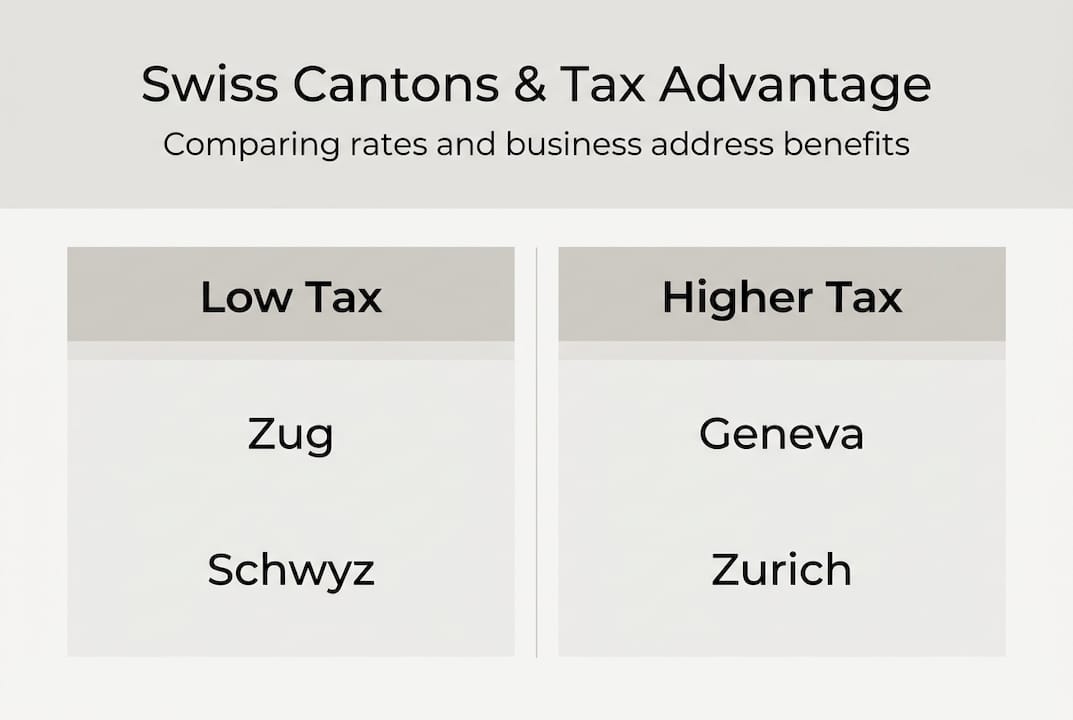
Different cantons have varying effective corporate tax rates, and the gap between the lowest and highest is significant. Switzerland’s corporate tax average is 14.4%, but individual cantons can be considerably lower.
Canton | Effective tax rate | Reputation | Best for |
Zug | ~11.8% | Crypto, holdings | Holding companies, fintech |
Nidwalden | ~11.9% | Low-profile, stable | Asset management, SMEs |
Lucerne | ~12.3% | Balanced | Trading, services |
Zurich | ~19.7% | Global prestige | Finance, professional services |
Geneva | ~13.99% | International hub | NGOs, multinationals |
Zug is the most well-known low-tax canton and hosts many holdings and crypto firms. But low tax alone is not the whole story. Zurich commands higher rates yet offers unmatched access to talent, banking relationships, and international credibility. Geneva suits companies with a global or diplomatic profile.
Here is what smart founders weigh before choosing:
Tax rate: Lower is not always better if it attracts scrutiny without real substance
Banking access: Zurich and Geneva have the strongest private and corporate banking ecosystems
Talent pool: Urban cantons offer more local hiring options
Client perception: Some industries expect a Zurich or Geneva address
One critical point: tax-driven setups must align with genuine activity under BEPS (Base Erosion and Profit Shifting) rules. Registering in Zug purely for the rate, without any real local operations, is a red flag for Swiss and international tax authorities. Review the tax benefits by canton before committing, and consider whether an address service for expansion can help you establish presence in your chosen canton.
Mechanics: registering and proving your business address
With your canton chosen, the actual registration process begins. It is more structured than many founders expect, and missing a single document can set you back weeks.
Here is how the process works step by step:
Choose your address during the incorporation planning phase, before drafting company statutes
Secure proof of address through a rental agreement, fiduciary declaration, or domicile agreement with a local provider
Draft and notarize your company statutes, listing the registered address
Submit incorporation documents to the cantonal Commercial Register, including address proof
Await registration confirmation, which officially establishes your company’s legal domicile
Select your address during incorporation and submit proof to cantonal authorities as part of the standard filing. The registration typically takes 2 to 4 weeks, and proof required can include a rental agreement or fiduciary declaration.
Document | Purpose | Notes |
Rental agreement | Proves physical tenancy | Must be in company name |
Fiduciary declaration | Confirms c/o arrangement | Signed by local fiduciary |
Notarized statutes | Legal company foundation | Lists registered address |
ID documents | Director/shareholder verification | Apostille may be required |
Common issues that delay registration include incomplete paperwork, mismatched names between documents, and failure to notarize correctly. Foreign founders often underestimate how precise Swiss administrative requirements are.
Pro Tip: If you are managing your Swiss company remotely, a fiduciary c/o arrangement is a practical solution. Just make sure it reflects genuine substance, not just a mailing address, or you risk scrutiny later. Review the full address registration guide and ensure your Swiss company documents are complete before submission. Your company statutes and rules must also reflect the correct registered address from day one.
Substance vs. form: avoiding pitfalls and regulatory scrutiny
Registering your address is just the start. Maintaining real substance and avoiding pitfalls is what ensures lasting legitimacy, especially for foreign-owned companies.
Nominal c/o addresses are legal but risk scrutiny if there is no local activity. Home addresses can negatively impact your company’s image and increase liability exposure. Neither is a strong long-term strategy.
What does “substance” actually mean in Swiss regulatory terms? It goes beyond having a street address:
Local bank account with regular transactions
At least one director or authorized signatory reachable in Switzerland
Documented business activity: contracts, invoices, meetings held locally
Board meetings conducted in Switzerland, with minutes on file
Employees or service providers engaged locally
“Substance is not about where you sleep. It is about where decisions are made and where business is genuinely conducted.”
Business addresses enable remote management but require real substance to satisfy Swiss and international regulators. BEPS rules, adopted by Switzerland, mean that tax authorities can look through a registered address and assess whether the company has real economic activity in that location. Low-tax cantons like Zug are under particular scrutiny.
Pro Tip: Document everything. Keep records of local meetings, contracts signed in Switzerland, and any correspondence handled at your registered address. This paper trail is your best defense in a substance review.
Using a professional business address service can help, but only if it is paired with genuine operational activity. Understanding the registered office importance is what separates compliant companies from those that face costly corrections later.
Our perspective: why substance matters more than location
We have worked with hundreds of international founders, and the pattern is consistent. Most arrive focused on two things: which canton has the lowest tax rate and whether a prestigious Zurich address will impress clients. Both are reasonable questions. But they are the wrong starting point.
The founders who run into trouble are almost always those who treated the address as a checkbox. They found the cheapest c/o arrangement, registered in Zug for the rate, and then continued running everything from abroad. On paper, they had a Swiss company. In practice, they had a liability waiting to surface.
The founders who thrive are those who invest in real local presence early, even if it is modest. A local director, a genuine banking relationship, documented Swiss activity. These are not bureaucratic burdens. They are the foundation of a company that can withstand scrutiny, attract serious banking partners, and build lasting credibility.
Our honest advice: choose your canton based on where you can realistically build substance, not just where the rate is lowest. Tax savings mean nothing if a substance audit forces you to restructure. Explore Swiss company formation with substance in mind from the start.
Next steps: expert help with your Swiss business address
Setting up a Swiss business address correctly the first time saves you from costly corrections, regulatory delays, and banking complications down the line. If you are ready to move forward, RPCS offers end-to-end support for international founders navigating Swiss incorporation.

From selecting the right canton and securing a compliant registered office to handling notarization, Commercial Register filings, and banking introductions, our team manages the process so you do not have to guess. Explore our company formation services to see how we structure Swiss GmbH and AG setups for foreign clients. For address-specific solutions, our Swiss business address solutions cover compliant domicile arrangements across key cantons. And when you are ready to open accounts, our Swiss bank account setup service connects you with the right banking partners.
Frequently asked questions
Can I use a virtual mailbox or P.O. box for my Swiss company address?
No. Swiss law requires a verifiable physical registered office, and virtual mailboxes and P.O. boxes are explicitly not permitted by the cantonal Commercial Register.
How long does it take to register a business address in Switzerland?
The process typically takes 2 to 4 weeks from document submission to official Commercial Register approval, assuming all paperwork is complete and correctly notarized.
Do I need to operate locally if my company is registered in a low-tax canton?
Yes. Regulatory checks under BEPS require genuine local activity and substance, particularly in low-tax cantons like Zug, to avoid legal and tax reclassification risks.
What kind of proof is needed for a business address during incorporation?
You will need a rental agreement or fiduciary declaration, typically notarized, submitted alongside your company statutes to the cantonal Commercial Register.
Can using a home address for my company create liability or reputation issues?
Yes. Home addresses risk image and liability issues compared to dedicated business premises, and they may signal a lack of substance to banking partners and regulators.
Recommended
Comments