
Swiss Banking for Crypto: Legal and Business Impact
- Jan 23
- 19 min read

Finding effective banking solutions for cryptocurrency ventures can feel complex, especially when global regulations shift overnight. Switzerland stands out by integrating digital assets directly into its established financial laws, a model that fosters both innovation and regulatory certainty. For crypto entrepreneurs and investors eyeing Swiss expansion, understanding how compliance, custody, and licensing work together is crucial. This guide breaks down key Swiss banking concepts, helping you secure operations that balance opportunity with legal peace of mind.
Table of Contents
Key Takeaways
Point | Details |
Custody and Asset Security | Swiss banking offers compliant options for safeguarding digital assets, but businesses must balance security with transaction irreversibility. |
Regulatory Integration | Crypto businesses face the same compliance obligations as traditional banks, including AML and KYC regulations, which enhances legitimacy but demands diligence. |
Banking Infrastructure | Different types of banks serve crypto clients; choose the one that aligns with your business model for improved access to services. |
Compliance Rigor | Engaging a qualified legal advisor and specialized tax accountant is crucial to navigating Swiss regulations and avoiding costly mistakes. |
Swiss banking for crypto: key concepts
Swiss banking for cryptocurrency operates within a unique regulatory environment that distinguishes Switzerland from most other jurisdictions. Unlike countries that either ban crypto or create separate regulatory frameworks, Switzerland integrates digital assets into existing financial market laws. This approach means crypto businesses work alongside traditional banking regulations rather than operating in legal gray zones. Understanding these foundational concepts is essential before establishing your crypto banking presence in Switzerland.
The first critical concept is custody and asset security. Switzerland has emerged as a global leader in digital asset custody, offering institutional and professional investors compliant options for safeguarding cryptocurrencies, tokens, and NFTs. Swiss custody services provide multiple structures including B2C and B2B accounts, off-balance sheet custody arrangements, and deposit insurance protection. However, the irreversible nature of blockchain transactions creates a fundamental challenge: balancing security with transaction speed and cost. Private key custody requires exceptional diligence because once a transaction broadcasts to the network, no bank can reverse it. This reality shapes how Swiss banks structure their crypto operations compared to traditional asset management.
The second key concept involves regulatory integration and classification. Switzerland doesn’t treat crypto as a separate asset class requiring entirely new rules. Instead, regulators apply existing financial services laws to digital assets, meaning your Swiss crypto company must comply with Anti-Money Laundering (AML) regulations, Know Your Customer (KYC) requirements, and capital adequacy standards just like traditional financial institutions. This creates both an advantage and a requirement: you gain legitimacy through Switzerland’s reputation, but you cannot operate with less rigor than a conventional bank. The Swiss Financial Market Supervisory Authority (FINMA) oversees this landscape, and banks must obtain specific licenses depending on whether they offer custody, trading, lending, or payment services.
Third, understand the banking infrastructure available to crypto businesses. Swiss banks increasingly offer accounts specifically designed for cryptocurrency companies, though access depends on your business model and compliance posture. Traditional banks evaluate crypto companies based on factors like your customer verification procedures, transaction monitoring systems, and business legitimacy. This differs from some jurisdictions where crypto companies face blanket rejections. When establishing a Swiss business bank account, you’ll need comprehensive documentation demonstrating your regulatory compliance framework, risk management procedures, and AML protocols. The banking relationship becomes a partnership requiring transparency about your customer base and transaction patterns.
A fourth consideration is tax treatment and reporting. Switzerland applies standard corporate tax rules to crypto businesses, but gains tax status depends on how you classify your activities. If you hold digital assets as inventory for trading, gains are taxed as income. If you hold them as investments, capital gains treatment may apply in certain cantons. Each canton offers different tax rates and incentive structures, making location selection important. Additionally, Swiss banks provide comprehensive tax reporting services, preparing documentation that helps your international clients meet their home country’s crypto tax obligations.
Pro tip: Before opening any Swiss bank account for your crypto operations, engage a Swiss accountant who specializes in digital asset taxation to confirm your tax classification and identify which canton offers the most favorable treatment for your specific business model.
Types of Swiss banks for crypto clients
Swiss banking options for crypto clients fall into distinct categories, each serving different client profiles and business needs. Understanding which type suits your operation determines not only your banking experience but also your ability to access certain services and meet regulatory requirements. Switzerland hosts both crypto-first institutions built from the ground up for digital assets and traditional banks adapting their infrastructure to accommodate this emerging sector. Your choice depends on whether you need institutional-grade custody, retail trading access, or comprehensive banking services for a crypto company.
The first category consists of dedicated crypto banks, the most specialized banking institutions in Switzerland. Sygnum Bank and AMINA Bank represent the primary players in this space, both holding FINMA licenses and designed specifically for institutional and high-net-worth clients in the cryptocurrency sector. These banks operate with blockchain technology embedded into their core infrastructure rather than bolted on as an afterthought. They understand private key management, smart contracts, and tokenization in ways traditional bankers never will. Sygnum and AMINA focus on custody services, allowing you to hold digital assets with insurance protection comparable to traditional banking. Their teams speak your language when discussing wallet architecture, node operations, and network security. However, accessing these institutions typically requires significant assets under management and a sophisticated understanding of your own compliance obligations. These banks target professional investors and institutional operators, not retail traders looking to buy Bitcoin.

The second category includes traditional private banks adapting to crypto, institutions like Maerki Baumann that maintain deep roots in Swiss banking while expanding into digital assets. These banks offer a hybrid approach, combining traditional wealth management expertise with emerging crypto services. They appeal to high-net-worth individuals who want one relationship managing both conventional investments and digital assets. The advantage here is trust and regulatory pedigree that spans decades. These institutions provide crypto trading and related banking options alongside traditional advisory services, creating a one-stop banking relationship. Their compliance teams understand both Swiss regulatory requirements and international banking standards. The trade-off is they often move slower on innovation and may maintain more conservative custody approaches compared to crypto-native banks.
A third category encompasses larger retail and cantonal banks now offering crypto services through partnerships. PostFinance, for example, provides crypto trading access via partnerships with specialized providers like Swissquote. Cantonal banks across different regions have begun integrating cryptocurrency into their product offerings, reflecting broader industry adoption. These institutions serve retail clients and small to medium crypto businesses seeking basic trading and custody functionality without the complexity of institutional arrangements. Their main attraction is convenience and accessibility, combined with the comfort of banking with an established institution. The limitation is they typically don’t offer the same depth of institutional custody or the sophisticated infrastructure you’d find at dedicated crypto banks.
For crypto companies establishing operations in Switzerland, your banking choice intertwines with your company structure and licensing requirements. If you are operating a Swiss crypto company, you may need to demonstrate banking relationships as proof of operational capacity. FINMA-licensed institutions have distinct advantages when you’re seeking credibility with regulators and international partners. However, not all crypto businesses need institutional-grade banking. A small trading operation might function perfectly well with a cantonal bank account, whereas a custody provider requires the infrastructure only dedicated crypto banks provide.
Here’s a comparison of Swiss bank types serving crypto clients:
Bank Type | Ideal For | Main Strength | Typical Limitation |
Dedicated Crypto Banks | Institutions, HNWIs | Deep crypto expertise | High entry requirements |
Traditional Private Banks | HNWIs seeking hybrid services | Reputation, stability | Slow innovation, conservative |
Retail / Cantonal Banks | Retail, small crypto businesses | Accessibility, ease | Limited advanced services |
Pro tip: Request meetings with at least two different bank types before committing to a relationship, as each maintains different approval timelines, compliance documentation requirements, and service capabilities that directly impact your operation’s launch schedule.
Legal framework for crypto banking entities
Swiss law creates a specific regulatory environment for crypto banking that differs fundamentally from most other countries. Rather than banning cryptocurrency or treating it as an unregulated activity, Switzerland has integrated digital assets into its existing financial market laws. The Financial Market Supervisory Authority (FINMA) oversees this framework, establishing clear expectations for how crypto entities must operate. This approach gives crypto businesses legal certainty and the ability to partner with traditional banks, but it also means you cannot cut corners on compliance. The framework demands the same rigor applied to traditional banking institutions.
At the core of this framework lies FINMA’s regulatory guidance on token classification and licensing requirements. Crypto tokens fall into three categories based on their function: payment tokens used primarily for transactions, asset tokens representing ownership stakes or claims, and utility tokens granting access to services or products. Your token classification determines which regulations apply to your business. A payment token exchanged for fiat currency triggers different requirements than a utility token distributed to users. Payment tokens require compliance with anti-money laundering and know your customer protocols as though you operate a traditional payment service. FINMA provides this clarity through published guidelines, meaning you know the regulatory path before committing resources. This contrasts sharply with jurisdictions where crypto businesses operate in legal gray zones and face sudden enforcement actions.
The licensing requirements for crypto banking entities depend entirely on your business model. If you accept customer deposits in cryptocurrency or fiat currency, you need a banking license. If you operate a custody service holding digital assets on behalf of clients, you must comply with FINMA’s custody rules requiring segregation and prudential oversight. If you facilitate trading without holding client assets, you may need different licensing depending on whether you provide investment advice. Registering a crypto company in Switzerland requires identifying your specific business activities and obtaining appropriate licenses before launching operations. This upfront clarity prevents costly regulatory surprises later. FINMA publishes clear supervisory expectations addressing operational risks, cyber security, governance, and capital requirements. Banks must demonstrate they can manage the unique risks of blockchain transactions, particularly the irreversibility of transfers and the custody of private keys.
Anti-money laundering compliance represents the most operationally demanding aspect of the Swiss regulatory framework for crypto entities. FINMA requires enhanced due diligence on customer identification, source of funds verification, and transaction monitoring. This means you cannot simply accept anonymous cryptocurrency transfers. You must understand who your customers are, where their funds originate, and whether transactions match their stated business purpose. The regulation applies to all transfers involving digital tokens and covers both hosted and unhosted wallets. If a customer deposits crypto from a self-custodied wallet, you must verify they legitimately own that wallet. This creates operational complexity but also protects your business from money laundering liability. Swiss authorities take AML violations seriously, with significant fines and criminal penalties for institutions that fail compliance standards.
An additional layer involves integrating Swiss crypto regulations with international financial standards. Switzerland participates in the Financial Action Task Force (FATF) and must maintain compliance with global anti-money laundering standards. This means your customer data and transaction records may need to be shared with Swiss and international authorities under mutual legal assistance treaties. Your compliance program must account for these international obligations. However, Switzerland’s transparent regulatory approach means you understand these requirements upfront rather than discovering them during an audit.
Here’s a summary of key regulatory and compliance considerations for Swiss crypto banking entities:
Regulatory Area | What It Covers | Business Impact |
Token Classification | Determines applicable rules | Influences required licenses |
Licensing | Activity-based requirements | Affects business model and go-to-market |
AML/KYC | Anti-money laundering, KYC | Intensive due diligence, regular audits |
Global Standards | FATF, CRS participation | Requires international data sharing |
Pro tip: Before launching any crypto banking operation in Switzerland, engage a specialized legal advisor to conduct a licensing assessment, as misclassifying your business model can delay approvals by months or trigger regulatory enforcement actions.
Opening Swiss accounts for crypto businesses
Opening a Swiss bank account for your crypto business requires navigating a more rigorous process than traditional business banking, but the outcome provides legitimacy and operational stability unmatched in most jurisdictions. Swiss banks have become increasingly sophisticated about cryptocurrency, developing specific onboarding procedures for crypto companies rather than treating them as pariahs. However, banks demand comprehensive documentation demonstrating your compliance infrastructure, business legitimacy, and risk management practices. You cannot simply walk into a bank with a business license and expect approval. The process typically spans three to six months, depending on your business model complexity and how thoroughly you prepare your application materials.
The foundation of any successful bank account application rests on clear business documentation and compliance framework. Banks require detailed business plans explaining your revenue model, customer acquisition strategy, and how you plan to handle digital asset transactions. They want to understand whether you operate a custody service, trading platform, payment processor, or lending operation because each model carries different regulatory and operational risks. Beyond the business plan, you must submit comprehensive anti-money laundering and know-your-customer policies tailored to crypto operations. These aren’t generic documents downloaded from templates. Swiss banks scrutinize your policies against FINMA guidelines and expect them to address specific crypto risks like wallet validation, exchange rate volatility, and transaction irreversibility. You should include your internal compliance procedures for monitoring customer activity, detecting suspicious transactions, and reporting suspicious cases to Swiss authorities. Banks also demand organizational charts showing who manages compliance, risk management, and customer service functions.
The second critical element involves demonstrating proper governance and qualified personnel. Swiss banks want to know who runs your company and whether they possess relevant experience in financial services or cryptocurrency. Having a qualified compliance officer, preferably someone with banking background, dramatically increases approval odds. Banks conduct background checks on all directors and significant shareholders, examining whether anyone has regulatory violations or criminal history. They review LinkedIn profiles, news articles, and regulatory databases to assess your team’s credibility. If your founding team consists entirely of software engineers with no financial services experience, you need to hire someone who bridges that knowledge gap. Additionally, banks expect detailed information about your ownership structure, capital sources, and funding history. Demonstrate that your initial capital comes from legitimate sources and that you are not using customer deposits to fund operations.
Documentation regarding customer base and transaction monitoring systems cannot be overlooked. Banks ask detailed questions about your customer types and expected transaction volumes. Will you serve retail traders or institutional investors? Are you targeting Swiss residents, Europeans, or global customers? What geographic regions will you operate in? Be specific with numbers and demonstrate you have realistic expectations. Banks also require evidence that you possess transaction monitoring systems capable of detecting suspicious patterns. If you plan to operate at scale, they expect you to employ automated screening tools that flag unusual activity. Document your data retention policies, backup procedures, and cybersecurity measures. Given that your asset custody involves private keys or access to digital wallets, banks need confidence that you maintain fortress-level security.
The application process itself follows a structured sequence. First, you meet with the bank’s relationship manager to discuss whether your business model fits their appetite. Crypto-focused banks like Sygnum or AMINA will be more receptive than traditional private banks, though traditional banks increasingly participate in this space. Second, you submit your comprehensive application package including business plans, compliance policies, organizational documents, shareholder information, and financial projections. Third, the bank’s compliance and risk teams conduct detailed reviews, often requesting additional documentation or clarifications. Fourth, senior management reviews the recommendation and decides whether to approve. Fifth, if approved, you execute account opening agreements and deposit your initial capital. Understanding Swiss banking requirements before initiating this process prevents you from discovering disqualifying factors late in the process.
One practical consideration: some crypto businesses open accounts at multiple banks to diversify banking relationships and mitigate risk of account closure. This strategy requires explaining to each bank why you maintain accounts elsewhere, as banks want to understand your overall business structure. Transparency about these arrangements prevents later accusations of concealment. Additionally, expect ongoing compliance requirements after account opening. Banks conduct periodic reviews of your operations, customer base, and transaction patterns. They may request updated documentation annually or whenever your business model changes.
Pro tip: Begin your bank account application process at least six months before you need operational funding, and assign one team member as the primary bank relationship manager rather than having multiple people communicate with the bank, as this creates confusion and delays approvals.
Costs, tax treatment, and compliance risks
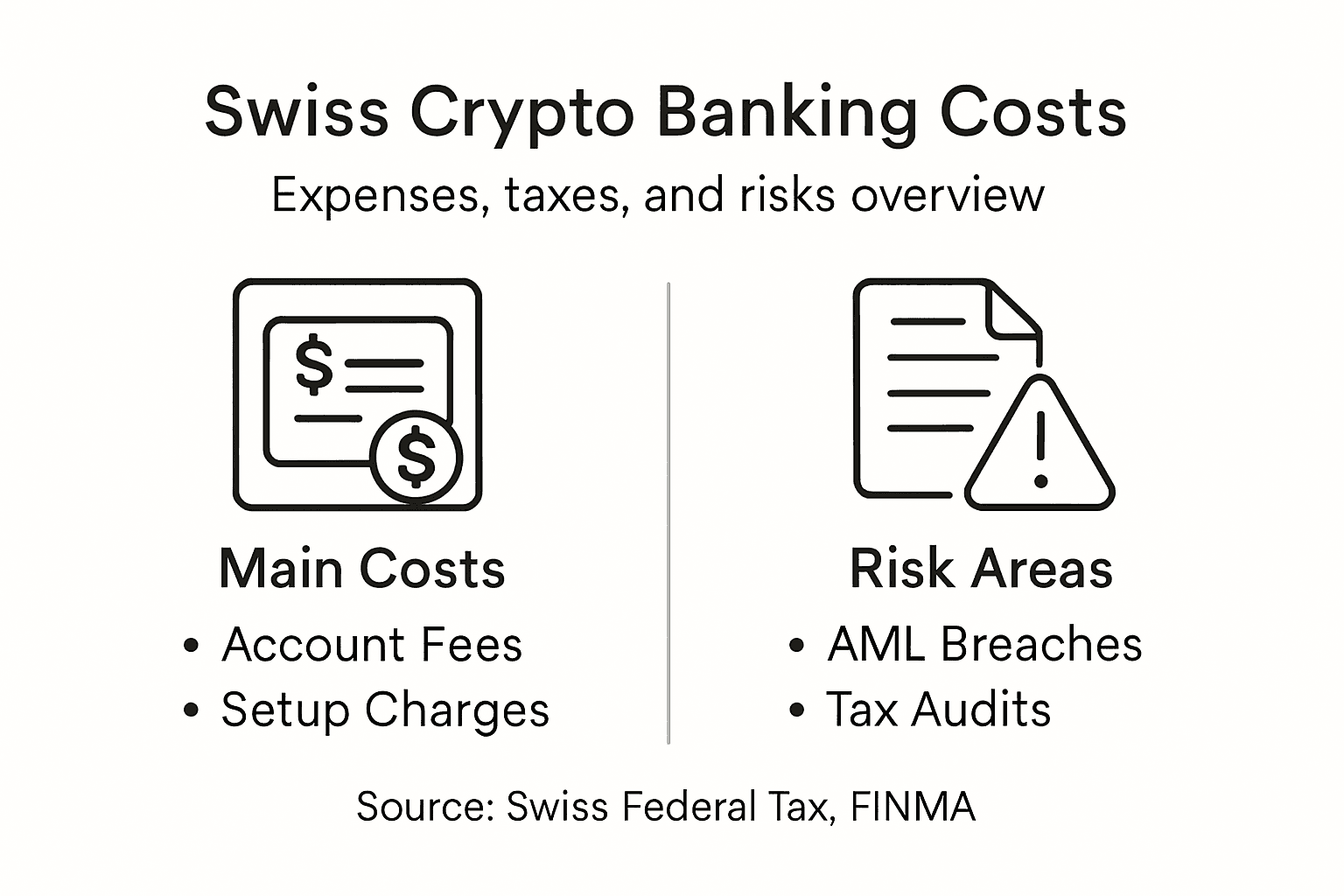
Operating a crypto banking business in Switzerland involves three distinct financial and legal considerations that directly impact your profitability and operational viability. First come the direct costs of banking relationships and regulatory compliance. Second comes the tax treatment of your business activities and client transactions. Third comes the compliance risk exposure if you mishandle regulatory obligations. Understanding all three before launch prevents costly surprises that could derail your operation or expose you to enforcement actions.
Direct Operating Costs
Swiss bank accounts for crypto businesses cost substantially more than traditional business accounts. Expect monthly account maintenance fees ranging from 500 to 2,000 Swiss francs depending on your transaction volume and the institution. Dedicated crypto banks like Sygnum and AMINA charge premium fees reflecting their specialized infrastructure and compliance costs. Beyond account maintenance, you will pay for compliance services. Swiss accountants specializing in crypto charge 5,000 to 15,000 Swiss francs annually for basic bookkeeping and tax preparation, with costs escalating if your transaction volume or customer base grows. If you need external audit services, expect 10,000 to 30,000 Swiss francs annually depending on your size. Legal costs for ongoing regulatory compliance, contract review, and policy updates typically run 3,000 to 10,000 Swiss francs annually. The custody infrastructure itself carries costs, whether you use a third party provider or build internal capability. Insurance for digital asset custody, cyber liability, and professional indemnity can cost 5,000 to 25,000 Swiss francs annually depending on your asset volumes and risk profile. These costs compound quickly, making it essential to build them into your business model from the beginning. Many crypto startups underestimate compliance costs and discover midway through the year that their budget is exhausted.
Tax Treatment of Crypto Operations
Swiss tax law applies standard corporate income tax rules to crypto businesses, but the specific tax outcome depends on your business classification. If you operate as a trading entity buying and selling digital assets, your gains are ordinary income taxed at corporate rates ranging from 11.5 percent to 21.6 percent depending on which canton you operate in. If you hold digital assets as long-term investments and rarely trade them, you may qualify for capital gains treatment in some cantons, though Switzerland does not provide a blanket capital gains exemption. The distinction matters tremendously for profitability. A 30 percent trading margin subject to income tax leaves far less profit than the same margin on capital gains. Additionally, if you operate a staking service or earn yield through crypto lending, those activities trigger specific tax consequences. Staking activities conducted by financial institutions may trigger withholding tax obligations depending on whether arrangements occur on-chain or off-chain. Your accountant must carefully classify each revenue stream to determine the correct tax treatment. Switzerland also participates in the Common Reporting Standard (CRS) and the international Automatic Exchange of Information (AEOI) initiative, meaning customer financial information flows to their home countries. Your clients bear ultimate tax responsibility in their home jurisdictions, but you must provide accurate tax reporting documentation supporting their compliance. This creates operational complexity when serving international customers.
Compliance Risks and Enforcement Exposure
The biggest compliance risk stems from anti-money laundering violations. Swiss authorities take AML breaches seriously, with penalties ranging from warning letters for minor deficiencies to criminal prosecution and asset seizure for serious violations. A single missed customer verification or failed transaction monitoring could trigger a regulatory investigation consuming months and costing hundreds of thousands of francs in legal defense. FINMA conducts periodic inspections of licensed institutions and pursues enforcement actions against those falling short of standards. Beyond AML, you face risks from market conduct violations if you engage in deceptive practices or misrepresent services to customers. You also face cyber security risks. If your platform suffers a breach exposing customer digital assets or private keys, you face both civil liability from customers and potential regulatory sanctions from FINMA. The regulatory environment continues evolving as Switzerland refines its approach to crypto. What is compliant today might become non-compliant tomorrow if regulations change. Monitoring regulatory developments and adjusting your operations accordingly prevents sudden non-compliance.
Another significant risk involves transaction reversals and customer disputes. Unlike traditional banking, crypto transactions cannot be reversed once broadcast to the network. If a customer claims they were defrauded or entered an incorrect address, you cannot simply reverse the transaction. You must navigate this reality with careful customer service procedures and clear terms of service. Additionally, if you hold customer assets in custody, you face counterparty risk if your custody provider fails. Ensure your custody arrangement includes appropriate insurance and segregation protections.
Pro tip: Hire a specialized crypto tax accountant in year one rather than trying to handle taxes yourself, as correct classification of staking income and yield-generating activities prevents costly tax adjustments from cantonal authorities later.
Common mistakes in Swiss crypto banking
Crypto entrepreneurs establishing banking operations in Switzerland often repeat the same errors that delay approvals, trigger regulatory scrutiny, or create operational chaos after launch. Many of these mistakes stem from underestimating the rigor Swiss regulators demand or overestimating how similar crypto banking is to traditional fintech. Learning what others got wrong prevents you from walking the same path. The mistakes cluster around three categories: regulatory compliance shortcuts, inadequate governance structures, and misunderstanding the banking relationship.
Compliance Shortcomings and Documentation Failures
The most common and costly mistake involves treating compliance documentation as a checkbox exercise rather than a genuine operational framework. Crypto businesses submit polished anti-money laundering policies to banks without actually implementing them operationally. Banks discover this disconnect during due diligence when they ask how you monitor transactions or verify customer sources and get vague responses about future plans. Common audit pitfalls reveal that incomplete customer due diligence records are among the most frequently cited deficiencies in Swiss AML reviews. Your policies must describe exactly how you verify customer identity, what documents you collect, how long you retain records, and how your team handles exceptions. Banks want to see evidence that you actually execute these procedures, not just documents describing them. Another compliance mistake involves failing to conduct ongoing transaction monitoring. Many crypto businesses implement customer verification at onboarding but then never monitor their transactions for suspicious patterns. This is precisely backwards. Ongoing monitoring catches the customer who starts with legitimate trades then suddenly moves to massive volumes of suspicious activity. Banks expect documented transaction monitoring procedures with clear thresholds triggering escalation and reporting. If you cannot articulate how you detect suspicious activity, you will not pass bank approval.
A related error involves inadequate risk assessments. Swiss regulators expect you to classify your customers and transactions by risk level, then apply monitoring intensity accordingly. A high-net-worth individual making regular large institutional trades requires different scrutiny than a new retail customer making unusual activity patterns. Developing documented risk assessment procedures before approaching banks demonstrates sophistication that accelerates approvals. Many startups also fail to document their AML governance structures clearly. Banks want to know who holds compliance responsibility, who makes escalation decisions, and how compliance integrates with business operations. If your founder is trying to handle compliance alone while building the product, banks see operational risk. They want dedicated compliance personnel with clear authority and reporting lines.
Governance and Operational Structure Mistakes
Crypto founders frequently make governance mistakes that seem minor but significantly impact banking relationships. Failing to establish a proper board structure or compliance committee suggests amateur operations. Banks expect formal governance documented through board minutes, compliance committee meetings, and clear decision logs. Having no board at all, or a board that never meets, raises red flags about how you make important decisions. Another error involves poor separation of duties. If one person handles both business development and compliance approvals, conflicts of interest emerge. Banks want assurance that your compliance function operates independently from sales pressure. This requires hiring people specifically for compliance roles, not assigning compliance duties to operational staff.
Many crypto businesses also make the mistake of structuring themselves without considering how Swiss authorities view their legal entity. Operating as a sole proprietorship when you should be organized as a limited company signals you do not understand regulatory expectations. A proper corporate structure with identified shareholders, directors, and management layers demonstrates professionalism. Additionally, failing to segregate customer assets properly creates significant liability. If you operate as a custodian, customer digital assets must be held separately from your operating capital. Commingling customer assets with company funds violates regulatory expectations and puts both at risk.
Banking Relationship and Strategic Mistakes
Many crypto businesses approach banking relationships without understanding what banks actually need. Reaching out to traditional retail banks expecting quick approval for crypto operations guarantees rejection. Traditional banks have not developed crypto expertise and maintain cautious policies. Starting conversations with crypto-focused banks like Sygnum or AMINA dramatically improves approval chances. Another mistake involves having multiple team members contact banks without coordination. Banks appreciate consistent communication from a single relationship manager who understands your business deeply. Inconsistent stories or conflicting information across team members signals disorganization. Additionally, approaching banks without having your licensing strategy fully developed creates confusion. If a bank asks what license you need and you respond uncertainty, approval becomes unlikely. Before banking conversations, determine whether you need a banking license, investment firm license, or crypto trading license based on your actual business model.
Many businesses also fail to understand that banking relationships require ongoing compliance after account opening. Banks will audit your operations periodically, requesting updated documentation and transaction records. Treating the account opening as the finish line rather than the beginning of a compliance journey leads to relationship deterioration. Expect banks to request annual compliance certifications, updated AML policies, and transaction reports.
Approaching banking relationships strategically from the beginning prevents these mistakes. Developing your overall Swiss crypto incorporation strategy before contacting banks ensures you understand your licensing requirements, governance structure, and compliance obligations.
Pro tip: Document your compliance procedures in writing before your first bank meeting, then demonstrate you actually execute them by showing audit trails of customer verifications and transaction monitoring decisions rather than just policies.
Simplify Your Swiss Crypto Banking Journey with Expert Support
Navigating the complex regulatory environment and strict compliance demands of Swiss banking for crypto can feel overwhelming. From establishing a compliant governance structure to securing the right banking relationships, the process challenges even the most experienced entrepreneurs. Key hurdles include demonstrating thorough AML and KYC procedures, selecting the optimal company structure, and meeting stringent FINMA licensing requirements that directly influence your crypto business’s legitimacy and operational success.

Unlock the full potential of Switzerland’s crypto-friendly market by partnering with RPCS. Our professional services platform specializes in seamlessly guiding international entrepreneurs through every step of Swiss company formation, including establishing GmbH and AG structures tailored for crypto operations, preparing legal documentation, facilitating banking setup, and ensuring ongoing compliance with Swiss financial regulations. Avoid costly delays by leveraging our expertise in regulatory navigation, tax optimization, and banking relationships. Take the decisive step now to secure your business future with trusted Swiss incorporation and continuous support. Learn more about how we can help at RPCS and see why smart crypto entrepreneurs choose our comprehensive solutions to thrive confidently in the Swiss market.
Frequently Asked Questions
What are the key concepts of Swiss banking for cryptocurrency?
Swiss banking for cryptocurrency operates under a unique regulatory framework that integrates digital assets into existing financial market laws, focusing on custody and asset security, regulatory integration, banking infrastructure, and tax treatment.
How does the regulatory environment in Switzerland affect crypto businesses?
Switzerland’s regulatory environment integrates cryptocurrencies into existing laws, requiring compliance with Anti-Money Laundering (AML) and Know Your Customer (KYC) regulations, similar to traditional financial institutions, which enhances legitimacy but demands rigorous adherence to compliance standards.
What types of Swiss banks are available for crypto clients?
Swiss banks catering to crypto clients fall into three categories: dedicated crypto banks that focus solely on digital assets, traditional private banks adapting their services to include crypto, and larger retail banks offering basic crypto services through partnerships.
What is required to open a Swiss bank account for a crypto business?
To open a Swiss bank account for a crypto business, you need to provide comprehensive business documentation, including a clear business plan, AML and KYC policies, governance structure, and satisfactory customer verification systems, with the application process typically taking three to six months.
Recommended
Comments