
Swiss Accounting Standards: Key Benefits for Startups
- Jan 5
- 8 min read
Updated: Jan 8

Many American tech founders are surprised to learn that Swiss accounting standards rank among the most trusted systems for startups worldwide. With strict transparency rules and flexible frameworks, Switzerland offers a path to credibility and compliance that attracts foreign entrepreneurs looking for a strategic advantage. Understanding how Swiss practices outshine global alternatives can help your tech business secure investor trust and enjoy meaningful tax benefits right from your initial setup.
Table of Contents
Key Takeaways
Point | Details |
Understanding Swiss Accounting Standards is Essential | Swiss GAAP FER specifically addresses the unique business environment in Switzerland, making it crucial for local startups and foreign entities to integrate these standards into their financial reporting. |
Framework Comparison for Reporting Flexibility | Swiss accounting standards, such as Swiss GAAP FER, provide a more adaptable approach as compared to IFRS, catering to companies of varying sizes and complexities. |
Compliance and Documentation Mandates | Businesses must adhere to strict legal requirements under the Swiss Code of Obligations, ensuring accurate bookkeeping and financial documentation according to their size and structure. |
Tax Efficiency and Strategic Planning | Startups can benefit from attractive tax structures and deductions in Switzerland, emphasizing the importance of early engagement with tax specialists for sustainable financial management. |
Swiss accounting standards explained
Swiss accounting standards represent a sophisticated framework designed to ensure transparent and accurate financial reporting for businesses operating in Switzerland. These standards, particularly the Swiss GAAP FER, provide comprehensive guidelines tailored specifically to the unique business environment of Swiss enterprises.
The core objective of Swiss accounting standards is to create a robust and reliable system of financial documentation. Governed by the Swiss Code of Obligations, these standards mandate precise bookkeeping requirements for all business entities, ranging from sole proprietorships to complex corporate structures. Unlike generic international accounting frameworks, Swiss standards emphasize principle-based reporting that considers industry-specific nuances and local economic conditions.
Key characteristics of Swiss accounting standards include:
Principle-oriented approach
Enhanced transparency requirements
Adaptability to different business sizes
Comprehensive documentation guidelines
Emphasis on communicating financial health
For startups and foreign companies, understanding these standards is crucial. Accounting standards in Switzerland offer multiple recognized frameworks including Swiss GAAP FER, IFRS, and US GAAP, allowing businesses flexibility in financial reporting while maintaining stringent compliance protocols.
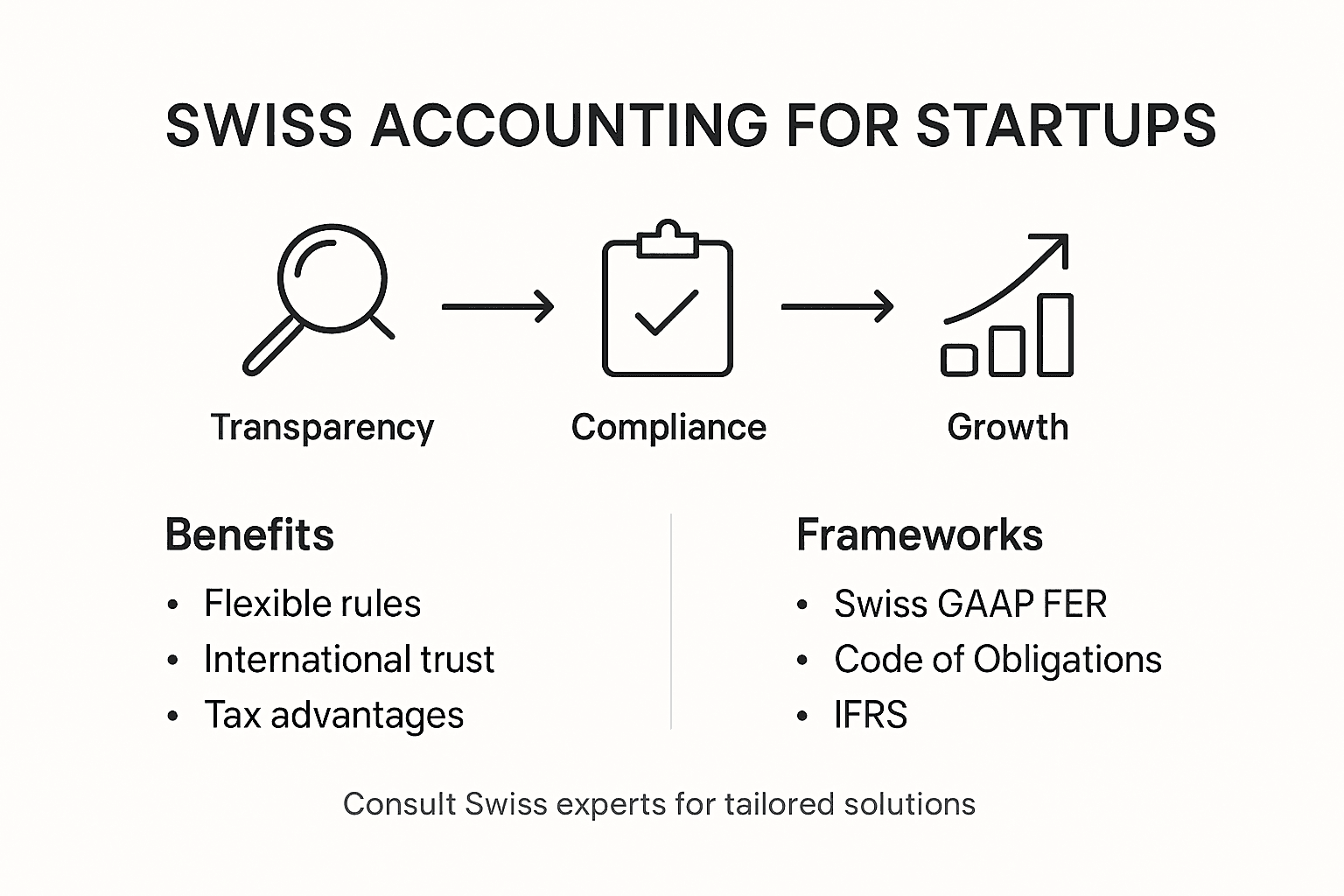
Pro tip: When establishing a Swiss company, consult a local accounting professional who understands these nuanced standards to ensure seamless financial reporting and compliance.
Major frameworks: Code of Obligations, FER, IFRS
The Swiss accounting landscape features multiple robust frameworks designed to provide comprehensive financial reporting standards for businesses. At the foundation lies the Swiss Code of Obligations, which establishes baseline legal requirements for financial documentation and accounting practices across different business entities.
Swiss GAAP FER emerges as a critical framework tailored specifically for Swiss businesses. Switzerland’s accounting regulations highlight its unique positioning, offering a true and fair view of financial statements with lower regulatory complexity compared to international standards. This framework is particularly beneficial for medium-sized and larger enterprises seeking flexible yet comprehensive reporting guidelines.
Compared to Swiss GAAP FER, International Financial Reporting Standards (IFRS) provide a more globally recognized approach. IFRS is typically mandatory for publicly listed companies and their consolidated financial statements, offering a standardized framework that enables international comparability. Key differences between these frameworks include:
Regulatory complexity
Scope of application
International recognition
Reporting depth and requirements
Flexibility for different business sizes
For startups and foreign entities operating in Switzerland, understanding these frameworks is crucial. Each standard offers unique advantages, and the choice depends on factors like company size, industry, and reporting objectives.
Pro tip: Consult a Swiss accounting professional to determine the most appropriate financial reporting framework for your specific business structure and goals.
Here’s a quick comparison of the major Swiss and international accounting frameworks:
Framework | Suitable for | International Recognition | Reporting Complexity |
Swiss Code of Obligations | All Swiss entities | Low | Basic legal standards |
Swiss GAAP FER | Medium/Large Swiss firms | Moderate | Flexible, moderate detail |
IFRS | Publicly listed companies | Very high | Extensive requirements |
US GAAP | US-based/global firms | High | Detailed, industry-specific |
Legal requirements and compliance steps
Swiss accounting regulations impose stringent legal requirements for businesses across different organizational structures. Bookkeeping and accounting guidelines mandate comprehensive financial documentation based on company size, revenue, and legal entity type.
For startups and small businesses, the compliance landscape varies depending on specific criteria. Sole proprietorships and partnerships with annual revenues below CHF 500,000 can utilize simplified accounting methods, while those exceeding this threshold must implement full double-entry bookkeeping systems. The Swiss Code of Obligations serves as the primary regulatory framework, establishing mandatory standards for financial reporting and record maintenance.
Key compliance steps for Swiss business entities include:
Maintaining accurate financial records
Preparing annual financial statements
Implementing appropriate bookkeeping systems
Conducting mandatory audits based on company size
Submitting required financial documentation to relevant authorities
Audit requirements represent a critical aspect of legal compliance. Companies are categorized into two primary audit classifications: ordinary audits for larger enterprises and limited audits for smaller organizations. These classifications determine the depth of financial review and reporting obligations, ensuring transparency and accountability in business financial practices.
Pro tip: Consult a Swiss accounting professional early in your business formation process to understand specific compliance requirements tailored to your company’s unique structure and financial profile.
This summary outlines audit classifications under Swiss regulations:
Audit Type | Company Size | Depth of Review | Typical Requirement |
Ordinary Audit | Large companies | Comprehensive financial checks | Mandatory over certain thresholds |
Limited Audit | Smaller organizations | Basic compliance review | Required for small entities above minimum size |
International credibility and transparency advantages
Swiss accounting standards provide remarkable opportunities for startups seeking global financial credibility. Accounting practices that enhance transparency create a robust framework that significantly boosts investor confidence and international business relationships.
The Swiss GAAP FER standards play a critical role in establishing corporate trustworthiness. By implementing these comprehensive reporting guidelines, companies demonstrate a commitment to precise financial communication that transcends typical national accounting practices. This approach offers several strategic advantages for international businesses, including enhanced investor trust, streamlined cross-border financial interactions, and a reputation for meticulous financial management.
Key international credibility advantages include:
Standardized financial reporting protocols
Enhanced transparency for global investors
Improved risk assessment capabilities
Clear communication of financial health
Alignment with international best practices
Beyond technical compliance, these accounting standards serve as a powerful signal to international stakeholders. Foreign investors and business partners view Swiss accounting practices as a hallmark of reliability, viewing companies adhering to these standards as more professional, trustworthy, and strategically sound. The detailed reporting requirements effectively minimize information asymmetry and provide a comprehensive view of a company’s financial landscape.
Pro tip: Invest in high-quality translation and professional interpretation of your financial statements to maximize the global communication potential of Swiss accounting standards.
Tax efficiency and cost implications
Startups considering Swiss incorporation can leverage significant financial advantages through strategic tax planning and efficient accounting frameworks. Tax benefits for entrepreneurs create a compelling environment for businesses seeking optimal fiscal management and growth potential.

Switzerland’s tax system offers remarkable efficiency for emerging companies, with cantonal and federal tax structures providing multiple opportunities for reducing overall tax burden. Small and medium enterprises can benefit from progressive tax rates, potential tax holidays for new businesses, and generous deduction policies that support entrepreneurial investment and expansion.
Key tax efficiency considerations for startups include:
Competitive corporate tax rates
Potential cantonal tax incentives
Generous research and development deductions
Simplified tax reporting mechanisms
Favorable holding company regulations
The cost implications of Swiss accounting standards are designed to be transparent and manageable. While initial compliance might require upfront investment in professional accounting services, the long-term benefits include reduced administrative complexity, enhanced financial visibility, and improved investor confidence. Startups can optimize their tax strategy by carefully selecting their corporate structure and leveraging region-specific tax optimization techniques.
Pro tip: Engage a Swiss tax specialist early in your company formation process to develop a comprehensive tax strategy tailored to your specific business model and growth objectives.
Comparing Swiss standards to global alternatives
The landscape of international accounting standards presents unique challenges and opportunities for businesses seeking global financial transparency. Accounting standard comparisons reveal critical distinctions between Swiss GAAP FER, International Financial Reporting Standards (IFRS), and US GAAP that can significantly impact corporate financial strategy.
Swiss GAAP FER stands out as a distinctive framework tailored specifically to the Swiss business environment. Unlike more complex international standards, it offers a streamlined approach that balances local regulatory requirements with international comparability. This standard provides a more cost-effective and less administratively burdensome alternative to full IFRS implementation, making it particularly attractive for small and medium-sized enterprises.
Key comparative aspects of accounting standards include:
Complexity of reporting requirements
Cost of implementation
International recognition
Flexibility for different business sizes
Depth of financial disclosure
International Financial Reporting Standards (IFRS) represent the most globally recognized accounting framework, mandatory for publicly listed companies in many jurisdictions. While IFRS offers broader international acceptance, Swiss GAAP FER provides a more nuanced approach that considers specific Swiss economic contexts. US GAAP, primarily used in American markets, presents yet another distinct set of reporting guidelines, adding further complexity to the global accounting landscape.
Pro tip: Consult with a financial advisor to determine the most appropriate accounting standard for your specific business structure, industry, and international expansion goals.
Unlock the Full Potential of Swiss Accounting Standards for Your Startup
Navigating Swiss accounting standards such as Swiss GAAP FER and understanding legal compliance can feel overwhelming for international entrepreneurs. The challenges of selecting the right framework, meeting audit requirements, and maximizing tax efficiency are critical to your company’s success and credibility. You want clear financial reporting that boosts investor trust while keeping administration manageable and compliant with Swiss regulations.
At rpcs.ch, we specialize in simplifying the complexities of Swiss incorporation and accounting. Our professional services cover everything from company formation to ongoing financial and legal support. We help startups like yours implement compliant bookkeeping systems, optimize tax benefits, and choose the best accounting standards tailored to your business goals. With rapid setup times, strict confidentiality, and expert guidance, you stay focused on growing your venture knowing financial transparency and international credibility are covered.

Take the first step toward seamless Swiss company incorporation and accounting excellence. Explore how professional Swiss company formation combined with expert accounting and tax services can transform your startup’s growth trajectory. Contact us today to ensure your business meets all Swiss accounting standards efficiently and confidently.
Frequently Asked Questions
What are Swiss accounting standards?
Swiss accounting standards are a set of guidelines designed for transparent and accurate financial reporting for businesses in Switzerland, primarily governed by the Swiss Code of Obligations.
How do Swiss GAAP FER standards benefit startups?
Swiss GAAP FER offers a principle-based, flexible approach to financial reporting, making it easier for startups to comply with local regulations while enhancing transparency and investor trust.
What is the difference between Swiss GAAP FER and IFRS?
Swiss GAAP FER is tailored specifically for Swiss businesses and is less complex than IFRS, which is required for publicly listed companies and offers broader international recognition. Swiss GAAP FER allows more flexibility and lower compliance costs for medium-sized and smaller enterprises.
What legal requirements must startups meet under Swiss accounting regulations?
Startups must maintain accurate financial records, prepare annual financial statements, implement appropriate bookkeeping systems, conduct mandatory audits based on company size, and submit required financial documents to relevant authorities.
Recommended
Comments