
Nominee Director in Switzerland: Complete Guide
- Rolands Plotnieks
- Nov 25
- 7 min read

Updated: 2 days ago

For many american entrepreneurs, entering the Swiss market comes with a unique challenge. Swiss law requires at least one locally resident director for any company, which often leaves international businesses searching for effective solutions. Nominee directors offer a strategic pathway by providing the required local presence without permanent relocation. Understanding how nominee directors operate in Switzerland can help american business owners streamline setup, stay compliant, and protect their interests from the start.
Table of Contents
Key Takeaways
Point | Details |
Nominee Directors Defined | Nominee directors act on behalf of foreign companies in Switzerland, facilitating local representation and compliance without requiring a physical presence. |
Types of Nominee Directors | Various types include local resident directors, professional service directors, independent corporate directors, and compliance directors, each serving distinct roles in business operations. |
Legal Framework Compliance | Swiss companies must have at least one resident director for legal compliance, ensuring accountability to local authorities and adherence to corporate regulations. |
Risks and Liabilities | Nominee directors face significant legal risks, including personal liability for corporate misconduct and the need for robust compliance protocols to mitigate potential legal exposure. |
Defining Nominee Directors in Switzerland
A nominee director represents a strategic solution for international entrepreneurs seeking efficient company management in Switzerland. According to maicsa.org.my, a nominee director is an individual or legal entity exercising director functions on behalf of another party, without being the beneficial owner of the legal entity.
In the Swiss business ecosystem, a nominee director serves as a crucial intermediary who provides local representation for foreign-owned companies. These professionals enable international investors to establish and operate Swiss businesses without requiring permanent physical presence.

Key responsibilities typically include handling administrative tasks, ensuring regulatory compliance, and representing the company in official capacities.
The primary characteristics of a Swiss nominee director include:
Legal authorization to act on company’s behalf
Maintenance of corporate governance standards
Facilitation of communication between international shareholders and local authorities
Compliance with Swiss corporate regulations
Businesses often leverage nominee director services when they need a local point of contact who understands Swiss legal frameworks and can efficiently manage administrative requirements. How to Appoint Swiss Director for Your Company Easily provides additional insights into the practical steps of engaging a professional nominee director in Switzerland.
Types and Roles of Nominee Directors
In the Swiss corporate landscape, nominee directors play diverse roles that can be strategically categorized to meet specific business requirements. These professionals offer flexible representation models designed to accommodate the unique needs of international investors and entrepreneurs seeking efficient company management in Switzerland.
The primary types of nominee directors include:
Local Resident Directors: Professionals physically residing in Switzerland who provide direct local representation
Professional Service Directors: Corporate service providers offering comprehensive director services
Independent Corporate Directors: Experienced business professionals who serve as neutral third-party representatives
Compliance Directors: Specialists focused on ensuring regulatory adherence and corporate governance
Each type of nominee director brings distinct advantages to businesses.
Local resident directors offer immediate credibility and direct access to Swiss regulatory systems. Professional service directors provide comprehensive administrative support, handling complex legal and financial documentation. Independent corporate directors bring specialized expertise and objective oversight, while compliance directors ensure stringent adherence to Swiss corporate regulations.
Businesses can select nominee director services based on their specific operational requirements and strategic objectives. How to Appoint Swiss Director for Your Company Easily can help entrepreneurs understand the nuanced selection process for identifying the most appropriate nominee director type for their Swiss business ventures.
Swiss Legal Framework and Compliance Rules
Navigating the Swiss legal landscape for nominee directors requires a nuanced understanding of complex regulatory requirements. According to star.worldbank.org, Switzerland technically does not recognize the traditional concept of ‘nominee’ as defined in Anglo-Saxon or FATF terminology, which creates unique challenges for international businesses.
ftrust.ch emphasizes a critical legal requirement: Swiss companies must have at least one Swiss-resident director who serves as a local representative and primary contact for governmental authorities. This mandate is explicitly outlined in Article 718 of the Swiss Code of Obligations, which establishes the fundamental legal framework for corporate governance.
Key compliance considerations for nominee directors in Switzerland include:
Mandatory local representation
Direct accountability to Swiss regulatory bodies
Comprehensive documentation and reporting requirements
Strict adherence to corporate governance standards
Personal liability for corporate legal and financial obligations
Businesses must carefully structure their nominee director arrangements to ensure full legal compliance. Swiss Accounting Requirements Explained: Complete Guide provides additional insights into the intricate regulatory environment that nominee directors must navigate when representing international companies in Switzerland.
Key Responsibilities and Typical Use Cases
A nominee director serves as a critical strategic resource for international businesses seeking to establish a robust presence in Switzerland. While their specific responsibilities can vary, these professionals fundamentally act as local representatives who bridge the complex gap between foreign investors and Swiss regulatory requirements.
The primary responsibilities of a nominee director typically encompass:
Maintaining legal compliance with Swiss corporate regulations
Representing the company in official communications
Managing administrative and bureaucratic documentation
Facilitating interactions with local governmental authorities
Ensuring timely filing of necessary corporate reports and financial statements
Typical use cases for nominee directors include scenarios where international businesses require local representation without establishing a full-scale physical presence. This might involve startup ventures, cryptocurrency companies, fintech organizations, and investment holding entities seeking to leverage Switzerland’s favorable business environment. Emerging technology companies and international investment funds frequently utilize nominee director services to streamline their operational setup and maintain regulatory compliance.
Company Formation Checklist Switzerland: Step-by-Step Guide offers entrepreneurs additional insights into navigating the intricate process of establishing a business presence in Switzerland, highlighting the strategic importance of professional nominee director services in this complex regulatory landscape.
Risks, Liabilities, and Legal Exposure
Navigating the complex landscape of nominee director services requires a comprehensive understanding of potential legal risks and personal liability exposures. Nominee directors assume significant responsibilities that extend far beyond traditional administrative roles, potentially placing their professional reputation and personal assets at substantial risk.
Key legal risks and liability considerations include:
Personal financial responsibility for corporate misconduct
Potential criminal liability for intentional or negligent corporate violations
Direct accountability for ensuring regulatory compliance
Risk of professional reputation damage
Potential legal proceedings stemming from corporate financial irregularities
Mandatory disclosure of corporate financial and operational activities
The intricate nature of nominee director responsibilities demands exceptional diligence and professional expertise. Professionals must maintain meticulous documentation, implement robust compliance protocols, and ensure transparent communication with both corporate stakeholders and Swiss regulatory authorities. Failure to meet these stringent requirements can result in severe legal consequences, including financial penalties, professional sanctions, and potential criminal investigations.
Swiss Accounting Requirements Explained: Complete Guide provides additional context for understanding the complex regulatory environment that nominee directors must navigate, emphasizing the critical importance of comprehensive legal and financial management.
Comparing Nominee and Traditional Directors
The distinction between nominee directors and traditional directors represents a critical nuance in corporate governance, particularly within the Swiss business ecosystem. While traditional directors typically emerge from within a company’s internal leadership structure, nominee directors function as external professionals providing specialized representation and administrative support.
Key differences between nominee and traditional directors include:
Ownership Involvement: Traditional directors often have direct ownership stakes, whereas nominee directors typically act without personal financial interest
Decision-Making Authority: Traditional directors usually have comprehensive strategic decision-making power, while nominee directors operate within more prescribed operational boundaries
Physical Presence: Traditional directors are frequently company insiders, but nominee directors serve as external local representatives
Legal Accountability: Nominee directors carry specific compliance-focused responsibilities that differ from broader traditional director roles
Duration of Engagement: Traditional directors tend to have long-term commitments, whereas nominee directors might provide more flexible, project-specific representation
The strategic selection between nominee and traditional directors depends on an organization’s specific operational requirements, international expansion goals, and regulatory compliance needs.
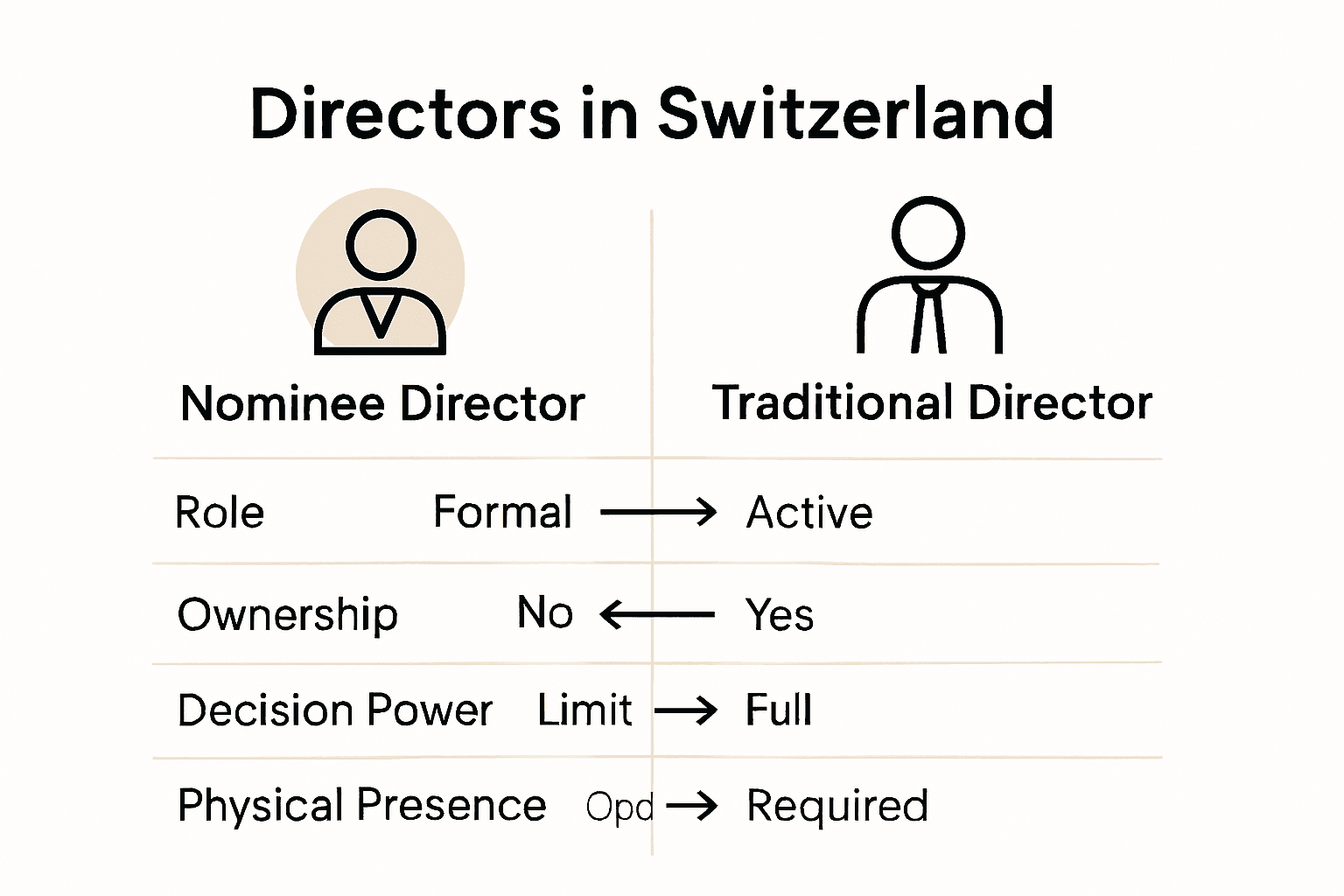
Companies must carefully evaluate their unique circumstances to determine the most appropriate directorship model. Nominee directors offer particular advantages for international businesses seeking efficient Swiss market entry without establishing comprehensive local infrastructure.
Company Formation Checklist Switzerland: Step-by-Step Guide provides entrepreneurs with additional insights into selecting the most appropriate directorship approach for their Swiss business ventures.
Simplify Your Swiss Nominee Director Needs with Expert Support
Navigating the complexities of appointing a nominee director in Switzerland can feel overwhelming especially with strict legal requirements and significant personal liabilities involved. Whether you need a local resident director to ensure compliance or a professional service director to handle administrative duties, understanding these roles and their responsibilities is critical. The right nominee director not only satisfies Swiss legal mandates but also safeguards your company’s future and reputation.

Take control of your Swiss company formation journey today by partnering with RPCS Our comprehensive solutions guide you through every step including legal documentation, registration processes, and ongoing compliance management. Leverage our expertise in Swiss corporate governance to minimize risks and maximize your business potential. Explore how to appoint Swiss directors with confidence by visiting How to Appoint Swiss Director for Your Company Easily and secure your company’s success with reliable nominee director services. Act now to benefit from swift setup and expert legal support that ensures peace of mind.
Frequently Asked Questions
What is a nominee director in Switzerland?
A nominee director is an individual or legal entity who performs director functions on behalf of another party, enabling foreign entrepreneurs to manage Swiss companies without a permanent physical presence.
What are the different types of nominee directors available?
The main types of nominee directors include local resident directors, professional service directors, independent corporate directors, and compliance directors, each offering unique advantages based on business needs.
What are the key responsibilities of a nominee director?
Nominee directors typically maintain legal compliance with regulations, represent the company in official communications, manage bureaucratic documentation, facilitate interactions with local authorities, and ensure timely filing of corporate reports.
What are the legal risks associated with being a nominee director?
Nominee directors face significant legal risks, including personal financial responsibility for corporate misconduct, potential criminal liability for corporate violations, and direct accountability for ensuring regulatory compliance.
Recommended
Comments