
How to Register Payment Business Switzerland Easily
- Rolands Plotnieks
- Dec 21, 2025
- 8 min read

Most American entrepreneurs find Swiss financial regulations both promising and daunting. With Switzerland’s robust legal standards and strong emphasis on compliance, setting up a payment business here requires close attention to every detail. Over 80 percent of Swiss retail transactions are now digital, reflecting a rapidly evolving payment landscape. This guide breaks down each step so American founders can launch a compliant and competitive payment company in Switzerland with confidence.
Table of Contents
Quick Summary
Key Point | Explanation |
1. Understand Swiss regulatory requirements | Comprehend licensing, anti-money laundering, and capital requirements for establishing a payment business in Switzerland. |
2. Choose the right company structure | Selecting between GmbH and AG impacts legal compliance, taxation, and growth potential for your payment business. |
3. Prepare comprehensive documentation | Compile essential documents like business plans and risk management frameworks to demonstrate compliance with Swiss financial regulations. |
4. Navigate registration with Swiss authorities | Successfully register by submitting required documents to relevant government entities while ensuring legal compliance. |
5. Establish ongoing compliance processes | Implement systematic procedures for continuous regulatory monitoring and internal audits to ensure adherence to evolving Swiss regulations. |
Step 1: Assess legal requirements for payment businesses
Registering a payment business in Switzerland requires careful navigation of complex regulatory frameworks. You will need to understand the legal landscape governing financial services to ensure full compliance and smooth establishment of your company.
The Swiss Financial Market Supervisory Authority (FINMA) plays a critical role in overseeing payment business regulations. When assessing legal requirements, focus on several key areas: licensing prerequisites, anti-money laundering regulations, capital requirements, and operational standards. Payment businesses must typically obtain specific authorization depending on their exact service model.
Your legal assessment should include comprehensive documentation of your business structure, planned financial services, risk management protocols, and corporate governance mechanisms. This involves preparing detailed documentation demonstrating your organization’s ability to meet Swiss regulatory standards. You will need to show robust internal controls, transparent ownership structures, and comprehensive compliance strategies.
Pro Tip: Engage a Swiss legal specialist experienced in financial services regulations before submitting your official application to FINMA. Their targeted guidance can help you anticipate potential compliance challenges and streamline your registration process.
Step 2: Select optimal Swiss company structure
Selecting the right company structure is critical for your payment business in Switzerland. Your choice will impact legal compliance, taxation, operational flexibility, and long-term business scalability.
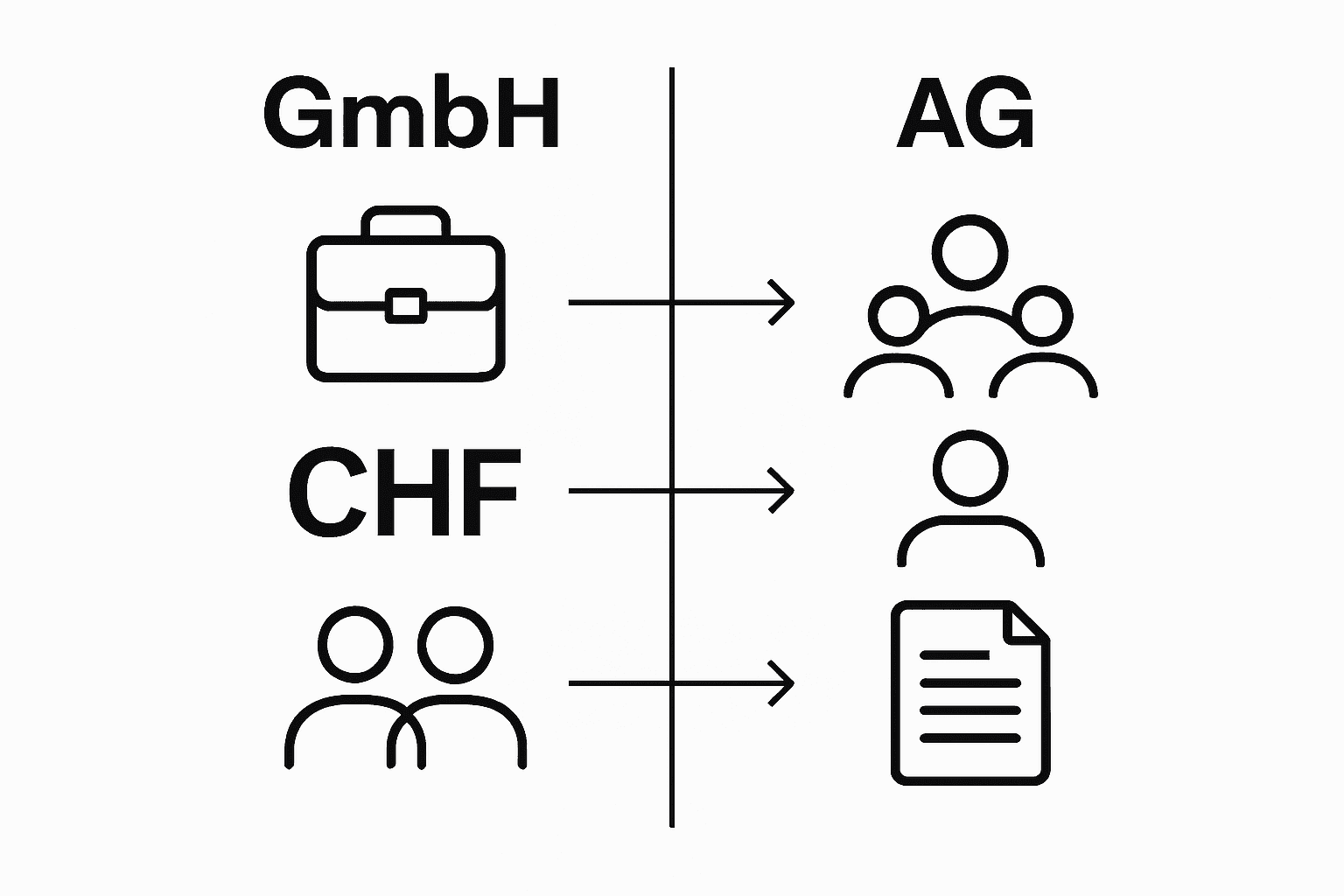
For payment businesses, two primary structures dominate the Swiss corporate landscape: GmbH (Limited Liability Company) and AG (Stock Corporation). The Swiss company formation process requires careful consideration of your specific business model, capital requirements, and strategic goals. A GmbH typically suits smaller payment businesses with lower initial capital requirements, offering simpler administrative processes and faster setup times. An AG provides more robust structures for larger payment enterprises, allowing broader investor participation and more complex corporate governance mechanisms.
Your selection should factor in several critical elements: minimum capital requirements, shareholder restrictions, reporting obligations, and potential future expansion plans. GmbH structures require a minimum capital of 20000 Swiss Francs, while AG structures demand 100000 Swiss Francs. Consider your initial funding, anticipated transaction volumes, and long-term growth strategy when making this pivotal decision.
Pro Tip: Consult a Swiss corporate formation specialist who can analyze your specific business model and recommend the most tax efficient and legally appropriate company structure for your payment business.
Here’s a side-by-side comparison of Swiss company structures for payment businesses:
Aspect | GmbH (Limited Liability Company) | AG (Stock Corporation) |
Minimum Capital | 20,000 Swiss Francs | 100,000 Swiss Francs |
Shareholder Flexibility | Limited to a small group | Unlimited, easy transfer |
Suitable Business Size | Small to medium payment firms | Larger, scaling enterprises |
Investor Access | Limited external investment | Broad public investment possible |
Reporting Complexity | Simpler requirements | More complex disclosures |
Setup Speed | Quicker, less formal | Slower, more formal steps |
Step 3: Prepare documents for regulatory compliance
Preparing comprehensive documentation is crucial for successfully registering your payment business in Switzerland. Your goal is to demonstrate robust compliance with Swiss financial regulations and build credibility with regulatory authorities.

The Swiss company registration process demands meticulous documentation that proves your business meets stringent financial service standards. Essential documents include your detailed business plan, comprehensive risk management framework, anti-money laundering policies, corporate governance structure, and proof of adequate initial capital. You will need to compile financial projections, shareholder information, management credentials, and precise operational protocols that showcase your organization’s commitment to regulatory excellence.
Specifically, you must prepare documents such as articles of association, proof of initial capital deposit, detailed organizational charts, compliance policy manuals, and background checks for key management personnel. Each document should demonstrate transparency, financial stability, and a comprehensive understanding of Swiss financial regulations. Pay special attention to creating clear, professional documents that explicitly outline your business model, risk mitigation strategies, and commitment to maintaining the highest standards of financial integrity.
Pro Tip: Engage a Swiss legal professional specializing in financial services regulatory compliance to review your documentation before submission. Their expert review can help identify potential gaps and ensure your application meets FINMA’s exacting standards.
Below is an overview of essential regulatory documents and their primary purpose:
Document Type | Purpose | Importance for Registration |
Business Plan | Outline business model and goals | Demonstrates operational readiness |
Articles of Association | Legal foundation of company | Required for registry approval |
Risk Management Framework | Address potential financial risks | Proves robust controls in place |
AML Policy | Shows anti-money laundering compliance | Mandatory for financial businesses |
Organizational Chart | Illustrates governance structure | Confirms management transparency |
Step 4: Register business with Swiss authorities
Registering your business with Swiss authorities is a precise process that requires careful attention to legal and administrative details. You will need to navigate multiple government channels to successfully establish your payment business in Switzerland.
The Swiss company registration process involves submitting your meticulously prepared documentation to several key governmental bodies. You must first register with the Commercial Registry in the canton where your business will be headquartered. This involves filing your company articles of association, proof of initial capital, and detailed corporate governance documents. The registration typically requires appearing in person or through a designated legal representative who can verify all submitted materials.
After commercial registration, you will need to complete additional registrations with tax authorities, social security systems, and industry specific regulators like FINMA for payment businesses. Each registration requires specific documentation proving your business structure, financial stability, and compliance with Swiss regulatory standards. Ensure you have multiple certified copies of your corporate documents, identification materials for key stakeholders, and comprehensive proof of your business model and operational protocols.
Pro Tip: Work with a Swiss corporate registration specialist who understands the nuanced requirements of different Swiss cantons. Their local expertise can significantly streamline your registration process and help you avoid potential administrative delays.
Step 5: Set up Swiss bank accounts and payment systems
Establishing robust banking and payment infrastructure is critical for your payment business in Switzerland. This step requires strategic planning and careful selection of financial partners that align with your operational requirements.
Understanding Swiss business bank account requirements is fundamental to successful financial setup. Swiss banks demand comprehensive documentation including detailed business plans, proof of capital, corporate registration documents, and extensive compliance materials. Contactless payment methods are increasingly prevalent, with over 80% of transactions in shops and restaurants now occurring through digital channels. This means your payment systems must support advanced electronic transaction capabilities while maintaining rigorous security standards.
When setting up your payment systems, consider integrating multiple transaction methods. Swiss regulations require merchants to accept traditional cash payments, so your systems must accommodate both digital and cash transactions. Develop a comprehensive strategy that includes secure online payment gateways, support for international bank transfers, compatibility with major credit card networks, and provisions for local Swiss payment methods. Ensure your infrastructure meets strict Swiss financial regulations and provides seamless, secure transaction processing for your clients.
Pro Tip: Partner with a Swiss banking consultant who specializes in fintech and payment businesses to navigate the complex regulatory landscape and optimize your financial infrastructure.
Step 6: Verify regulatory approval and ongoing compliance
Verifying regulatory approval is a critical final step in establishing your payment business in Switzerland. Your goal is to secure official recognition and maintain continuous adherence to Swiss financial regulations.
The Swiss company registration process demands comprehensive verification through multiple governmental channels. You will need to obtain official approval from FINMA (Swiss Financial Market Supervisory Authority), demonstrating that your business meets stringent financial service standards. This verification process involves submitting detailed compliance documentation, undergoing thorough background checks, and proving your organization has robust risk management protocols.
Ongoing compliance requires establishing systematic processes for continuous regulatory monitoring. This means implementing regular internal audits, maintaining updated documentation, tracking regulatory changes, and preparing periodic reports for Swiss financial authorities. Your compliance strategy should include comprehensive record keeping, transparent financial reporting, anti-money laundering protocols, and mechanisms for quickly adapting to evolving regulatory requirements. Create a dedicated compliance team or assign specific team members responsible for tracking and implementing regulatory updates.
Pro Tip: Develop a digital compliance management system that automatically tracks regulatory changes and alerts your team to potential compliance modifications, helping you stay proactively aligned with Swiss financial regulations.
Simplify Your Swiss Payment Business Registration Today
Registering a payment business in Switzerland involves navigating complex legal requirements and selecting the optimal company structure. You may feel overwhelmed managing licensing, AML policies, capital demands, and detailed documentation while ensuring compliance with FINMA regulations. Your goal is clear: launch your payment business efficiently without missing critical regulatory steps or facing delays.
At RPCS, we specialize in guiding entrepreneurs through every stage of Swiss company formation. From choosing between GmbH and AG structures to preparing meticulous regulatory documents, notarization, and registration, our expert team ensures your setup is fast, confidential, and fully compliant. We also assist with banking setup and ongoing compliance management so you can focus on growing your business with confidence.

Don’t let administrative hurdles hold you back. Visit https://rpcs.ch now to access professional support and discover how our end-to-end services simplify the entire registration process. Start your Swiss payment business journey the right way today and capitalize on Switzerland’s stable, reputable business environment.
Explore our expert guidance on Swiss company formation and learn more about the company registration process to take the next confident step.
Frequently Asked Questions
What legal requirements must I consider to register a payment business in Switzerland?
To register a payment business in Switzerland, you need to understand licensing prerequisites, anti-money laundering regulations, capital requirements, and operational standards. Start your assessment by reviewing relevant documentation that showcases your compliance with Swiss regulatory standards.
How do I select the right company structure for my payment business?
The two primary structures for payment businesses in Switzerland are GmbH (Limited Liability Company) and AG (Stock Corporation). Evaluate your business model, anticipated transaction volumes, and funding availability to choose the structure that best fits your goals.
What documents do I need to prepare for regulatory compliance?
You will need to prepare comprehensive documentation, including a business plan, risk management framework, and anti-money laundering policies. Ensure that your documents clearly demonstrate financial stability and compliance with Swiss regulations.
What is the registration process with Swiss authorities like?
The registration process involves submitting your prepared documentation to the Commercial Registry and other relevant authorities. Ensure you have certified copies of necessary documents and be prepared to appear in person or use a legal representative to facilitate the process.
How can I set up a bank account and payment systems for my business?
To set up a bank account and payment systems, ensure you have the required documentation like a business plan and proof of capital. Focus on establishing secure online payment gateways and accommodating both digital and cash transaction methods to meet compliance standards.
How do I maintain ongoing compliance after registering my payment business?
After registration, you must engage in regular internal audits and stay updated on regulatory changes. Develop a system for maintaining comprehensive records and preparing periodic reports to ensure continuous alignment with Swiss financial regulations.
Recommended